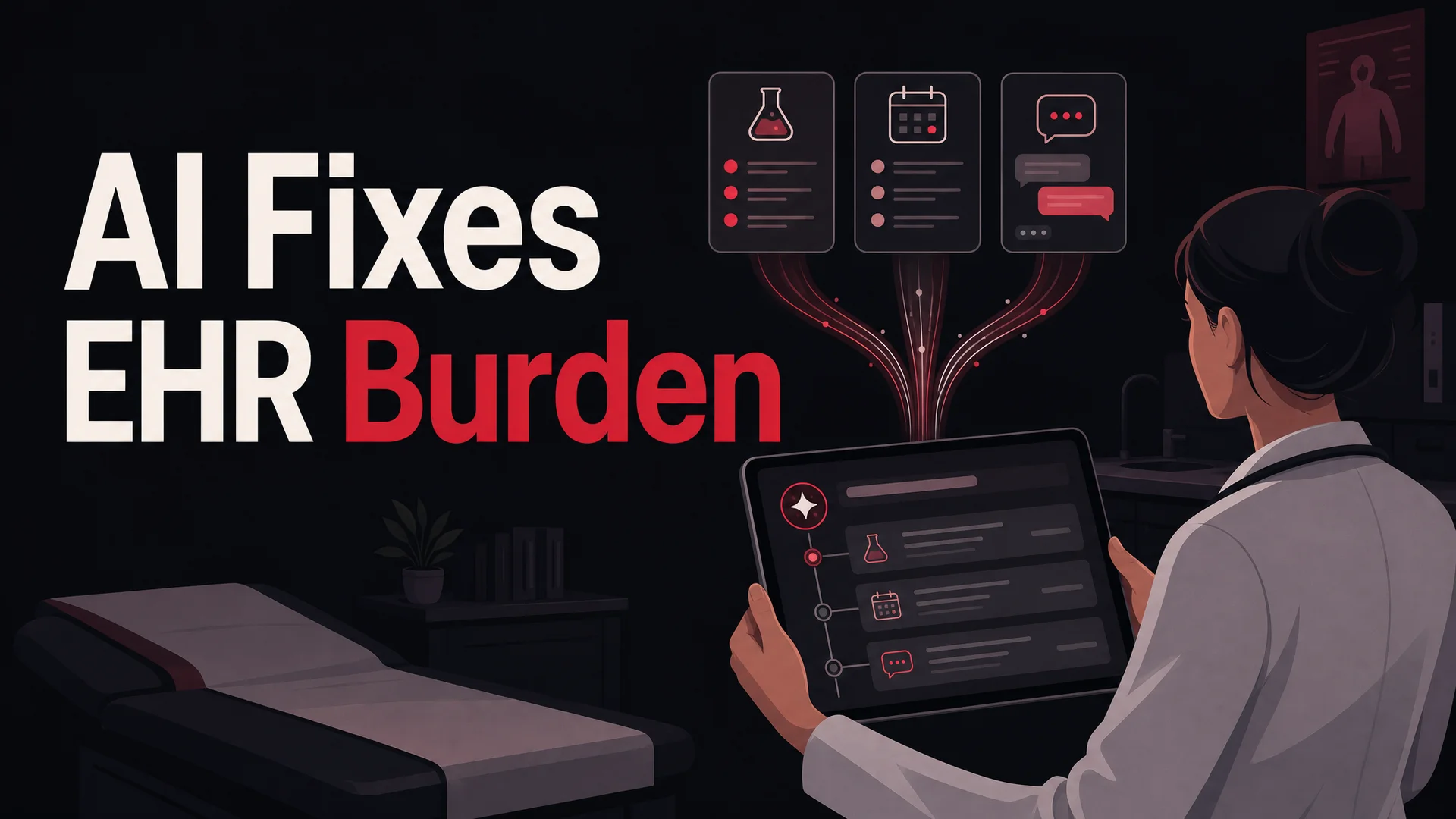
It is 7:48 a.m. at a mid-sized internal medicine clinic. The first patient is already in the waiting room. A nurse is hunting through a chart that lives across three different tabs. The attending is pasting lab values into a note template that times out every twenty minutes. By the time the patient is actually seen, three people have spent more energy on the software than on the case.
This is what most clinics still look like in 2026. Electronic health records were supposed to make care safer and faster. In practice, they have become a quiet tax on every encounter - a tax paid in clicks, in dropdowns, in late-night documentation, and in the slow erosion of clinician attention. The technology meant to remove friction has, for a generation of providers, become the friction.
What is changing now is not the EHR itself. It is the layer of AI agents and copilots beginning to sit on top of it. With frontier models in mid-2026 capable of holding a million tokens of patient history in working memory, transcribing visits in real time, and reliably executing multi-step administrative actions, the EHR is finally starting to behave like a tool again instead of a checklist.
Here is what that shift actually looks like on the floor.
Where Today's EHR Workflows Break Down
Before talking about what AI fixes, it is worth being precise about what is actually broken. Most of the complaints clinicians have about their EHR fall into five buckets, and almost every "AI for healthcare" pitch is really a claim about one of them.
Documentation is eating the visit. Surveys consistently show clinicians spending one to two hours on EHR documentation for every hour of face-to-face care. That includes notes, orders, billing codes, and a long tail of structured fields that the system insists on collecting before it will let anyone move on. The clinician is now the highest-paid data entry worker in the building.
Patient data is fragmented across systems. A primary care physician opening a chart often sees a partial picture: notes from inside the practice are rich, but the cardiology consult lives in another vendor's system, the urgent care visit lives in a third, and the wearable data the patient brought up never made it in at all. The relevant information exists; it just is not assembled.
Alerts have become noise. Drug interaction warnings, allergy alerts, best-practice reminders, prior authorization pop-ups - most clinicians dismiss the majority of them on reflex because the false positive rate is so high. The result is alert fatigue, and the genuinely critical warning gets clicked away with everything else.
Interoperability is mostly aspirational. HL7, FHIR, and a decade of policy work have moved the needle, but every health system that has tried to merge feeds from labs, imaging vendors, payers, and external clinics knows the integration work is rarely "plug and play." Mapping conventions diverge. Identifiers collide. Edge cases pile up.
The system dictates the workflow, not the other way around. Traditional EHR builds force clinicians to follow the screens the vendor designed, which were rarely designed for the way an actual encounter unfolds. A specialist's intake is not a primary care intake. An ED handoff is not a clinic visit. One template trying to serve all of them serves none of them well.
These are not exotic problems. They are the daily texture of clinical work, and they are exactly what a well-deployed AI agent layer is positioned to absorb.
What Modern AI Actually Brings to the EHR Stack
The reason this conversation looks different in 2026 than it did even eighteen months ago is that the underlying models have moved. Long-context reasoning, reliable tool use, and dramatically lower inference costs have all arrived together, and each one removes a different bottleneck.
Automated, ambient documentation. Ambient AI scribes built on Claude Opus 4.7 or GPT-5.5 Pro now sit on the encounter, transcribe both sides of the conversation, and produce structured notes, problem list updates, and orders in the EHR's expected format. The clinician reviews and signs rather than authors from scratch. Done well, this gives back the better part of an hour per provider per day.
Unified patient context. With Gemini 3.1 Ultra offering a 2M-token context window and Claude Sonnet 4.6 shipping 1M tokens at no surcharge, an agent can hold an entire longitudinal record - every prior note, every medication change, every relevant lab - in-context for a single query. RAG is still useful as a retrieval and citation layer, but the brittle "fetch top-five chunks and hope" pattern is no longer the only option.
Smarter, ranked alerts. Models can now read the full clinical context and decide whether an alert is genuinely actionable for this specific patient, this specific moment, this specific clinician. The same drug-drug interaction that warrants a hard stop in one chart can be silenced in another where the prescriber has already documented the rationale. Alert fatigue is, fundamentally, a ranking problem, and ranking is something LLMs do well.
Real interoperability bridges. Agentic models like Moonshot Kimi K2.6 and Z.ai's GLM-5.1 - both open-weight, both designed for long autonomous tool-use loops - can be pointed at a tangle of APIs, faxed PDFs, and CSV exports and produce a normalized, queryable patient record. This is the unglamorous work that used to demand a custom integration team and now can be handled by an agent with the right scaffolding.
Workflows that adapt to the clinician. Because agents can be configured per role, per department, and per individual user, the same underlying platform can present a triage-shaped interface to an ED nurse and a longitudinal-care-shaped interface to a primary care physician - without forcing IT to maintain two separate builds.
The 2026 Model Landscape Powering Healthcare AI
The single most underrated shift for healthcare CIOs this year is cost. Open-weight frontier models have collapsed the per-resolution price of running an AI agent at scale, and that changes which use cases are economically viable.
DeepSeek V4 Flash, released in April 2026, runs at roughly $0.14 per million input tokens and $0.28 per million output tokens with a 1M-token context. MiniMax M2.7 prices in at around 8% of Claude Sonnet's rate while running roughly twice as fast. Alibaba's Qwen3.6-27B and Z.ai's GLM-5.1 ship under permissive MIT and Apache licenses, which makes on-premise and air-gapped deployments - the only kind many hospital systems will actually approve - genuinely practical.
The right architecture for most health systems is no longer "pick one model." It is a routed stack: a cheap, fast, open-weight model handling the long tail of routine queries; a frontier closed model like Claude Opus 4.7 (currently leading SWE-Bench Pro at 64.3%) or GPT-5.5 Pro reserved for the cases that require deeper reasoning, better safety behavior, or stricter audit trails. Berrydesk lets you set up exactly this kind of routing without building it from scratch.
For regulated workloads - psychiatry notes, pediatric records, anything covered by stricter state laws - the open-weight Chinese frontier (GLM-5.1, Qwen3.6, Xiaomi MiMo-V2) gives compliance teams something they have never really had before: a top-tier model that runs entirely inside the hospital's network, with no data leaving the premises and no vendor lock-in to a single API.
Tools and Patterns That Are Actually Moving the Needle
The right way to think about AI in healthcare is not as a single product but as a set of patterns that show up across vendors. A few of the ones doing real work today.
Ambient AI scribes. Tools like Nuance DAX Copilot and AWS HealthScribe sit on the encounter, draft the note, and push structured updates back into the EHR. The 2026 generation is markedly better at preserving clinical nuance - distinguishing a ruled-out diagnosis from a confirmed one, for instance - because the underlying models have improved at maintaining structured intent across long conversations.
Predictive analytics for population health. Platforms built on top of long-context models can ingest a panel of patients and surface the ones most likely to be readmitted in the next 30 days, the ones overdue for a critical follow-up, and the ones whose medication regimen is drifting toward a known interaction risk. The work moves from descriptive ("here is what happened") to anticipatory ("here is what is about to happen"), which is where care management actually creates value.
Smart scheduling and capacity matching. AI scheduling layers analyze appointment-type duration, no-show probability, provider preference, and acute demand patterns to produce a daily schedule that holds up under reality. During flu season or a respiratory surge, this is the difference between a clinic that absorbs the volume and one that collapses under it.
Agentic interoperability. Rather than building a point-to-point integration between every system, an agent can be given access to the relevant APIs and asked to compose them on demand. "Pull this patient's last six months of cardiology data, normalize it, and surface anything inconsistent with what's in our EHR" becomes a single instruction.
Conversational patient engagement. This is where most health systems are starting, because it is the lowest-risk surface area: a branded AI agent on the patient portal or website, handling appointment booking, pre-visit intake, post-visit follow-up, and routine medication or aftercare questions.
Where Berrydesk Fits In
Berrydesk is built for that last category and the workflow logic that sits behind it. The platform lets a clinic or hospital launch a branded AI support agent in four steps.
First, pick your model. Healthcare buyers can route different traffic to different models - Claude Opus 4.7 or GPT-5.5 for clinical reasoning, DeepSeek V4 Flash or MiniMax M2.7 for high-volume routine intake - without writing routing code.
Second, train on your sources. Upload PDFs of clinical protocols, point at the patient-facing knowledge base, sync a Notion workspace of internal SOPs, or connect a Google Drive folder of policy documents. The agent grounds every response in those sources and cites them.
Third, brand the widget. Match your colors, voice, and patient-safe disclaimers, with the appropriate "this is not a substitute for medical advice" language baked into your prompt scaffolding.
Fourth, enable AI Actions. This is where the leverage shows up. AI Actions let the agent actually do things - book or reschedule an appointment, push a pre-visit intake summary back into your scheduling system, generate a lab requisition draft for clinician review, email an aftercare summary to a patient. Because the underlying models in 2026 (Claude Opus 4.7, Kimi K2.6, GLM-5.1, Qwen3.6) are reliably good at multi-step tool use, these actions move from demoware to production-ready.
Then deploy where your patients actually are: web, Slack for staff coordination, WhatsApp for patient-facing follow-up in markets where it dominates, Discord for community health programs. One agent, multiple surfaces.
Common Pitfalls When Layering AI on EHRs
Plenty of AI healthcare projects underperform, and the failure modes are predictable.
Treating AI as a search box. If the agent only answers "what is in this document," you have built a slightly nicer FAQ. The point is the actions - bookings, intakes, escalations, follow-ups - and projects that scope those out at the start tend to plateau quickly.
Skipping the human-in-the-loop design. Anything that touches a clinical decision should default to drafting, not finalizing. The clinician signs. The agent prepares. Reversing that ordering is how organizations get into trouble.
Underinvesting in evaluation. Healthcare workflows are long-tail. A model that handles 95% of queries well can still cause a meaningful incident on the remaining 5%. Berrydesk includes message-level review and labeling so support and clinical operations teams can build evaluation sets from real traffic, not from synthetic prompts.
Ignoring data residency and licensing. For HIPAA-covered workloads, BAAs matter; for international deployments, data residency matters; for academic health systems, model license terms matter. The 2026 open-weight Chinese frontier under MIT and Apache makes on-prem real, but only if procurement and security understand what they are signing.
Closing
The promise of EHR was always that the technology would recede into the background and let clinicians spend their time on patients. For most of the last fifteen years, that promise was unmet. What is different in 2026 is that the AI layer is finally good enough - and finally cheap enough - to deliver on it.
If you are exploring how a branded AI agent could absorb the repetitive surface area of patient communication and free your clinical team for the work only they can do, start building one on Berrydesk. Most teams have a working prototype the same afternoon.
 Berrydesk
Launch a healthcare-grade AI agent in an afternoon
- Train on your protocols, EHR exports, and patient-facing docs in minutes
- Trigger AI Actions for booking, intake, and follow-ups - across web, WhatsApp, and Slack
Set up in minutes

Chirag Asarpota is the founder of Strawberry Labs, the team behind Berrydesk - the AI agent platform that helps businesses deploy intelligent customer support, sales and operations agents across web, WhatsApp, Slack, Instagram, Discord and more. Chirag writes about agentic AI, frontier model selection, retrieval and 1M-token context strategy, AI Actions, and the engineering it takes to ship production-grade conversational AI that customers actually trust.