Picture a typical Monday in an HR department. Maya, the people ops lead at a 400-person SaaS company, opens her laptop to roughly 220 applicants for two open roles, a stack of new-hire paperwork waiting on signatures, and an inbox already buzzing with the usual: "What's left in my PTO bank?", "When does open enrollment close?", "Can someone re-send the equity grant doc?". Half a dozen Slack DMs are stacked up too, most of them asking questions she has answered, in writing, on the company wiki, more than once this quarter.
By 11 a.m. she is buried in a performance-review tracker that pulls data from three different systems, none of which talk to each other. She still has not started the headcount plan her CFO needs by Friday. The strategic work - the engagement program, the manager-training rollout, the comp-band refresh - keeps slipping to "next week." It is exhausting, error-prone, and almost entirely a problem of bandwidth, not skill.
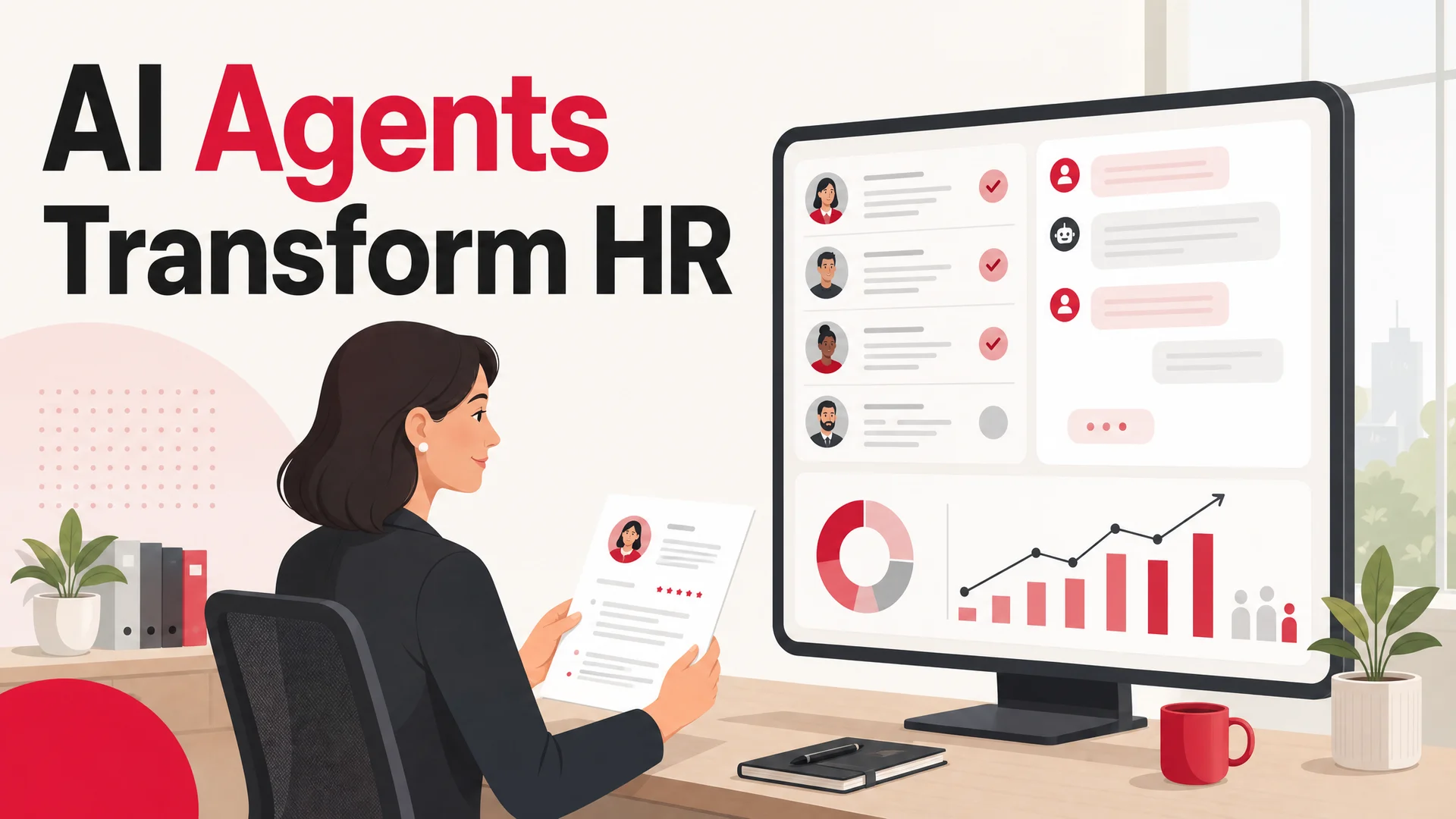
Now imagine what changes when an AI agent is sitting next to her. Resume triage runs in the background and surfaces a shortlist with the receipts behind every ranking. New hires get a personalized onboarding checklist the moment their offer is signed, with policy documents that explain themselves on demand. The payroll and PTO questions never reach Maya's inbox - a branded internal chatbot answers them in seconds, in the right tone, with the right policy version, and escalates anything sensitive to a human. Performance-review prep arrives as a one-page brief instead of a half-day spreadsheet exercise.
That is not a hypothetical. In 2026, with the current generation of foundation models and agentic tooling, this is a weekend build. The harder question is not whether AI belongs in HR software - it is which problems to point it at first, and which tools actually deliver. This piece walks through both, and lands on a stack you can ship without a six-month procurement cycle.
Why HR has been waiting for this
HR work breaks down, roughly, into three buckets: high-volume repetitive questions and tasks, document- and policy-heavy reasoning, and people-judgment work that benefits from data but should never be fully automated. Until recently, software served the first bucket badly (rigid ticket forms, FAQ pages nobody read), the second bucket worse (PDFs in a SharePoint folder), and the third bucket not at all.
The 2026 model landscape changes the math on the first two buckets in a serious way. Three shifts matter for HR specifically.
Long context windows replace brittle search. Claude Sonnet 4.6 and Opus 4.6 ship with a 1M-token context window at no surcharge. Gemini 3.1 Ultra goes to 2M tokens. DeepSeek V4 Flash and Moonshot Kimi K2.6 also clear 1M. That means an AI agent can hold an entire employee handbook, the latest benefits summary, the compliance policies for every region you operate in, and the full history of an employee's prior conversations all at once. Retrieval still helps for very large corpuses, but it stops being a hard requirement for getting accurate answers about leave policy.
Agentic tool use turns demos into production. The newest open-weight models - Kimi K2.6, Z.ai's GLM-5.1, Alibaba's Qwen3.6 family, Xiaomi's MiMo-V2-Pro - and closed leaders like Claude Opus 4.7 and GPT-5.5 are built around reliable, multi-step tool use. For HR, that means an agent can actually execute: pull a PTO balance from Workday, file an IT request in Jira, schedule an interview through Google Calendar, kick off a background check, then confirm back to the employee. Last year's chatbots could only point you to a form. This year's agents fill it in.
Open-weight frontier collapses the cost of internal traffic. DeepSeek V4 Flash is priced around $0.14 per million input tokens and $0.28 per million output. MiniMax M2 lands at roughly 8% the cost of Claude Sonnet at twice the speed. For an HR helpdesk that fields tens of thousands of "where do I find X?" questions a quarter, routing the routine 80% to an open-weight model and reserving a frontier model like Claude Opus 4.7 or Gemini 3.1 Ultra for the hard, judgment-laden 20% turns AI from a line item into rounding error. Models like GLM-5.1 and Qwen3.6-27B ship under MIT or Apache licenses, which makes on-prem and air-gapped deployments realistic for regulated industries that cannot ship employee data to a third party at all.
With those three shifts, the bottleneck for AI in HR is no longer model capability. It is integration, governance, and the patience to wire it up properly.
What AI actually does for HR teams in 2026
Here is the real list - not "AI will revolutionize" platitudes, but the concrete jobs an agent can take off Maya's plate this quarter.
1. Recruiting that gives time back, without hiding the math
A modern recruiting agent does the unglamorous parts of sourcing and screening end to end. It parses inbound resumes against a structured rubric, ranks candidates with a written justification for each score, drafts personalized outreach for cold sourcing, books screening calls against a recruiter's calendar, and runs a first-pass conversational screen for role-specific qualifications.
The important nuance in 2026 is auditability. Bias, EEOC exposure, and emerging EU AI Act obligations mean an HR team needs to be able to explain why a candidate was advanced or rejected. Agents built on Claude Opus 4.7 or Qwen3.6-Plus produce structured rationales alongside their rankings, so a recruiter (and a regulator) can trace a decision back to the rubric, not to a black-box embedding score. Pair that with a human-in-the-loop checkpoint before any rejection email goes out and you get speed without ceding judgment.
2. Onboarding that runs itself
Most onboarding pain is sequencing: the offer accepts, then twelve different systems and three humans need to do something, in the right order, before day one. An agent can own the orchestration. It triggers IT provisioning, generates a personalized 30-day plan based on role and team, schedules the welcome calls, and answers the new hire's "where do I…" questions live in Slack as they come up. Compliance documents stop being chase-down items because the agent tracks signature status and nudges in the right tone on the right cadence.
The win compounds. New hires consistently report that the first two weeks set their long-term engagement, and a smooth, responsive onboarding experience is one of the cheapest retention investments a company can make.
3. Internal helpdesk for payroll, benefits, and policy
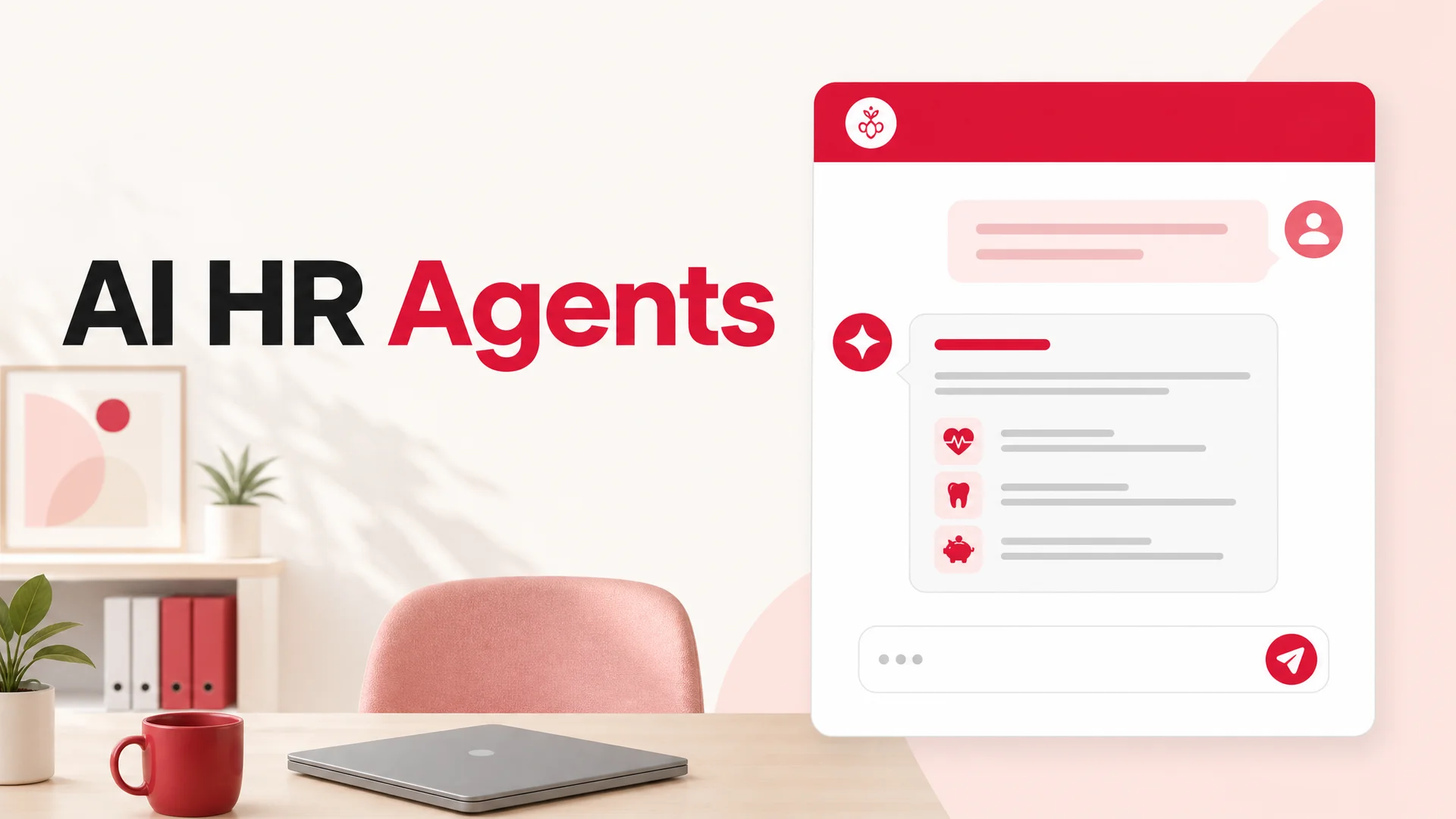
This is the highest-volume, lowest-judgment bucket - and the easiest to ship. An internal AI agent trained on the handbook, benefits summaries, payroll calendar, leave policy, and country-specific addenda can resolve the majority of inbound HR questions in seconds, around the clock, in the employee's preferred language.
The real value shows up in three places. First, after-hours and across-time-zone answers - engineers in Berlin and salespeople in Singapore get the same response time as the team sitting next to HR. Second, consistency - every employee sees the same policy interpretation, every time, instead of whichever version landed in their reply thread. Third, sensitivity routing - well-built agents recognize a question that should not be answered by software ("I'd like to discuss a harassment concern") and hand off cleanly to a named human, with no awkward dead end.
4. Performance, engagement, and workforce analytics
Workforce data is the asset HR teams have been told to use for a decade and have rarely had time to actually exploit. AI changes that by collapsing the cost of analysis. An agent can read across HRIS, ATS, engagement surveys, and 1:1 notes to surface trends - rising attrition risk in a specific team, training completion gaps before a compliance deadline, manager-feedback patterns that correlate with regrettable departures.
The practical pattern that works in 2026 is "analyst on demand." Instead of waiting for a quarterly people-analytics report, a manager can ask "which of my reports look at risk based on recent 1:1 themes and engagement scores?" and get a structured, sourced answer back, with the option to drill into any signal. Pair that with a human reviewer before any sensitive action is taken and you get insight without surveillance creep.
5. Personalized learning and development
Generic LMS courses are largely a waste of everyone's afternoon. An AI agent that knows an employee's role, recent projects, performance feedback, and stated career goals can build a learning path that is actually relevant - and adjust it as the work changes. It can also recommend internal mobility paths the employee might not have considered, which is increasingly the cheapest way to fill a senior role: from inside.
6. Administrative drudgery, finally automated
Policy updates, compliance tracking, certifications expiring, document retention windows, audit prep - all of it. None of this is glamorous, all of it is necessary, and all of it has been a long tail of work that ate HR's capacity. Agents handle the orchestration; humans handle the exceptions.
A 2026 HR AI stack: tools worth a look
A short, opinionated list. The point is not to assemble all of them - most teams need one or two - but to show what each category looks like in 2026.
1. Berrydesk: the AI agent layer for HR
Berrydesk is built to be the conversational front door for both customers and employees. For HR, that means a branded internal agent that you can stand up in roughly an afternoon and refine over the next month.
What that looks like in practice:
- Pick the model that fits the job. Berrydesk lets you choose from GPT-5.5, Claude Opus 4.7 or Sonnet 4.6, Gemini 3.1, DeepSeek V4, Kimi K2.6, GLM-5.1, Qwen, MiniMax, and others. For a high-volume internal helpdesk you might route routine policy questions to DeepSeek V4 Flash or MiniMax M2 to keep cost negligible, and reserve Claude Opus 4.7 or GPT-5.5 Pro for harder reasoning like comp questions or escalations.
- Train on the sources HR actually uses. Connect Notion, Google Drive, your wiki, the employee handbook PDF, benefits summary documents, and any internal websites. The agent stays in sync as you update them - no re-uploading every quarter.
- Brand the experience. The chat widget matches your company's design system, sits inside Slack, Microsoft Teams, or your intranet, and speaks in the tone you set.
- Use AI Actions for real work. Wire the agent to file PTO requests, look up payroll details, kick off background checks, schedule interviews, or open IT tickets. This is where an HR agent stops being a glorified FAQ and starts being staff.
- Deploy where employees already are. Web, Slack, Discord, Microsoft Teams, WhatsApp - same agent, same knowledge, consistent answers everywhere.
- Keep a human in the loop. Sensitive topics route to a named HR partner with full context, no awkward handoff.
For most teams, this is the layer that turns the rest of the HR stack into something employees actually talk to.
2. iSmartRecruit: AI-driven applicant tracking
A capable ATS for teams that want recruiting workflows out of the box: resume parsing and ranking, applicant tracking, automated interview scheduling, multilingual support for global hiring, and bias-mitigation features. Pairs naturally with a Berrydesk recruiting agent that handles candidate Q&A and pre-screen conversations on top.
3. Workday: the enterprise system of record
Still the dominant HRIS for mid-market and enterprise. Its 2026 AI features lean on predictive analytics for attrition and skills-gap detection, automated payroll across geographies, and localized compliance management. Best treated as the source of truth that an AI agent reads from and writes to via API, not as the conversational layer itself.
4. Eightfold AI: talent intelligence
Specializes in matching candidates and current employees against roles using deep learning models trained on broad labor-market data. Strongest for organizations that want to take internal mobility seriously and reduce reliance on external recruiting.
5. BambooHR: lightweight HRIS for SMB
A clean choice for sub-500-employee companies that need core HRIS functionality - onboarding workflows, PTO tracking, employee records, basic reporting - without the weight of an enterprise platform. Easy to plug into a Berrydesk agent for the conversational layer.
6. Lattice: performance and engagement
Goal tracking, performance review cycles, engagement pulse surveys, and AI-summarized feedback. Particularly useful for managers who want a structured way to run 1:1s and growth plans without building the scaffolding themselves.
Common pitfalls when rolling out AI in HR
A few patterns we see teams trip on, often after a smooth-looking pilot.
Treating the handbook as the whole knowledge base. Half of what employees ask about lives in tribal knowledge - Slack threads, manager calls, team-specific norms. An agent trained only on the formal handbook will be confidently wrong on the questions employees actually ask. Spend the first two weeks logging every gap and feeding it back in.
Skipping the escalation path. Employees lose trust in an internal agent the first time it says something tone-deaf about a sensitive topic. Bake in clear, named escalation paths for harassment, mental health, leaves of absence, comp disputes, and immigration - and test them.
Letting the agent send hiring rejections. Even when the model's reasoning is solid, a fully automated reject email is a brand and legal risk. Always keep a human approval step on negative candidate decisions; let the agent do the drafting and the queue management.
Picking one model for everything. A single frontier model on every query is expensive and slow. A single cheap model on every query is unreliable on the hard ones. The 2026 winning pattern is routed: cheap and fast for the long tail, frontier for the edge cases. Berrydesk handles this routing natively.
Ignoring data residency. EU and APAC employee data carries real obligations. If your HR data cannot leave a region, the open-weight Chinese frontier (GLM-5.1, Qwen3.6-27B, MiMo) under MIT/Apache licenses gives you a path to fully on-prem agents that the closed-frontier providers cannot match.
Where to start
The honest first project is the internal helpdesk. It is high volume, low risk, easy to measure (deflection rate, response time, employee CSAT), and a natural training ground for the rest of the stack. Stand it up on Berrydesk in an afternoon, point it at your handbook and benefits docs, route it into Slack, and watch where it struggles for two weeks. Those failure modes will tell you exactly what to wire up next - usually PTO actions, then payroll lookups, then onboarding orchestration.
From there, recruiting is the second project most teams take on, because the volume is real and the ROI is legible to a CFO in a single quarter.
The teams that do this well in 2026 are not the ones with the biggest AI budget. They are the ones that pick a clear first job, ship it in a week, learn from the gaps, and expand from there.
If you want to see what an HR agent built on the current generation of models looks like in practice, you can build one for free on Berrydesk. Connect your handbook, pick a model, brand the widget, and put it in front of your team this week.
 Berrydesk
Launch your HR AI agent in minutes
- Train it on your handbook, policies, and Notion in one click
- Wire up AI Actions for PTO, payroll lookups, and onboarding tasks
Set up in minutes

Chirag Asarpota is the founder of Strawberry Labs, the team behind Berrydesk - the AI agent platform that helps businesses deploy intelligent customer support, sales and operations agents across web, WhatsApp, Slack, Instagram, Discord and more. Chirag writes about agentic AI, frontier model selection, retrieval and 1M-token context strategy, AI Actions, and the engineering it takes to ship production-grade conversational AI that customers actually trust.