Picture an HR function that doesn't go offline at 5pm, doesn't drown in repeat tickets about parental leave policy, and doesn't lose half a recruiter's week to scheduling. That isn't a thought experiment in 2026 - it's what teams running a well-trained HR agent quietly look like already.
The shift has happened faster than most people inside HR realize. The same wave of agentic, long-context AI models that turned customer support from a cost center into a measurable revenue lever is now hitting the people function. The interesting questions have moved on from "should we use an HR chatbot" to "which model do we route to, what should it be allowed to do on its own, and how do we keep employees trusting it."
This piece is a working answer to those questions: what an HR agent actually is in 2026, where it's earning its keep, what it costs, what to watch out for, and how to roll one out without breaking employee trust.
What an HR agent really is in 2026
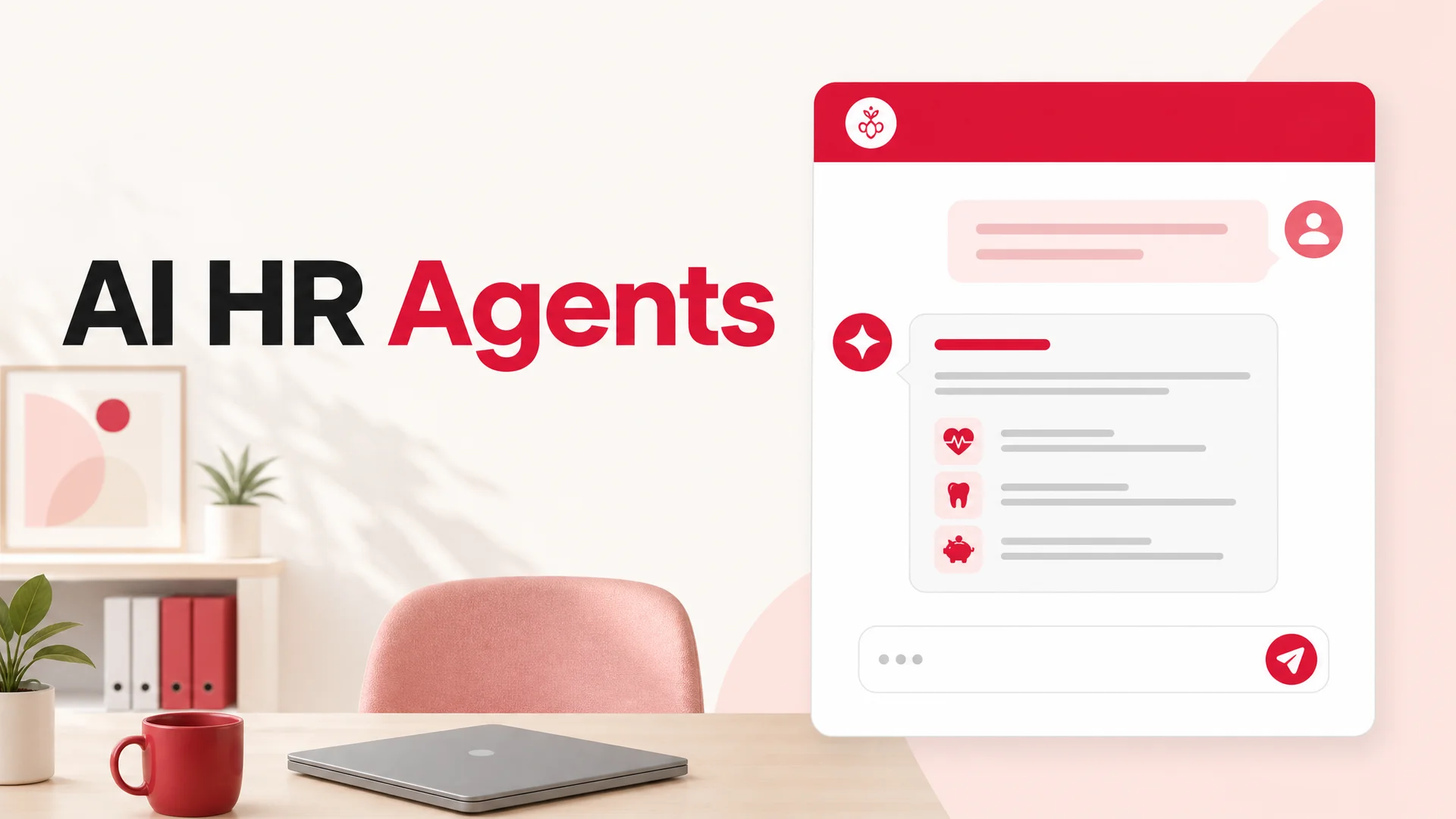
The phrase "HR chatbot" still gets used, but it undersells what's now possible. A 2026 HR agent is closer to a junior HR business partner who happens to be available in Slack, on the intranet, and inside your HRIS - built on top of a frontier language model, trained on your handbook and policy docs, and wired into the systems where work actually happens.
Three changes in the underlying technology are what made the leap possible. First, context windows. Claude Opus 4.6 and Sonnet 4.6 now ship with a 1M-token context window at no surcharge, and Gemini 3.1 Ultra goes to 2M. An HR agent can hold the entire employee handbook, the benefits SPDs, the leave policy, and the running thread of a conversation in-context - without aggressive retrieval gymnastics. Second, agentic tool use. Models like Claude Opus 4.7, Kimi K2.6, GLM-5.1, and Qwen3.6 now reliably handle multi-step workflows: looking up a balance, drafting a request, posting it to the right system, and confirming back. Third, cost. Open-weight frontier models from DeepSeek, Z.ai, MiniMax, and Alibaba have collapsed the per-resolution price. DeepSeek V4 Flash runs at $0.14 per million input tokens and $0.28 per million output. MiniMax M2 lands at roughly 8% the price of Claude Sonnet at twice the speed. Routing routine HR questions through one of these and reserving Claude Opus 4.7 or GPT-5.5 for the gnarly stuff turns the unit economics from interesting to obvious.
In practical terms, an HR agent in 2026 can handle policy lookups, benefits questions, time-off requests, onboarding walk-throughs, recruiting screening, performance check-in nudges, and engagement surveys - and it can take action on a fair share of those, not just answer.
Why HR teams are leaning in
There's a long version of the business case, but it boils down to five things.
Capacity, not headcount
The single biggest unlock is freeing senior HR staff from the long tail of repeat questions. A mid-sized company - say 800 people - typically sees the same fifty questions on loop: PTO accrual, parental leave eligibility, stock vesting cliff, expense limits, holiday calendar, healthcare provider in network. An agent that handles those at first touch lets HRBPs spend their time on the work that actually moves the dial: comp planning, manager coaching, sticky employee-relations cases.
Always-on, across time zones
A distributed company has employees asking questions at 11pm Sydney time and 6am Berlin time. Email queues and ticketing systems were built for an HR team that worked one set of hours. Agents don't have hours. New hires onboarding from a different continent can ask "how does my equity vest" the night before their start date and get a useful answer instead of a weekend of anxiety.
A measurably better employee experience
This one shows up in engagement scores once you measure it. Employees rate their HR experience higher when answers come fast and consistent - not because they prefer a bot, but because they were used to waiting two days for a one-paragraph reply. An agent built on Claude Opus 4.7 or Gemini 3.1 Pro that has read the actual handbook gives a sharper answer than a junior HR rep skimming a Confluence page under time pressure.
Real cost reduction, especially with model routing
Routing matters. A typical pattern in 2026 is to send most traffic - policy questions, FAQ, status checks - to a cheap, fast open-weight model like DeepSeek V4 Flash, MiniMax M2, or Qwen3.6-27B (Apache 2.0, beats much larger MoE rivals on agentic benchmarks). Then escalate the harder cases - disputed leave calculations, sensitive ER conversations, compensation reviews - to Claude Opus 4.7 or GPT-5.5 Pro. That tiering can cut model spend by 80–90% versus running everything on a frontier closed model, with no perceptible quality drop on the routine traffic.
Consistency across the organization
Employees in the New York office should not get a different answer about parental leave than employees in São Paulo. A trained agent reads the same source documents every time and answers from them. That consistency is genuinely hard to maintain with a distributed HR team and is one of the more underrated wins.
Where HR agents are earning their keep
A few use cases have moved from pilot to production over the last year.
Recruiting and screening
The recruiting funnel is full of repetitive, scriptable steps that AI agents handle well: answering candidate questions about role scope, compensation bands, and culture; pre-screening with a structured set of questions; scheduling interviews against recruiter and panel calendars; sending follow-ups; and handing off finalists to a human recruiter with a clean summary. The agentic models - Kimi K2.6 with its 12-hour autonomous coding sessions and 300-sub-agent swarms, GLM-5.1 with its 8-hour plan-execute-test-fix loops - overshoot what's needed for recruiting, but the same tool-use reliability they prove out is what makes scheduling-and-screening agents work without supervision.
Onboarding
A new hire's first two weeks are mostly a flood of questions: where do I file expenses, what's the WiFi password in the London office, when does my health insurance kick in, how do I request a laptop, who do I ping about parking. Walking that flood is a thankless job for a People Ops generalist. An onboarding agent trained on the new-hire packet and connected to your IT and HRIS systems can answer 80% of it and create tickets for the rest. With long-context models, the agent can hold the new hire's entire onboarding plan in mind and proactively surface what's next.
Self-service for the everyday stuff
This is the workhorse use case: an employee asking about leave balance, requesting PTO, checking a pay stub, updating an address, or enrolling in a benefits change. With AI Actions wired up, the agent doesn't just point to a portal - it executes. "Take next Friday off" becomes a draft request submitted in your HRIS, awaiting manager approval, with the right leave type and balance check performed first.
Learning and development
A learning-focused agent can recommend courses based on someone's role and recent projects, surface internal mobility opportunities that match their stated career goals, and answer questions about certifications or tuition reimbursement. The interesting move here is using long-context models to read a person's manager-feedback notes (with permission) and suggest a learning path, instead of just dumping the LMS catalog.
Performance and feedback cycles
Reminders for review cycles, prompts for managers who haven't filed yet, gentle nudges to set goals at the right cadence, structured intake for 360 feedback. These are calendar-driven, repetitive workflows that benefit hugely from automation but historically lived in spreadsheets and Slack pings.
Engagement and pulse surveys
Pulse surveys delivered conversationally tend to get better response rates than form-based ones. An agent can ask three questions in chat, follow up on a flat answer with a real probe, and aggregate sentiment back to HR leadership without any individual employee identified.
Choosing your model: open-weight vs frontier closed
This is the call that matters most for cost and risk. The right answer is usually "both, routed."
For routine HR Q&A - handbook lookups, policy questions, leave balance summaries - the open-weight class is now genuinely strong enough. DeepSeek V4 Flash at $0.14/$0.28 per million input/output tokens with a 1M context is unreasonably cheap for what it does. MiniMax M2 / M2.7 is open-weight, fast, and roughly 8% the price of Claude Sonnet. Qwen3.6-27B (dense, Apache 2.0) is small enough to run on modest infrastructure and beats much larger MoE rivals on agentic coding benchmarks - translating to crisp tool use for HR Actions. GLM-5.1 (754B-param MoE, MIT license, 58.4 on SWE-Bench Pro) is built for agentic workflows and can drive multi-step HRIS automations.
For the harder, higher-stakes interactions - sensitive ER conversations, comp questions, anything compliance-adjacent - route to a frontier closed model. Claude Opus 4.7 leads SWE-bench Pro at 64.3% and brings the kind of careful, calibrated reasoning you want for nuanced employee conversations. GPT-5.5 Pro offers parallel reasoning that helps when an answer requires juggling multiple policy threads. Gemini 3.1 Ultra with its 2M context is unmatched when you want the agent to genuinely read a binder full of policy at once.
For regulated industries - healthcare, finance, defense - the MIT/Apache-licensed Chinese open-weight models (GLM-5.1, Qwen3.6-27B, Xiaomi MiMo-V2-Pro) make on-prem and air-gapped deploys realistic in a way they weren't a year ago.
In Berrydesk you pick the model in the first step of agent setup, and you can route by intent - so the cheap model handles "how many vacation days do I have left" while the expensive model handles "I want to talk about my performance review."
What to watch out for
Most failed HR agent rollouts share the same handful of mistakes.
Letting it answer questions it shouldn't. An HR agent should know what's outside its scope and hand off cleanly. Anything involving discrimination, harassment, mental health crises, or termination should route to a human. Configure refusal explicitly - don't hope the base model gets it right.
Stale knowledge. A handbook from eighteen months ago will give wrong answers on benefits that changed in the last open enrollment. The agent is only as good as the source material. Wire it to the system of record, schedule re-syncs, and audit answers monthly against current policy.
Over-promising on automation. It's tempting to wire up AI Actions for everything on day one. Don't. Start with read-only - answers, not actions - and earn the right to take action on a few well-tested workflows like PTO requests and ticket creation. Expand from there.
Treating data privacy as a checkbox. HR data is among the most sensitive an organization holds. Verify model providers' data retention policies, prefer providers that don't train on your data, restrict the agent's source documents to what it needs, and log every interaction for audit.
Skipping change management. Employees who feel a chatbot is being inflicted on them will route around it. Communicate what the agent does, what it doesn't, and how to escalate to a human. Make the human escalation path obvious in the chat itself.
Rolling it out: a practical sequence
A clean rollout usually looks like this:
- Pick a narrow first use case. Onboarding FAQ or benefits questions are good starting points. They're high-volume, low-risk, and easy to measure.
- Train on a curated corpus. In Berrydesk that means uploading your handbook, connecting Notion or Google Drive, and pointing at any policy PDFs. Keep the corpus tight - fewer, better documents beat a dump of everything HR has ever written.
- Pick the model. For step one, pick one cheap and capable open-weight model (DeepSeek V4 Flash or MiniMax M2 are reasonable defaults) and one frontier closed model (Claude Opus 4.7 or Sonnet 4.6) for the harder questions. Configure routing.
- Brand the widget. Employees should feel like they're talking to your company's HR, not to a generic AI tool. Match colors, voice, and tone.
- Wire one or two AI Actions. Start with low-risk ones - opening a ticket, scheduling a meeting with a People Ops generalist. PTO requests next.
- Deploy where employees already are. Slack, Microsoft Teams, the intranet. A chat widget that lives only on a portal nobody visits will be unused.
- Measure, iterate, expand. Resolution rate, escalation rate, employee CSAT, time-to-answer. Cycle the things that don't work and expand the agent's scope only after the current scope is solid.
Where this goes next
The next two years will sharpen what's already in motion. Long-context models will keep getting cheaper, which means more of your knowledge base lives in-context and RAG becomes a tuning lever rather than a hard requirement. Agentic models will keep maturing, which means AI Actions move from "convenient for booking" to "trusted for full workflows" - including things like benefits enrollment changes, where the consequences of getting it wrong are real. Voice-first interfaces, increasingly grounded in multimodal models like Gemini 3.1 Ultra, will start to matter for in-office and field workforces. And open-weight frontier models will keep eating into the cost story for high-volume internal use.
The HR teams that win this transition won't be the ones who automated the most. They'll be the ones who automated the boring stuff thoughtfully, kept the human in the loop where it counts, and used the time they got back to do better strategic work.
If you're ready to stand up an HR agent that's actually grounded in your policies, plugged into your tools, and built on the model that fits your team's risk profile, you can get one running on Berrydesk in an afternoon - no credit card, no engineering ticket required.
 Berrydesk
Stand up an HR agent your team will actually use
- Train it on your handbook, Notion, Google Drive, and HRIS docs in minutes
- Wire AI Actions for PTO, benefits enrollment, and ticket creation
Set up in minutes

Chirag Asarpota is the founder of Strawberry Labs, the team behind Berrydesk - the AI agent platform that helps businesses deploy intelligent customer support, sales and operations agents across web, WhatsApp, Slack, Instagram, Discord and more. Chirag writes about agentic AI, frontier model selection, retrieval and 1M-token context strategy, AI Actions, and the engineering it takes to ship production-grade conversational AI that customers actually trust.