Marketing teams are no longer asking whether to use AI. They are asking which slice of the stack to upgrade first, which tools survive contact with real customers, and how to keep the bill from quietly tripling. The answer in 2026 is messier than a single all-in-one suite: the strongest marketing orgs are stitching together two or three sharp tools - one for conversation, one for content, one for media - and routing each task to whichever model handles it best.
The cost story has flipped, too. With open-weight frontier models from DeepSeek, Z.ai, Moonshot, MiniMax, Alibaba, and Xiaomi all shipping under MIT or Apache licenses in the last quarter, you can now run high-quality copy generation, classification, and conversation flows for fractions of a cent per call. The closed frontier - GPT-5.5 Pro, Claude Opus 4.7, Gemini 3.1 Ultra - still earns its keep on the hard work: nuanced tone, complex tool use, multimodal reasoning. The marketers winning in 2026 know which lever to pull when.
This guide walks through eleven tools we actually see deployed in modern marketing stacks, what each one does well, where it falls down, and how to think about cost and integration. Some are mature platforms; some are newer specialists. None of them replace a strategist - but together, they can take a five-person team and give them the throughput of fifteen.
1. Berrydesk: Branded AI Support Agents That Convert
Top of the list is the layer that touches the most revenue per dollar spent: the conversation. Berrydesk lets a marketing or support team launch a fully branded AI agent in four steps - pick a model, train it on your sources, style the widget, and deploy. There is no SDK ceremony, no prompt engineering certificate required, and no vendor lock-in on which model powers it.
What sets it apart:
- Model choice that actually matters. Berrydesk runs on GPT-5.5, GPT-5.5 Pro, Claude Opus 4.7, Sonnet 4.6, Gemini 3.1 Ultra and Pro, DeepSeek V4 (Pro and Flash), Moonshot Kimi K2.6, Z.ai GLM-5.1, Alibaba Qwen 3.6, MiniMax M2.7, and more. Route routine FAQs to DeepSeek V4 Flash at $0.14 / $0.28 per million tokens, escalate complex retention conversations to Opus 4.7, and reserve Gemini 3.1 Ultra's 2M-token context for cases where the agent needs to hold an entire onboarding history in-context.
- Training that respects how your knowledge actually lives. Point the agent at your docs site, help center, Notion workspace, Google Drive folder, sitemap, or YouTube channel. Long-context models like Sonnet 4.6 and Gemini 3.1 mean RAG is a tuning lever now, not a hard requirement - for most knowledge bases under a few hundred thousand tokens, the agent can hold the entire corpus in its window.
- AI Actions that close loops. Bookings, refunds, order lookups, payment intents, account changes - Berrydesk's tool-use layer turns the agent into something that resolves issues instead of summarizing them. Agentic models like Kimi K2.6 (12-hour autonomous sessions, 4,000 coordinated steps) and Claude Opus 4.7 make these flows reliable enough to put in production.
- Multilingual out of the box. 80+ languages without prompt gymnastics.
- Deploy where customers already are. Website widget, Slack, Discord, WhatsApp, Messenger, plus a clean API for everything else.
- Lead capture, qualification, and analytics in one dashboard so marketing can see which campaigns are funneling into the right conversations.
Why marketers care: A support agent is a marketing surface. It greets first-time visitors, qualifies leads, recovers cart abandoners, and answers the questions that would otherwise bounce people off your pricing page. With Berrydesk, that surface is on-brand, accurate, and routed to whichever model best fits the task.
Pricing: A free tier to ship your first agent, then paid plans that scale with usage and seats - no separate inference bill, no per-conversation surprise.
2. Jasper: Long-Form and Brand-Voice Content at Scale
Content marketing did not get easier in 2026, it got more competitive. Search results are full of well-edited AI prose, social feeds are saturated, and the marginal blog post needs to be faster, sharper, or more useful to earn a click. Jasper is still the heavyweight on the brand-voice side, with workflow tooling that small models do not replicate well on their own.
Key features:
- Multi-document workflows for long-form pieces with consistent voice
- Brand voice tuning across team members and content types
- SEO and on-page optimization integrations
- Plagiarism scanning for compliance-sensitive teams
- Multi-language support, useful for any team running localized programs
Why it matters: When five writers need to produce content that sounds like one team, Jasper's brand-voice models do most of the unglamorous reconciliation work - terminology, sentence rhythm, regulatory phrasing. Underneath, it taps into modern frontier models, which means the raw quality has improved sharply since the GPT-4 days; the differentiator now is the editorial scaffolding around the model rather than the model itself.
Pricing: Creator and Pro plans run roughly $49–$69 per seat per month, with Business pricing for larger orgs. Compare against the cost of a freelance writer per draft and the math is straightforward.
3. Albert.ai: Autonomous Cross-Channel Campaign Management
Albert.ai sits in the part of the stack most marketers underestimate: media buying, audience segmentation, and bid optimization across paid channels. It does not just suggest changes - it executes them, continuously, against KPI targets you set.
Key features:
- Cross-channel campaign orchestration (search, social, display, video)
- Predictive audience modeling that compounds over time
- Real-time creative and bid optimization
- Reporting that translates back to acquisition and retention metrics
Why it matters: A human team running paid acquisition across five platforms might re-evaluate creatives weekly. Albert.ai is doing it hourly. For mid-market teams without a 12-person performance group, that gap shows up in CAC. The 2026 generation of models - GPT-5.5 Pro's parallel reasoning, agentic tool use from the open-weight side - has made the autonomy meaningfully more reliable than the early-2024 version of these promises.
Pricing: Custom, generally tied to media spend.
4. Persado: Language Optimization Backed by Behavioral Data
Persado treats marketing copy as a data problem. It generates variants, predicts which emotional registers resonate with which audiences, and optimizes the language across channels using outcome data, not vibes.
Key features:
- AI-generated marketing copy graded against behavioral models
- Emotional and motivational language analysis
- A/B testing infrastructure baked into the workflow
- Cross-channel orchestration so subject lines, push, and on-site copy stay coherent
Why it matters: "Trust your gut" works for a senior copywriter; it does not scale. Persado pairs generation with measurement, which is exactly the loop most in-house teams skip when they bolt a generic LLM onto their CMS. The result is copy that wins more often, not just copy that gets shipped faster.
Pricing: Custom, based on volume and integrations.
5. Durable: Instant Sites with a Marketing Engine Inside
Durable spins up a complete, mobile-ready website from a few business details - name, industry, location, vibe - in under thirty seconds. The trick is what comes after the site: it bundles a CRM, SEO tooling, an invoicing module, and a marketing engine that can draft blog posts, ads, and social content from the same brand profile.
Key features:
- AI-generated website in about half a minute
- Integrated CRM, invoicing, and SEO basics
- Automated blog, ad, and social content tied to brand profile
- Drag-and-drop editor with managed hosting and SSL
Why it matters: Solo founders, agencies bootstrapping client sites, and small businesses replacing a stale Wix presence get an entire go-to-market posture in a single tool. It is not the right pick for a 200-person SaaS marketing team; it is the right pick for the 80% of small businesses that still do not have a working site and a content cadence.
Pricing: Starter around $12/month, Business around $20/month - comfortably below the cost of a single design contractor for an afternoon.
6. Crayon: Competitive Intelligence Without the Spreadsheet
Crayon ingests competitor signals - pricing changes, messaging tweaks, hires, product updates, review trends - and surfaces what matters for product marketing, sales enablement, and positioning teams.
Key features:
- Real-time monitoring across competitor web properties, review sites, hiring boards, and social
- Automated battlecards that update when the underlying data changes
- Customizable intelligence dashboards by team or persona
- CRM and Slack integrations so insights show up in the workflows people actually use
Why it matters: Competitive intel is the work that gets dropped first when a team is busy, which is also when it is most valuable. Crayon's AI layer keeps it running in the background and pings teams when something material shifts - a pricing page change, a new positioning push, a hire that signals a product direction.
Pricing: Essential plans start around $500/month, with custom pricing for enterprise scope.
7. Email Subject-Line and Push Optimization (Phrasee / Jacquard)
The category formerly led by Phrasee - now operating as Jacquard - uses generative models plus reinforcement-style optimization to produce subject lines, push copy, and SMS that consistently outperform human-written controls.
Key features:
- AI-generated subject lines, preview text, and push copy
- Brand voice constraints so the optimization does not drift into off-brand cleverness
- Continuous A/B and multi-armed-bandit testing
- Native integrations with major ESPs
Why it matters: Email is still one of the highest-ROI channels, and most teams squeeze it for one or two percentage points of open rate per quarter. A specialized language optimizer, especially one tuned on the team's own historical send data, often finds gains that generic LLM prompts miss because it knows what did not work in the last 50 sends, not just what looks plausible.
Pricing: Custom, generally based on send volume.
8. Seventh Sense: Send-Time Optimization Per Subscriber
Seventh Sense answers a narrow but valuable question: when, individually, is each subscriber most likely to open and click? It plugs into HubSpot, Marketo, and similar platforms and adjusts send time per recipient.
Key features:
- Per-individual send-time models
- Automated frequency throttling so heavy senders stop nuking their list
- Engagement analytics segmented by behavior, not just demographics
- Native integration with the major marketing automation platforms
Why it matters: Most marketing teams optimize the what of an email and forget the when. Sending the same message at each subscriber's personal sweet spot, instead of a single batch time, can lift open and click rates without changing a single line of copy. It is one of the cheapest performance wins available in 2026.
Pricing: Starter around $100/month, Growth around $400/month, Enterprise custom.
9. Pattern89-Style Ad Creative Optimization
The category Pattern89 pioneered - predictive creative analytics for paid social - is now a crowded space, but the core promise is the same: feed the system your ad library, and it predicts which combinations of imagery, headline, and audience will perform before you spend money on them.
Key features:
- Predictive scoring of ad creatives against performance benchmarks
- Decomposition of which creative elements drive lift
- Automated budget reallocation across high- and low-performers
- Cross-platform insights spanning Meta, TikTok, and emerging surfaces
Why it matters: Paid social is unforgiving. Creative fatigue sets in within days, audience signals change weekly, and the cost of running an underperforming variant for a week is real money. AI that scores creatives before they go live - and shifts spend automatically once they are - closes the feedback loop tighter than any human ops team can.
Pricing: Custom, tied to ad spend.
10. Acrolinx: Content Governance for Large Orgs
Acrolinx is the tool that boring, regulated, large-scale content operations actually need. It scores every piece of content for clarity, brand voice, terminology, tone, and SEO, and integrates into Word, Google Docs, CMSs, and Figma so the feedback shows up where writers already work.
Key features:
- Content quality and consistency scoring across teams and locales
- Terminology management for regulated industries (medical, financial, legal)
- SEO and readability suggestions woven into the editor
- Integrations across the major writing surfaces
Why it matters: When 60 people across 12 countries publish in your brand's name, "consistent voice" stops being a style guide and starts being an ops problem. Acrolinx turns the style guide into a runtime check, which is the only thing that actually scales.
Pricing: Custom, based on org size and integration footprint.
11. Optimizely: Experimentation and Personalization, Now AI-Native
Optimizely's experimentation platform has been the standard for years; the 2026 version layers AI across hypothesis generation, personalization, and statistical analysis, so teams test more, faster, and with sharper confidence.
Key features:
- AI-assisted A/B and multivariate testing
- Personalization at scale using behavioral and contextual signals
- Multi-page funnel optimization across the full journey
- Integrations with the major analytics, CDP, and data warehouse platforms
Why it matters: The bottleneck in experimentation has always been throughput - how many ideas you can test per quarter - and statistical confidence - how soon you can call a winner. Modern AI tightens both. The marketers getting the most lift in 2026 are the ones running 2–3x the experiments their 2024 selves did, with the same headcount.
Pricing: Custom, scaled by traffic volume and feature footprint.
How to Think About Routing: Open-Weight vs Closed Frontier
A pattern that did not exist two years ago is now central to running an AI marketing stack: routing tasks to whichever model gives the best cost-per-quality ratio.
The closed frontier still wins the hardest work. Claude Opus 4.7 leads complex reasoning on benchmarks like SWE-bench Pro at 64.3%, and is the safe pick for nuanced retention conversations, sensitive PR copy, or anything multi-step. GPT-5.5 Pro's parallel reasoning is the strongest pick when you need a model to explore several solution paths before committing. Gemini 3.1 Ultra's 2M-token context window is unmatched for "summarize the entire customer history" tasks.
But routine traffic - FAQ answers, classification, basic copy generation, summarization - does not need that horsepower. Open-weight frontier models from DeepSeek, Z.ai, Moonshot, Alibaba, Xiaomi, and MiniMax are now strong enough that running them as the default tier saves 90%+ on inference costs. DeepSeek V4 Flash at $0.14 / $0.28 per million tokens, MiniMax M2 at roughly 8% the price of Claude Sonnet at twice the speed, and GLM-5.1 (which beats GPT-5.4 and Claude Opus 4.6 on SWE-Bench Pro at 58.4) all change the unit economics of what a "support agent per resolution" or "campaign per lead" actually costs.
For regulated industries, the MIT- and Apache-licensed Chinese open weights - GLM-5.1, Qwen3.6-27B, MiMo-V2 - also unlock on-prem and air-gapped deployments that closed frontier APIs cannot offer. That has changed which companies can adopt AI at all.
The takeaway: do not pick a model. Pick a routing strategy. Berrydesk treats this as a first-class concern; most other tools on this list lean on the frontier API of the month and pass the cost through.
Common Pitfalls When Stacking AI Tools
A few mistakes show up over and over in marketing stacks that started buying AI tools faster than they could integrate them:
Treating tools as features instead of workflows. A copy tool that does not feed your CMS, an ad optimizer that does not see your CRM data, and a chatbot that lives outside your help center each create their own data silos. The stack is only as strong as the joins between tools.
Over-indexing on generation, under-indexing on measurement. It is easier to ship 100 AI-generated subject lines than to wire up the analytics that prove which ones drove revenue. The teams winning are the ones spending equally on instrumentation.
Locking into a single model. Twelve months ago that was a reasonable bet; today it is leaving 80% cost savings on the table and limiting what the agent can do as new agentic models ship monthly. Any tool you adopt should be model-agnostic, or at least transparently swap models without rewriting your prompts.
Skipping the human review loop. AI gets good fast, then plateaus, then needs human signal to keep improving. The teams that have pulled human review out of the loop entirely are the ones whose conversion rates quietly slide over six months.
Wrapping Up: The Stack, Not the Tool
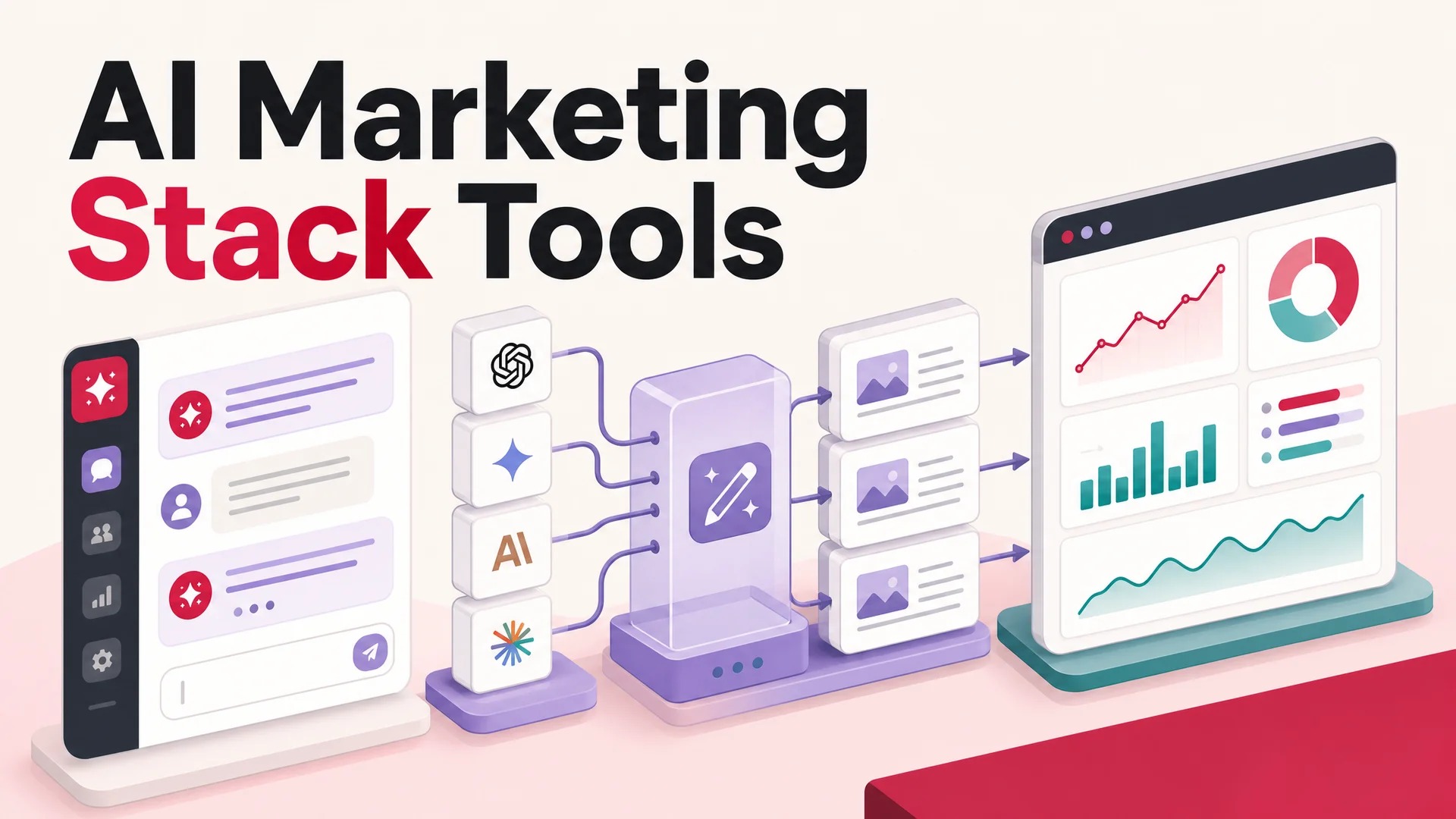
There is no single AI marketing tool that wins. There is an AI marketing stack, and the teams that pick three to five sharp pieces - a conversation layer, a content layer, a media layer, a measurement layer, and one or two specialists - are putting daylight between themselves and the teams still trying to find one platform to do everything.
Berrydesk is our pick for the conversation layer because that is where AI most directly touches revenue - every visitor who would have bounced is now a conversation, and every conversation is a chance to qualify, recover, or convert. The model choice across GPT-5.5, Claude Opus 4.7, Gemini 3.1, DeepSeek V4, Kimi K2.6, GLM-5.1, Qwen 3.6, and MiniMax M2.7 means you do not have to bet on which provider wins 2026; the agent picks per task.
If you are building or rebuilding your AI marketing stack this quarter, start with the layer that compounds: conversation. Launch your first Berrydesk agent free, point it at your docs and your help center, and watch which questions your visitors actually ask. The rest of the stack gets clearer once you can see the conversations.
 Berrydesk
Your AI marketing stack starts at the conversation layer
- Launch a branded support and lead-capture agent in under an hour.
- Route traffic across GPT-5.5, Claude Opus 4.7, Gemini 3.1, DeepSeek V4, Kimi K2.6, and more - pick the model per use case.
Set up in minutes

Chirag Asarpota is the founder of Strawberry Labs, the team behind Berrydesk - the AI agent platform that helps businesses deploy intelligent customer support, sales and operations agents across web, WhatsApp, Slack, Instagram, Discord and more. Chirag writes about agentic AI, frontier model selection, retrieval and 1M-token context strategy, AI Actions, and the engineering it takes to ship production-grade conversational AI that customers actually trust.