Cast your mind back to marketing the way it used to be. Whiteboards covered in sticky notes. A folder of half-finished copy decks. The Friday afternoon panic of trying to ship a campaign launch email before the weekend. Many of those rituals haven't disappeared, but the muscle behind them has. A modern marketing team that knows how to use AI well can compress a week of drafting, segmenting, and rewriting into an afternoon - and free up the rest of the week for the parts of the job that actually require taste.
The shift goes well beyond "ChatGPT writes my emails now." In 2026, the underlying models can hold a million tokens of context, plan across multiple steps, call APIs, and run autonomously for hours at a time. The question is no longer whether to use AI in marketing. It's how to use it without ending up with a content library full of generic, indistinguishable blog posts. This guide walks through the use cases that actually move the needle, the model landscape worth knowing about, and how to graduate from copy-paste prompting to a real, branded AI agent that lives on your site.
What AI Can Do for a Marketing Team in 2026
Before we get into specific plays, it helps to understand the raw materials. The frontier closed models - OpenAI's GPT-5.5 and GPT-5.5 Pro, Anthropic's Claude Opus 4.7, and Google's Gemini 3.1 Ultra - all handle long context, nuanced brand voice, and structured output reliably. Claude Opus 4.7 currently leads SWE-bench Pro at 64.3% for technical and engineering work, and Gemini 3.1 Pro tops GPQA Diamond at 94.3% for reasoning-heavy research tasks. Gemini 3.1 Ultra ships with a 2M-token context window, which means an agent can ingest your entire content library, brand guidelines, and a year of campaign data in one shot.
On the open-weight side, the cost story has changed completely. DeepSeek V4 Flash runs at $0.14 per million input tokens and $0.28 per million output tokens, with a 1M context window. Moonshot Kimi K2.6 can run agentic sessions for up to twelve hours and coordinate hundreds of sub-agents - useful if you're orchestrating a campaign rollout across many channels. MiniMax M2.7 lands at roughly 8% the price of Claude Sonnet at twice the speed. Z.ai's GLM-5.1 is MIT-licensed and beats GPT-5.4 and Claude Opus 4.6 on SWE-Bench Pro, which means open-source agents are now genuinely production-ready, not just demoware.
For a marketing team, that mix means you no longer have to pick one model and live with its quirks. You can route bulk drafting to a cheap fast model, send brand-critical writing to Claude Opus 4.7 or GPT-5.5, and reserve a long-context Gemini call for the rare moment you need to reason across your entire knowledge base.
1. Drafting copy that doesn't sound like everyone else's copy
AI models are good at copy. They are even better at first drafts of copy. Where teams get into trouble is treating the first draft as the final draft. The fix is structural: feed the model your own raw material - past high-performing campaigns, voice-and-tone guidelines, customer quotes, product specs - and ask it to produce variants you can edit, not finished assets you can ship.
Useful prompt shapes:
- "Using the brand voice document and the three high-performing emails below, write five subject-line variants for our Q2 retention campaign. Optimize for curiosity, not urgency."
- "Here is a product description and three customer interview transcripts. Pull the three most common reasons customers say they bought, and turn each into a 90-character ad headline."
- "Write a LinkedIn post announcing this feature. Match the rhythm of the three example posts below. No hashtags, no emojis."
The detail is what separates a usable draft from a generic one. A vague prompt gets you LinkedIn-flavored boilerplate. A prompt that hands the model your actual voice samples and customer language gets you something a senior writer can polish in ten minutes instead of starting from scratch.
2. Researching topics and outlining long-form content
Staring at a blank page is no longer a forced ritual. When you're not sure what to write about, a single prompt - "Give me twelve blog post angles for a project management tool aimed at engineering managers at Series B startups, ranked by likely search intent" - produces a list you can immediately critique and refine.
For outlining, the long-context models earn their keep. Drop your last twenty blog posts into a Gemini 3.1 Ultra or Claude Opus 4.6 (1M tokens at no surcharge as of 2026) prompt and ask it to identify gaps, redundancies, and cluster opportunities. You get a content map informed by what you've actually published, not a generic "10 SEO trends" list. From there, asking the model to draft a detailed outline with H2s, H3s, supporting points, and target keywords takes another minute.
The trick is to use the model as a research partner, not a ghost writer. Have it surface the angles. Have it pull stats from sources you provide. Have it stress-test your thesis. Then write the actual prose yourself, or hand the outline to a writer who has the context the model can't fake.
3. Building FAQs and knowledge base content
Support content is where AI marketing tends to quietly produce the most ROI. Every week, your support team answers the same fifteen questions in slightly different words. That's training data. Feed the conversation logs into a long-context model with a prompt like, "Cluster these 4,000 support emails into the top thirty topics, then for each topic write a 150-word knowledge base article in our brand voice using only information from the attached product docs."
What used to take a content marketer two months now takes an afternoon. The articles still need editorial review - and they should get it - but the bulk of the structural work is done. The same approach extends to release notes, getting-started guides, integration tutorials, and policy pages.
4. Email campaigns that actually feel personal
Personalization at scale has historically meant first-name merge tags. With current models, it can mean something closer to what the word actually implies. Give the model a customer segment definition, three behavioral signals, and a campaign goal, and ask it to draft variants tuned to each segment's likely objections and motivations.
Example: an e-commerce brand with three segments - recent purchasers, lapsed buyers from the last twelve months, and price-sensitive new visitors - can ask a model to write three sequence variants from the same offer. The lapsed-buyer email leans on what changed since their last purchase. The price-sensitive variant leads with a total-cost frame. The recent-purchaser version focuses on cross-sell. Same offer, three different stories, drafted in minutes. Send a small test, measure, iterate.
For subject lines, the play is volume plus filtering. Generate forty options, sort them by how distinct they are from your last twenty subject lines, and A/B the top eight. Most teams underuse this because they generate five and pick one.
5. Survey questions that produce useful answers
A survey is only as good as its questions. "How was your experience?" gets you "good" forever. AI helps here in two ways: it generates question variants you wouldn't have written, and it stress-tests the questions you already have for leading language, double-barreled phrasing, and ambiguous scales.
Try: "I want to understand why mid-market customers churn after their first renewal. Draft fifteen open-ended questions and ten Likert-scale items that surface the specific moment they decided to leave, without leading them toward a particular answer."
Run the draft past the same model with a follow-up prompt - "Critique these for leading language and survey fatigue" - and you'll usually get better self-edits than a junior researcher would catch on the first pass.
6. Video scripts and multi-format content
Video is a channel most marketing teams underweight because it's expensive to produce. AI doesn't make the camera work cheaper, but it absolutely lowers the cost of pre-production. A solid prompt - "Write a 90-second product launch script for our trading app aimed at first-time investors, hook in the first 3 seconds, three benefits, soft CTA at the end" - gives you something a creative director can react to instead of generate.
Even better, ask the model to produce the same idea across formats: a long-form blog post, a 90-second video script, a Twitter thread, three LinkedIn posts, an email, and a podcast outline. The work goes from "write six pieces of content" to "edit six drafts of one idea." Long-context models like Gemini 3.1 Ultra make this kind of multi-format generation trivially easy.
Picking the Right Model for the Right Job
A small but underrated marketing skill in 2026 is knowing which model to point at which task. A rough cheat sheet:
- Brand voice and high-stakes long-form: Claude Opus 4.7. Strong instruction following, excellent prose, holds nuance across long documents.
- Reasoning, research, and fact-heavy work: Gemini 3.1 Pro for raw GPQA-grade reasoning, Gemini 3.1 Ultra when you need the 2M-token context for full-corpus questions.
- Volume drafting and bulk variants: DeepSeek V4 Flash or MiniMax M2.7. Cheap enough to run thousands of variants without flinching.
- Agentic, multi-step campaign workflows: Kimi K2.6 or GLM-5.1, both built for long autonomous sessions and tool use.
- General-purpose creative work: GPT-5.5 remains the safe default when you don't want to think about it.
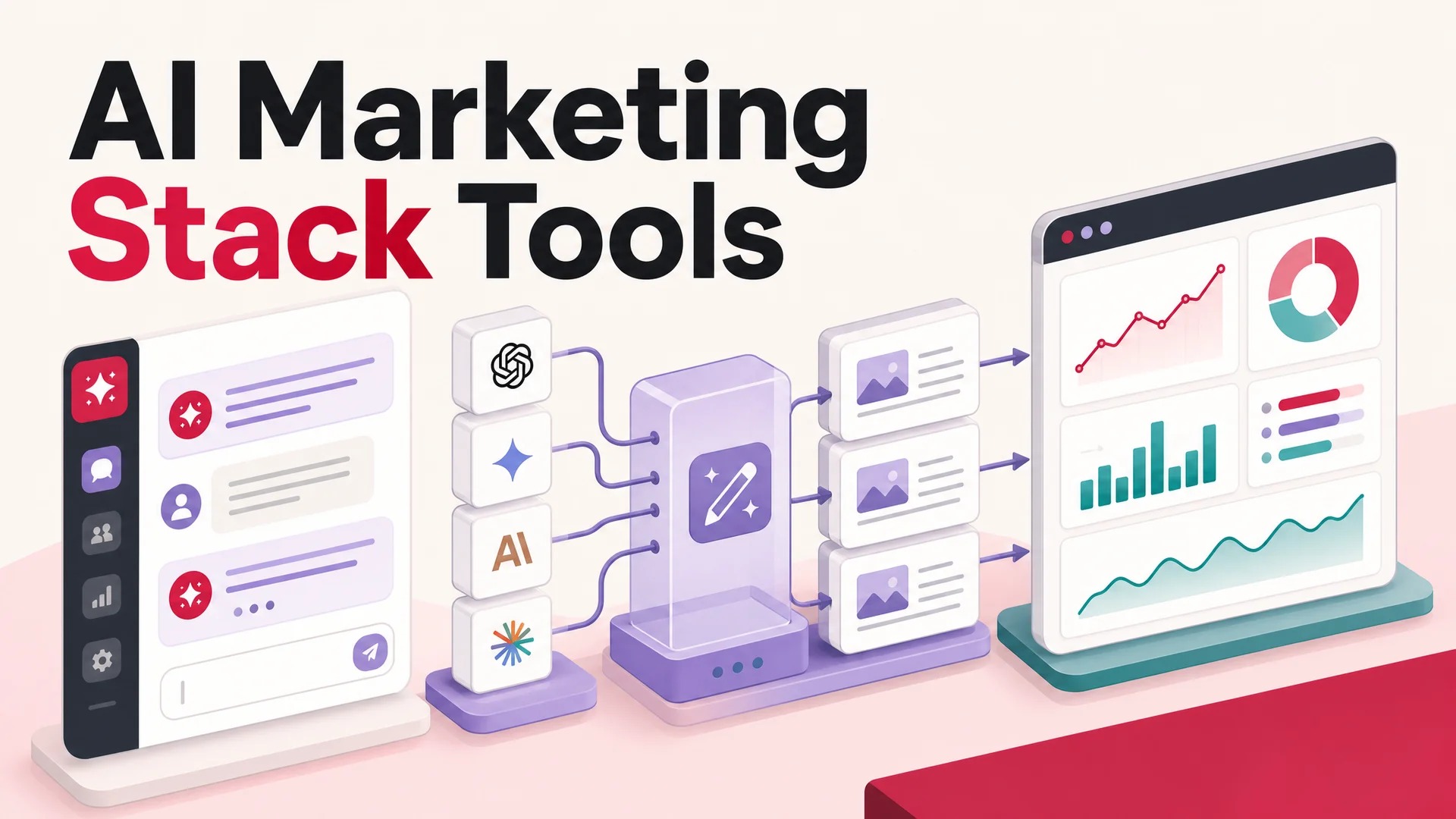
The teams getting the most out of AI marketing aren't the ones with access to a single great model. They're the ones who route work to the model that fits the task and stitch it all together with a layer that knows their brand, their data, and their customers.
Where Raw Chatbots Fall Short
This is the part most "use AI for marketing" guides skip past. A vanilla model - even a frontier one - has three structural limits that bite as soon as you try to use it for anything beyond drafting.
It doesn't know your business. The model has read the public internet up to its training cutoff. It hasn't read your internal style guide, your last six months of customer interviews, your product roadmap, or the Slack thread where your VP of marketing decided you don't say "leverage" anymore. Without that context, every output reverts to a kind of bland industry mean.
It can't take action. A model can draft an email. It can't send the email, log the result in your CRM, route the lead to the right rep, or follow up in three days if the prospect doesn't reply. The gap between "produced text" and "moved a number" is where most AI marketing experiments quietly stall.
It doesn't remember. Each conversation starts from zero. Without an external memory layer, the model can't learn that this customer has asked about pricing twice, hated last month's webinar, and prefers Slack to email.
These aren't failings of the model. They're missing layers around it.
From Prompting to Production: Branded AI Agents with Berrydesk
The next step up from "I use ChatGPT to draft my emails" is "I have an AI agent on my site that talks to every visitor, knows my product, and can actually take action." That's what Berrydesk is built for.
Berrydesk gives you a four-step path from idea to live agent. You pick a model - GPT-5.5, Claude Opus 4.7, Gemini 3.1, DeepSeek V4, Kimi, GLM, Qwen, MiniMax, or any of the other frontier and open-weight options - based on the trade-off between cost, latency, and capability you care about. You train the agent on your real material: documentation, your website, Notion workspaces, Google Drive folders, YouTube videos, anything where your knowledge actually lives. You brand the chat widget so it feels like part of your product, not a bolted-on AI badge. And you ship it to wherever your customers are: your website, Slack, Discord, WhatsApp, and more.
The piece that turns this from a chatbot into a marketing teammate is AI Actions. An agent that can only talk is a research tool. An agent that can book a demo, take a payment, look up an order, send a follow-up email, or update a CRM record is a teammate. Models like Claude Opus 4.7, Kimi K2.6, GLM-5.1, and Qwen3.6 are good enough at tool use that these flows are reliable in production, not just impressive in a demo.
A concrete scenario: an online course platform deploys a Berrydesk agent on its homepage. A visitor lands from a Reddit thread about machine learning. The agent greets them, asks about their background and goals, recommends a specific bundle, surfaces a relevant testimonial, answers three questions about prerequisites, books a 15-minute call with the founder if they're enterprise, and processes the payment if they want to enroll directly. Every interaction gets logged. Every objection gets fed back into the next round of training. The agent doesn't get tired, doesn't go on vacation, and doesn't forget the brand voice halfway through a long conversation.
For regulated industries, the open-weight side of the landscape unlocks a path that didn't exist a year ago. MIT-licensed models like GLM-5.1 and Qwen3.6-27B, plus Apache-licensed weights from Xiaomi's MiMo-V2, mean you can run a frontier-grade agent on your own infrastructure or in an air-gapped environment if compliance demands it.
Common Pitfalls to Watch For
A few patterns reliably go wrong when teams ramp up AI in marketing.
Treating the first draft as final. Models are confident, fluent, and often plausible-sounding while being subtly wrong about your product. Always edit. Always fact-check anything specific to your business.
Generic prompts, generic output. The single biggest predictor of useful AI output is the quality and specificity of the context you provide. A two-line prompt gets a two-line-prompt-quality answer. A prompt with brand voice samples, customer quotes, and a clear job-to-be-done gets something usable.
Ignoring routing and cost. Running everything on Claude Opus 4.7 or GPT-5.5 is the AI equivalent of paying for premium economy when most of your trips are between adjacent cities. Open-weight models like DeepSeek V4 Flash or MiniMax M2.7 handle the bulk of marketing drafting at a fraction of the cost.
Confusing content production with content strategy. AI is excellent at producing more content faster. It's not a substitute for knowing what you should be writing about, who you're writing for, and why anyone should care. The teams that win in 2026 are the ones who treat AI as leverage on a clear strategy, not a replacement for one.
Skipping the action layer. Drafting more emails doesn't grow revenue. Sending the right emails to the right people at the right time, and following up automatically, does. If your AI marketing stack stops at "we have a model that writes well," you're leaving most of the value on the table.
Where to Start
If you've been using AI for marketing as a glorified writing assistant, the upgrade path is clear. Pick one workflow - your support FAQ, your email sequences, your top-of-funnel ad variants - and build a real loop around it. Train an agent on your actual data. Hook it into the systems that matter. Measure whether it moves a number, not whether it produces words.
When you're ready for that next step, Berrydesk gives you the model choice, the training pipeline, the branded widget, the AI Actions, and the deployment surface to go from prompting in a chat window to running a real AI teammate on your site, your Slack, and wherever your customers show up. Build your first agent for free and see what happens when AI stops being a draft generator and starts being part of your team.
 Berrydesk
Turn AI from a writing tool into a marketing teammate
- Train an agent on your docs, site, and Notion in minutes
- Pick GPT-5.5, Claude Opus 4.7, Gemini 3.1, DeepSeek V4, or any model
Set up in minutes

Chirag Asarpota is the founder of Strawberry Labs, the team behind Berrydesk - the AI agent platform that helps businesses deploy intelligent customer support, sales and operations agents across web, WhatsApp, Slack, Instagram, Discord and more. Chirag writes about agentic AI, frontier model selection, retrieval and 1M-token context strategy, AI Actions, and the engineering it takes to ship production-grade conversational AI that customers actually trust.