A B2B support day rarely fits a tidy script. At 9 AM you're walking a new admin through SSO setup before their company-wide rollout. By 11:30 you're three messages deep into a shared Slack channel, helping a developer untangle a webhook signature mismatch. Lunch gets interrupted by a finance contact who needs a custom invoice reissued before quarter close. After that, a 30-minute call with a product lead at a Series C customer who wants a preview of the feature your team is shipping next sprint.
Tomorrow looks nothing like today. You'll triage feedback from a private community, line up a regression test with engineering before a key customer's launch, and quietly defuse a CSAT-threatening incident with a customer whose own customers are watching them.
That is B2B customer service in practice. It is not a queue. It is a portfolio of long, layered relationships where the people you support are themselves accountable to other people. One incident affects a roadmap. One stalled reply affects a renewal. One thoughtful save earns you a reference customer for the year.
The surface looks like support. What sits underneath is closer to operations, product, and account strategy braided together - and increasingly, an AI agent layer doing the connective tissue work that used to fall through the cracks.
What B2B customer service actually means
B2B customer service is the continuous work of helping other businesses succeed with your product or service over a long, often multi-year arc. Where B2C support tends to optimize for high-volume, low-context resolutions - refund this order, reset that password - B2B support is high-context and low-tolerance. Each account is a small ecosystem of stakeholders, each with their own success criteria.
In a B2B motion, your job is rarely "close the ticket." It is closer to:
- Helping admins, end-users, and integrators all get value from the same product, in different ways and on different timelines.
- Solving issues whose blast radius extends far beyond the person typing the message - a single broken sync at one of your customers may freeze hundreds of their own customers.
- Aligning across your sales, product, and engineering teams so an answer in support is consistent with what was promised in the deal and what's on the roadmap.
- Earning renewals, expansions, and references - the metrics that quietly fund the rest of the business.
Every touchpoint counts toward the customer's mental model of you. A two-line email at midnight that unblocks a release matters more than a polished QBR deck the next month. The work is part onboarding specialist, part product consultant, part relationship manager. None of it is optional.
Skills that separate good B2B support teams from great ones
In B2B, "be friendly and respond quickly" is the floor, not the bar. The accounts you serve sign multi-year agreements, depend on you for revenue-critical workflows, and compare you to specialist teams they could hire instead. Below are the seven capabilities that the best teams develop intentionally.
1. Strategic thinking
A great B2B support rep is fluent in the customer's underlying objective, not just the symptom in front of them. The question is not "how do I unblock this user?" but "what are they actually trying to ship, and what is the cleanest path to it given what our product can do today?"
That mindset reshapes everything downstream. You suggest a workaround that survives next quarter's redesign, not the duct-tape fix. You loop in a product manager when three accounts ask for the same gap in a week. You document the workaround so the next rep does not relearn it. The artifact of strategic thinking is fewer repeat tickets, not more clever ones.
2. Stakeholder management
In a B2C ticket you usually have one person on the other end. In B2B you almost never do. There is the daily user who feels the pain. The admin who configured the integration. The economic buyer who signed the contract. Sometimes legal, IT, security, finance, and procurement all want to weigh in.
Each role has different priorities and a different vocabulary. A security questionnaire from the IT contact and a "can we get this fixed before our board meeting?" from the buyer are the same incident, and they need the same underlying truth, but they need it framed completely differently. Knowing which signal to send to which stakeholder, on which channel, at which moment is one of the highest-leverage skills in B2B support.
3. Technical fluency
B2B products are dense. APIs, webhooks, OAuth scopes, role-based permissions, data residency, sandbox vs. production environments, SSO edge cases, rate limits, retry semantics - these come up in normal tickets, not edge cases.
You do not have to write production code to be technically fluent. You do have to read a stack trace without flinching, understand the difference between a 401 and a 403, and know enough about your customer's stack to ask the right clarifying question on the first reply. Teams that invest in technical fluency cut their time-to-resolution dramatically because they stop pinging engineering for context that a careful re-read of the logs would have surfaced.
4. Communication that creates control
In B2B, the goal of communication is not just clarity - it is the felt sense, on the customer's side, that someone is in control. Customers want to know that the issue is logged, owned, scoped, and on a known path to resolution. Silence reads as "they forgot about us," and forgotten customers churn.
That means proactive updates even when there is nothing new ("still investigating, next update at 4 PM your time"), well-documented final solutions the customer can paste into their internal incident write-up, and honest framing when something is genuinely uncertain. A small handwritten note or a follow-up message after a hard incident - "I know that one cost your team a weekend, here's what we changed so it does not happen again" - is the kind of detail that converts a frustrated customer into a multi-year reference.
5. Empathy under pressure
B2B customers are not just upset for themselves. They are upset because they are accountable to their own customers, their own boss, and their own quarterly numbers. The CSM at the SaaS company who paged you at 11 PM is not being dramatic - their CTO is asking them every 20 minutes when it will be fixed.
Empathy in B2B is operational, not emotional. It is matching the customer's urgency, communicating in the cadence they need, and making it visible that you understand the downstream cost of the problem. Politeness without urgency reads as oblivious. Urgency without politeness reads as panic. The blend is the craft.
6. Product mastery
B2B customers ask harder questions than the documentation alone can answer. They want to know how two features interact at scale, where the edge cases live, how a behavior will change in the next release, and whether a workaround they invented is supported.
Top reps know the product the way a senior engineer knows their own service: not just the happy path, but the failure modes, the historical baggage, and where the bodies are buried. And when they don't know - they know exactly which engineer or PM to pull in, how to brief that person in two sentences, and how to come back to the customer with an answer the same day.
7. Reliability and follow-through
B2B is a long game played in small reputational increments. One missed callback, one unanswered Slack thread, one promise to "circle back next week" that quietly dies - each one chips away at trust that took months to build. The teams that retain best are the ones their customers never have to chase.
That reliability is mostly a systems problem dressed up as a discipline problem. Tickets that auto-surface when they go cold, callbacks that land on a calendar instead of a sticky note, post-incident summaries that go out without anyone having to remember to write them. Build the rails, and "reliability" stops being a personality trait and starts being a property of your team.
Seven ways to actually improve B2B customer service
Improvement in B2B support is not about scripts or smiles. It is about building systems that scale trust, compress response time, and surface signal back into product and sales without anyone having to chase it. Here is what the highest-leverage moves look like in 2026.
1. Put modern AI agents on the front line
The biggest shift in the last twelve months is that AI agents have crossed the line from "deflection tool" to "reliable Tier 1 - and a competent Tier 1.5." A 2024-era support bot could match a question to an FAQ. A 2026-era agent can read your full knowledge base in-context, reason about a multi-step problem, take an action against your backend, hand off cleanly to a human with full context attached, and continue learning from every conversation.
The capability jump is not marketing - it is downstream of three concrete model changes. Frontier closed models like Claude Opus 4.7 (64.3% on SWE-bench Pro) and GPT-5.5 Pro now reason reliably enough to handle multi-step troubleshooting that used to require a human. Long-context models like Claude Opus 4.6 and Sonnet 4.6 (1M tokens, no surcharge) and Gemini 3.1 Ultra (2M tokens) can hold an entire help center, the customer's full conversation history, and your policy documents in a single context - RAG becomes a tuning lever rather than a hard requirement. And open-weight frontier models like DeepSeek V4 Flash ($0.14 / $0.28 per million input/output tokens), MiniMax M2.7, Z.ai's GLM-5.1, and Alibaba's Qwen3.6-27B make it economically realistic to route most routine traffic through an AI agent at fractions of a cent per resolution, while reserving the closed frontier models for the genuinely hard escalations.
A modern AI agent for B2B support can:
- Walk a customer through a complex troubleshooting tree. Not "here are the docs." More like "your webhook is failing because your endpoint is returning a 301 - that is almost always a missing trailing slash on your route. Here's the exact line to change in Express."
- Take real actions, not just answer questions. File a ticket pre-populated with the conversation transcript, error logs, and customer plan. Look up an order. Issue a refund within policy. Trigger a webhook to page the on-call engineer. Book a follow-up call on the right CSM's calendar. This is the AI Actions layer, and it is where most of the time savings actually come from.
- Hand off to a human with the full context attached. When the agent decides - or the customer asks - to escalate, the human inherits a clean summary, the customer's account state, and the steps already tried. No more "can you re-explain everything to a new person?"
- Carry context across channels and time. A conversation that starts in your in-app widget, continues in Slack Connect, and ends in email should be one conversation, not three. The same goes for a follow-up two weeks later about the same issue.
This is exactly where Berrydesk fits. You pick the model that matches your traffic profile - DeepSeek V4 or MiniMax M2 for the volume of routine work, Claude Opus 4.7 or GPT-5.5 for the hard tickets, or a routed mix of both. You train the agent on your docs, help center, Notion, Google Drive, YouTube walkthroughs, and crawled product pages. You wire AI Actions into the systems that matter - Stripe, your CRM, your ticketing tool, your internal APIs. And you deploy across the website widget, Slack, Discord, WhatsApp, and email without rebuilding any of it. Most teams ship a working agent the same day they sign up.
2. Build a customer-facing culture, not a support silo
In high-performing B2B companies, customer service is not a department - it is a behavior the whole company exhibits. When your sales reps follow up after the deal closes to make sure onboarding actually landed, when your product manager joins a customer's QBR and listens before pitching, when an engineer drops into the support Slack channel with a workaround for a customer who is mid-incident - that is what a customer-facing culture looks like in motion.
A small example. A SaaS PM who attends a quarterly review at a mid-market customer hears the same friction surface three times in 40 minutes. That single hour reshapes the next sprint better than any spreadsheet of feature requests would. A salesperson who reviews recurring support tickets for an account spots an upsell opportunity that the customer was about to raise themselves. None of this is heroics - it is just the natural consequence of putting the people who build, sell, and ship the product in regular contact with the people using it.
The companies that get this right tend to share a small set of habits: every team is expected to spend a few hours a month talking to or reading transcripts from real customers, support data is reported alongside product and revenue data in company reviews, and there is no internal status hierarchy that places "talking to customers" beneath "shipping features."
3. Listen, then close the loop
Feedback is worthless if it dies in a spreadsheet, and worse than worthless if customers tell you something three times before they realize you are not actually listening. The fix is not "collect more feedback" - most B2B teams already drown in it. The fix is routing.
Tag tickets with structured categories the moment they come in. Separate "feature request" from "bug" from "documentation gap" from "unclear pricing." Route each category to the team that can act on it. Summarize themes weekly, not yearly. When a recurring complaint about onboarding crosses a threshold, it should land on the head of product's desk automatically, not wait for the next QBR.
Then close the loop. The single most underrated B2B retention move is telling customers, by name, when something they asked for actually shipped - even if it took six months. "You flagged this in March. We just deployed it. Here's how to turn it on." That message is worth more than any NPS survey will ever capture, because it proves something a survey only asks about: that you actually listen.
Modern AI agents help here in a quiet but compounding way. Because every conversation passes through the agent, themes surface in days instead of quarters. A Berrydesk agent that fields 5,000 conversations a month is also, almost as a side effect, the most accurate listening device your company has.
4. Make self-service serious
Self-service in B2B has to do more than link to an FAQ. Your customers are trying to ship board-level things - "sync our CRM data before the QBR on Thursday" or "spin up isolated environments for our pre-prod and prod teams before our compliance review." A help center built for "where do I reset my password?" will not survive contact with that.
The teams that get self-service right tend to do all of the following:
- Keep docs ruthlessly current. A UI redesign without updated screenshots is a churn driver. Treat docs as a release artifact, not an afterthought.
- Organize around jobs to be done, not the product's internal structure. Customers do not think in terms of your modules; they think in terms of what they are trying to accomplish.
- Add short, focused video walkthroughs. Two minutes on "how to export invoices for accounting" is worth ten support emails per month, every month, forever.
- Embed an AI agent into the help center itself. With Berrydesk, your agent can answer in plain language, cite the exact section of the doc it is drawing from, link the next step, and escalate cleanly when it detects frustration or urgency in the customer's wording. Long-context frontier models - Gemini 3.1 Ultra at 2M tokens, Claude Opus 4.6 at 1M - mean the agent can hold every doc, runbook, and recent conversation in-context and still respond in seconds.
A grounded example: a customer types "how do I connect our Salesforce sandbox?" into your help center search. Instead of returning ten documents and hoping, the agent surfaces the specific subset of the integration guide that applies to sandbox connections, calls out the gotcha around OAuth scopes, and offers to generate a checklist their admin can follow. If the customer's tone shifts toward urgency - a deadline, a threat to escalate, a frustrated question - the agent quietly routes the conversation to a human with the full transcript attached.
5. Meet customers on their channels, not yours
B2B users do not live on your website. They live in Slack with their team, in Microsoft Teams with their company, inside your product, in email, on LinkedIn, and increasingly in shared channels with you. Great support shows up where they already are.
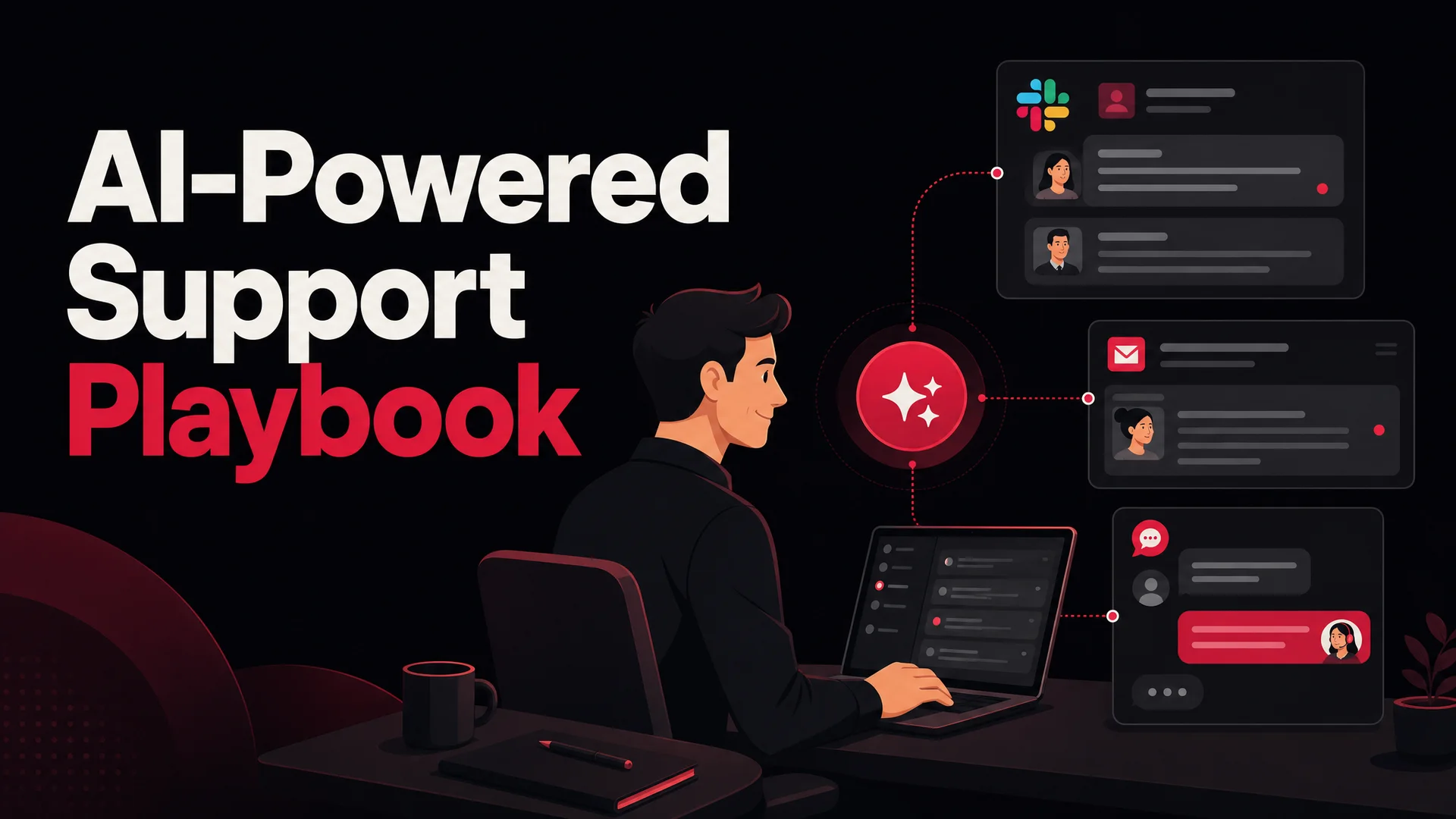
Picture a shared Slack channel with a mid-market customer. A developer pings, "anyone seeing the rate limit fire on /v1/sync this morning?" An omnichannel agent connected to that channel can reply in seconds with a status check, an explanation, and an open ticket - and log the entire exchange to your support system and CRM. The customer gets an answer in their tool. Your team gets the audit trail in theirs. No one had to choose.
Or imagine a new admin opening your in-app sidebar two days into onboarding. They start typing a question. The agent surfaces the exact help doc, walks them through the configuration, and quietly schedules a 15-minute check-in with their CSM for next week. No tab-switching. No hand-off cliff. No lost context.
Berrydesk deploys across the website widget, Slack, Discord, WhatsApp, and email out of the same configuration, so the experience is genuinely one conversation across surfaces - not five disconnected ones glued together by a shared logo.
6. Pick tools that scale with the shape of your business
Early-stage B2B teams need an AI agent that can handle the long tail of repetitive questions: "where is my invoice?", "how do I invite a teammate?", "is there an SSO option on this plan?" That alone can reclaim a third of a support team's week.
But the tooling has to grow with the company. As you scale you start needing:
- Role-based routing so finance questions go to billing, security questions to your IT lead, and developer issues to engineering, without humans triaging each one.
- Custom AI Actions wired into your internal APIs so the agent can quote a renewal, look up a customer's plan, generate a usage report, or reset an environment without a human on the path.
- Conversation analytics with sentiment, themes, and trend detection so you spot a pattern in week one instead of quarter three.
- Native integrations with HubSpot, Salesforce, Slack, Intercom, Zendesk, and your data warehouse so support context flows into the systems where revenue and product decisions actually get made.
Berrydesk is built for that arc. You can start with a single agent on a help page and grow into a multi-channel, multi-action, multi-model deployment that routes routine questions to a low-cost open-weight model and reserves the closed frontier for hard escalations - without rebuilding the agent every time you add a channel or a tool.
7. Watch out for the common pitfalls
Even teams that get the strategy right often stumble on the same handful of operational mistakes. A short list, in rough order of how often we see them.
Treating the AI agent as launch-and-forget. A support agent is a product, not a project. The first version will have gaps. Track unanswered questions, low-confidence answers, and conversations that escalated unnecessarily, and feed those back into training and configuration weekly for the first quarter, then monthly after that.
Picking one model for everything. A single-model deployment either overpays for routine traffic or underpowers your hard tickets. The cleaner pattern in 2026 is routed: send high-volume, low-stakes queries to an open-weight model like DeepSeek V4 Flash or MiniMax M2 at a fraction of a cent each, and reserve Claude Opus 4.7 or GPT-5.5 Pro for the conversations where reasoning quality is the difference between a save and a churn.
Letting AI Actions drift out of policy. Giving an agent the ability to issue refunds, change plans, or reschedule renewals is leverage; it is also risk. Define the policy boundaries upfront, log every action, and have a human review sample every week for the first month. After that, sample monthly.
Forgetting the escalation craft. The hand-off from agent to human is where most "AI support" experiences fall apart. Make sure the human inherits the full transcript, the customer's account context, and a short summary of what was already tried. Customers tolerate AI on the front line as long as the human moment, when it comes, is excellent.
Ignoring data residency and air-gap requirements. In regulated industries - healthcare, finance, public sector, parts of EMEA - closed frontier APIs are off the table. The good news is that 2026 has real options here: GLM-5.1 (MIT license), Qwen3.6-27B (Apache 2.0), and Xiaomi MiMo-V2 (MIT) are all open-weight, frontier-quality, and deployable on-prem or in an air-gapped environment. If you have ever lost a deal over "we can't send our data to OpenAI," that constraint just got dramatically easier to solve.
Smarter, faster, sharper - and built to last
Great B2B customer service is not really about a help desk or a chatbot. It is about how your company shows up across every touchpoint of a relationship that, if you do this right, will outlast several leadership changes on both sides.
It is how fast you respond when a mid-market customer's billing breaks the day before their board meeting. It is how clearly you guide a startup through their first webhook implementation. It is how consistently your team turns recurring feedback into actual roadmap items and tells the customer when those items ship. It is how reliably an AI agent answers the easy 60% so your humans can spend their time on the 40% that genuinely needs them.
If your B2B support today feels reactive, scattered across tools, or too dependent on the same three senior reps to keep accounts from churning - there is a more durable way to build it. Berrydesk gives you the building blocks: pick a model (or a routed mix) that fits your cost and quality profile, train an agent on your full knowledge base, brand the widget, wire up AI Actions for the work that used to require a human, and deploy across every channel your customers already use.
Whether you are a five-person SaaS team trying to hold a service standard your competitors cannot match, or a scaling B2B platform looking to stop hiring linearly with ticket volume, the goal is the same: a support experience that feels fast, accurate, and unmistakably human in the moments where it has to be.
Try Berrydesk and see how much of your support load a 2026-grade AI agent can quietly take off your team's plate - and how much sharper the work that's left becomes.
 Berrydesk
Launch your B2B support agent in an afternoon
- Train Berrydesk on your docs, Notion, Drive, and product walkthroughs in minutes
- Wire up AI Actions for tickets, billing lookups, and escalations across web, Slack, and WhatsApp
Set up in minutes

Chirag Asarpota is the founder of Strawberry Labs, the team behind Berrydesk - the AI agent platform that helps businesses deploy intelligent customer support, sales and operations agents across web, WhatsApp, Slack, Instagram, Discord and more. Chirag writes about agentic AI, frontier model selection, retrieval and 1M-token context strategy, AI Actions, and the engineering it takes to ship production-grade conversational AI that customers actually trust.