If you sell into other businesses, the inbox never sleeps. Procurement managers ping you about contract clauses at 11 p.m. their time. Implementation leads file urgent tickets the morning of a go-live. Channel partners drop the same five onboarding questions into Slack every quarter. The volume is not the problem - most of it is repeat work that your strongest people should never touch. The problem is that, traditionally, the people answering have been the same ones running discovery calls, writing renewal proposals, and shepherding a $400,000 deal across the line.
That is the gap AI support agents are now closing for B2B companies. They no longer feel like the deflection bots of three or four years ago. With frontier models such as Claude Opus 4.7, GPT-5.5, and Gemini 3.1 Ultra now reasoning across million-token contexts, and open-weight competitors like DeepSeek V4, GLM-5.1, and Kimi K2.6 driving the cost of a routine resolution toward fractions of a cent, a well-built agent can carry the bottom 70% of partner and account traffic without your team noticing. That frees humans to do what humans are uniquely good at in B2B: the high-trust, high-context work that closes and renews business.
By mid-2026, AI-powered support agents are quietly the default front door for most mid-market and enterprise B2B websites. The interesting question is not whether to deploy one, but how to choose, scope, and integrate it so it actually compounds value instead of becoming another tool collecting dust in your stack.
Why B2B is a different problem than B2C
A consumer chatbot answering "where is my order?" is solving a one-shot question against a small data envelope. A B2B agent rarely is. It usually has to:
- Recognize which company the user belongs to, what tier of contract they sit on, and which features they have access to.
- Pull from technical documentation, integration guides, API references, contract terms, and account-specific configuration - often spanning thousands of pages.
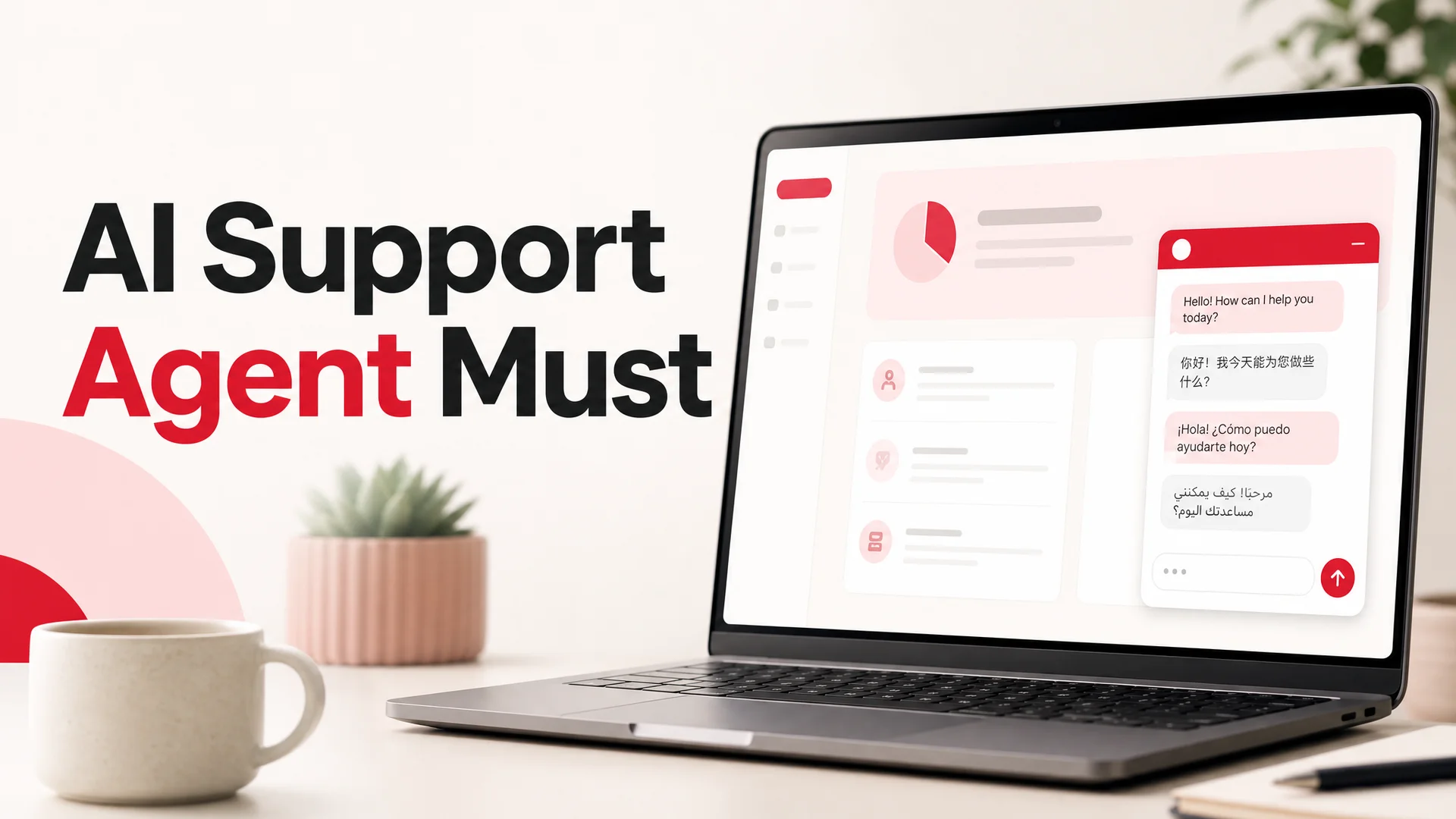
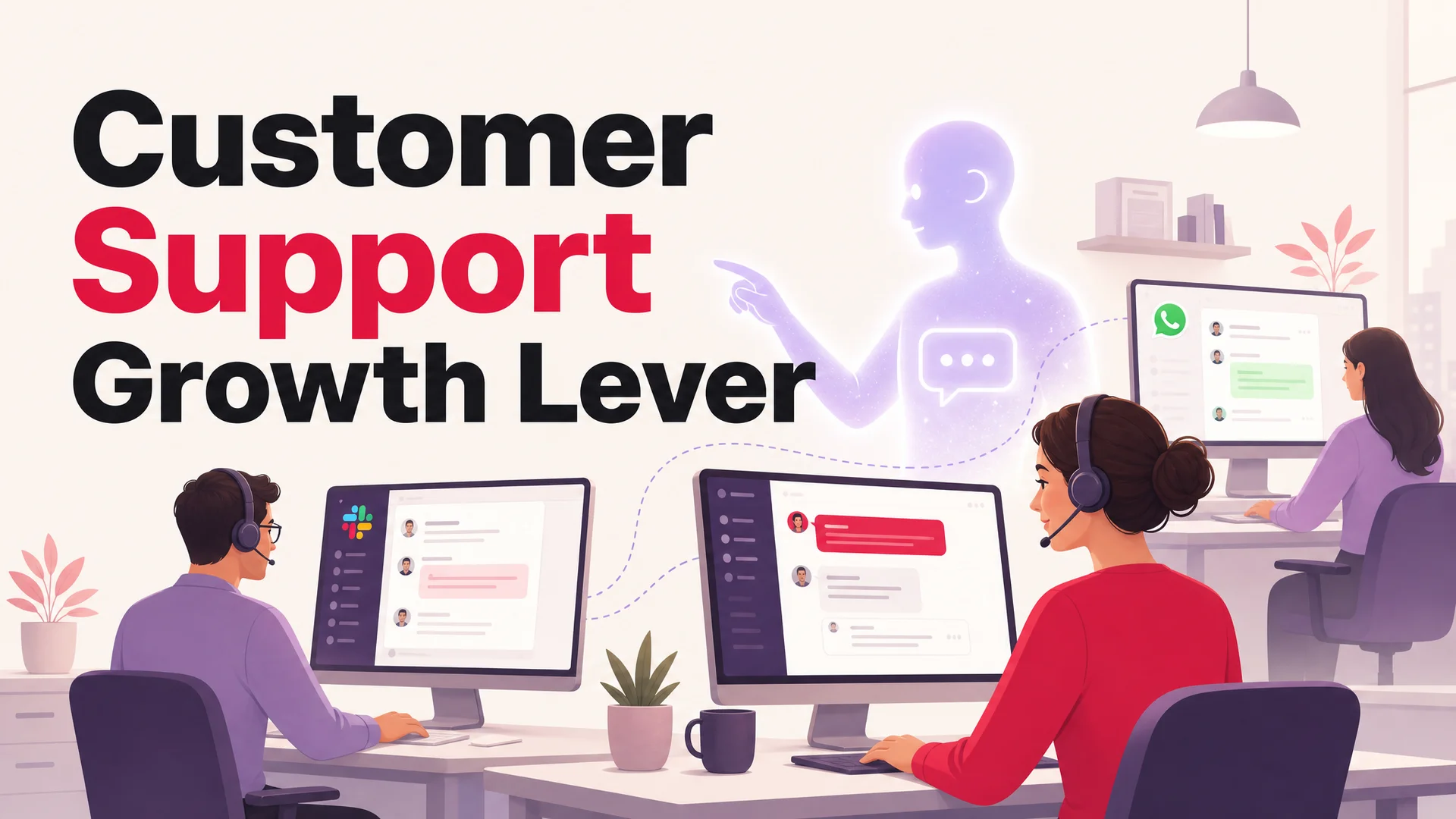
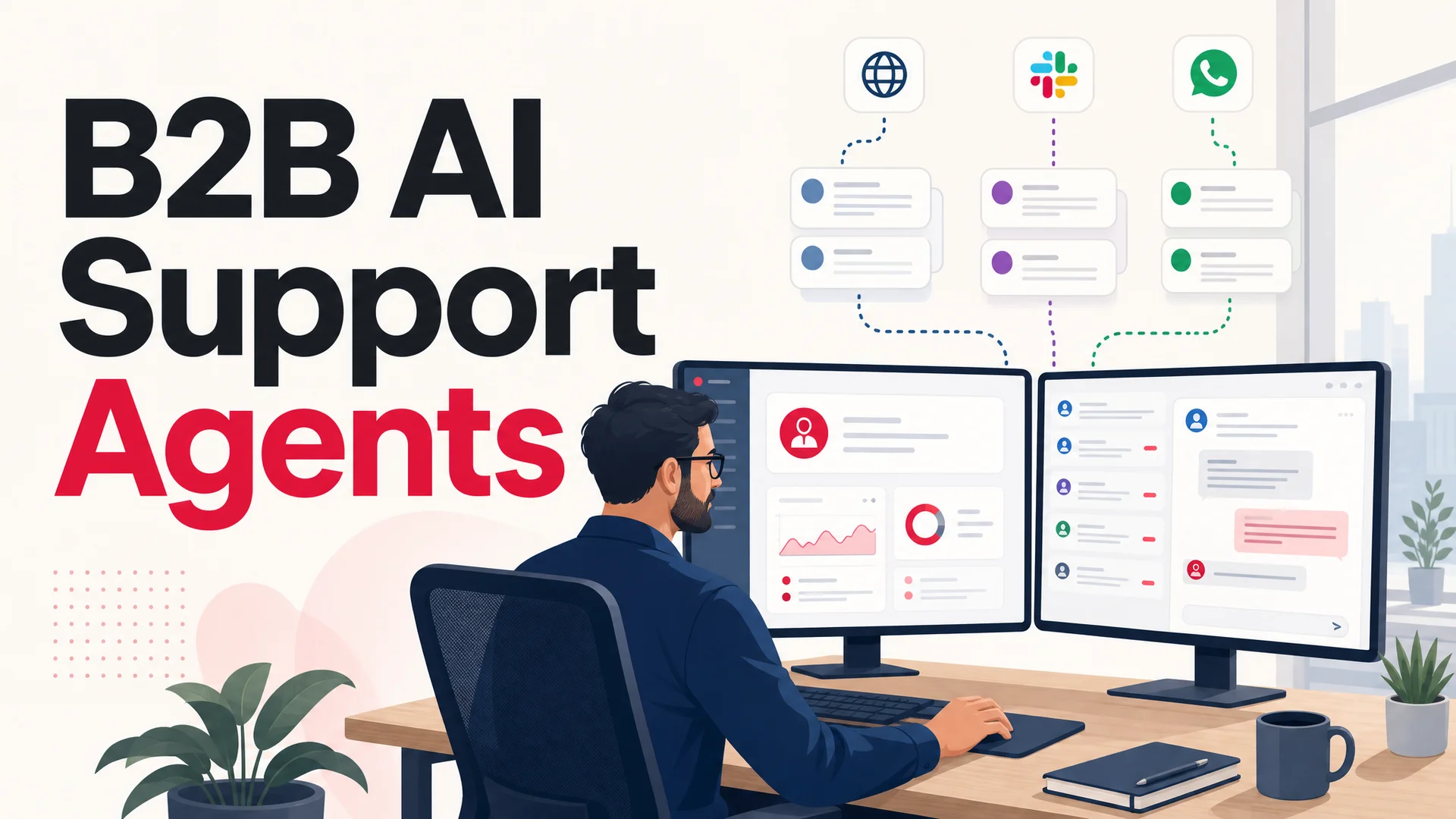
- Speak across multiple channels in parallel: a public chat widget for prospects, a Slack Connect channel for live customers, WhatsApp for international partners, and email for procurement.
- Hand off cleanly to the right human - account manager, support engineer, or solutions architect - and bring them the conversation history they need.
The bar is higher. The good news is that the latest generation of models is finally tall enough to clear it. Long-context reasoning means an agent can hold an entire customer's contract, integration spec, and last six months of tickets in working memory while it answers. Tool-use reliability means that an agent can do real work - pull invoices, schedule a sync, open a Jira ticket - instead of pretending to. That is the version of B2B AI that is worth deploying.
Why B2B teams are reaching for AI agents in 2026
The macro trend is straightforward: AI agents have crossed the line from novelty to infrastructure. Three things changed in the last twelve months that pushed adoption from "the marketing team is experimenting" to "this is in our budget."
Models got dramatically better at the things B2B requires. Long context, tool use, and accurate citation of source material. Claude Opus 4.7 leads SWE-bench Pro at 64.3% and is, in practice, the model most teams reach for when an agent needs to reason carefully across a dense knowledge base. Gemini 3.1 Ultra ships with a 2M-token context window, meaning an agent can hold an entire customer's account history, contract, and product manual in working memory without an elaborate retrieval pipeline. GPT-5.5 Pro adds parallel reasoning that pays off whenever an agent needs to consider multiple paths before answering.
The cost story flipped. Open-weight frontier models from DeepSeek, Z.ai, Moonshot, MiniMax, Alibaba, and Xiaomi have collapsed the per-resolution cost of routine traffic. DeepSeek V4 Flash runs at $0.14 per million input tokens and $0.28 per million output - the kind of pricing that makes "let the agent answer everything it can" a defensible default rather than a finance conversation. MiniMax M2 sits at roughly 8% the cost of Claude Sonnet at twice the speed. The economics for B2B support, where ticket volume and response length are both modest, are now genuinely favorable.
Agentic tool use became reliable. Kimi K2.6, GLM-5.1, and Qwen3.6 made AI Actions work in production. An agent that can confidently look up an order, generate a quote, schedule a meeting, or trigger a refund - and do so without hallucinating the wrong endpoint - is a different product than a 2024-era FAQ bot. That single capability shift is what turns an AI agent from a deflection tool into a revenue tool.
The market data tracks the technical shift. By Statista's enterprise AI tracking, the share of B2B marketing teams using AI agents in some form has climbed past 60%, with the largest reported gains in lead qualification and post-sale support. Statista has also reported that a clear majority of US B2B marketers running chatbots saw measurable lifts in qualified pipeline - with a meaningful slice landing 30% or more incremental volume after deployment. The teams seeing the biggest lift are not the ones who plugged in a generic widget; they are the ones who trained an agent on their actual product, connected it to their CRM, and let it do real work.
Six places AI agents earn their keep in B2B
1. Always-on coverage for accounts on different clocks
In B2B, your customers are rarely in the same time zone as your support team. A procurement lead in Singapore needs an answer at 10 AM local; your support team in Austin will not see that message for nine hours. Multiply that across a few hundred accounts and you have a measurable revenue leak.
Picture the scenario every account team has lived through. A US-based logistics platform's biggest European customer hits a critical integration error at 2 a.m. local. Their warehouse runs on your APIs. The next eight hours of inactivity translate into missed deliveries and a Monday morning escalation call you do not want.
A modern B2B agent can hold that line. It recognizes the customer, parses the error code from the message, queries your status page and recent deploys, surfaces the matching runbook, and walks the on-call engineer at the customer through the recovery steps. If the issue is genuinely novel, it captures everything - error logs, account context, attempted fixes - and pages the right human with a clean handoff brief instead of a one-line "client is angry" Slack ping.
The mechanic that makes this work in 2026 is two-fold. First, agentic tool-use models like Claude Opus 4.7, Kimi K2.6, and GLM-5.1 - the latter posting 58.4 on SWE-Bench Pro and built around an eight-hour autonomous plan-execute-test-fix loop - can chain multiple system calls reliably enough to actually triage a real incident. Second, with 1M-token context windows now standard on Claude Sonnet 4.6 and DeepSeek V4 Flash, the agent does not have to forget what it learned three messages ago. The customer feels heard, not pinged-ponged.
2. Continuous account intelligence, not one-off surveys
In B2B, knowing what your customer thinks is the difference between a healthy renewal and a quiet churn. The traditional methods - quarterly business reviews, NPS sweeps, customer advisory boards - are useful but slow. By the time a CSM hears about a problem, it has often been festering for weeks. B2B customers are also over-surveyed; asking them to fill out yet another NPS form is a tax on the relationship.
An AI agent sitting in your support flow is, effectively, an always-on listening post. Every conversation is a structured signal. With sentiment analysis baked into modern reasoning models, the agent can flag rising frustration before it boils over. With native multimodal understanding from models like Gemini 3.1 Ultra, screenshots and short Loom recordings shared in chat become parseable data, not opaque attachments. And because the agent can be wired to your CRM, the patterns surface where they belong: in account health scores, renewal forecasts, and product feedback dashboards.
What this changes day-to-day is the kind of insight you can act on. Recurring questions about a poorly documented webhook show up as a documentation gap, not a vague "support volume is up." Sudden spikes in friction language from a strategic account get routed straight to the account team. Feature mentions in unprompted chat get tagged for product. The agent is not replacing your QBRs - it is making sure you walk into them with real data.
3. Reclaiming sales and CSM time from rote work
The most expensive bottleneck in most B2B orgs is not headcount. It is what your highest-value people are spending their time on. A senior account executive forwarding a security questionnaire to the SDR team. A customer success manager retyping the same SSO setup steps to the fourth customer this month. A solutions engineer answering "does this integrate with Salesforce?" for the hundredth time. Your account managers were not hired to answer "how do I rotate my API key" for the seventieth time this quarter.
A trained B2B agent absorbs this layer cleanly. With tools like AI Actions in Berrydesk, it does not just answer - it executes. It can pull the latest SOC 2 report from your trust center, prefill the answers your security team has approved, kick off the SSO setup wizard, schedule the implementation call, and confirm the meeting in your CRM. The work that used to bounce around three Slack channels finishes inside a single conversation.
When teams audit it after deploying an agent, the typical finding is that 50–70% of inbound was answerable from existing docs. Pulling that off the human queue does not just save labor cost; it changes what your team gets to spend their attention on.
4. A genuinely cheaper unit economic, with room to scale
B2B support has historically scaled linearly with headcount. More accounts, more tickets, more agents. That math gets uncomfortable fast in regulated industries or international expansion, where a single new market means a translation team, off-hours rotations, and another tier of escalation.
The 2026 cost curve looks different. With open-weight frontier models from DeepSeek, Z.ai (formerly Zhipu), Moonshot, MiniMax, Alibaba, and Xiaomi all clustered within a few benchmark points of the closed leaders, you can route the bottom 60–80% of conversations to a model that costs an order of magnitude less than what you paid two years ago. Scaling to 10x the conversation volume does not mean 10x the operating cost. It means more capacity on the same budget, with frontier-grade reasoning in reserve for the cases that warrant it.
There is a second cost lever worth naming: model location. MIT-licensed open weights - GLM-5.1, Qwen3.6-27B, Xiaomi MiMo-V2 - make on-prem and air-gapped deployments viable for regulated industries that previously had no real AI option. If you sell into healthcare, finance, or defense, the conversation has shifted from "can we use AI here at all?" to "which open model should we self-host behind our firewall?"
5. Retention you can run plays against
Churn in B2B rarely arrives as a slammed door. It arrives as a slow fade - fewer logins, slower replies, a quiet drop-off in support tickets that turns out to mean the customer has stopped using the product. By the time a customer says they are leaving, they have already mentally left.
An AI agent flips that timeline. Because every conversation is observed, scored, and tagged, you can run real proactive plays:
- Inactivity nudges. When an account that used to ping support weekly goes silent for a month, the agent reaches out with a tailored check-in - referencing their actual integration, not a generic "how are things?"
- Sentiment-triggered escalation. When tone shifts from neutral to frustrated across two or three messages, the agent loops in the named CSM with a brief instead of waiting for a formal complaint.
- Renewal-window outreach. Sixty days before renewal, the agent runs a curated check-in: usage trends, unresolved tickets, requested features the team shipped, and a clear path to expand seats or upgrade the plan.
- Self-serve recovery. For minor issues - expired API keys, role changes, billing address updates - the agent resolves the problem inside the chat, removing the friction before it accumulates into a reason to leave.
Done well, this turns retention from a post-hoc, reactive motion into a continuous one. The CSM team stops being the people who learn about churn last and starts being the people with the earliest, cleanest signal. The personalization layer matters too: an agent with access to a customer's history, contract terms, and prior tickets can frame answers in their context - "given your enterprise plan includes SSO, here is the doc that applies to your setup" - which is the kind of touch that compounds trust over a multi-year relationship.
6. Pipeline that actually qualifies itself
Lead capture and qualification is where the gap between B2C and B2B chatbots is starkest. A B2C bot can ask "what are you shopping for?" and route to a product page. A B2B bot has to figure out company size, decision-making authority, technical fit, budget timing, and competitive context - and do it without scaring the prospect off with a 14-field form.
The classic B2B funnel leaks at the top. A prospect lands on a pricing page at 11 PM, has one question that would have moved them forward, finds no one to ask, and bounces. By the time your SDR sees the form fill the next morning, intent has cooled.
Modern agents catch that prospect in the moment. A senior infra lead landing on your pricing page can have a real exchange about deployment topology, get a useful answer about your VPC peering options, and - if the fit is there - book time directly with a solutions engineer on the same screen. The agent has already attached firmographic enrichment, scored the lead against your ICP, and dropped a clean record into your CRM with the conversation transcript attached. Your AE walks into the call already briefed.
For prospects who are not ready to buy, the same agent runs nurture sequences far better than an email drip. It can recommend a relevant case study based on the industry it inferred from the conversation, follow up two weeks later with a webinar invite tied to the specific pain point that came up, and re-engage when the prospect returns to the site. The line between "marketing automation" and "sales motion" gets blurry - in a good way.
Common pitfalls to avoid
The deployments that quietly fail tend to fail for the same handful of reasons.
Treating the agent as a replacement, not a teammate. B2B is a relationship business. The agent should make the human team look better - by handling the tedium, prepping handoffs, and surfacing context - not paper over them. The teams that get the best results frame their agent as the support engineer's assistant, not the support engineer's replacement.
Underinvesting in the knowledge base. A B2B agent is only as good as what you train it on. Stale docs, undocumented edge cases, and tribal knowledge living in DMs all show up as hallucinations or wrong answers in the chat. Plan for a weekly review of the conversations the agent could not handle confidently, and feed those gaps back into your knowledge base.
Skipping the handoff design. The worst customer experience is an AI agent that loops on a question it cannot answer. The right pattern is a clean, low-friction escalation to a human with full conversation context attached. Get this right before you go live.
Over-routing to frontier models. It is tempting to send everything to Claude Opus 4.7 or GPT-5.5 Pro for the safety of brand-name reasoning. For most queries, it is overkill - and the bill compounds. A routed setup, where the cheap open-weight model handles the long tail and the frontier model is reserved for ambiguity and escalation, almost always wins on both quality and cost.
Over-relying on RAG when long context would do. With 1M–2M token windows on Claude Sonnet 4.6, Claude Opus 4.6, DeepSeek V4 Flash, and Gemini 3.1 Ultra, many B2B knowledge bases now fit entirely in-context. RAG is still useful for very large corpora and for citation guarantees, but it is no longer the only way to ground an agent. For mid-sized doc sets, long context is often simpler and more accurate.
Picking a single model and freezing it. Model capability shifts every few weeks in 2026. Picking a platform that locks you into one provider is a mistake. Model portability is a feature, not a luxury.
Ignoring data residency and compliance. If your customers are in healthcare, finance, EU public sector, or defense, where the model runs matters as much as how it performs. The open-weight, MIT-licensed Chinese frontier models - GLM-5.1, Qwen3.6-27B, MiMo-V2 - are now strong enough for production and can be deployed on-prem or air-gapped. Worth knowing before you sign a SaaS contract that locks you to a single hosted endpoint.
Open weights, closed frontier, or a routed mix?
A practical question every B2B team eventually hits: which model should the agent run on?
The honest answer is "probably more than one." The 2026 frontier - Claude Opus 4.7, GPT-5.5 Pro, Gemini 3.1 Ultra - leads on the hardest reasoning tasks, multimodal grounding, and the gnarliest tool-use chains. For high-stakes escalations, complex troubleshooting against a long technical context, or anything customer-facing where a wrong answer is expensive, frontier-closed remains the safer bet.
For everyday volume - order lookups, password resets, common product questions, onboarding walkthroughs - the open-weight tier is now genuinely production-ready. DeepSeek V4 Flash holds 1M-token context at $0.14/$0.28 per million input/output tokens. Kimi K2.6 from Moonshot brings agentic-first design with native video input and long autonomous coding sessions, useful for complex technical support. Z.ai's GLM-5.1 hits 58.4 on SWE-Bench Pro, edges out GPT-5.4 and Claude Opus 4.6 on that benchmark, and ships under MIT - making it a strong fit for self-hosted enterprise deploys. Alibaba's Qwen3.6-27B punches above its weight on agentic coding for a dense, Apache-licensed model that runs well on commodity hardware.
A routed deployment lets you have it both ways. Cheap, fast models carry the long tail. Frontier reasoning kicks in when the agent's confidence drops, when the topic falls into a sensitive category, or when a human escalation is one step away. You get frontier-grade quality where it matters and open-weight economics where it does not.
The B2B AI agent platforms worth shortlisting in 2026
The market has consolidated around a handful of serious platforms. Here is the honest read on each.
1. Berrydesk
Berrydesk is built specifically for teams that want a branded AI support agent live quickly without giving up control over the model behind it. The setup is four steps: pick a model from a deep menu (GPT-5.5, Claude Opus 4.7, Gemini 3.1, DeepSeek V4, Kimi K2.6, GLM-5.1, Qwen3.6, MiniMax M2, and others), train it on your docs, websites, Notion, Google Drive, or YouTube content, brand the chat widget to match your site, and deploy.
The differentiator for B2B teams is the combination of model choice and AI Actions. Model choice means you can route routine traffic through cheap open-weight models like DeepSeek V4 Flash and reserve a frontier model for hard escalations - the kind of cost structure that makes AI support viable at scale rather than a line item that grows with your traffic. AI Actions turn the agent from a Q&A surface into something that books meetings, processes payments, looks up orders, and triggers workflows. Deployment targets cover the channels B2B customers actually live in: your website, Slack, Discord, WhatsApp, and more.
The setup is no-code, so a marketing or success lead can ship a working agent in an afternoon. Try it free if you want to see the full flow without committing.
2. Lyro
Lyro pitches itself on resolving up to 80% of common queries with minimal training. It runs on Claude under the hood and handles natural conversational flow well. The honest catch is pricing - entry tiers are accessible, but enterprise plans climb quickly, and customization compared to platforms with explicit model selection is limited. Worth a look for SMB-shaped support orgs; less compelling if you need to mix models or run heavy AI Actions.
3. Ada
Ada has earned its enterprise reputation, especially for global brands needing WhatsApp, Facebook Messenger, and WeChat support out of the box. Its drag-and-drop builder is mature, and its multilingual handling is genuinely strong. The trade-off is that deep customization - bespoke automations, distinctive personality, custom integrations - gets harder than on more flexible platforms. Strong choice for global consumer-facing B2B; less ideal if you want to inject a lot of personality or build complex agentic flows.
4. LivePerson
LivePerson's strength is conversation continuity across channels. A customer who starts on the website, picks back up in your mobile app, and finishes on Apple Business Chat keeps full context throughout. Its intent manager is a real asset for organizations with rich historical conversation data. The point-and-click builder is functional but feels less polished than newer entrants. Best fit for established support orgs already routing high volume across many channels.
5. Zendesk Answer Bot
If you already live in Zendesk, the Answer Bot is the path of least resistance. It learns from your existing knowledge base, gets smarter with each ticket, and hands off cleanly to live agents inside the Zendesk console. The ceiling on customization is lower than standalone platforms, and you are locked into Zendesk's roadmap, but for teams with a mature Zendesk Guide setup it is a sensible add-on rather than a separate product.
6. Kasisto
Kasisto's KAI is purpose-built for financial services. It handles the specific jargon, regulatory framing, and account-aware reasoning that bank and fintech B2B support requires. If you are outside finance, it is the wrong tool. If you are inside finance and need an agent that already speaks the domain, it is one of the few credible options.
7. Salesforce Einstein
Einstein is the natural choice for organizations already deep in the Salesforce ecosystem. It accesses customer data directly from Service Cloud, can update records and trigger workflows, and routes to live agents when needed. The cost of admission is the rest of the Salesforce stack - and the corresponding licensing - but for teams already there, the integration depth is unmatched.
8. Kommunicate
Kommunicate sits in the hybrid bot-plus-human category. Its strength is the smooth handoff: when the bot reaches its limit, the conversation moves to a service rep with full context preserved. Analytics and reporting are above average for the price tier. A reasonable mid-market choice if your team is small and you want one tool covering both AI and live chat.
9. Intercom Fin
Fin is Intercom's bet on AI support, and it benefits from Intercom's polish. It uses your existing knowledge base to answer questions, asks clarifying follow-ups, flags humans for complex inquiries, and lets you override AI-generated answers with custom responses for sensitive topics. The catch is the Intercom subscription gating it - Fin is not a standalone product, and if you are not already an Intercom customer, the total cost adds up quickly.
How to decide
The honest framework: figure out where your conversation volume actually concentrates, what tools your agent will need to call, and how much model flexibility you want over the next two years. If you are early and want to test the impact quickly, pick a no-code platform with model choice and AI Actions and ship something this week. If you are deeply embedded in a specific stack - Salesforce, Zendesk, Intercom - the native option is usually the right starting point even if it is not the most flexible.
What you should not do is wait. The teams that started routing routine B2B conversations through AI agents in 2025 are now a year ahead on the data, the tuning, and the workflow design. That gap compounds.
If you want the fastest path to a branded, model-flexible B2B agent that handles real work - bookings, lookups, qualified handoffs - across your website, Slack, Discord, and WhatsApp, give Berrydesk a try. The setup takes minutes, the first agent is free, and you can see whether the economics make sense for your team before you commit to anything.
 Berrydesk
Launch a branded B2B support agent in an afternoon
- Train on your docs, Notion, Drive, and product data - no code required
- Route routine traffic to cheap open-weight models, escalate to Claude Opus 4.7 or GPT-5.5
Set up in minutes

Chirag Asarpota is the founder of Strawberry Labs, the team behind Berrydesk - the AI agent platform that helps businesses deploy intelligent customer support, sales and operations agents across web, WhatsApp, Slack, Instagram, Discord and more. Chirag writes about agentic AI, frontier model selection, retrieval and 1M-token context strategy, AI Actions, and the engineering it takes to ship production-grade conversational AI that customers actually trust.