A customer messages your support widget at 2:14 a.m. asking why their order hasn't shipped. The agent that replies needs to know who they are, what they bought, what shipping window they were promised, what the warehouse status is right now, and what your refund policy says - and it needs to know all of that in the same breath as the question. None of that lives in a single document. It lives in your CRM, your order system, your help center, and the last seventeen email threads they've had with your team.
That is the problem an AI agent with deep CRM integration is built to solve. In 2026 this stopped being a "nice to have" and started being the default expectation. The model layer caught up - context windows are now measured in millions of tokens, agentic tool use is reliable enough to refund a charge or reschedule a delivery without a human in the loop, and open-weight frontier models have collapsed the per-conversation cost to fractions of a cent. The bottleneck moved from "can the model handle it?" to "is the agent actually wired into the systems where the answers live?"
This guide walks through what a CRM-connected AI support agent actually does, which platforms are worth a serious look in 2026, the model choices behind each one, and the practical playbook for wiring it into Salesforce, HubSpot, Zoho, or Pipedrive without spending a quarter on integration work.
What "CRM integration" really means in 2026
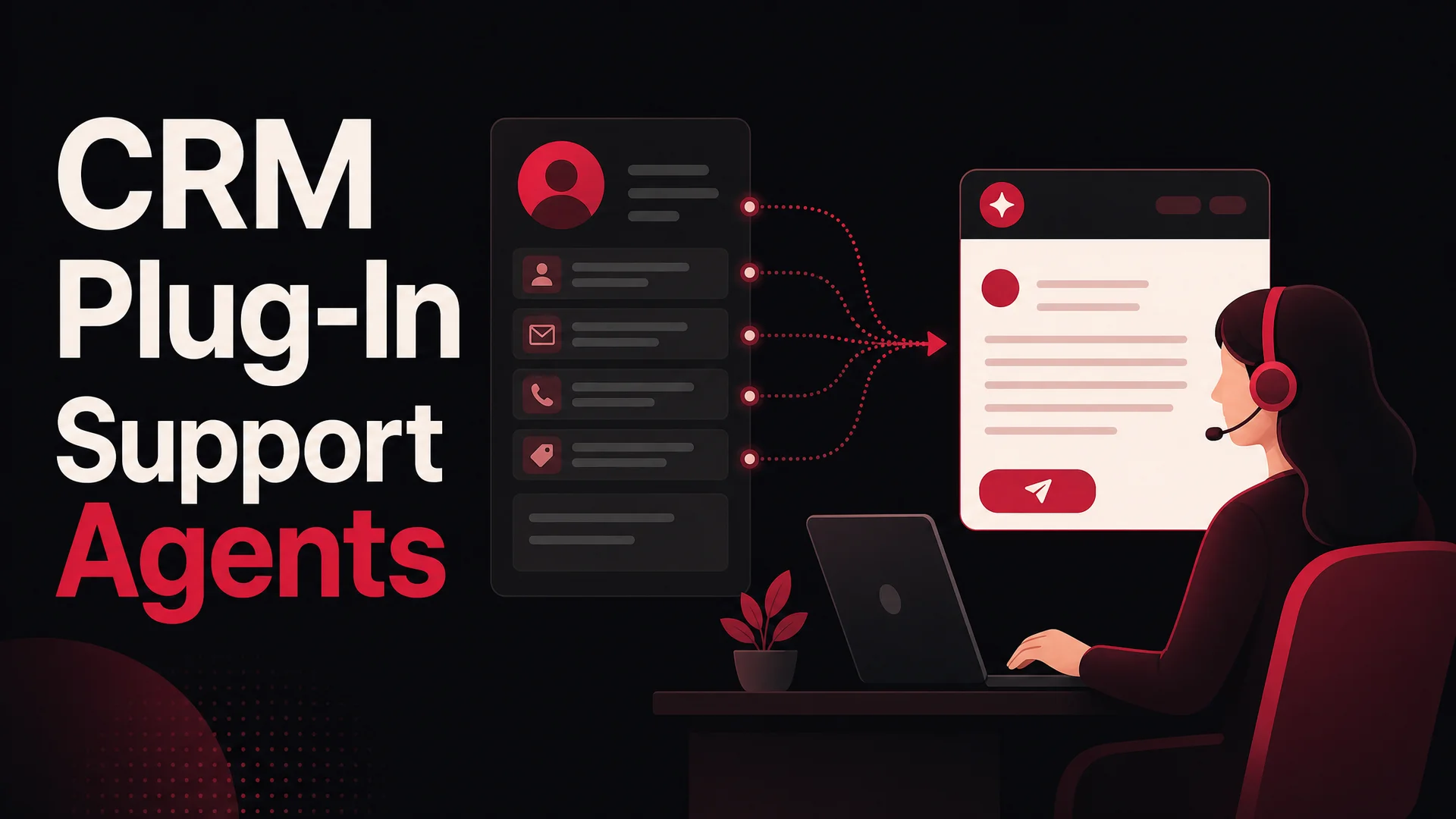
The term gets thrown around loosely, so it's worth being precise. A chatbot that scrapes a contact's name from a form and stuffs it into a greeting is not CRM-integrated. A real integration moves in both directions and crosses a few capability boundaries.
Read access into customer records. The agent can look up a contact, an account, and the deals, tickets, subscriptions, and order history attached to them. When a customer asks "where is my order?" the agent retrieves the actual order, not a generic answer about shipping policies.
Write access for deterministic actions. When the agent decides a refund is appropriate, it doesn't draft an email asking a human to do it. It calls the refund endpoint, logs the result on the customer record, and tells the customer it's done. Same for booking a meeting, updating a subscription, escalating a deal stage, or attaching a tag.
Conversation logging back to the timeline. Every interaction the agent has shows up on the customer's CRM timeline as a first-class event, with the transcript, the resolution, and any actions it took. This is what lets your account managers and CSMs walk into a call already knowing what the customer said at 2 a.m. last Tuesday.
Lifecycle awareness. A first-touch prospect should be handled differently from a contract-renewal customer. The agent reads the lifecycle stage from the CRM and adjusts its tone, escalation rules, and the actions it's allowed to take.
The platforms below differ mostly in how many of these four capabilities they actually deliver, and how much engineering work it takes to turn them on.
The model layer underneath - and why it changed everything
Before getting into platforms, it's worth grounding the conversation in what's running under the hood, because the choice of model is now part of the buying decision.
The frontier closed models in 2026 are GPT-5.5 and GPT-5.5 Pro from OpenAI (released in April with parallel reasoning), Claude Opus 4.7 from Anthropic (currently leading SWE-bench Pro at 64.3% and the strongest model for nuanced reasoning over long policy documents), and Google's Gemini 3.1 Ultra with its 2M-token context window and native multimodality across text, image, audio, and video. Claude Opus 4.6 and Sonnet 4.6 also ship with a 1M-token context window at no surcharge, which matters for support workloads where you want to drop an entire knowledge base and full conversation history into a single call.
What changed the economics is the open-weight frontier. DeepSeek V4 Flash launched in April 2026 at $0.14 per million input tokens and $0.28 per million output tokens with a 1M context - meaning a typical support conversation costs a fraction of a cent. Moonshot's Kimi K2.6 is a 1T-parameter MoE designed for agentic work, capable of orchestrating swarms of up to 300 sub-agents across 4,000 coordinated steps. Z.ai's GLM-5.1 (MIT-licensed, 754B-parameter MoE) hits 58.4 on SWE-Bench Pro and was trained entirely on Huawei Ascend chips. Alibaba's Qwen 3.6 family includes a 27B dense Apache-licensed model that beats much larger MoE rivals on agentic coding benchmarks. MiniMax M2.7 runs at roughly 8% the price of Claude Sonnet at twice the speed.
The practical implication: a 2026 CRM-aware agent can route routine "where's my order" traffic to DeepSeek V4 Flash or MiniMax M2 at near-zero marginal cost, then escalate the gnarly billing dispute to Claude Opus 4.7 or GPT-5.5 Pro. Long-context windows mean RAG becomes a tuning lever rather than a hard requirement - for many mid-sized knowledge bases, you can simply load the whole thing into context. And MIT/Apache-licensed Chinese open weights make on-prem and air-gapped deploys realistic for regulated industries that previously couldn't touch a hosted LLM.
The platforms worth evaluating
Berrydesk - multi-model, CRM-aware, deploy in an afternoon
Berrydesk lets you spin up a branded support agent and choose your model up front: GPT-5.5, Claude Opus 4.7, Gemini 3.1, DeepSeek V4, Kimi K2.6, GLM-5.1, Qwen, MiniMax, or others. You can route routine and escalated traffic to different models - using DeepSeek V4 Flash for FAQ-style deflection and Claude Opus 4.7 for nuanced policy questions, for example - without rebuilding the agent.
Training sources cover the spread of where companies actually keep their knowledge: docs, public websites, Notion workspaces, Google Drive folders, and YouTube. The chat widget is brandable down to colors, fonts, avatars, and copy, and ships to a website, Slack, Discord, WhatsApp, and other channels from the same configuration.
The CRM piece is handled by AI Actions. You define the actions the agent can take - create a HubSpot contact, look up a Salesforce opportunity, refund a Stripe charge, book a Calendly slot, update a Zoho ticket - and the agent decides when to call them based on the conversation. Because the underlying models in 2026 are genuinely good at tool use (Claude Opus 4.7, Kimi K2.6, GLM-5.1, and Qwen 3.6 all benchmark strongly here), AI Actions in production now resolve cleanly rather than misfiring.
The trade-off Berrydesk leans into: it's a horizontal platform, not a CRM-vendor's bundled bot. That means it's not pre-wired to a single CRM, but it also means you're not locked into one - you can keep the same agent across HubSpot, Salesforce, and Zoho if your stack changes.
HubSpot Breeze - the native HubSpot path
HubSpot's AI layer (Breeze, which absorbed and expanded what was previously called ChatSpot) is the obvious choice if your team lives inside HubSpot and you don't want to think about integration plumbing. It reads from and writes to HubSpot CRM data natively, generates reports, drafts marketing copy, and can run conversational queries against your pipeline.
The strength is depth inside HubSpot - every CRM property, list, workflow, and report is one chat command away. The weakness is the inverse: if your customer data also lives in NetSuite, Stripe, Snowflake, or a homegrown order system, Breeze has limited reach beyond the HubSpot perimeter, and your agent's answers will only be as complete as what you've already synced into HubSpot.
Salesforce Agentforce - for Salesforce-anchored enterprises
Salesforce's agent platform (Agentforce, which evolved from the Einstein Bots line) is a reasonable default if Salesforce is your system of record and you have the admin capacity to configure it properly. It handles multilingual conversations, multi-channel deployment across web, mobile, WhatsApp, and SMS, and it pulls deeply on Customer 360 data.
The flip side is the usual Salesforce trade-off: configuration is powerful but heavy, and you'll typically need a partner or a dedicated admin to get a non-trivial agent live. The model choices are also more constrained than what an open platform like Berrydesk offers - you're working within Salesforce's curated set rather than picking the cheapest or most capable model for each task.
Zoho Zia - for the Zoho-native sales motion
Inside the Zoho ecosystem, Zia covers conversational sales assistance, lead scoring, real-time pipeline insights, and workflow automation. It plays well across Zoho CRM, SalesIQ, Desk, and the rest of the suite, which makes it a sensible default if you've already standardized on Zoho. Outside that ecosystem its reach drops off quickly.
Pipedrive AI Sales Assistant - focused on the deal cycle
Pipedrive's assistant is built around the deal pipeline. It surfaces which deals are likely to close, drafts outreach emails, and helps reps prioritize their day. It is less a general-purpose support agent and more a sales rep's copilot, which makes it a good fit for sales-led organizations and a poor fit for support-heavy ones.
Freshworks Freddy AI - sentiment-aware support
Freddy is positioned around customer support specifically, with sentiment analysis baked in so the agent can detect frustration and adjust its responses or escalate to a human. It integrates with Freshsales and Freshdesk natively, and has decent reach into third-party stacks via API.
Canary for Support - shared inbox with an AI layer
Canary combines a lightweight helpdesk and shared inbox with an AI assistant that auto-deflects common tickets and escalates the rest. It's a good fit for small support teams that want a unified inbox plus AI deflection without buying a full enterprise platform. CRM integration is shallower than the dedicated CRM-vendor options.
Honorable mentions
Zoho's SalesIQ Zobot offers a no-code visual builder for live-chat automation. Agile CRM bundles a chatbot with its CRM at a price point aimed at small businesses. Both are reasonable if their pricing or simplicity matches your situation, but neither pushes the model layer hard, which means the gap to platforms running on 2026-era frontier models will keep widening.
How to actually wire it into your CRM
The platforms above all promise integration. The day-to-day reality of getting one live looks like this.
Start from the conversations you already have
Pull a representative sample - a hundred or so - of the support conversations your team handled in the last month. Cluster them by intent: order status, returns, account changes, billing questions, product how-to, escalations, and so on. The clusters become the spec for what the agent has to handle, and the percentage of volume in each cluster tells you what to prioritize.
This step is boring and people skip it. Skipping it is the most reliable way to end up with an agent that does an impressive demo and then deflects 12% of real tickets.
Decide what the agent is allowed to do
For each intent cluster, decide whether the agent should answer in text only, take an action, or escalate. "Where is my order?" is a read-only action - look up the order and tell the customer. "I want to cancel my subscription" is a write action that may need a confirmation step. "I'm being charged twice" is almost always an escalation in the early days, even if the model could handle it, because the cost of getting it wrong is high.
Berrydesk, Agentforce, and Breeze all let you scope which actions the agent can call and under what conditions. Use that. An over-empowered agent that issues refunds it shouldn't is a much worse outcome than one that escalates a few cases it could have handled.
Connect data sources before tuning prompts
Most teams jump straight to the prompt and the persona. Connect the data sources first - CRM, knowledge base, order system, billing - and let the agent answer with whatever defaults the platform ships. Then look at where it's wrong. Almost always the failures trace back to missing data, not to a poorly worded system prompt.
Pick your model with cost in mind
In 2026 there is no reason to send every conversation to your most expensive model. A reasonable default split: route deflectable, FAQ-style traffic to DeepSeek V4 Flash or MiniMax M2 at near-zero cost, route the bulk of mid-complexity conversations to Sonnet 4.6 or Qwen 3.6 for the long-context behavior, and reserve Claude Opus 4.7 or GPT-5.5 Pro for the small fraction of conversations that involve nuanced policy reasoning, multi-step actions, or visible escalation risk. Berrydesk handles this routing natively; on most other platforms you'll need to model it as multiple agents.
Instrument from day one
Track resolution rate, escalation rate, average handle time, customer satisfaction (CSAT), and cost per resolved conversation from the first day the agent is live. The first two weeks of data will tell you more about your knowledge base than about the agent - gaps in the documentation surface as gaps in the answers.
Common pitfalls
A few patterns show up over and over in CRM-integrated agent rollouts.
Treating the agent as a deflection machine. If the only metric is "tickets avoided," the agent will be tuned to avoid tickets - including ones it shouldn't have. The right framing is resolution at quality, not deflection at volume. CSAT on agent-handled conversations should be at parity with or better than human-handled ones.
Letting the agent answer from generic web data. Most platforms in 2026 will happily fall back to the model's training data when they can't find an answer in your sources. That's how an agent confidently quotes a refund policy that hasn't been valid since 2024. Configure strict grounding - the agent should escalate when it doesn't have a sourced answer, not invent one.
Ignoring the lifecycle stage. A trial user asking a billing question should not be handled the same way as a six-figure enterprise customer asking the same question. Read the lifecycle stage from the CRM and route accordingly.
Wiring write actions before read accuracy is solid. If the agent gets the customer's order wrong 5% of the time on read-only questions, you do not want it issuing refunds. Get reads right first, then turn on writes one action at a time.
Skipping the human handoff design. When the agent escalates, what does the human see? In the worst case, a fresh ticket with no context, and the customer has to repeat everything. In the best case, a transcript, the agent's working hypothesis, the actions it considered, and the CRM context already loaded. Design the handoff explicitly - it is half of what makes the agent feel good to interact with.
Open-weight vs closed frontier - the trade-off worth understanding
A question that comes up in every evaluation: do we run an open-weight model (DeepSeek V4, Kimi K2.6, GLM-5.1, Qwen 3.6, MiniMax M2) or stick to closed-frontier (GPT-5.5, Claude Opus 4.7, Gemini 3.1)?
Cost. Open-weight wins decisively. DeepSeek V4 Flash at $0.14/$0.28 per million tokens is roughly an order of magnitude cheaper than the closed leaders, and MiniMax M2 is cheaper still. For high-volume support workloads this is the difference between a five-figure and a six-figure annual model bill.
Reasoning ceiling. Closed frontier still wins on the hardest 5% of conversations - multi-policy reasoning, ambiguous escalations, nuanced tone. Claude Opus 4.7 in particular is the model to beat for support nuance.
Tool use reliability. Both camps are now strong here. Kimi K2.6, GLM-5.1, and Qwen 3.6 are explicitly built for agentic work and benchmark competitively with closed models on tool-use accuracy.
Data residency and on-prem. MIT/Apache-licensed open weights (GLM-5.1, Qwen 3.6-27B, MiMo-V2) are the only realistic path for regulated industries that need air-gapped deployments. If your compliance posture requires "data never leaves our infrastructure," this is the answer.
The right answer for most teams. Route. Use the cheap open-weight model for the long tail of routine traffic, use the closed frontier for the conversations where the cost of being wrong dominates the cost of the call. Berrydesk lets you do this in configuration; if you're on a single-model platform you'll likely need to add a routing layer yourself.
Measuring whether it's working
Vanity metrics are easy. Useful metrics are these.
Resolution rate at quality. Percentage of conversations that ended without human escalation and with CSAT at or above your human-handled baseline. Tracking only the first half is how teams convince themselves the agent is great while customers quietly leave.
Escalation timing. When the agent does escalate, does it do so within the first two or three turns, or does it thrash for ten turns and then hand over? Early, clean escalations are good. Late, frustrated escalations are worse than no agent at all.
Action accuracy. Of the write actions the agent took (refunds, updates, bookings), what percentage were correct? This is the one metric where you genuinely cannot tolerate drift - track it weekly.
Cost per resolved conversation. Total model spend plus platform cost divided by resolved conversations. In 2026 this number should be in the cents for routine support and at most low-dollar for complex cases. If it's higher, you're either over-using a frontier model or your knowledge base has too many gaps and the agent is making too many calls per resolution.
Pipeline impact. For sales-leaning use cases (lead qualification, demo booking, deal acceleration), measure what the agent contributed at the top of the funnel - qualified meetings booked, deals advanced, opportunities surfaced - not just chat engagement.
Where this is heading
Two shifts are worth watching over the next few quarters.
The first is that the line between "support agent" and "operations agent" is dissolving. With agentic models like Kimi K2.6 capable of running 12-hour autonomous sessions across hundreds of sub-tasks, and GLM-5.1's eight-hour autonomous loops, the same agent that answers "where is my order" can investigate the warehouse delay, file a vendor ticket, and proactively message every affected customer - without a human in the loop. CRM integration becomes the substrate for an agent that runs entire workflows, not just conversations.
The second is that long context is reshaping what "training" means. With 1M-token windows standard and 2M available on Gemini 3.1 Ultra, many companies will simply load their entire knowledge base, recent conversation history, and active CRM record into every call. Vector search and RAG don't disappear - they become an optimization for the very largest knowledge bases - but the median support agent in 2026 doesn't really need them.
Both shifts reward platforms that are model-agnostic and integration-deep, and they punish single-vendor bundles that lock you to one model and one CRM.
Getting started
If you already have a CRM, a knowledge base, and a support volume that hurts, the path is short. Pick a platform, point it at your data, define the handful of actions it's allowed to take, and put it in front of real traffic with a low escalation threshold. Tighten from there.
Berrydesk is built for exactly this loop - choose your model, train on your sources, brand the widget, wire AI Actions into your CRM, and ship to your website, Slack, WhatsApp, or wherever your customers already are. If you want to see how it handles your specific stack, start a free agent at berrydesk.com and have something live by the end of the day.
 Berrydesk
Launch a CRM-aware support agent in an afternoon
- Pick from GPT-5.5, Claude Opus 4.7, Gemini 3.1, DeepSeek V4, Kimi K2.6, GLM-5.1, Qwen, MiniMax - and route between them
- Wire AI Actions into Salesforce, HubSpot, Zoho, Pipedrive, and your own APIs without writing glue code
Set up in minutes

Chirag Asarpota is the founder of Strawberry Labs, the team behind Berrydesk - the AI agent platform that helps businesses deploy intelligent customer support, sales and operations agents across web, WhatsApp, Slack, Instagram, Discord and more. Chirag writes about agentic AI, frontier model selection, retrieval and 1M-token context strategy, AI Actions, and the engineering it takes to ship production-grade conversational AI that customers actually trust.