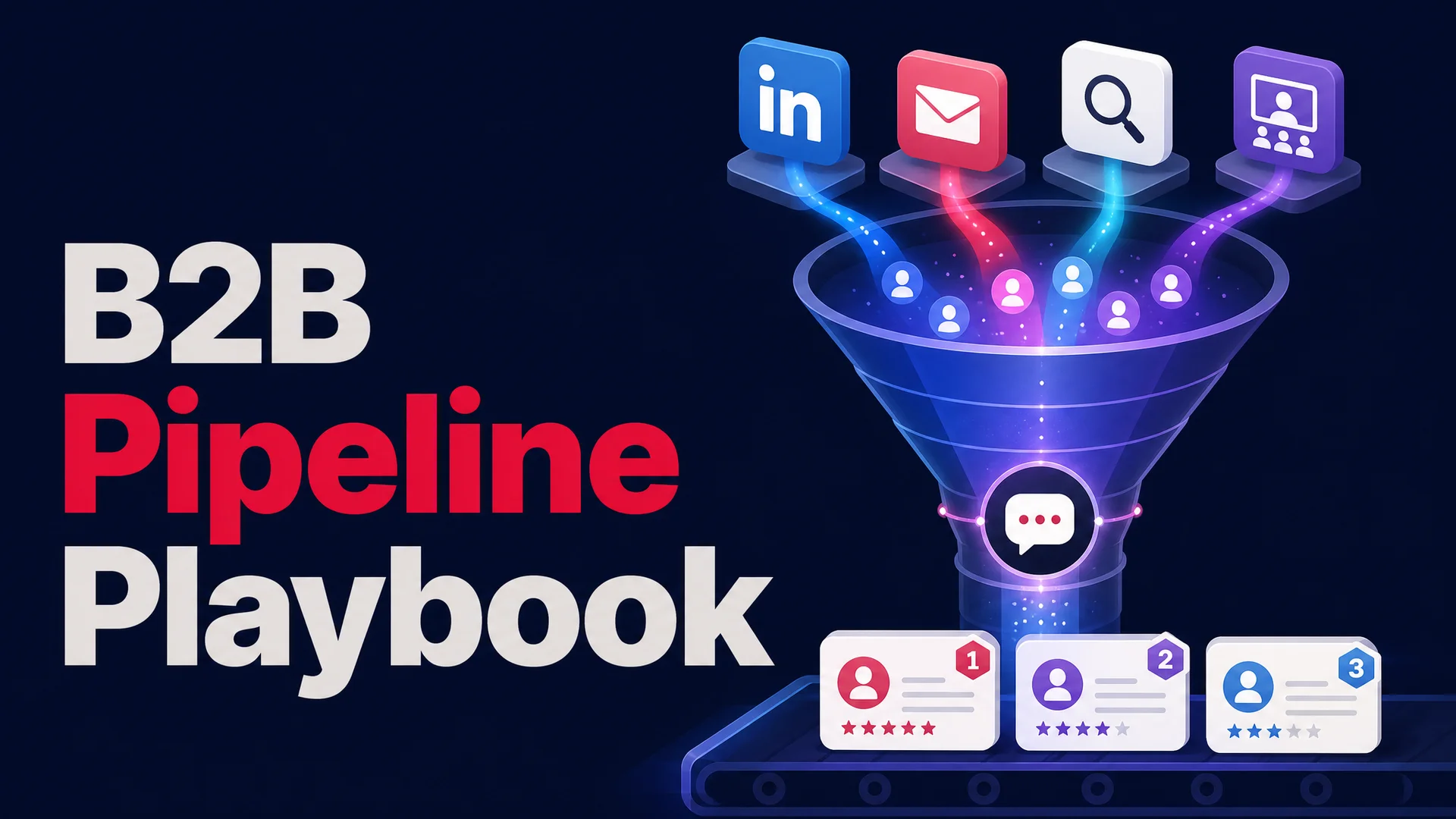
Pipeline is the one number every B2B revenue team is judged on, and it is also the number nobody can fully control. You can sharpen your nurture flows, polish your sales decks, and tune your CRM until it sings - but if not enough qualified buyers walk in the door, none of it matters. That single fact is why lead generation feels like an unsolvable puzzle at most companies.
There is no silver bullet. There is, however, a small set of strategies that consistently work when they are executed well, and a much larger set of half-finished tactics that drain budget without producing meetings. This guide is about the first group.
Below you will find 15 B2B lead generation strategies that are working in 2026, along with the underlying mechanics - what a lead actually is, how to qualify one, and where AI agents now sit in the funnel. By the end you should be able to look at your current motion, see exactly which gears are missing, and decide what to ship next quarter.
Let's get into it.
What B2B Lead Generation Actually Means
B2B lead generation is the practice of identifying companies and individual buyers who could plausibly buy from you, capturing enough of their attention and contact information to start a conversation, and moving them into a sales process that ends in a closed deal.
That definition is deliberately broad, because the work is broad. Marketing and sales teams blend channels - paid, organic, owned, partner, and outbound - and the right mix depends on your average contract value, sales cycle length, and ideal customer profile. A self-serve product selling to startups will not win with the same playbook as an enterprise platform selling six-month implementations.
Most teams that struggle here are over-indexed on one channel. They run paid ads with no organic foundation, or they obsess over SEO without an outbound motion, or they pour energy into LinkedIn without a way to capture intent on the website. Mature programs run multiple channels concurrently, including:
- Conversational AI agents on the website and in messaging apps
- Outbound email sequences and cold calling
- Paid acquisition across search, social, and retargeting
- Long-form content and SEO-driven organic traffic
- Webinars, virtual events, and in-person field marketing
- Partner co-marketing and referral programs
- Account-based marketing for named target accounts
If you are running fewer than three or four of these well, your pipeline is more fragile than you think. A single algorithm change, channel cost spike, or competitor outspending you can crater the funnel overnight.
The Two Types of B2B Leads You Need to Treat Differently
Lumping every form-fill into one bucket called "leads" is one of the fastest ways to torch a sales team's morale. A whitepaper download and a demo request are not the same thing, and treating them the same way is how you either annoy curious researchers or let buying-ready prospects go cold.
The standard split - Marketing Qualified Lead and Sales Qualified Lead - exists for a reason.
Marketing Qualified Leads (MQLs)
An MQL has signaled interest, but not buying intent. They might have downloaded a guide, signed up for your newsletter, registered for a webinar, or spent a meaningful amount of time reading product pages. They are warm, not hot. They want to learn - they have not asked to be sold to.
The job at this stage is education and trust. Useful content, helpful follow-up, and patience. A cold sales outreach to an MQL almost always backfires; you spook them out of the funnel before they have decided you are worth a conversation.
Sales Qualified Leads (SQLs)
An SQL has done something that signals genuine buying intent. They have requested a demo, asked for pricing, replied to a sales email, or had a chat conversation that explicitly indicated they are evaluating solutions.
Speed matters enormously here. Studies of inbound response time consistently show that contacting an SQL within five minutes of their request dramatically increases conversion compared to even an hour delay. The competitor that calls back first usually wins the deal.
Why the Distinction Pays Off
If you treat MQLs like SQLs, your sales team burns hours on people who are not ready to talk and starts ignoring inbound entirely. If you treat SQLs like MQLs, you drop hot leads into a 14-day nurture sequence and watch them go buy from someone else.
The teams that get this right do three things:
- They define MQL and SQL with explicit, measurable criteria, not vibes.
- They build automation that escalates an MQL to SQL the moment the qualifying signal fires.
- They give sales the context - what content was consumed, what was clicked, what was asked - so the first conversation feels informed instead of canned.
When marketing and sales agree on the handoff, conversion rates from lead to opportunity tend to double or triple from where they started.
15 B2B Lead Generation Strategies That Work in 2026
The B2B buyer in 2026 is more research-driven, more skeptical of marketing copy, and more likely to short-circuit your funnel by talking to an AI agent before talking to a human. The strategies below are the ones that account for that reality.
1. Put an AI Agent at the Front of Your Funnel
The biggest shift in lead generation over the last 18 months has been the move from static forms to conversational AI agents that engage every visitor in real time. The mechanics are simple: an agent embedded on your site greets visitors, answers their questions using your knowledge base, qualifies them with a few targeted prompts, and either books a meeting on the spot or hands a warm lead to sales.
What makes this work in 2026 that did not work in 2023 is the underlying model quality. With Claude Opus 4.7, GPT-5.5, and Gemini 3.1 Pro setting the bar for reasoning, an agent can hold a real conversation about your product instead of pattern-matching FAQs. With open-weight models like DeepSeek V4 Flash priced at $0.14 per million input tokens or MiniMax M2 at roughly 8% of Claude Sonnet's cost, you can run that agent across millions of monthly visitors without the unit economics breaking. And with 1M-token context windows on Claude Sonnet 4.6, DeepSeek V4, and Qwen3.6, your agent can hold your entire knowledge base, pricing rules, and conversation history in working memory - RAG becomes optional rather than mandatory.
Berrydesk is built for exactly this motion. You pick the model, train the agent on your docs, website, Notion, Drive, and YouTube, brand the chat widget, wire up AI Actions for booking and qualification, and deploy to your site, Slack, Discord, or WhatsApp. Routine traffic flows through an inexpensive open-weight model; the harder edge cases route to Claude Opus 4.7 or GPT-5.5. The result is a lead capture surface that runs 24/7 at a fraction of the cost of human SDRs.
2. Build Lead Magnets People Actually Want
Most lead magnets fail because they are thinly-disguised product brochures. A real lead magnet solves a problem the buyer has right now, gives them a usable deliverable in under five minutes, and feels like it has more value than the email address it costs to download.
The strongest formats in 2026:
- Original research and benchmark reports that tell the buyer something they cannot Google. A short, well-designed survey of 200 practitioners in your niche outperforms a 60-page general industry report.
- Templates, calculators, and configurators that the buyer can plug their own numbers into and get a tailored result. ROI calculators, pricing estimators, and audit templates convert at multiples of generic ebooks.
- Short, sharp video courses - three to five lessons, fifteen minutes each, that teach a specific skill. Long video courses lose people; tight ones build trust.
- Tooling and free utilities that overlap with what your paid product does. The free version creates the habit; the paid version scales it.
The unifying rule: your lead magnet has to be relevant to your product. Giving away a generic HR checklist when you sell observability software pulls in the wrong audience and pollutes your CRM with leads that will never convert.
3. Treat Your Website as a Lead Generation System
Your homepage is not a brochure. It is a 24/7 sales rep, and most websites are leaving the equivalent of a six-figure rep idling.
The optimizations that consistently move the needle:
- One unmistakable CTA per page. When you give a visitor three equally-weighted choices, they pick zero. Give them one obvious next step and a smaller secondary option.
- Embedded conversational agents on high-intent pages - pricing, product, integrations, and case studies - that can answer questions and capture intent without forcing a form.
- Exit-intent and scroll-triggered offers that surface a relevant lead magnet at the moment a visitor is about to bounce. Done with restraint, these convert. Done aggressively, they tank your trust.
- Forms placed where intent is highest. A signup CTA at the bottom of a deep technical blog post will outconvert the same form on the homepage, because the reader has already self-qualified by reading 1,500 words.
- Speed and accessibility. A site that loads in under two seconds and works cleanly on mobile and screen readers will convert demonstrably better than one that does not.
The website is the only piece of marketing real estate you fully own. Every other channel rents your audience. Make it earn its keep.
4. Build a LinkedIn Presence That Pulls Inbound
LinkedIn is still the highest-signal social platform for B2B, and the audience there is more buyer-dense than anywhere else in the consumer web. The mistake most teams make is treating it like a posting platform instead of a relationship platform.
What works in 2026:
- Founder and exec posting, not corporate brand pages. Personal accounts get 5–10x the reach of company pages, and buyers want to follow people, not logos.
- Sharp, opinionated content with specific examples and numbers. Generic best-practice posts get scrolled past; a real story about a deal you almost lost gets reshared.
- One-to-one outreach that is genuinely tailored. Mass connection-blast scripts are obvious and damaging; messages that reference something the recipient actually posted convert.
- LinkedIn Lead Gen forms for paid campaigns. Native forms remove a step and convert at meaningful rates above off-platform landing pages.
- Repurposing into a content engine. A single 30-minute podcast can become 6 LinkedIn posts, 3 short videos, a long-form blog, and 12 Twitter posts. The leverage on a single asset is enormous.
The goal of LinkedIn is to be the person buyers think of when their problem becomes acute. That is a multi-quarter game, and it compounds.
5. Run Paid Acquisition With a Real Strategy, Not Just a Budget
Paid ads still work, but the bar is higher than it was three years ago. Costs are up, attention is down, and AI-generated creative has flooded every feed. The teams that are winning with paid in 2026 are doing four things differently.
- Tight retargeting funnels. A first ad to drive interest, a second to handle objections, a third to push a specific offer. Treating retargeting as a conversation, not a single creative on repeat.
- Lookalike and intent audiences seeded from your closed-won customers, not all signups. The data quality of the seed list matters more than the lookalike percentage.
- Native lead forms on LinkedIn, Meta, and YouTube that prefill from the user's profile. Friction kills conversion; native forms remove it.
- Tight feedback loops between paid and CRM so the platform optimizes for opportunities or revenue, not raw lead volume. Without this, you are paying to fill the funnel with junk.
Paid is rarely a standalone strategy. It works best as an accelerator on top of strong organic, content, and conversational layers - not as a replacement for them.
6. Use Conversational Capture Instead of Forms
Most website visitors will not fill out a contact form. They will, however, ask a question if you make it easy.
A well-designed AI agent on the site can capture intent in conversation - qualifying buyers with a few smart questions, surfacing the right resources, booking meetings, and collecting contact information naturally as part of the dialogue. The conversion lift over static forms is consistently in the 30–50% range, and the leads are higher quality because they self-qualified through the conversation.
In Berrydesk this is one workflow. You define the qualifying questions, plug in AI Actions for calendar booking, payment, or CRM lookup, and the agent runs the playbook. Because Berrydesk lets you choose the model - agentic-first options like Claude Opus 4.7, Kimi K2.6, GLM-5.1, and Qwen3.6 are particularly good at multi-step tool use - the agent can do real work, not just answer questions. A booking flow that used to require a human SDR and a form-fill becomes a single conversation.
7. Stack Strategic Partnerships and Co-Marketing
Building an audience from scratch is slow. Borrowing one is fast. Partnerships with non-competing companies that share your ICP can expose you to a fully-formed audience overnight.
Formats that consistently produce leads:
- Co-hosted webinars where each partner brings their list. The combined audience is bigger than either could attract alone, and the cross-pollination is mutual.
- Joint research reports, where one partner brings the analysis and the other brings the distribution. The asset doubles as PR.
- Bundled offers - free trials of complementary products, joint discounts for shared customers - that give both partners a reason to promote each other.
- Integration launches. A well-marketed integration with a popular platform can drive sustained inbound for years.
The criterion for a good partner: same buyer, different problem. If you both solve the same pain, the partnership is competitive. If you solve adjacent pains for the same buyer, the partnership compounds.
8. Build a Referral Engine That Is Actually Easy to Use
Referrals from happy customers convert at rates the rest of your funnel cannot match - often 3–5x higher than cold inbound. Yet most companies have no formal referral program at all, and the ones that do typically bury it three clicks deep in the customer portal.
A referral program that works:
- Has a clear, generous incentive on both sides. Double-sided rewards (the referrer and the referred customer both benefit) outperform one-sided ones.
- Lives in the moments customers naturally talk about you - onboarding success, renewal, NPS responses - not buried in a settings menu.
- Is operationally easy. A copy-paste referral link beats a multi-step form every time.
- Tracks attribution properly so you can see which customers refer the most and reward them accordingly.
The leverage here is enormous because the cost of acquisition through referral is essentially zero, and the trust transfer from a peer is something no ad can buy.
9. Run Account-Based Marketing for Your Best-Fit Accounts
For high-ACV products with long sales cycles, broadcast marketing is wasteful. ABM flips the model: you start with a list of named accounts you want as customers, and you build a coordinated marketing and sales motion specifically for them.
A practical ABM motion in 2026 includes:
- A target account list of 50–500 companies, sourced from your ICP and validated by sales.
- Personalized landing pages and content tailored to those accounts' industry and use case.
- LinkedIn and display retargeting scoped to the IP ranges and personas at those accounts.
- Direct outreach from sales - email, LinkedIn, sometimes physical mail - coordinated with the marketing surface.
- Direct mail or executive gifting for the highest-priority accounts.
ABM is operationally heavier than broadcast marketing but the conversion rates and deal sizes justify the work for products in the $30k+ ACV range.
10. Run Webinars That Are Worth Showing Up To
The webinar format has been beaten to death, which is exactly why a good one stands out. The bar is no longer "schedule a Zoom and put up slides." The bar is content that an attendee would happily pay to consume.
The mechanics that consistently produce strong attendance and conversion:
- Pick a problem your audience is actively trying to solve right now, not a topic that sounds good in the title.
- Build the session around real artifacts - frameworks, templates, live builds, customer teardowns - not generic "what is X" overviews.
- Make it interactive. Polls, live Q&A, breakout discussions, and chat-driven tangents keep people present.
- Treat the post-webinar follow-up as the main event. Replay distribution, segmented follow-ups based on questions asked, and a fast SDR pass on the highest-engagement attendees is where the pipeline actually closes.
A single 60-minute webinar with 200 high-fit attendees can outperform a quarter of paid spend if the topic, content, and follow-up are all dialed in.
11. Build an SEO-Driven Lead Funnel
SEO is not just about ranking. It is about ranking on the queries that bring in buyers, then converting those buyers with content that matches their stage.
A funnel that works maps content to intent:
- Top of funnel - broad educational content for searches like "how to handle support tickets at scale." Goal: visibility and trust.
- Middle of funnel - comparison and methodology content for searches like "RAG vs long context" or "how to build an AI support agent." Goal: positioning your approach as the right one.
- Bottom of funnel - solution-led content for searches like "best AI customer support platform" or "AI agent for Shopify." Goal: capture buyers actively evaluating.
The teams winning at SEO in 2026 are the ones that produce content with genuine point of view and original data, not the ones cranking out generic AI-written content at scale. Search has gotten dramatically better at downranking thin AI content, and AI-driven answer engines like ChatGPT, Perplexity, and Gemini's Search Generative Experience are pulling traffic away from generic listicles. The way to survive both is to publish content that has something to say.
12. Run Cold Email That Buyers Don't Hate
Cold email has a bad reputation because most of it is bad. A well-crafted cold email, sent to the right person at the right moment, is still one of the highest-ROI lead generation tactics in B2B.
The fundamentals:
- Personalization that reflects actual research. Reference something the recipient posted, shipped, or said publicly. Templated mail-merge with
{{first_name}}is the same as no personalization. - Lead with value, not pitch. A relevant insight, a free audit, a piece of original research - something the recipient would forward to a colleague.
- Keep it short. Under 100 words. Buyers scan; they do not read.
- Sequence properly. Most replies come from the second through fourth message in a sequence, not the first. A two-email "campaign" leaves most of the conversion on the table.
- Protect deliverability. Domain warmup, proper SPF/DKIM/DMARC, and tight list hygiene matter more than copy. The best email in the world doesn't convert from the spam folder.
Done well, cold email is not spam. It is targeted, personal outreach that opens conversations the buyer is glad to have.
13. Use Interactive Content to Capture Engaged Leads
Static content is read and forgotten. Interactive content is used, and the act of using it pulls the visitor deeper into your funnel.
Formats that consistently outperform passive content:
- Quizzes and assessments that diagnose the visitor's situation and recommend a tailored path. "What's your current support automation maturity?" is a better hook than a generic ebook.
- Calculators - ROI, pricing, capacity, savings - that take the visitor's inputs and produce a personalized output worth gating.
- Configurators that let prospects model what your product would look like for their use case.
- Polls and surveys that capture data while giving the respondent a benchmark to compare themselves against.
The conversion rate on interactive assets is often 2–4x that of static PDFs, because the visitor has invested effort and now has a personal stake in seeing the result.
14. Ship a Free Tool That Solves a Real Problem
A free tool that lives on your domain and genuinely helps people is one of the most durable lead generation assets you can build. It pulls in organic traffic for years, requires no ad spend, and generates leads at near-zero marginal cost.
Examples that work:
- A keyword research tool from an SEO platform.
- A headline analyzer from a marketing platform.
- A site speed tester from a performance company.
- A free AI agent playground from an AI platform.
The criteria for a good free tool: it has to be genuinely useful (not a teaser for the paid product), it has to overlap with what your paid product does, and it has to solve a problem the right buyer has on a recurring basis. Recurring use means recurring brand exposure.
If you can ship a free tool that becomes a habit for your target buyer, you have built a piece of marketing infrastructure that compounds for years.
15. Use YouTube as an Evergreen Pipeline Source
YouTube is the second-largest search engine in the world, and B2B buyers actively use it to research solutions. A library of well-made YouTube videos can drive leads for years after publishing, with no ongoing cost.
What works:
- Educational long-form - tutorials, walkthroughs, deep-dives - that show up for solution-aware queries.
- Customer story videos that document specific outcomes with named companies and concrete metrics.
- Founder commentary on industry trends, product philosophy, and category positioning.
- Lead magnets in descriptions and pinned comments that route engaged viewers into your funnel.
- Search-optimized titles, descriptions, and chapters so videos surface for the queries you want to win.
A single high-performing YouTube video can deliver inbound for three or four years. Few channels offer that kind of half-life.
What to Watch Out For
Three pitfalls show up at almost every company that scales lead generation poorly.
Optimizing for volume instead of fit. Hitting an MQL number is easy if you lower the bar. The cost shows up two quarters later when sales conversion craters and the team gives up on inbound. Define quality criteria before you scale volume.
Treating AI agents as a deflection layer instead of a sales surface. An AI agent that is set up only to answer FAQ deflects support tickets but leaves pipeline on the table. The same agent, configured to qualify and book, becomes one of your top-of-funnel channels.
Underinvesting in the handoff. Most deals that should have closed are lost between channels - a lead fills out a form and waits three days for a reply, or chats with an agent and never gets the human follow-up they were promised. Map the handoffs and instrument them. The boring middle of the funnel is where pipeline leaks.
Picking Your Stack
You do not need all 15 strategies. You need three or four that fit your motion, executed well, with a system to measure what is working and prune what is not.
For most B2B teams in 2026 the modern foundation is: a conversational AI agent at the top of the funnel, a content and SEO engine driving qualified organic traffic, an outbound motion targeting your ICP, and a partner or referral layer that compounds over time. Paid, ABM, and webinars layer on top once the foundation is producing.
The teams that win the lead generation game are not the ones with the cleverest tactic. They are the ones who picked the right channels for their motion, instrumented them properly, and kept iterating quarter after quarter.
If you are ready to add a conversational AI layer to the front of your funnel - one that captures intent, qualifies leads, and books meetings 24/7 across your site, Slack, Discord, and WhatsApp - Berrydesk is built for exactly that. Pick a model, train it on your content, brand the widget, and ship in an afternoon.
 Berrydesk
Turn website traffic into qualified pipeline
- Deploy an AI support and lead-gen agent in minutes - pick GPT-5.5, Claude Opus 4.7, Gemini 3.1, DeepSeek V4, or any other top model
- Capture, qualify, and route leads 24/7 with branded chat, AI Actions, and CRM handoff
Set up in minutes

Chirag Asarpota is the founder of Strawberry Labs, the team behind Berrydesk - the AI agent platform that helps businesses deploy intelligent customer support, sales and operations agents across web, WhatsApp, Slack, Instagram, Discord and more. Chirag writes about agentic AI, frontier model selection, retrieval and 1M-token context strategy, AI Actions, and the engineering it takes to ship production-grade conversational AI that customers actually trust.