Chain-of-thought prompting. You may have seen the phrase show up in research papers, in vendor decks, in arguments on developer forums about why one model "reasons better" than another. It is one of the most useful ideas in modern prompt engineering, and also one of the most misunderstood.
So what is it actually? Why does it matter when you are designing an AI support agent? And how do you put it to work without overcomplicating the rest of your stack?
Let us walk through it.
A small scene to start. Imagine a logistics company is rolling out an AI agent to handle inbound questions from drivers. A driver pings the chat at 4:47am: "My truck is showing a low DEF warning, I am 80 miles from the nearest service center, can I keep going to my delivery?" A naive agent might pull a snippet from the maintenance manual and reply with a generic "consult your supervisor." That answer is technically not wrong, and it is also useless.
A reasoning agent treats the same message as a small problem to think through. What is the truck model? What does the manual actually say happens between a low warning and a forced derate? How far is the next service center along the planned route, not as the crow flies? Is there a delivery deadline that changes the calculation? Each of those questions is a step. Strung together, they produce an answer the driver can act on: "Your model derates engine power at roughly 5% DEF remaining. You are currently at 12%, so 80 miles is within the safe band. Continue to your delivery, then refill at the truck stop two miles past it before heading back."
That is the difference chain-of-thought prompting makes. Same model, same knowledge base, completely different answer - because the second one was forced to think before it spoke.
What chain-of-thought prompting actually is
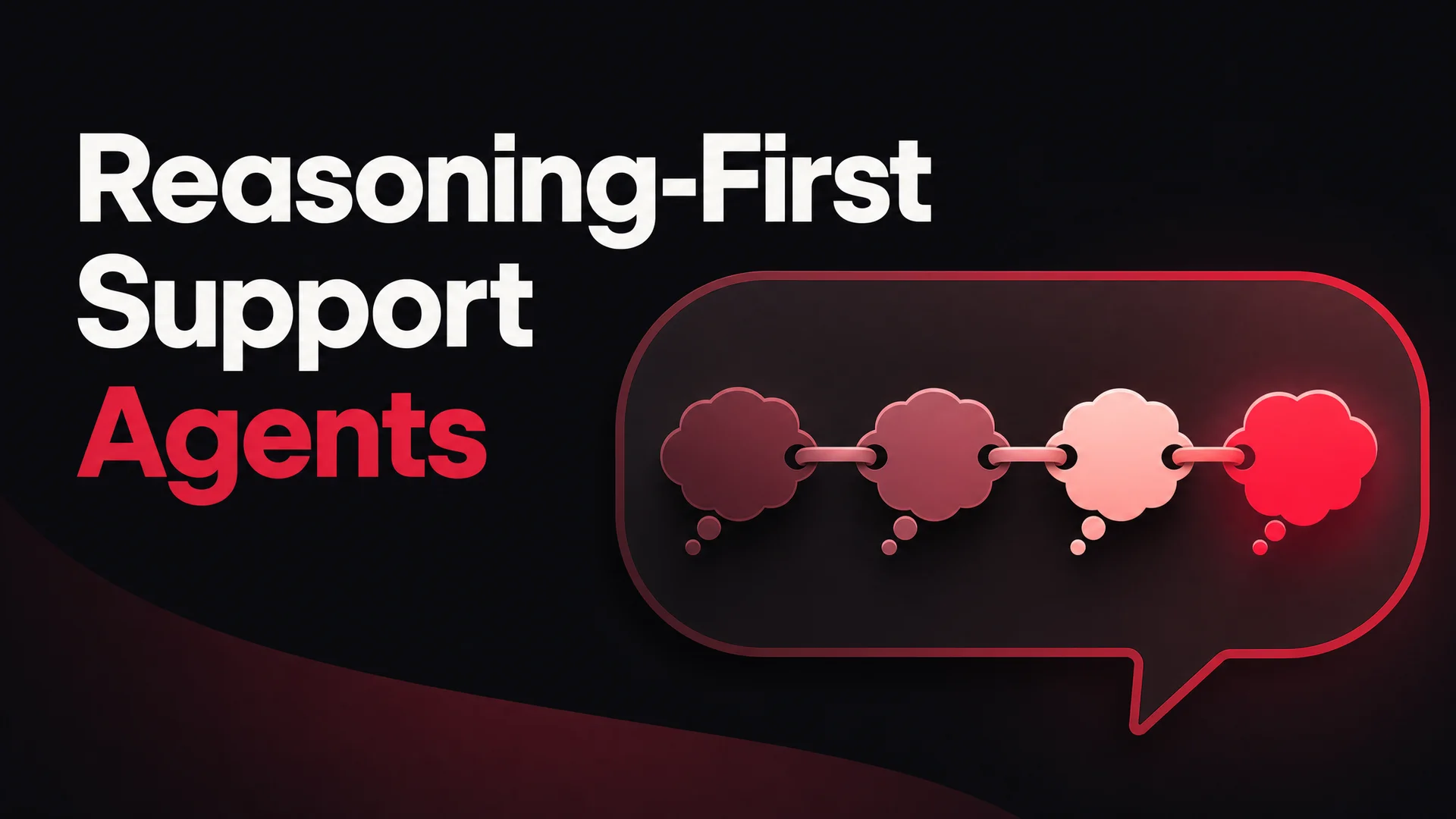
Chain-of-thought (CoT) prompting is a technique that asks a large language model to produce intermediate reasoning steps before its final answer, rather than jumping straight to the conclusion. Instead of "give me the answer," you are saying "show your working, then give me the answer."
In practice this can take many shapes. You can put the instruction directly into the system prompt ("think step by step before responding"). You can include worked examples that demonstrate the reasoning structure you want, which is sometimes called few-shot CoT. You can chain multiple model calls together, where one call produces a plan and the next executes it. With the latest models you can lean on built-in reasoning modes - GPT-5.5 Pro runs parallel reasoning passes, Claude Opus 4.7 has explicit extended thinking, and Gemini 3.1 Pro exposes its thought traces - and steer their reasoning rather than reinvent it.
The shared mechanic is the same across all of these: more compute and more tokens spent on intermediate thinking, in exchange for more accurate, more grounded final answers. The model is no longer pattern-matching its way to a quick reply. It is decomposing the problem.
Why it matters more in 2026 than it did two years ago
A few years back, chain-of-thought was a clever trick that nudged a 30% accuracy on multi-step math up to 50%. Today the landscape is different. Reasoning is no longer a hack; it is the central feature of frontier models, and the gap between "ask and answer" and "ask, think, answer" has widened sharply.
Consider what a support agent now has access to. Claude Opus 4.7 leads SWE-bench Pro at 64.3% on complex multi-step engineering tasks - exactly the kind of layered debugging logic a technical support bot needs to imitate. GLM-5.1, the open-weight model from Z.ai released in April 2026, can run an eight-hour autonomous plan-execute-test-fix loop and posts 58.4 on SWE-Bench Pro, beating GPT-5.4 and Claude Opus 4.6. Moonshot's Kimi K2.6 sustains twelve-hour autonomous coding sessions and coordinates swarms of up to 300 sub-agents across 4,000 steps. DeepSeek V4 Flash carries 1M tokens of context for $0.14 per million input tokens. MiniMax M2.7 hits 56.22% on SWE-Pro at roughly 8% of the price of Claude Sonnet, at twice the speed.
What does this have to do with customer support? Two things. First, the floor on reasoning quality has risen so high that even your routine deployment can afford a model that genuinely thinks. Second, the cost of letting a model think out loud - generating reasoning tokens before its final answer - has collapsed. Spending an extra 800 tokens of internal reasoning on a tricky refund question used to be a real budget conversation. On DeepSeek V4 Flash it costs a fraction of a cent.
Chain-of-thought is no longer an optimization. It is the default posture for any agent that needs to be trusted with real customer outcomes.
Where reasoning earns its keep in support
Not every ticket needs a reasoning chain. A "what are your hours" question does not. A "reset my password" question does not. The value of CoT shows up in three categories of work, and they happen to be the same three categories that drive escalation costs at most support orgs.
Layered policy questions
"Can I return this if I opened the box but did not use the product, and I bought it during a Black Friday sale, and I am outside the standard 30-day window because I was traveling?" That is four conditions stacked on top of one another. Each one points at a different paragraph of the return policy. A fast-answer model will latch onto whichever paragraph it pattern-matches first and ignore the rest. A reasoning model walks through the conditions in order and arrives at the actual outcome - which is often "yes, but with a 15% restocking fee."
Diagnostics and troubleshooting
Most technical issues are decision trees. "My device will not turn on" branches into checks for power source, battery, firmware state, and physical damage, and each branch has its own follow-ups. A CoT prompt makes the model explicitly enumerate the branches and walk down them, instead of guessing at the most common cause. This is also where the agentic tool-use models pay off: Claude Opus 4.7, Kimi K2.6, GLM-5.1, Qwen3.6, and Xiaomi MiMo-V2-Pro can interleave reasoning with tool calls, so the agent can check the order status, then reason about what the result implies, then call another tool, all inside a single response.
Multi-step actions through AI Actions
When your agent is not just answering but also doing - booking, refunding, looking up an order, charging a card, escalating to a human - you want it to think through the consequences before it acts. "Customer wants a refund" is not a single decision; it is "is the order eligible, what is the refund amount net of any partial-use deductions, do we issue store credit or original payment, do we need approval, what is the message back to the customer." Reasoning chains make those steps explicit, which means they are auditable when you review transcripts later.
Techniques for designing useful chains
Building a chain that holds up under real traffic is more craft than recipe, but there is a set of techniques worth keeping close. They show up again and again in production support agents that work.
Progressive decomposition
The most basic move: instead of asking for an answer, ask for the parts of the problem first. "Before you respond, list the things you need to know to answer this question. Then answer each one. Then write the final reply."
This single instruction does most of the work. It pushes the model from "best-guess output" mode into "decompose and resolve" mode. It is also surprisingly portable - the same instruction works on GPT-5.5, Claude Opus 4.7, DeepSeek V4, Gemini 3.1 Pro, and Qwen3.6 with very little tuning. A pattern that works across models is a pattern you can keep when you swap models for cost reasons later.
Context priming
Reasoning is only as good as the inputs the model is reasoning over. Before you ask for thought, hand the model the right context. For a logged-in customer, that means their account state, recent orders, and any open tickets. For an anonymous visitor, that means the page they are on and the source they arrived from. With 1M-token context windows now standard on Claude Opus 4.6, Sonnet 4.6, DeepSeek V4, and several others - and 2M on Gemini 3.1 Ultra - you no longer need to fight to fit context in. You can give the agent the entire policy document, full conversation history, and recent product updates without flinching.
This is one of the bigger shifts of the last twelve months. Retrieval-augmented generation is still useful, but it is now a tuning lever rather than a hard requirement. For a smaller knowledge base, dropping the whole thing into context and letting the model reason over it often beats a flaky retrieval pipeline.
Guided questioning
Sometimes you do not want the model to plow forward; you want it to stop and ask the customer a clarifying question. CoT prompting is how you get there. Tell the model, in the system prompt, "If a critical piece of information is missing - such as order number, product variant, or the specific error message - ask one targeted clarifying question before reasoning further."
The result is an agent that does not invent details. For a refund flow, that might be the difference between confidently telling the wrong customer they will see their money back in three days, and politely asking which order they mean.
Modular reasoning blocks
For agents that handle a wide topic range, do not write one giant chain-of-thought instruction. Build modular blocks: a troubleshooting block, a returns block, a billing block, an escalation block. Each block has its own decomposition prompt. The router decides which block applies, then the model reasons inside that block.
This is how you keep prompts maintainable as the agent grows. It is also how you swap in a cheaper model - say, MiniMax M2.7 or DeepSeek V4 Flash - for the simpler blocks while reserving Claude Opus 4.7 or GPT-5.5 Pro for the hairy ones. Routed deployments are the cost-control story for 2026, and modular reasoning is what makes routing safe.
Reflection and self-check
After the model produces an answer, give it one more pass: "Re-read the customer's message and your answer. Does your answer address every part of their question? Are there any factual claims you are not certain about? If yes, fix them before sending."
This catches a surprising number of small mistakes. It is the prompt-engineering equivalent of having someone re-read an email before they send it.
Implementing chain-of-thought in a Berrydesk agent
Here is what this looks like in a real Berrydesk deployment, end to end. The four-step setup - pick a model, train it on your sources, brand the widget, add AI Actions - is the same as any agent. The CoT work happens in two places: the system prompt and the action design.
Step 1: pick a reasoning-capable model
For a support agent that will see real volume, default to a model with strong reasoning. Claude Opus 4.7 or GPT-5.5 Pro for premium accuracy on complex tickets. DeepSeek V4 Flash, MiniMax M2.7, or Qwen3.6-27B as cost-effective workhorses for the long tail of routine traffic. GLM-5.1 if you need an MIT-licensed open-weight option for on-prem or air-gapped deploys. Kimi K2.6 if you want long-running agentic workflows that span hours. Berrydesk lets you mix models per agent or per route, so you do not have to commit to one.
Step 2: write a structured system prompt
In the agent's system prompt, lay out the reasoning structure you want. A working template:
When a customer message arrives, do not respond immediately. First, identify what the customer is actually asking for - the surface question and any deeper goal. Second, list every piece of information you need to answer accurately, and check whether you have it from the customer's message, their account context, or the knowledge base. If something critical is missing, ask one clarifying question and stop. Third, when you have what you need, walk through the steps required to answer or act. Fourth, write the response to the customer in plain, friendly language - without exposing your reasoning steps unless they are useful for the customer.
That last clause matters. Customers do not want to read the agent's inner monologue. The reasoning chain is for the model's benefit, not theirs. Most modern models can produce hidden reasoning that does not appear in the visible reply; if you are using Claude Opus 4.7 or GPT-5.5 Pro, lean on their built-in extended thinking modes rather than asking the model to manually separate "thinking" from "answer."
Step 3: train on the right sources
A reasoning agent is only as good as what it can reason over. Connect Berrydesk to your help center, product documentation, internal Notion or Google Drive workspace, and any YouTube product demos. The 1M-token context windows now available on most frontier and open-weight models mean you rarely have to choose what to leave out - you can include the full policy and let the model decide what is relevant for each ticket.
Step 4: design AI Actions for traceability
When you wire up AI Actions - the parts of the agent that book, refund, look up, or charge - design them so that each action call is preceded by an explicit reasoning step. "Before calling issue_refund, state the order ID, the refund amount, the policy clause that applies, and any approval thresholds that have been checked." This is not just for accuracy; it is for the audit trail. When you go back to review tickets where the agent made a mistake, the reasoning chain tells you exactly where it went wrong.
Step 5: deploy, then close the loop
Push the agent live to your website, Slack, Discord, WhatsApp, or wherever your customers are. Then watch transcripts. The first round of fixes always comes from reading the reasoning chains in real conversations and noticing the patterns: a step that gets skipped, an assumption the model keeps making, a clarifying question it should have asked but did not. Tighten the prompt. Repeat.
Common pitfalls
A few things to watch for once you start deploying CoT in earnest.
Reasoning leaks. Models will sometimes spill their internal reasoning into the customer-facing reply: "Let me think about this. First, I need to check…" That is a UX problem, not a model problem. Either use a model with a clean separation between thinking and output, or add an explicit "do not output your reasoning steps to the customer" line to the system prompt.
Over-thinking simple questions. If you tell the model to reason before every answer, it will reason about "what time do you close?" too. The cost adds up, and the latency is annoying. The fix is conditional reasoning: in your prompt, give the model permission to skip the chain for trivial questions and reserve it for anything that involves policy, diagnostics, or actions.
Confidently wrong reasoning. A chain that looks plausible can still arrive at the wrong answer, and now it is wrong with a paper trail. The defense is grounding: tie reasoning steps to specific source documents, and use citations or quoted snippets in the chain. Models that excel at agentic tool use - Claude Opus 4.7, GLM-5.1, Kimi K2.6, Qwen3.6, MiMo-V2-Pro - are markedly better at this because they can call a retrieval or lookup tool partway through reasoning instead of guessing.
Inconsistent quality across models. A chain that works beautifully on GPT-5.5 Pro may fall apart on a smaller open-weight model. If you are routing traffic across models for cost reasons, test each route independently. Do not assume a prompt that works on Claude Opus 4.7 will hold up on Qwen3.6-27B without tuning, even if the headline benchmarks look similar.
Reasoning as a substitute for knowledge. No amount of step-by-step thinking will conjure facts the model does not have. If your agent does not know your refund policy, telling it to "think harder" will produce a more confident wrong answer, not a right one. Reasoning amplifies whatever is in the training, the context, and the retrieved sources. Get those right first.
Long-context vs RAG vs reasoning: how they fit together
A question that comes up a lot in 2026: with 1M and 2M-token context windows now standard, do we still need RAG, and how does reasoning fit in?
The honest answer is that all three are complementary. Long context lets you put the full knowledge base in front of the model without retrieval. RAG still earns its place when the corpus is too large for context, when you need to track which sources were used, or when freshness matters more than recall. And reasoning is what turns either of those raw inputs into a coherent answer.
For most Berrydesk deployments, the practical pattern is: long context for the conversation history and core policies, retrieval for the deeper product or knowledge corpus, and chain-of-thought for the synthesis step. You do not have to pick one.
Bringing it home
Chain-of-thought prompting is the move from an agent that responds to one that thinks. In 2026, with reasoning baked into every frontier model and open-weight alternatives like DeepSeek V4, GLM-5.1, Kimi K2.6, MiniMax M2.7, and Qwen3.6 making the cost of thoughtful answers negligible, there is no real reason to ship a support agent that does not use it.
The lift is small. The system prompt becomes a few paragraphs longer. AI Actions get a reasoning step in front of them. You spend an hour reading transcripts each week to tune the chain. In return you get an agent that handles the messy, layered, high-stakes tickets - the ones that were getting escalated to humans - with the same care a senior support rep would bring.
Want to put this into practice? You can build, train, and deploy a reasoning support agent on Berrydesk in a single afternoon. Pick a model, point it at your docs and Notion, brand the widget, wire up the actions you need, and ship it to your website, Slack, WhatsApp, or Discord. Try it at berrydesk.com.
 Berrydesk
Launch a reasoning support agent in minutes
- Pick from GPT-5.5, Claude Opus 4.7, Gemini 3.1, DeepSeek V4, Kimi, GLM, Qwen, MiniMax, and more
- Train on docs, websites, Notion, Drive, and YouTube - then deploy to web, Slack, WhatsApp, Discord
Set up in minutes

Chirag Asarpota is the founder of Strawberry Labs, the team behind Berrydesk - the AI agent platform that helps businesses deploy intelligent customer support, sales and operations agents across web, WhatsApp, Slack, Instagram, Discord and more. Chirag writes about agentic AI, frontier model selection, retrieval and 1M-token context strategy, AI Actions, and the engineering it takes to ship production-grade conversational AI that customers actually trust.