The hardest problem in marketing right now is not getting attention. It is keeping it. People click, scroll, browse, abandon, return, and rarely say a word in between. Email gets opened hours later, if at all. Forms feel like paperwork. Phone trees feel like punishment. The one place customers will still happily linger is the place they already use to talk to their friends - a chat window.
That is why chat marketing has shifted from "interesting tactic" to default channel for a serious chunk of the brands that grew the fastest in 2026. It is not new. What is new is the underlying technology. Modern AI agents can hold context across thousands of turns, take real actions like booking a slot or processing a refund, and be deployed to a website, WhatsApp, Slack, Discord, and Instagram from a single brain. The economics that used to make 24/7 chat support a luxury have collapsed. Conversational marketing went from a feature you bolt on to a layer you build on.
This guide walks through what chat marketing actually is in 2026, why it works, where it pays off, and how to stand it up - including a tour of the platforms most teams compare when they shop for one.
What chat marketing actually means in 2026
Chat marketing is the use of messaging surfaces - live chat widgets, business messaging apps, social DMs, and AI agents on top of all of them - to engage prospects and customers in real time across the buyer journey. The classic definition stops at automated promotional messages. The 2026 definition is bigger: a conversational layer that handles discovery, qualification, support, transactions, and post-purchase nurture inside the same thread.
A few things changed to make that broader definition realistic. Long-context models like Gemini 3.1 Ultra (2M tokens) and Claude Sonnet 4.6 (1M tokens at no surcharge) let an agent hold a customer's entire history, your full knowledge base, and your policy documents in working memory at once. Agentic models like Claude Opus 4.7, Moonshot's Kimi K2.6, Z.ai's GLM-5.1, and Alibaba's Qwen3.6 family can execute multi-step actions reliably - not just suggest a next step, but actually take it. And open-weight frontier models from DeepSeek, MiniMax, and Xiaomi have driven inference costs down far enough that a high-traffic ecommerce store can route routine chat traffic for fractions of a cent per resolution.
The result is a channel that is no longer one-directional broadcast or scripted FAQ. It is two-way, persistent, and capable of doing real work inside the conversation. A visitor can ask a product question, get a personalized recommendation, see live inventory, book a fitting, and apply a promo code in the same window - without ever leaving the message thread to fill out a separate form.
Why chat marketing keeps winning
The short answer is that it lines up with how people already prefer to communicate, and the longer answer is that the underlying stack got dramatically better.
Here is what makes the difference, expanded:
1. Engagement happens at peak intent
When someone is on your pricing page, comparing two SKUs, or trying to figure out whether your product ships to Berlin, that moment is short. Email cannot reach them inside it. A chat window can. Real-time engagement turns a fleeting flicker of interest into a qualified conversation while the visitor is still leaning forward. Even small lifts in capture-at-peak-intent compound, because the alternative is losing the visitor entirely. In 2026, the better AI agents do not just answer; they probe gently, qualify, route, and close - and they do it with the kind of judgment that earlier rule-based bots could not fake.
2. The clock no longer matters
Customers shop and ask questions on their schedule, not yours. A founder in Singapore looking at a SaaS tool at 2 a.m. local time should not have to wait until your team logs on in San Francisco. The economics of frontier-quality AI agents now make round-the-clock coverage trivial. A typical Berrydesk deployment can route nights and weekends to a low-cost open-weight model like DeepSeek V4 Flash (priced at $0.14 per million input tokens) and only escalate the genuinely hard moments to a frontier model. Coverage that used to require a follow-the-sun support team becomes a routing rule.
3. Personalization is no longer cosmetic
Chat marketing in 2026 is not just inserting a first name into a templated reply. With long context windows, an agent can pull together a customer's order history, browsing pattern from this session, prior support tickets, and product docs and reason over the whole picture. Recommendations feel less like a banner ad and more like a thoughtful colleague who remembers you. That depth is what turns a chat thread from a transactional touchpoint into a relationship surface.
4. Conversion follows the moment
When the right message arrives at the right time with the right context, the conversion delta is not subtle. Real-time engagement plus 24/7 availability plus genuine personalization is a multiplicative effect, not an additive one. Teams that move from email-led nurture to chat-led conversion routinely see step-change improvements in lead-to-meeting and chat-to-purchase rates, not because chat is magic but because it removes friction in three places at once.
5. Trust is a side effect of reliability
Customers do not consciously notice when an answer arrives in eight seconds with the right detail. They notice when it does not. The compounding effect of fast, accurate, helpful conversations over weeks and months is loyalty - the kind that shows up in net revenue retention and referrals, not just NPS surveys. A well-trained chat agent that consistently solves the small problems is the modern equivalent of a great corner-shop owner who remembered your name.
6. Support without the wait
The old playbook was "submit a ticket and someone will reply within 24 hours." That standard is no longer competitive. With agentic models like Claude Opus 4.7 (64.3% on SWE-Bench Pro) and Kimi K2.6 (autonomous sessions of up to 12 hours), an AI support agent can handle the long tail of password resets, order lookups, refund requests, and integration questions on its own. Humans focus on the cases that genuinely need them.
7. Marketing that meets people where they are
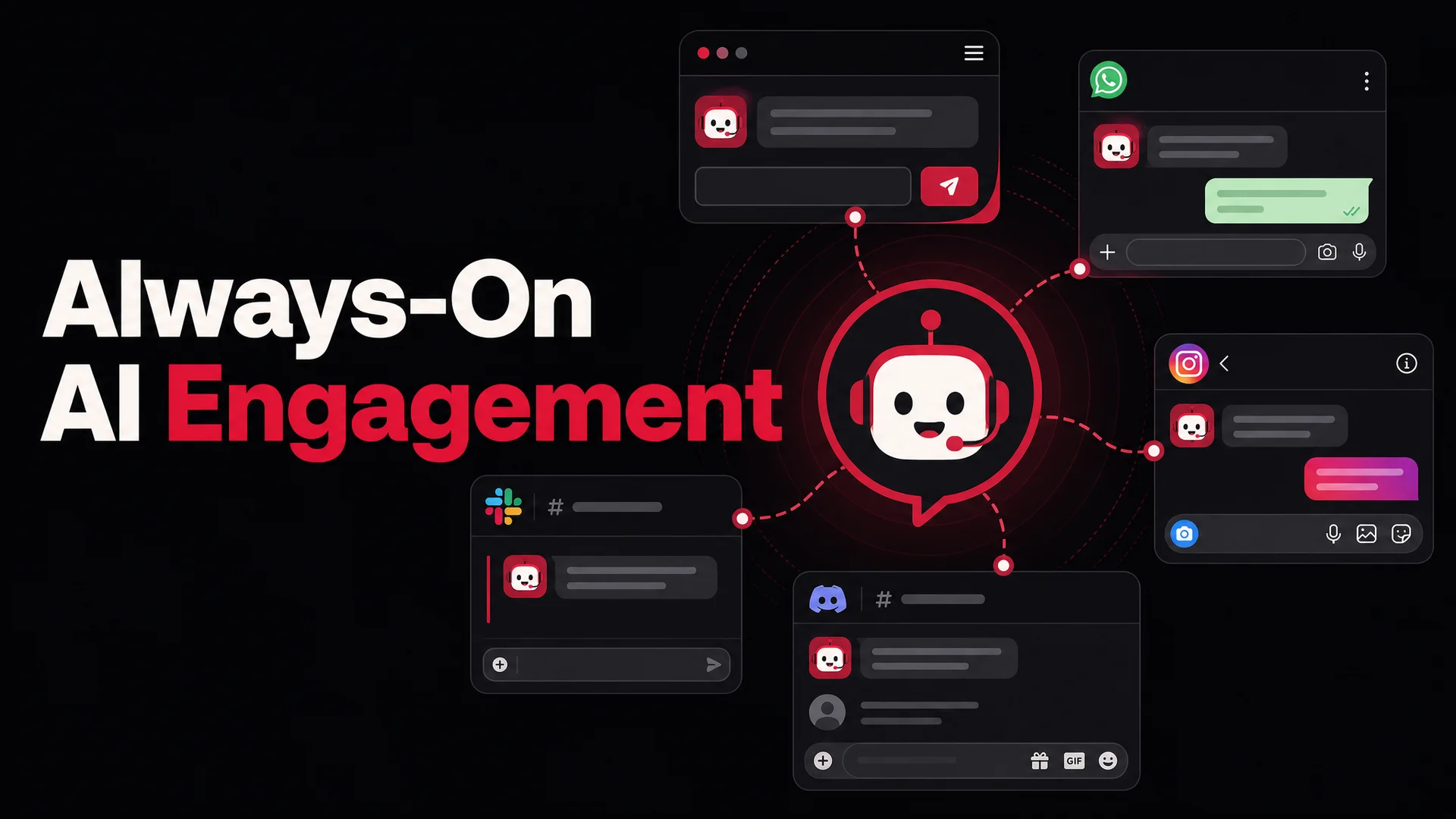
Customers spend their days in WhatsApp, Instagram DMs, Slack, Discord, iMessage. A chat marketing program that lives only on your website is leaving most of the conversation on the table. Native presence in the apps people already use feels less like marketing and more like service. The same agent brain - same training, same tone, same product knowledge - can sit on a web widget, answer a WhatsApp message, and field a Slack DM without the customer ever knowing it is the same system.
The mechanics: what actually happens inside a great chat program
Underneath the surface, a serious chat marketing setup is doing four things at once.
Knowledge. The agent has been trained on your docs, your site, your Notion workspace, your Google Drive folders, and ideally your YouTube tutorials. That is the corpus it answers from. The training step matters more than people expect, because a well-trained agent stops hallucinating, stops dodging, and starts sounding like the brand.
Context. The agent maintains conversation memory and customer state across sessions. With models like Claude Sonnet 4.6 or DeepSeek V4 carrying 1M-token windows, you no longer have to engineer aggressive RAG pipelines just to fit a single user's history into the prompt. RAG becomes a tuning lever for cost optimization, not a hard requirement for usability.
Actions. The agent can do things. Book a meeting in your calendar. Take a payment. Look up an order. Issue a refund. Open a ticket. Push a lead to your CRM. This is the part of chat marketing that earlier generations of bots simply could not do reliably. The current generation of agentic models - Claude Opus 4.7, Kimi K2.6, GLM-5.1, Qwen3.6, MiMo-V2-Pro - make it production-ready.
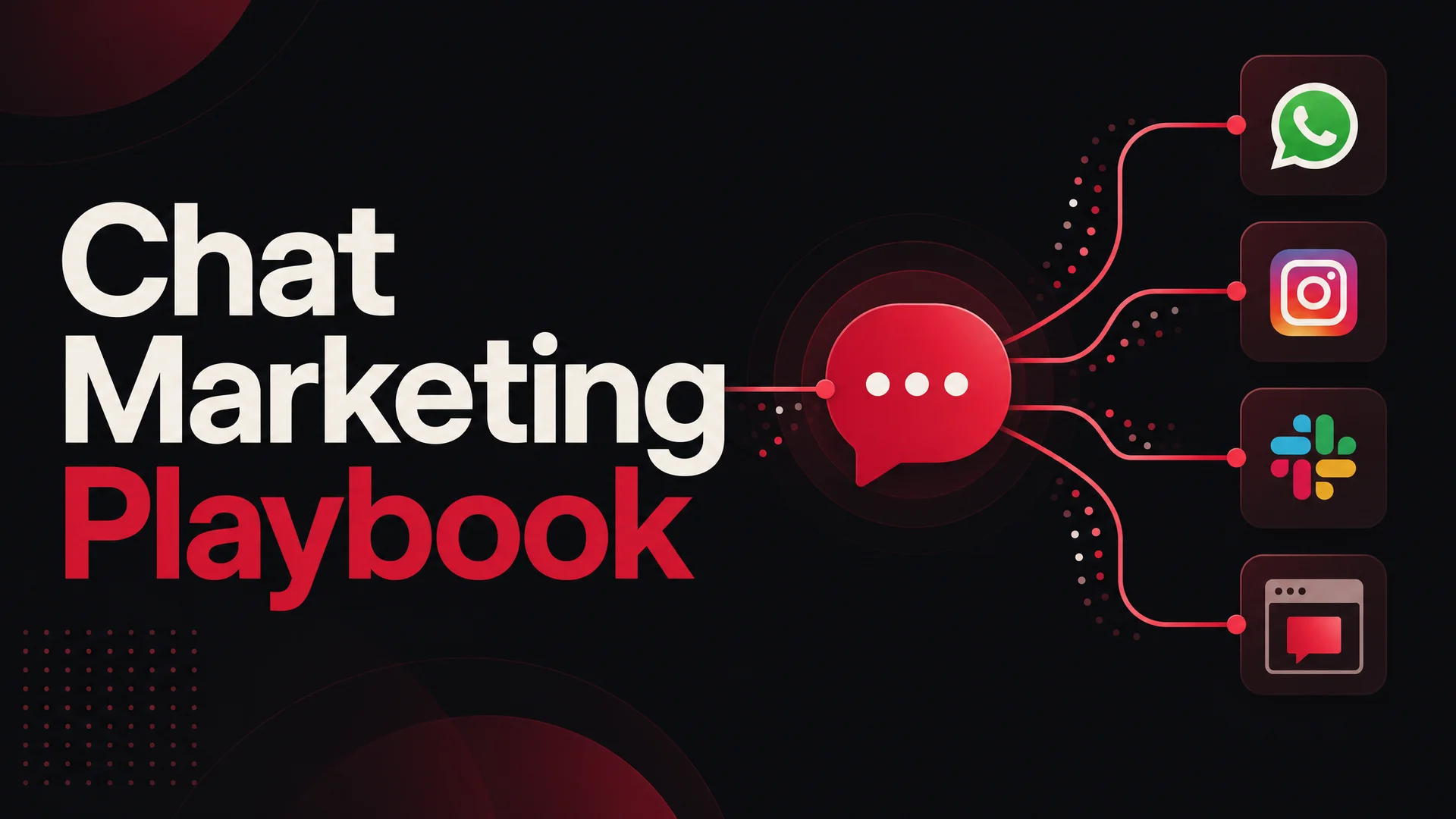
Distribution. The agent shows up where the customer is. Web widget, WhatsApp Business, Instagram, Slack, Discord, sometimes SMS. Distribution is the multiplier. A great agent on one channel is good. A great agent on five channels with shared memory is a system.
When all four pieces are wired up, "chat marketing" stops being a marketing channel and starts being something closer to a customer operating system.
How to get started without overcomplicating it
The mistake most teams make is trying to do everything at once. A more sensible sequence:
Pick the platform first. The platform you choose largely determines what is possible. Look for one that lets you train on your real data sources, deploy across multiple channels, support AI Actions natively (so you can move beyond Q&A into actual workflows), and choose between models - because you will eventually want to route different traffic to different models for cost and quality reasons.
Start with one channel that maps to your traffic. If most of your visitors hit your website first, start with the web widget. If you are a DTC brand whose audience lives on Instagram, start there. If you sell B2B SaaS and most of your reach is via outbound, start with web plus a Slack Connect option for paid customers. The goal is to learn the patterns of your conversations before you fan out.
Train the agent on real, current content. Garbage in, garbage out applies double here. Connect your help center, product docs, pricing page, FAQs, and policies. If they are out of date, fix them first - because the agent is going to surface them faithfully.
Define your AI Actions deliberately. Decide which tasks the agent is allowed to complete autonomously (booking a demo, looking up an order), which it should escalate (high-value refunds, custom contracts), and which it should never touch. The agent is only as trustworthy as the boundaries you give it.
Then go omnichannel. Once one channel works, add the next. The trick is making sure the same brain serves all of them, so a customer who pings you on WhatsApp on Tuesday can keep the same conversation on web on Thursday.
The single most important shift to internalize: chat marketing is no longer a tool you bolt on to a CMS. It is the conversational layer your business runs on. Treat it that way and everything else gets easier.
A note on choosing your model - and why it matters
One of the underrated decisions in any chat marketing rollout is which model your agent runs on. Most platforms hide this from you, which is fine until you start hitting cost ceilings or quality plateaus.
The honest answer in 2026 is that no single model is right for everything. A practical setup looks like this:
- Routine, high-volume questions ("where is my order?", "what are your hours?") route to a fast, cheap open-weight model like DeepSeek V4 Flash or MiniMax M2. The marginal cost per resolution is essentially noise.
- Nuanced support and sales conversations route to a mid-tier frontier model like Claude Sonnet 4.6 (1M context, no surcharge) or Gemini 3.1 Pro (94.3% GPQA Diamond). Quality is excellent, latency is good, cost is reasonable.
- The hardest 5% of cases - multi-step refunds, edge-case integrations, anything legally sensitive - route to a top-tier frontier model like Claude Opus 4.7 or GPT-5.5 Pro.
- Regulated and air-gapped deployments can run entirely on MIT or Apache-licensed open weights - Z.ai's GLM-5.1, Alibaba's Qwen3.6-27B, or Xiaomi's MiMo-V2-Pro - which makes on-prem viable for finance, healthcare, and government workloads.
Berrydesk lets you pick the model and route between them. That flexibility is not a vanity feature; it is the difference between a chat program that scales linearly with cost and one that does not.
Common pitfalls to avoid
A few traps that catch teams when they first roll out chat marketing:
Treating the agent as a static FAQ. If you train it once and never update it, the answers go stale within a quarter. Set up a habit of re-syncing your knowledge sources monthly at minimum.
Letting the agent guess. Configure it to escalate or say "I don't know" rather than fabricate. Customers forgive "let me get a teammate" far more readily than a confident wrong answer.
Skipping the AI Actions step. A chat agent that can answer questions but not take actions is a glorified search box. The lift comes when it can actually do things - book the meeting, take the payment, file the ticket.
Going omnichannel before one channel works. Distribution is a multiplier. Multiplying a broken experience produces a bigger broken experience. Get one channel right first.
Ignoring the human handoff. Some conversations need a person. The handoff should be smooth, with full context handed over - not "let me transfer you" followed by the customer repeating themselves.
Tools worth comparing
When teams shop for a chat marketing platform, a handful of names come up consistently. Here is an honest read on what each is good at.
1. Berrydesk
Berrydesk is built for teams that want a real AI agent - not a scripted bot - running their conversational layer. You train it on your docs, websites, Notion, Google Drive, and YouTube; pick the model that fits the job (GPT-5.5, Claude Opus 4.7, Gemini 3.1, DeepSeek V4, Kimi K2.6, GLM-5.1, Qwen3.6, MiniMax M2, and others); brand the widget; wire up AI Actions for bookings, payments, refunds, lookups, and custom workflows; and deploy to your website, Slack, Discord, WhatsApp, and more from a single source of truth.
The model flexibility is the differentiator. Most platforms lock you to one provider, which means you pay frontier prices for traffic that does not need it and miss out on whichever model happens to be best at a given moment. Berrydesk lets you route routine traffic to cheap open-weight models and reserve the frontier for hard cases - which keeps unit economics sane as you scale.
Build your Berrydesk agent for free →
2. ManyChat
ManyChat remains a strong choice for creators and DTC brands whose audiences live primarily on Instagram and Facebook Messenger. It is excellent at the basics of social DM automation: comment-to-DM triggers, story replies, and sequenced flows for ecommerce. It also covers SMS and email, so you can extend a single conversation across channels.
Where it shines is campaign automation - abandoned-cart nudges, time-based follow-ups, action-triggered messages. Where it falls short of a full AI agent platform is in the depth of training and the sophistication of actions. If your strategy lives or dies on social DMs, ManyChat is a serious tool. If you need an agent that can hold a 40-turn conversation and execute multi-step workflows, you will want something more.
3. Intercom
Intercom is the long-standing default for SaaS and service businesses that want messaging to be central to the product experience, not just the support inbox. It blends live chat, in-app messaging, and automation, and it is particularly strong for behavior-based onboarding flows - segmenting users by what they have or have not done in your product and reaching out accordingly.
Its integration ecosystem is broad, which matters when you are stitching messaging into a CRM, analytics, and help-desk stack. The trade-off is cost and complexity at scale; Intercom rewards teams that lean fully into its ecosystem and gets expensive fast for those that do not.
4. Tidio
Tidio occupies the small-and-mid-sized-business sweet spot. The setup is fast, the UI is approachable, and you can be running live chat plus basic chatbot automation on a website in an afternoon. It handles website chat, Messenger, and email from one dashboard, and its native Shopify and WooCommerce integrations make it a natural fit for online stores.
It is intentionally less ambitious than agent-first platforms; the bots are more rule-based than reasoning-based. For a team that needs a competent live-chat-plus-FAQ-bot setup, that is plenty. For a team building a full conversational layer, it will feel limiting.
5. Drift
Drift is the conversational-marketing tool aimed squarely at B2B sales teams. Its bias is toward speed-to-meeting: pre-qualify the lead in chat, book the meeting in the rep's calendar, route high-value accounts to humans on the spot. The ABM features - customizing the chat experience for accounts your sales team already cares about - are genuinely useful for outbound-heavy GTM motions.
The reporting is strong, especially for tying chat conversations to pipeline. The trade-off is that Drift is built around a specific motion (B2B SaaS demand gen) and is heavier than you need if your use case is broader than booking meetings.
6. Heyy.io
Heyy.io has emerged as a focused alternative for teams that want native messaging automation across WhatsApp, Instagram, and Messenger without wiring everything through Zapier or Make. Its pitch is more native automation, fewer third-party dependencies, less context switching when building flows.
It is optimized for sales and marketing operations more than deep support, and it is making real progress in the WhatsApp commerce space in particular. Worth a look if your bottleneck is WhatsApp at scale.
Where this is heading
The arc of chat marketing in 2026 is clear. The frontier models are good enough that the conversation feels human. The open-weight models are cheap enough that 24/7 coverage is a budget item, not a moonshot. Agentic tool-use makes the agent useful, not just chatty. Long context makes personalization work without elaborate engineering. And the channels - web, WhatsApp, Slack, Discord, Instagram - are all addressable from a single brain.
The teams that win in this environment are not the ones with the biggest stack. They are the ones who treat chat as a first-class surface, train it on real data, give it real actions, and let it work everywhere their customers already are.
If you are ready to put this into practice, Berrydesk is the fastest way we know to get there. Pick a model, train it on your docs, brand the widget, wire up AI Actions, and deploy across the channels that matter - in the time it takes to draft an email campaign you would have sent in the old playbook.
 Berrydesk
Launch a chat marketing agent in an afternoon
- Train on your docs, site, Notion, and Drive - no code
- Deploy across web, WhatsApp, Slack, Discord, and more
Set up in minutes

Chirag Asarpota is the founder of Strawberry Labs, the team behind Berrydesk - the AI agent platform that helps businesses deploy intelligent customer support, sales and operations agents across web, WhatsApp, Slack, Instagram, Discord and more. Chirag writes about agentic AI, frontier model selection, retrieval and 1M-token context strategy, AI Actions, and the engineering it takes to ship production-grade conversational AI that customers actually trust.