Sales teams used to treat conversational AI as a curiosity - a clever demo that lived next to the live chat icon and rarely earned its keep. That era is over. The models powering AI agents in 2026 are sharper, faster, and dramatically cheaper than the GPT-4-class systems that made early chatbots feel like a novelty. With frontier models like GPT-5.5 Pro, Claude Opus 4.7, and Gemini 3.1 Ultra alongside open-weight workhorses such as DeepSeek V4 Flash, GLM-5.1, Kimi K2.6, and MiniMax M2, an AI agent can genuinely sell - qualifying prospects, answering hard product questions, recovering abandoned carts, and even taking payments - without taking a coffee break.
This post walks through the concrete ways an AI agent moves the revenue needle, what's actually changed in the underlying models, and how to put it to work without burning budget or trust.
Why the math suddenly works
For a long time, the case for an AI sales agent stalled on cost. Routing every site visitor through a top-tier model was either prohibitively expensive or so heavily rate-limited that the experience felt broken. That's no longer the constraint.
DeepSeek V4 Flash, released in April 2026, is priced at roughly $0.14 per million input tokens and $0.28 per million output tokens - open-weight, with a 1M-token context window. MiniMax M2 sits at about 8% the cost of Claude Sonnet at twice the speed. Z.ai's GLM-5.1 ships under MIT license and outscores GPT-5.4 and Claude Opus 4.6 on SWE-Bench Pro. The point isn't the leaderboard; it's that capable models now exist at every price tier.
That changes the deployment shape entirely. A modern AI agent doesn't need to pick one model - it routes. Routine "is this in stock?" or "what's your return policy?" questions go to a fast, cheap open-weight model. Multi-step questions about a custom configuration, a tricky refund edge case, or a high-stakes enterprise lead get escalated to Claude Opus 4.7 or GPT-5.5 Pro, where the extra reasoning is worth the extra cents. The economics that used to forbid 24/7 AI sales coverage now actively encourage it.
Berrydesk is built around exactly this routing philosophy. You pick the model - or the mix - that fits your traffic and your margins.
Six ways an AI agent generates revenue, not just deflects tickets
Most teams adopt AI to cut support load. The teams winning in 2026 are using the same agent to drive top-line growth. Here is how that plays out in practice.
1. Coverage that doesn't sleep
The most obvious benefit is also the most underrated: your storefront has a sales-capable representative on duty every minute of every day. Human reps need shifts, breaks, holidays, and weekends. An AI agent doesn't.
Consider a mid-sized DTC apparel brand whose buyers skew international. Half its checkout-stage questions arrive between 10pm and 6am Eastern, when its US-based support team is offline. Before deploying an AI agent, those visitors either bounced or sat in a contact form queue until morning, by which point most had already bought elsewhere. After deployment, the agent answered sizing, shipping, and return questions in seconds, recovering a meaningful share of that nighttime traffic into completed orders. The cost of running it overnight on an open-weight model was a rounding error against the recovered revenue.
This is also a customer-experience point. Buyers in 2026 are conditioned to expect immediate, conversational answers - the same pattern they get from a phone search. Make them wait, and you train them to find the answer (and the product) somewhere else.
2. Proactive nudges at the right moment
A reactive widget that waits for visitors to click is leaving money on the table. The interesting work is proactive: noticing intent signals and engaging at the precise moment a buyer is about to disengage.
If someone has been comparing two laptop configurations for four minutes, the agent can open with: "It looks like you're weighing the 16GB and 32GB models - happy to walk you through which workloads see a real difference." If a cart has been idle for ninety seconds with a coupon code applied but not redeemed, the agent can surface the discount before the visitor closes the tab. With long-context models like Gemini 3.1 Ultra (2M tokens) and Claude Sonnet 4.6 (1M tokens at no surcharge), the agent can hold the visitor's full session, your product catalog, and your sales playbook in a single prompt - no awkward retrieval gaps mid-conversation.
The behavioral effect is closer to a great floor associate than a chatbot. Done well, it feels like attentiveness, not interruption.
3. Lead qualification on autopilot
Sales reps lose hours each week sifting curious browsers from real buyers. AI agents are now reliably good at that triage.
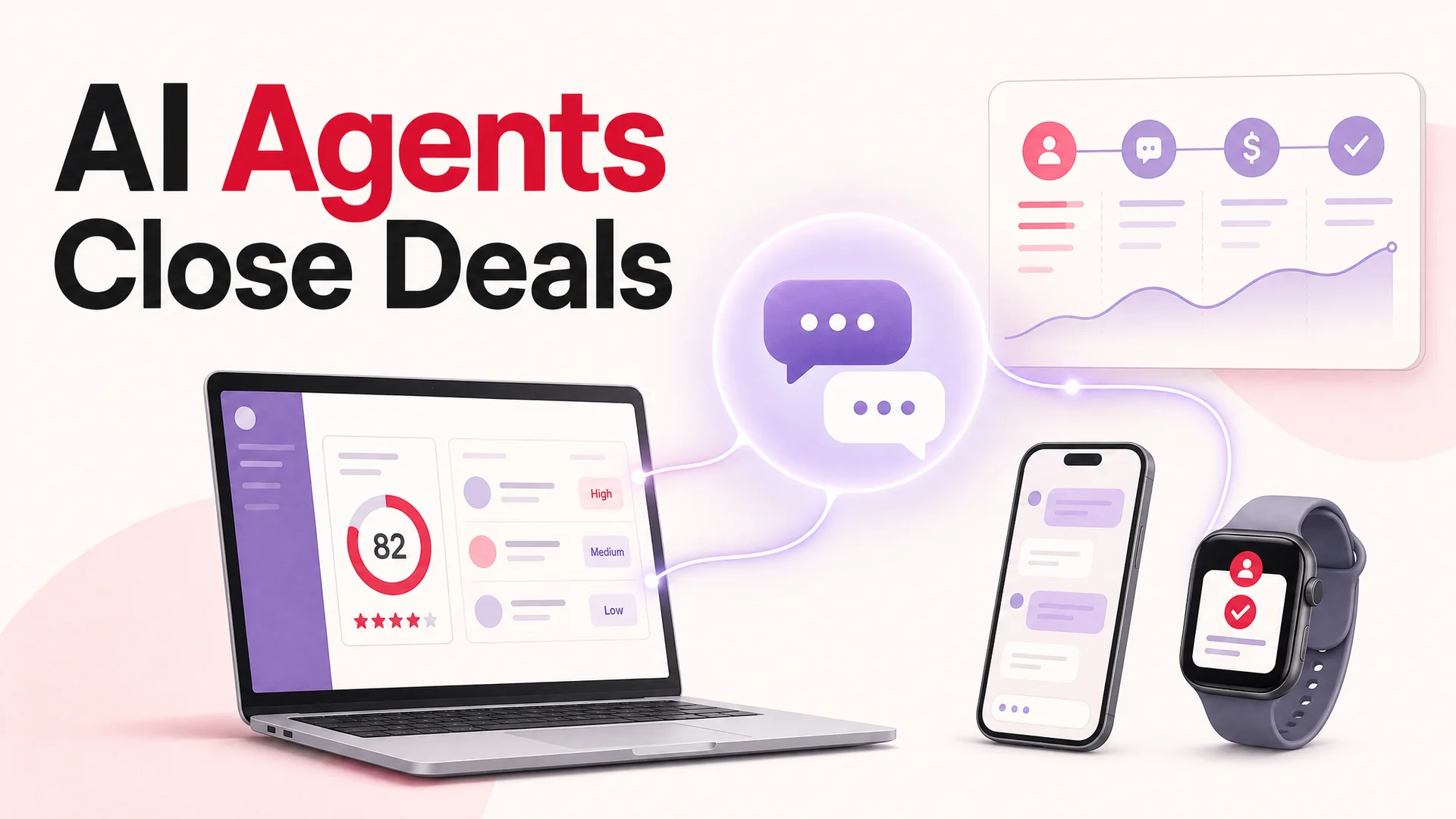
A well-configured agent quietly learns budget, timeline, headcount, integration needs, and decision-maker context across the natural arc of a conversation, never reading like a form. Agentic models such as Kimi K2.6, Qwen3.6, and Claude Opus 4.7 are particularly strong at this - they can plan a multi-turn discovery flow, follow up on vague answers, and cleanly hand off a structured lead summary to your CRM via an AI Action.
The output is a steady feed of pre-qualified leads with the boring intake work already done. Reps walk into every call with context. Conversion rates from MQL to closed-won climb because reps stop wasting cycles on poorly fit prospects, and unfit prospects stop wasting their own time on misaligned demos.
4. Speed as a closing tool
The hold-music experience is the conversion killer most companies underestimate. A buyer who has to wait for an answer is a buyer whose enthusiasm is decaying in real time, and many will simply abandon the purchase rather than wait.
Modern AI agents collapse that gap to near zero. Objection? Answered in two seconds. Sizing question on a $400 jacket? Resolved before the buyer reconsiders. Eligibility question on a financing offer? Cleared instantly.
This matters most for impulse and time-sensitive purchases - flash sales, event tickets, restocked items, expiring promos - where any delay torpedoes intent. The same speed advantage applies to B2B SaaS demos: a prospect who can get a precise pricing answer in their first session is far more likely to move to a sales call than one who has to email and wait.
5. A direct line into customer thinking
Every AI agent conversation is, in effect, a transcript of how your customers describe their needs in their own words. That's a goldmine your team has never had at scale before.
Beyond passive listening, the agent can actively probe. Ask it to validate three pricing-page hypotheses across the next thousand conversations, and you'll have signal in days, not quarters. Ask it to flag every conversation where a buyer mentioned a specific competitor, and your product marketing team gets a live competitive feed. Models with strong reasoning - Claude Opus 4.7 and GPT-5.5 Pro especially - are good at clustering and summarizing those conversations into themes a human can act on.
The decisions that follow are sharper. Pricing pages get rewritten against actual objections instead of imagined ones. Product roadmaps get reordered around what buyers genuinely ask for. Marketing messaging stops guessing and starts mirroring real language.
6. Upsell and cross-sell that actually fit
Generic "you might also like" widgets get ignored because they're obviously dumb. A conversational AI agent connected to your customer data can recommend with judgment - and that's the difference between annoying upsell and genuinely useful suggestion.
If a buyer just added a mirrorless camera body to their cart, a smart agent knows to ask whether they already own compatible lenses and whether they need an SD card rated for 4K video. If a SaaS account is bumping its seat limit three months in, the agent can surface the annual plan with the actual savings calculated for that account. With AI Actions, the agent doesn't just recommend - it can apply the upgrade, generate the invoice, or book the install call without a human in the middle.
The recommendations land because they're contextual, not pushy. Long-context models hold the buyer's full history; agentic models execute the follow-through. Together they make upsell feel like service.
What changed in the model layer (and why it matters for sales)
If your last serious look at conversational AI was during the GPT-4 or early Claude 3 era, the gap between then and now is wider than the gap between rules-based bots and GPT-3.5.
A few shifts deserve specific attention if you're planning a sales deployment:
- Context windows large enough to stop pretending. Gemini 3.1 Ultra's 2M-token window and Claude Opus 4.6 / Sonnet 4.6's 1M-token window mean an agent can hold your entire product catalog, your full pricing matrix, your refund policy, and the buyer's complete session history all at once. RAG becomes a tuning lever for cost, not a hard architectural requirement. Fewer retrieval failures means fewer hallucinated answers about your own product.
- Agentic tool use that's production-ready. Models like Claude Opus 4.7, Kimi K2.6 (which can run 12-hour autonomous sessions and coordinate up to 300 sub-agents), GLM-5.1, Qwen3.6, and Xiaomi's MiMo-V2-Pro execute multi-step workflows reliably. That's what makes "book a demo," "issue a refund," "check order status," "apply a discount," and "take payment" feel like real features instead of demoware.
- Open weights at the frontier. DeepSeek V4, GLM-5.1, Kimi K2.6, Qwen3.6-27B, MiniMax M2, and MiMo-V2 are all either open-weight or under permissive licenses (MIT, Apache 2.0). For regulated industries - finance, healthcare, government - that means on-prem and air-gapped sales agents are now genuinely viable. GLM-5.1 in particular was trained entirely on Huawei Ascend 910B chips, with no Nvidia dependency, which matters for some procurement profiles.
- Cost curves that make 24/7 routing trivial. With DeepSeek V4 Flash at $0.14/$0.28 per million tokens and MiniMax M2 at roughly 8% the price of Claude Sonnet, the question is no longer "can we afford to run this on every visitor?" It's "which model handles this exact conversation best?"
Open-weight vs closed frontier: how to think about the trade-off
Most teams shouldn't pick a single model - but it helps to know what you're choosing between.
Closed frontier (GPT-5.5, Claude Opus 4.7, Gemini 3.1 Ultra) still leads on the hardest reasoning, the most nuanced tone matching, and complex multi-step planning. If your AI agent is closing five-figure deals, troubleshooting nuanced product issues, or representing a brand where one bad reply is genuinely costly, the premium is worth it on the conversations that matter.
Open-weight frontier (DeepSeek V4, GLM-5.1, Kimi K2.6, Qwen3.6, MiniMax M2, MiMo-V2) wins on cost, deployment flexibility, and data control. They're more than capable of handling the long tail - order status, return policy, sizing, hours, basic FAQs - at a fraction of the price. They also unlock the on-prem option for buyers who can't send data to a US cloud.
In practice, the right answer for most companies is both. Cheap, fast model on the front line; frontier model on escalations and high-value flows. Berrydesk supports nine model families out of the box - GPT, Claude, Gemini, DeepSeek, Kimi, GLM, Qwen, MiniMax, and others - so you can mix and match based on the conversation, not the contract.
Common pitfalls to avoid
A few traps regularly trip up first-time deployments:
- Training on stale or contradictory content. If your help center, your sales deck, and your pricing page disagree, your agent will confidently surface whichever it found first. Audit your sources before you connect them.
- Skipping the fallback path. Every agent will eventually hit a question it shouldn't answer. Make sure there's a clean handoff to a human, with full conversation context preserved, rather than a dead end.
- Optimizing only for deflection. A bot tuned purely to "resolve without a human" will close conversations that should have been escalated. Track booked demos, captured leads, and revenue assisted alongside containment rate.
- One-size-fits-all model choice. Routing a $0.05 FAQ question to your most expensive model is wasteful; routing a $50,000 enterprise inquiry to the cheapest one is malpractice. Set rules and revisit them.
- Treating the launch as the finish line. The agents that compound value are the ones whose teams review transcripts weekly, watch where conversations stall, and tune prompts and tools accordingly.
Where Berrydesk fits
Berrydesk is built so a non-technical team can stand up a sales-capable AI agent in an afternoon, then keep tightening it.
- Pick your model. Choose from GPT-5.5 / 5.5 Pro, Claude Opus 4.7, Sonnet 4.6, Gemini 3.1 Ultra and Pro, DeepSeek V4, Kimi K2.6, GLM-5.1, Qwen3.6, MiniMax M2, and more. Route by use case, by ticket value, or by language.
- Train on what you already have. Point Berrydesk at your help docs, marketing site, Notion workspace, Google Drive, or YouTube channel. The agent ingests, structures, and indexes the content automatically.
- Brand the widget. Match your colors, your typography, your voice. The widget feels like part of your product, not a third-party bolt-on.
- Add AI Actions. Bookings, payments, order lookups, refunds, CRM updates - wired up through actions, not handoffs. The agent does the work, not just the talking.
- Deploy everywhere your buyers are. Your website, Slack, Discord, WhatsApp, and more, with the same brain across channels.
The platform is built for the model landscape that exists in 2026, not the one that existed when "AI chatbot" still meant a clunky FAQ matcher.
If your team is leaving sales conversations on the table after hours - or burning rep time on unqualified leads, or letting cart abandoners walk away in silence - an AI agent isn't a nice-to-have anymore. The models are good enough, the prices are low enough, and the tooling is mature enough that the only real question is how fast you can ship one.
Spin up your first Berrydesk agent free at berrydesk.com and see what a conversation worth converting looks like.
 Berrydesk
Launch a sales-ready AI agent in minutes
- Pick from GPT-5.5, Claude Opus 4.7, Gemini 3.1, DeepSeek V4, Kimi K2.6 and more
- Train on your docs, site, Notion, Drive, or YouTube - then add AI Actions for booking and payments
Set up in minutes

Chirag Asarpota is the founder of Strawberry Labs, the team behind Berrydesk - the AI agent platform that helps businesses deploy intelligent customer support, sales and operations agents across web, WhatsApp, Slack, Instagram, Discord and more. Chirag writes about agentic AI, frontier model selection, retrieval and 1M-token context strategy, AI Actions, and the engineering it takes to ship production-grade conversational AI that customers actually trust.