The buyer's journey has quietly inverted. Two years ago, a website visitor would land on a pricing page, scan it, and either book a demo or vanish. Today they expect to negotiate, ask about edge cases, compare plans, and get a tailored quote - all in a chat window, before they ever speak to a human. The companies that have figured this out are not running scripted bots from 2023. They are deploying AI sales agents built on the current generation of frontier models, and they are pulling away from the rest of the field on conversion, pipeline velocity, and cost per qualified lead.
This guide walks through what a modern sales chatbot actually is in 2026, what changed in the underlying model stack, where the wins are, and how to ship one that does real revenue work - not just collect emails.
What a Sales Chatbot Actually Is in 2026
A sales chatbot is an AI-powered conversational agent that engages prospects, answers buying questions, qualifies intent, and moves opportunities through the funnel - often without a human in the loop until the very last step, and sometimes not even then. The name itself is starting to feel dated. The systems shipping today are closer to autonomous sales agents: they understand context, remember prior conversations, take actions in your CRM, and reason across long documents like price books, contract templates, and competitive battlecards.
Under the hood, a 2026-grade sales agent stitches together three things. First, a frontier or near-frontier language model - typically Claude Opus 4.7, GPT-5.5, Gemini 3.1 Ultra, or one of the open-weight leaders like DeepSeek V4, Kimi K2.6, or GLM-5.1 - to handle reasoning and dialogue. Second, a knowledge base that the model can query in real time, drawn from your docs, website, Notion, Drive, and product database. Third, a tool layer - what Berrydesk calls AI Actions - that lets the agent actually do things: book a meeting on your team's calendar, generate a quote, capture a lead in HubSpot, charge a deposit, or hand off to a human rep with a full conversation summary attached.
The deployment surface has also widened. A single sales agent now lives simultaneously on your marketing site, in Slack for your AEs, on WhatsApp for inbound from paid social, in Discord for community-driven sales motions, and on iMessage for warm leads - sharing the same memory across all of them. The 24/7 part everyone talks about is table stakes. The interesting part is that it is the same agent everywhere, which means a prospect can start a conversation on your website at midnight, continue it on WhatsApp the next morning, and the agent never loses the thread.
Why the Model Landscape Suddenly Matters for Sales
Two years ago, the model conversation was a footnote. Today it is the whole game, because the cost and capability spread between models has widened to the point where your model choice directly drives your unit economics.
On the closed-frontier side, Claude Opus 4.7 is the strongest reasoner available, and it shows up especially in multi-turn negotiation, competitive comparison, and ambiguous discovery - exactly the moments where a sales agent has to think rather than retrieve. GPT-5.5 and GPT-5.5 Pro added parallel reasoning in April 2026, which translates to faster, more thorough handling of complex multi-product configurations. Gemini 3.1 Ultra, with a 2M-token context window and native multimodality, can ingest a prospect's entire RFP document along with screenshots, audio voicemails, and product videos in a single session - useful for enterprise sales motions where the discovery surface is huge.
On the open-weight side, the economics have collapsed. DeepSeek V4 Flash runs at $0.14 per million input tokens and $0.28 per million output tokens, with a 1M-token context. For a sales bot answering "what's in your starter plan?" three thousand times a day, that's fractions of a cent per conversation. MiniMax M2.7 is roughly 8% the price of Claude Sonnet at twice the speed, and it self-evolves on agentic tasks - a strong default for high-volume mid-funnel chat. Moonshot Kimi K2.6 can run 12-hour autonomous coding sessions and coordinate up to 300 sub-agents, which is overkill for most sales conversations but exactly right for an "agent that researches the prospect's company, writes a tailored one-pager, drafts the outbound email, and books the meeting" workflow. Z.ai's GLM-5.1 is MIT-licensed and built for agentic engineering loops, making it a natural fit for teams that want to run on-prem.
The practical upshot for a sales team: you can route routine questions ("what's your refund policy?", "do you have a Salesforce integration?") to a fast, cheap open-weight model, and reserve the expensive frontier reasoning for the high-stakes moments - pricing negotiation, multi-stakeholder discovery, deal recovery on a churn-risk customer. A well-designed Berrydesk deployment does this routing automatically based on conversation complexity and deal value, and the cost difference at scale is the difference between a sales agent being a line item and being a profit center.
The Real Benefits, With Some Honest Caveats
Most "benefits of sales chatbots" lists are written for an audience that has never deployed one. Here is the version that accounts for what actually happens after launch.
Always-On Availability That Actually Converts
The cliché is true: 62% of B2B buying activity now happens outside business hours, weighted heavily toward late evenings and Sunday afternoons. A human SDR team cannot cover that, and outsourced overnight coverage tends to deliver scripted responses that prospects can smell from the first message. A modern AI agent, by contrast, gives the same caliber of answer at 3 a.m. that it gives at 3 p.m. because there is no caliber gradient - the model is the model.
The caveat: availability only matters if the agent is useful in those off-hours. A bot that says "great question, let me have someone get back to you Monday" is worse than no bot, because you have now confirmed to the prospect that your company is asleep. A 2026-grade agent should be able to give a real answer, send a real quote, or book a real meeting before the prospect closes the tab.
Lead Qualification at the Speed of Curiosity
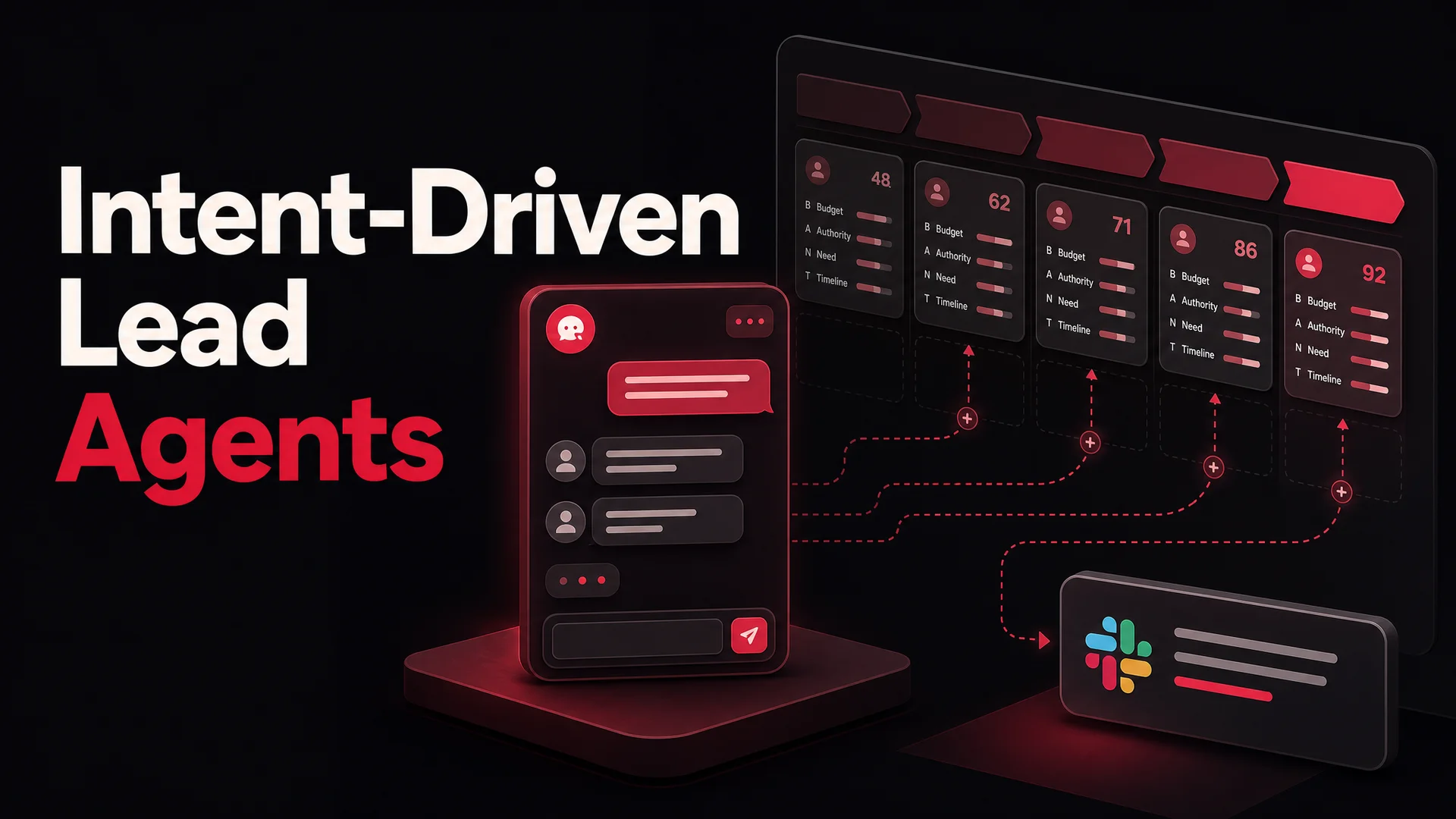
Traditional lead qualification routes inbound through a form, then to an SDR, then to a discovery call - a process that can take days and loses 30–50% of leads to fade between steps. A sales agent collapses that into a single conversation. It asks the BANT-style questions naturally ("are you looking at this for your team or for the whole company?", "what are you using today?", "what's the timeline you're thinking about?"), routes the answers into your CRM as structured fields, and scores the lead in real time.
What changed in 2026 is that long-context models can hold the entire qualification framework, your ICP definition, and the conversation history in-context simultaneously. With Gemini 3.1 Ultra's 2M-token window, you can hand the agent your full sales playbook, your last 200 closed-won deals, and your last 50 closed-lost deals, and ask it to qualify the current prospect against that corpus. Five minutes of conversation can produce a more accurate fit score than a 30-minute discovery call did in 2023.
Personalization That Reads Like a Person Wrote It
Personalization used to mean "{{first_name}}" tokens in templated copy. Today it means an agent that pulls the prospect's company size from Clearbit, notes that they are on the e-commerce vertical, references the specific product they were viewing on the pricing page, and tailors examples to retail use cases - all without anyone authoring a "retail" branch in a flow tree.
The mechanism is straightforward: the model is given the prospect context as part of the system prompt at conversation start, and instructed to weave it in naturally. Done well, the result is indistinguishable from a sharp SDR who did 90 seconds of research before a call. Done poorly, it tips into uncanny ("I see you're a 47-person company in Cincinnati who recently raised a Series B…") and breaks trust. The line is taste, and it is worth iterating on.
A Sales Process That Doesn't Drop Balls
The least-glamorous benefit is also the most valuable: AI agents are pathologically consistent. They never forget to follow up. They never skip a qualifying question because they're tired. They never hand off to the wrong rep because the round-robin spreadsheet is out of date. They log every interaction. They send the recap email. They update the deal stage.
For most sales teams, the gain from chatbot deployment is not "the bot does what humans were doing." It is "the bot does the things humans were supposed to be doing but weren't, because they were busy doing the actual selling." The follow-up that goes out in seven minutes instead of three days. The proposal that gets sent the same day instead of next Tuesday. The re-engagement message to the dormant lead that nobody had time to write.
Cost Economics That Reshape the P&L
This is the section where the open-weight model story matters most. A traditional outbound SDR in the U.S. costs $80–120K all-in and produces, optimistically, 15–25 qualified opportunities a month. An AI sales agent running on a routed stack - DeepSeek V4 Flash for routine traffic, Claude Opus 4.7 for the hard moments - can produce the same volume of qualified opportunities for under a thousand dollars in inference per month, and it scales linearly.
This does not mean the SDR job goes away. It means the work re-shapes. Your humans focus on the deals where a human voice changes the outcome, and the agent handles everything else. Companies running this play are shipping more pipeline per dollar than they did with pure-human teams, and they are doing it without burning out their reps on Tier-1 qualification calls.
Where Sales Chatbots Quietly Fail (And How to Avoid It)
Most public discussion of sales chatbots focuses on the wins. The failures are equally instructive.
The first failure mode is knowledge staleness. The agent was trained on a snapshot of your docs from launch day, and it is now three months later, your pricing has changed, your starter plan has a different name, and you've added a new integration. The agent confidently quotes the old prices to a prospect, who then signs a contract, and your billing team has a problem. The fix is to connect the agent to live sources - Berrydesk pulls from your website, Notion, and Drive on a schedule, so the agent's knowledge tracks reality without anyone having to re-train.
The second failure mode is handoff cliff. The agent does great work qualifying the prospect, books a meeting, and then the human rep walks into the call cold because the conversation context never made it to them. The fix is structured handoff: every conversation produces a CRM-ready summary with the prospect's pain points, the questions they asked, the objections they raised, and the deal stage to set. This should happen automatically.
The third failure mode is over-promising. Models hallucinate, especially when pushed on edge cases the knowledge base doesn't cover. A prospect asks "do you support SOC 2 Type II?" and the agent, lacking that document, makes up a confident answer. The fix is a combination of grounding (the agent must cite which document its claim came from) and graceful "I don't know" behavior (when ungrounded, the agent escalates rather than guesses). Frontier models in 2026 are dramatically better at this than the 2023 generation, but it is not free - you have to design for it.
The fourth failure mode is personality drift. The agent sounds like a generic AI on Monday and like a corporate press release on Friday because nobody set a clear voice. Sales conversations are emotional and stylistic; the wrong tone tanks conversion. Spend real time on your agent's voice - it is more important than which model you pick.
A Practical Playbook for Shipping a Sales Agent
Here is the sequence we see work consistently with Berrydesk customers. It is opinionated; treat it as a starting point, not gospel.
1. Pick One Funnel Stage and Win There First
The temptation is to build an agent that does everything: top-of-funnel education, mid-funnel qualification, late-stage objection handling, post-sale onboarding. Don't. Pick one stage, ship a sharp agent for it, prove the lift, then expand. The most common high-leverage starting point is qualified lead capture from your pricing page - high intent, high concentration, easy to measure conversion lift against the previous baseline.
2. Choose Your Model With Cost and Stakes in Mind
For most sales agents, a routed stack outperforms a single-model deployment. Use a fast, cheap model for the bulk of the conversation - DeepSeek V4 Flash, MiniMax M2.7, or Qwen3.6-35B-A3B all work well. Reserve a frontier model - Claude Opus 4.7 for nuanced reasoning, GPT-5.5 Pro for complex configurations, Gemini 3.1 Ultra when long context is essential - for the final-mile moments: pricing negotiation, complex multi-product quotes, save-the-deal conversations on at-risk renewals. Berrydesk lets you configure this routing without writing infrastructure code.
3. Train on the Right Sources, Not Every Source
The instinct to feed the agent every document you own is wrong. A well-curated knowledge base of 30 documents - current pricing, product overview, key differentiators, common objections with approved responses, and your top 10 case studies - outperforms a 3,000-document corpus where the model has to disambiguate between three versions of the pricing page. Curate ruthlessly.
4. Wire In AI Actions Early
A chatbot that talks but does not do is a brochure. The high-converting deployments connect AI Actions on day one: book a meeting, send a quote, capture a lead in CRM, charge a deposit, gate a piece of premium content. The agentic capabilities of Kimi K2.6, GLM-5.1, Claude Opus 4.7, and Qwen3.6 have made these flows reliable enough for production - they execute correctly, and when they don't, they fail in predictable, recoverable ways.
5. Instrument Everything, Then Iterate
Track conversation count, qualified lead rate, meeting-booked rate, eventual close rate, and cost per qualified lead. Read transcripts every week - not skim, read - for the first month. The patterns you find in the first 200 conversations will reshape your prompt, your knowledge base, and your handoff logic in ways no analytics dashboard will surface. After the first month, sample weekly.
Live Examples Across Industries
The sales chatbot pattern is now well-instantiated across verticals. A B2B SaaS company selling to mid-market ops teams uses an agent that lives on its pricing page, runs a five-question qualification, and books AE meetings for prospects above a fit threshold - closing 18% more pipeline per month with the same SDR team. A direct-to-consumer skincare brand runs an agent on WhatsApp that recommends routines, answers ingredient questions, and processes the first order, lifting first-time conversion by 22% on warm traffic. A residential solar installer deploys an agent that qualifies homeowners by zip code, roof type, and bill size, then books in-home consultations - cutting cost per booked appointment by roughly two-thirds. A legal-tech vendor selling to small law firms uses an agent that handles the entire trial-to-paid conversion conversation, including answering compliance questions and processing the upgrade payment.
The common thread is not the industry. It is that each agent owns one well-defined funnel stage, hands off cleanly when it should, and is measured on revenue, not vanity metrics.
Where This Goes Next
Three trends are worth watching over the next twelve months.
Voice-first sales agents. With Gemini 3.1 Ultra's native audio handling and the broader maturation of real-time voice models, sales chatbots are moving off keyboards. A prospect calling your sales line at 11 p.m. talks to an agent that sounds like a human, can be interrupted, and books the meeting before hanging up. Expect this to be standard by mid-2027.
Multi-agent sales swarms. Models like Kimi K2.6 (300 coordinated sub-agents) are making it feasible to have one agent run discovery, hand off to a specialist agent for technical deep-dives, hand off again to a pricing agent for quotes, and back to the lead agent for closing - all stitched into one conversation experience for the prospect. This is overkill for most companies today; it will be standard for enterprise sales motions within eighteen months.
On-prem deployments for regulated sales. MIT/Apache-licensed open weights - GLM-5.1, Qwen3.6-27B, MiMo-V2-Pro - are making it possible to run a frontier-class sales agent fully on your own infrastructure, no data leaving your VPC. For financial services, healthcare, and government sales motions where data residency is non-negotiable, this is a step-change.
The Bottom Line
Sales chatbots have crossed the threshold from "nice to have" to "competitive necessity." The combination of 2026's reasoning-class frontier models, collapsing inference costs from open-weight leaders, mature long-context windows, and reliable agentic tool use means the technology is now genuinely capable of selling - not just chatting about selling.
Berrydesk is built for exactly this moment. Pick a model - Claude Opus 4.7, GPT-5.5, Gemini 3.1 Ultra, DeepSeek V4, Kimi K2.6, GLM-5.1, Qwen, MiniMax, or others - train it on your docs, websites, Notion, Drive, and YouTube, brand the chat widget to look like yours, wire in AI Actions for booking and payments, and deploy across your website, Slack, Discord, WhatsApp, and beyond. You can ship a working sales agent in an afternoon. Whether it earns its keep depends on the choices in this guide.
If you're ready to put a sales agent to work, start at berrydesk.com - the first one is free to build, and you'll know within a week of traffic whether it pays for itself.
 Berrydesk
Launch a sales agent that books demos and closes deals
- Train on your product docs, pricing, and CRM in minutes
- Plug in AI Actions for booking, payments, and lead capture
Set up in minutes

Chirag Asarpota is the founder of Strawberry Labs, the team behind Berrydesk - the AI agent platform that helps businesses deploy intelligent customer support, sales and operations agents across web, WhatsApp, Slack, Instagram, Discord and more. Chirag writes about agentic AI, frontier model selection, retrieval and 1M-token context strategy, AI Actions, and the engineering it takes to ship production-grade conversational AI that customers actually trust.