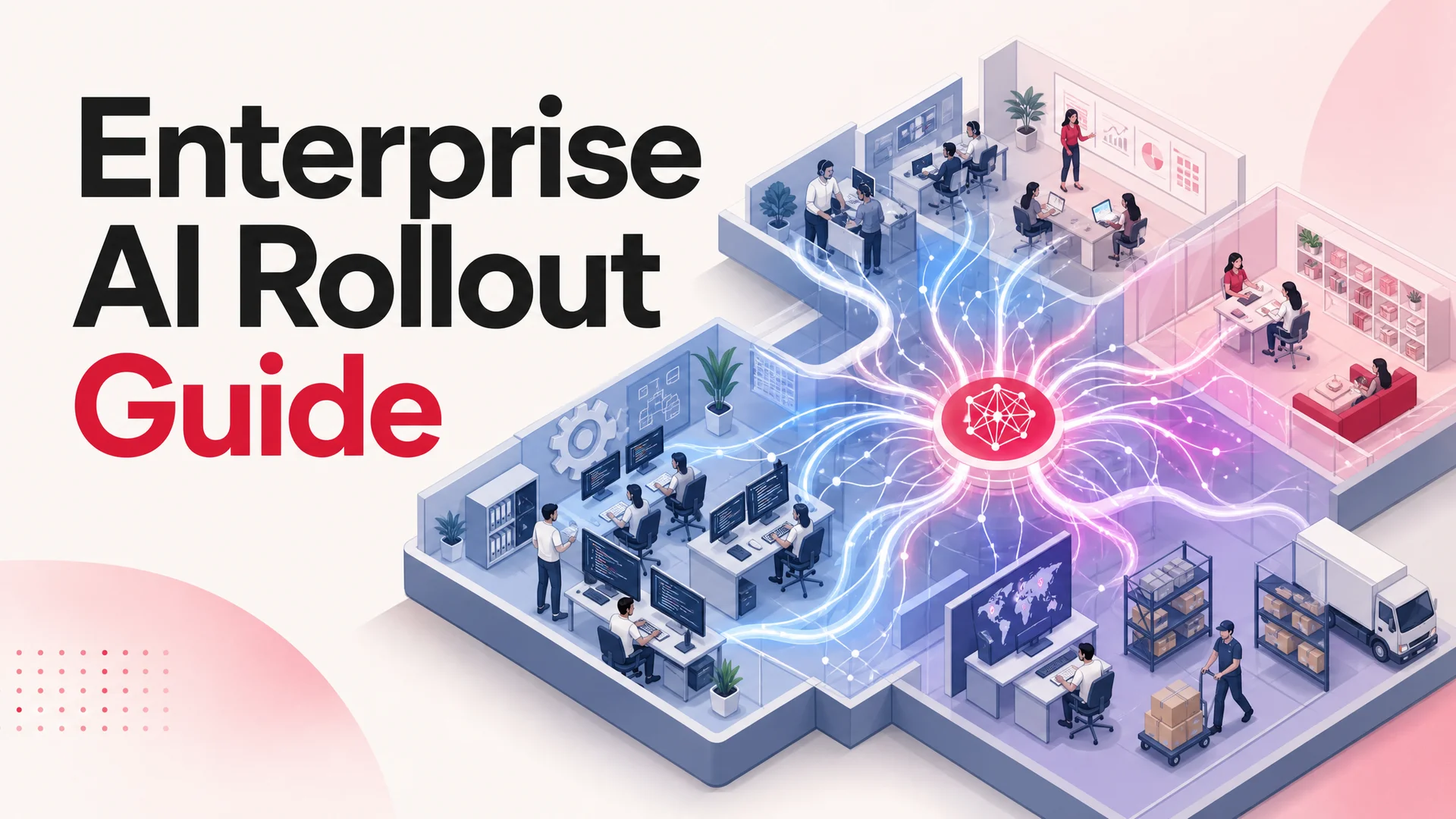
What if half your support team's queue cleared itself overnight, and the people you kept were the ones doing the work that actually compounds - root-cause investigations, escalation playbooks, voice-of-customer reports?
That is the promise enterprises like PwC, Zapier, and Block were sold when they signed ChatGPT Enterprise contracts. And to be fair, a lot of that promise has shipped. ChatGPT now has more than a billion weekly users, and the enterprise tier exists because the consumer one was never going to satisfy a security team, a compliance officer, or a CIO trying to roll AI out to fifteen thousand seats without losing sleep.
But the conversation in 2026 is no longer "should we buy ChatGPT Enterprise or stay on the free tier." The model market has fractured. Anthropic's Claude Opus 4.7 leads coding benchmarks. Google's Gemini 3.1 Ultra carries a 2M-token context window. Open-weight frontier models from DeepSeek, Z.ai, Moonshot, MiniMax, Alibaba, and Xiaomi have dropped the per-token cost of a routine support reply by an order of magnitude. The right question now is: when ChatGPT Enterprise is the right answer, and when something else - a routed multi-model platform, an open-weight deployment, or a purpose-built agent like Berrydesk - gets you further for less.
This piece walks through what ChatGPT Enterprise actually is in 2026, what it costs, where it fits, and what the realistic alternatives look like.
What ChatGPT Enterprise Actually Is in 2026
ChatGPT Enterprise is OpenAI's organization-tier offering for teams that need GPT-5.5 (and the GPT-5.5 Pro parallel-reasoning model) behind a control plane the security team will sign off on. It launched in 2023 and has been quietly rebuilt several times since - the version a buyer evaluates today bears only a passing resemblance to the original announcement.
A useful frame: the consumer ChatGPT product is a personal assistant. Enterprise is a tenant. Same underlying model family, but everything around it - identity, retention, audit, admin, billing, model access policy - assumes you are deploying to thousands of employees, not one curious analyst.
For an enterprise that has standardised on OpenAI as a strategic vendor, that bundle makes a lot of internal coordination easier. For an enterprise that has not, it can also be the most expensive way to get started.
What's Inside the Enterprise Plan
The feature set has converged across enterprise AI suites over the past year, but here is what ChatGPT Enterprise specifically ships in 2026.
Security and data isolation
Conversations and uploaded files are encrypted in transit and at rest. The tenant carries SOC 2 Type II, and OpenAI contractually commits not to train on enterprise-tenant data by default. Admins can configure data retention windows, and there is a standard DPA for European customers.
The admin console handles SAML SSO, SCIM provisioning from Okta or Entra ID, role-based access control, domain capture for auto-enrollment of new hires, and a searchable audit log. None of this is exotic anymore - every serious enterprise AI vendor offers it - but it is table stakes for IT to even begin a procurement conversation.
Unmetered access to GPT-5.5
This is the headline. Enterprise users get unlimited GPT-5.5 messaging without the throttling that consumer plans enforce. GPT-5.5 Pro, the parallel-reasoning variant released in April 2026, is metered separately via a credit pool that admins can size and assign. The same goes for the most expensive features - Deep Research, long-horizon Agent runs, advanced voice - which all draw from the credit balance rather than the flat per-seat fee.
Context windows in the ChatGPT product run up to 128K tokens, with 400K available via the API for teams that want to wire GPT-5.5 into their own systems. Useful, but worth noting that the rest of the frontier has moved further: Claude Opus 4.6 and Sonnet 4.6 ship a 1M-token window at no surcharge, Gemini 3.1 Ultra carries 2M, and open-weight DeepSeek V4 and Kimi K2.6 also run at 1M. If long context is the load-bearing requirement, ChatGPT Enterprise is not actually the strongest option.
Built-in tools
Enterprise bundles a few capabilities that would otherwise have to be bought, built, or stitched together.
- Advanced Data Analysis. A sandbox where the model writes and runs Python against uploaded files. Strong for ad-hoc analyst workflows where the alternative is a junior data scientist writing pandas for two hours.
- ChatGPT Agent. A long-horizon browser-and-tool agent that can navigate websites, fill forms, edit spreadsheets, and string together multi-step workflows. Useful, though the open-weight pack - Kimi K2.6 with its 12-hour autonomous coding sessions and 300 sub-agent swarms, GLM-5.1 with its 8-hour plan-execute-test-fix loop, and Qwen3.6's agentic family - has set a higher ceiling for tool-use depth.
- Deep Research. Reads dozens of sources, follows citations, and returns a structured report. Most useful for analyst, legal, and BD teams that previously paid junior staff to compile market scans.
- Multimodal input. Image, document, and video processing in a single chat surface.
- Canvas. A side-by-side editing environment for collaborative drafting.
- Voice and image generation. Production-grade voice synthesis and image creation, again metered through credits for the heaviest variants.
Customization and integration
ChatGPT Enterprise ships shared chat templates so teams can standardise common workflows, a connector framework for hooking up internal data sources, project and workspace primitives so the chat history doesn't sprawl, and an included API credit allowance so engineering teams can build custom apps on the same tenant.
It is genuinely a useful starting point for an internal "AI for the company" deployment. The catch is that it is also a starting point most enterprises end up outgrowing for any externally-facing use case - customer support agents, in particular - because the surface area is built for an internal assistant, not for a multi-tenant, branded, multi-channel product.
What ChatGPT Enterprise Costs
OpenAI does not publish ChatGPT Enterprise pricing. Buyers have to talk to sales, sign an NDA, and negotiate.
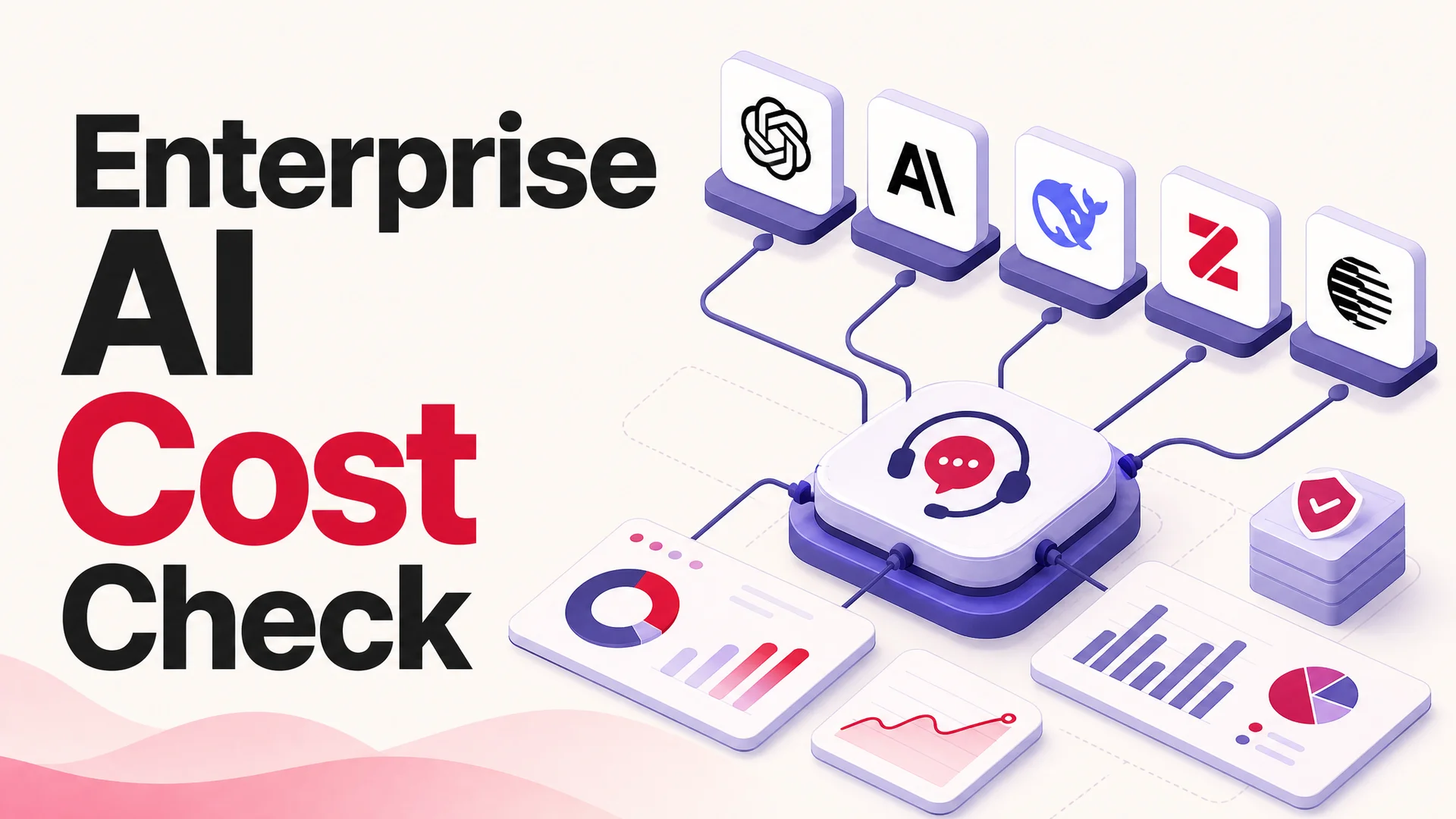
Reports from procurement leads and an oft-cited Reddit thread put the floor at roughly $60 per user per month, with a 150-seat minimum and a 12-month commitment. That math works out to about $108,000 per year for the smallest possible contract - before you've added GPT-5.5 Pro credits, Deep Research credits, Agent credits, or any of the metered features the sales pitch will lean on.
Real-world deals come in higher. Larger enterprises with multi-thousand seat counts negotiate the per-seat number down, but the credit pool tends to grow faster than the seat discount, and the total contract value lands well into the seven figures for a Fortune 1000 rollout. None of that is unreasonable for a strategic vendor, but it is a budget line the CFO will notice - and a commitment that is hard to walk back inside the contract term.
For comparison, the open-weight cost story has moved sharply. DeepSeek V4 Flash is priced at roughly $0.14 per million input tokens and $0.28 per million output tokens. A typical support resolution running through a routed Berrydesk agent - DeepSeek V4 Flash for the easy cases, Claude Opus 4.7 or GPT-5.5 only when escalation logic kicks in - comes in at fractions of a cent per resolved conversation. The economics of "flat per-seat for unlimited frontier model access" stop being obviously the right shape once that is on the table.
How Different Teams Actually Use It
ChatGPT Enterprise is most valuable when it stops being a chat window and starts being plumbed into a team's data and workflows. Here is where each function tends to find traction.
Marketing and content
Marketing teams plug the tenant into their CRM, campaign analytics, and brand asset library, and the assistant goes from a clever copywriter to something closer to a junior strategist that has read every campaign you've ever run.
- Concept generation grounded in real data. Instead of brainstorming personas from nothing, the team generates campaign concepts against actual segment-level behaviour from the CRM. The output is far more specific because the inputs are.
- Brand-faithful drafting at scale. Once the model has learned the voice from past landing pages and emails, every new asset comes out closer to the house style. This compounds - a year in, the team is barely editing first drafts for tone.
- Sentiment and trend analysis. Social listening tools surface raw mentions; the assistant compresses them into themes, flags anomalies, and suggests responses.
- Conversion-tested product copy. With the campaign archive in context, the model can lean on what has actually converted in the past instead of generic best practices.
Customer service and support
This is the use case that almost every enterprise underestimates at procurement and oversimplifies at deployment. The right framing is: ChatGPT Enterprise is a great internal copilot for support agents, but it is not a customer-facing support agent.
What works well inside Enterprise:
- Agent-assist for human reps. The assistant reads the ticket, pulls the relevant article from the knowledge base, drafts a response in the customer's tone, and the human edits and sends.
- Ticket-pattern analysis. Run the last 90 days of tickets through Deep Research and you get a structured view of recurring issues, with suggested fixes for the underlying product or content gaps.
- Knowledge base maintenance. The model spots stale articles, conflicting policies, and missing topics by cross-referencing tickets against published content.
What you usually need a different product for: a branded customer-facing chat agent that lives on your site, in Slack, on WhatsApp; that knows your customer's order history; that can take an action like booking a meeting, processing a refund, or triggering a payment flow; that you can train on your docs, your help center, your YouTube videos, and your Notion workspace without writing a connector for each. That is what Berrydesk is built for, and it is intentionally a different shape from "ChatGPT for our company."
Research and development
R&D teams use Enterprise for literature triage, patent landscape scans, and technical writing. The 128K-token context handles individual papers comfortably; for whole-corpus work, teams either chunk inputs or shift to longer-context alternatives like Claude Opus 4.6 or Gemini 3.1 Ultra. The biggest unlock here is not a model capability - it is the simple act of getting an analyst's first ten hours of every literature review back.
Sales and business development
Sales connects the tenant to the CRM, deal history, and product catalog, and the assistant becomes a deal-prep machine.
- Personalised pitch decks. Drafted from the prospect's industry, the closest historical wins, and the current product positioning.
- Objection handling. The model has read the win/loss notes and can propose responses to objections that have actually come up before.
- Real-time call support. A discreet sidebar surfacing pricing, technical detail, and competitive talking points while the rep stays focused on the call.
- Proposal generation. First-draft RFP responses and SOWs that match past templates, leaving humans to do the customisation rather than the boilerplate.
The pattern across teams is consistent: the value comes from connecting Enterprise to the data that already exists inside the company. Without that connection, it is an expensive consumer ChatGPT.
ChatGPT Plus vs. ChatGPT Enterprise
The two products run on overlapping model stacks but solve almost entirely different problems.
ChatGPT Plus
- Who it's for. Individual professionals who want faster access, longer conversations, and the latest features without enterprise overhead.
- Price. $20 per month, billed monthly. API usage is billed separately.
- Models. GPT-5.5 with priority access during peak load, image and voice modes, file uploads and analysis, and early access to new consumer features.
- Customisation. Custom GPTs and prompt-level tuning. No org controls, no shared workspaces, no admin policies.
- Privacy. Standard consumer terms. Conversations may inform product improvements unless the user opts out. Not designed for regulated workloads.
ChatGPT Enterprise
- Who it's for. Organisations that need centralised admin, security commitments, and predictable scaling across hundreds or thousands of seats.
- Price. Custom annual contract, typically a per-seat fee with a credit pool layered on top. API usage is billed separately.
- Models. Org-wide unlimited GPT-5.5, with GPT-5.5 Pro, Deep Research, Agent, and advanced voice gated through a credit allocation that admins can budget per team.
- Customisation. Connectors to internal systems, shared chat templates, projects and workspaces, and an API allowance for custom builds.
- Privacy. No training on enterprise data by default, encryption in transit and at rest, SOC 2 Type II, customer-controlled retention, and contractual ownership of inputs and outputs.
Where the line actually sits
Plus is the right product for one person. Enterprise becomes the right product when three things converge: you need centralised identity, you need a "we will not train on your data" contract a procurement team can sign, and you have enough heavy users that the unlimited messaging starts to pay back the per-seat fee.
If two of those three are missing - and for most companies under 500 employees, they are - the value-for-money line bends elsewhere fast.
Alternatives Worth Comparing in 2026
ChatGPT Enterprise is one option in a market that has gotten dramatically more interesting in the last twelve months. The honest comparison is not just "Microsoft Copilot vs Google Gemini Enterprise vs ChatGPT Enterprise." It is also "do I need an enterprise AI suite at all, or do I need a platform shaped around the specific job I am trying to do?"
The other suite vendors
- Microsoft Copilot for Microsoft 365. Around $30 per user per month, on top of an existing Microsoft 365 subscription. The strongest choice if your company already lives in Outlook, Teams, and SharePoint, because the assistant is plumbed directly into those surfaces.
- Google Gemini for Workspace. Around $30 per user per month, layered on Google Workspace. Compelling if Workspace is the daily tool, and Gemini 3.1 Pro brings a leading score on GPQA Diamond at 94.3% along with the 2M-token context on Ultra.
- Claude Team and Enterprise. Team starts around $30 per user per month with a five-seat minimum; Enterprise adds SSO, SCIM, audit logs, and the larger context windows. Anthropic has the strongest coding-benchmark story for the moment - Claude Opus 4.7 leads SWE-bench Pro at 64.3% - and Sonnet 4.6's 1M-token context at no surcharge is the sleeper feature for support and research workloads.
The pattern across the suite vendors: roughly $30 per seat per month, integrated into wherever the user already works, lower seat minimums than ChatGPT Enterprise, and a substantially shorter procurement path.
The open-weight option
For larger deployments, the cost calculus has changed enough that "run our own" has stopped being a niche position. The open-weight frontier in 2026 includes:
- DeepSeek V4 (V4 Pro 1.6T-param MoE with 49B active; V4 Flash 284B with 13B active), 1M context, V4 Flash priced at $0.14 / $0.28 per million input/output tokens, fully open source.
- Moonshot Kimi K2.6, 1T-param MoE built for agentic work, 12-hour autonomous coding sessions, swarms of up to 300 sub-agents and 4,000 coordinated steps, native video input, 58.6 on SWE-Bench Pro. Open weights.
- Z.ai GLM-5.1, 754B-param MoE under MIT license, 58.4 on SWE-Bench Pro - beats GPT-5.4 and Claude Opus 4.6 on that benchmark - and trained entirely on Huawei Ascend 910B silicon.
- Alibaba Qwen 3.6, including the dense Qwen3.6-27B (Apache 2.0, beats some 397B-param MoE rivals on agentic coding) and the MoE Qwen3.6-35B-A3B for local deployment.
- MiniMax M2 / M2.7, 230B total / 10B active, open-weight, self-evolving agent model running at roughly 8% of Claude Sonnet pricing at 2x speed.
- Xiaomi MiMo-V2-Pro, over 1T total params, 42B active, 1M context, MIT-licensed weights.
The MIT and Apache licensing on most of these is the part procurement teams actually care about: it makes air-gapped, on-prem, and sovereign deployments viable for healthcare, financial services, defence, and government workloads that simply cannot route conversations to a third-party API. For mid-sized enterprises, the same open weights make a private, single-tenant deployment cheaper to operate than an equivalent ChatGPT Enterprise contract once volume crosses a threshold.
The purpose-built option for customer support
If the actual problem you are trying to solve is "we need an AI agent that handles customer support, takes real actions, and lives across our website, Slack, Discord, and WhatsApp," ChatGPT Enterprise is solving a different problem. It is an internal productivity layer. It is not a deployable customer-facing agent.
Berrydesk is purpose-built for that job. The setup is four steps: pick the model that fits the workload (GPT-5.5, Claude Opus 4.7, Gemini 3.1, DeepSeek V4, GLM-5.1, Kimi K2.6, Qwen3.6, MiniMax M2, and others - switch any time, route different traffic to different models), train the agent on your docs, websites, Notion, Google Drive, and YouTube content, brand the chat widget, configure AI Actions for bookings, refunds, payments, and order lookups, then deploy to your site and the channels your customers actually use.
The pricing model fits the workload too: you are paying for an agent that resolves conversations, not for unmetered seats your support team won't use. For most teams evaluating ChatGPT Enterprise specifically for customer support, the right answer is to use Berrydesk for the customer-facing agent and let the engineering and analytics teams pick whichever AI suite they prefer for internal work.
How to Decide
A short decision framework, since enterprise AI procurement has become genuinely confusing:
- You need an internal copilot for a productivity-heavy team, you have 150+ seats, and OpenAI is already your strategic AI vendor. ChatGPT Enterprise is a clean fit.
- You need an internal copilot but you live in Microsoft or Google. Use Copilot or Gemini for Workspace. The integration is worth more than the marginal model difference.
- You want the strongest available model for coding, agents, or long-context work and you are not married to OpenAI. Look at Claude Enterprise (Opus 4.7 for the hard work, Sonnet 4.6 for the long-context volume) before signing the OpenAI paper.
- Cost or sovereignty is the binding constraint. Build on the open-weight frontier - DeepSeek V4, GLM-5.1, Qwen3.6, Kimi K2.6, MiniMax M2, MiMo-V2 - either through a managed router or self-hosted.
- The actual job is a customer-facing support agent. Use a platform purpose-built for it. Berrydesk gives you the model choice, the training pipeline, the brandable widget, the AI Actions, and the deployment surface in one place, without committing to a six-figure contract on day one.
ChatGPT Enterprise is a serious product solving a serious problem. It is just no longer the only serious answer, and for most companies looking specifically at customer support, it is not the right one.
If a customer-facing AI agent is what you actually need, you can build one on Berrydesk in an afternoon, route traffic across the model providers above, and ship it to your website, Slack, Discord, and WhatsApp without negotiating a contract first.
 Berrydesk
Skip the six-figure contract - launch a branded AI support agent in minutes
- Pick GPT-5.5, Claude Opus 4.7, Gemini 3.1, DeepSeek V4, GLM-5.1, or Kimi K2.6 - switch any time
- Train on your docs, websites, Notion, Drive, and YouTube; deploy to web, Slack, WhatsApp
Set up in minutes

Chirag Asarpota is the founder of Strawberry Labs, the team behind Berrydesk - the AI agent platform that helps businesses deploy intelligent customer support, sales and operations agents across web, WhatsApp, Slack, Instagram, Discord and more. Chirag writes about agentic AI, frontier model selection, retrieval and 1M-token context strategy, AI Actions, and the engineering it takes to ship production-grade conversational AI that customers actually trust.