If you run any kind of online business, you already feel the math of customer support. Reply windows shrink, ticket volume grows, the same fifty questions show up every week, and your team either burns out keeping pace or you watch your CSAT score drift. Hiring out of it stopped being affordable two model generations ago.
This is why AI customer support agents stopped being a curiosity and became a line item. Not the menu-driven chatbots from the last decade - those things that asked you to "press 1 for billing" and then dead-ended into "please email support@" - but agents that read tickets, understand the question, draft a real answer, and take real actions on the customer's behalf.
The shift is no longer theoretical. Support orgs are routing 60–80% of routine tickets to AI, holding response time under five seconds, and pushing live agents toward the conversations that actually need a human. Retention goes up because customers get answered. Margins go up because you stop paying people to copy-paste the same KB article forty times a day.
If you're shopping for a support agent in 2026 and the buying landscape feels louder than it did even six months ago, this guide is for you. We'll cover what these agents actually are now, how the underlying tech changed, what to evaluate, and where the leading platforms stack up.
What an AI customer support agent really is in 2026
The old chatbot was a decision tree wearing a chat bubble. You drew flows, you wrote the canned replies, and the moment a customer phrased their question slightly off-script, the whole thing fell apart. Builders spent more time editing flows than the bot saved them in tickets.
A 2026 AI support agent is a different category of system. It reads your help center, your product docs, your past conversations, your policy PDFs, your Notion wiki, your Drive folders, your YouTube tutorials. It composes answers in real time using a frontier model, decides when it's confident enough to send and when it should escalate, and increasingly takes action - looking up an order, issuing a refund, rescheduling a booking, kicking off a return - without an agent in the loop.
The mental model isn't "vending machine that spits out canned replies." It's closer to a well-onboarded support rep who has read every article you've ever written, never sleeps, never forgets, handles 300 conversations at once, and hands the hard ones to a human with full context attached.
What changed practically: instead of cutting ticket volume by 15% with deflection links, support teams using a proper agent platform are resolving the majority of routine tickets end-to-end. The bot isn't a pre-filter anymore. It's the first responder.
How these agents actually work under the hood
Three things make a 2026 agent feel different from a 2024 one. None of them are magic - they're concrete shifts in the underlying model stack.
They learn from sources you already have
You don't rewrite your documentation for the agent. You connect what exists. A modern platform like Berrydesk pulls from raw documents (PDFs, DOCX, CSV), live websites and sitemaps, Notion workspaces, Google Drive folders, YouTube transcripts, and your existing help center. The platform handles chunking, embedding, indexing, and re-syncing on a schedule. Whether you have twenty FAQ entries or a 4,000-page knowledge base, the same connector flow works.
The new factor here is context length. Claude Opus 4.6 and Sonnet 4.6 ship a 1M-token window at no surcharge. Gemini 3.1 Ultra runs to 2M tokens natively multimodal. DeepSeek V4 Flash carries 1M as well. That changes what "training" even means - for many teams, a long-context model can hold the entire active knowledge base in-context, and retrieval becomes a precision tuning lever rather than the load-bearing primitive it was when 8K and 32K were the norm.
They run on language models that actually reason
This is the engine. The current frontier - GPT-5.5 and GPT-5.5 Pro with parallel reasoning, Claude Opus 4.7 leading SWE-bench Pro at 64.3% for complex tool-use tasks, Gemini 3.1 Pro topping GPQA Diamond at 94.3% - handles ambiguous, multi-clause, partially-formed customer questions in a way the GPT-4-era models flat-out couldn't.
Open-weight models caught up faster than most predictions said they would. DeepSeek V4 Flash sits at $0.14/$0.28 per million input/output tokens - fractions of a cent per resolved conversation. Z.ai's GLM-5.1 (754B-param MoE, MIT license) hits 58.4 on SWE-Bench Pro, edging out GPT-5.4 and Claude Opus 4.6 on that benchmark while running on Huawei Ascend silicon. Moonshot's Kimi K2.6 sustains agentic tool sessions for up to twelve hours and coordinates swarms of sub-agents. MiniMax M2.7 hits 56.22% SWE-Pro at roughly 8% the price of a comparable closed model. Alibaba's Qwen 3.6 family ships dense and MoE variants under Apache 2.0 with strong agentic-coding scores.
What this means for support: a sensible deployment routes the long tail of routine traffic to a cheap open-weight model and reserves Claude Opus 4.7, GPT-5.5, or Gemini 3.1 Ultra for hard escalations and high-stakes flows. Cost per resolution drops by an order of magnitude versus a single-frontier-model setup, and quality on the hard cases stays where it needs to be.
They handle the whole conversation, not just the opening question
The "please rephrase your question" era is over. A 2026 agent tracks dialog state across follow-ups, holds onto entities the customer mentioned three turns ago, and stitches together facts from multiple sources mid-reply. Customers can interrupt themselves, change subject, ask "what about for the annual plan?" without re-explaining context. The agent keeps up.
They take real actions, not just read
This is the biggest shift since the last buying-guide cycle. Agentic tool-use models - Claude Opus 4.7, Kimi K2.6, GLM-5.1, Qwen 3.6, MiMo-V2-Pro - make AI Actions reliable rather than demoware. A Berrydesk agent can look up an order in your backend, create a Stripe refund, reschedule a Calendly booking, update a CRM record, or kick off a return shipment, all inside the same conversation, with audit trails. The conversation stops being a deflection layer and becomes the resolution layer.
They know when to escalate, and they hand off cleanly
A confident model is dangerous. A calibrated model is useful. Modern platforms expose confidence thresholds and let you wire escalation rules to topic, sentiment, customer tier, or specific phrases. When the bot hands off, the human agent sees the entire transcript, the sources the bot pulled from, and a synthesized summary of what the customer is actually trying to do. No "please describe your issue again" handoff friction.
What to actually evaluate before you pick a vendor
There is no shortage of glossy AI chatbot demos. The gap between "looks great in a sales call" and "still works at month four with 30,000 tickets behind it" is wide. Here's what separates the two.
1. Accuracy, grounding, and hallucination control
This is the first question, not the fifth. If the bot fabricates policies, invents shipping windows, or quotes prices that don't exist, you have a liability problem, not a productivity win.
Look for platforms that let you scope which sources the bot can answer from, expose confidence scoring so the agent declines to guess when it shouldn't, and show source citations on every reply so you can audit why the bot said what it said. Bonus points for transcript review tools where you can flag bad answers and feed them back into the bot's instructions.
2. Model choice and the freedom to switch
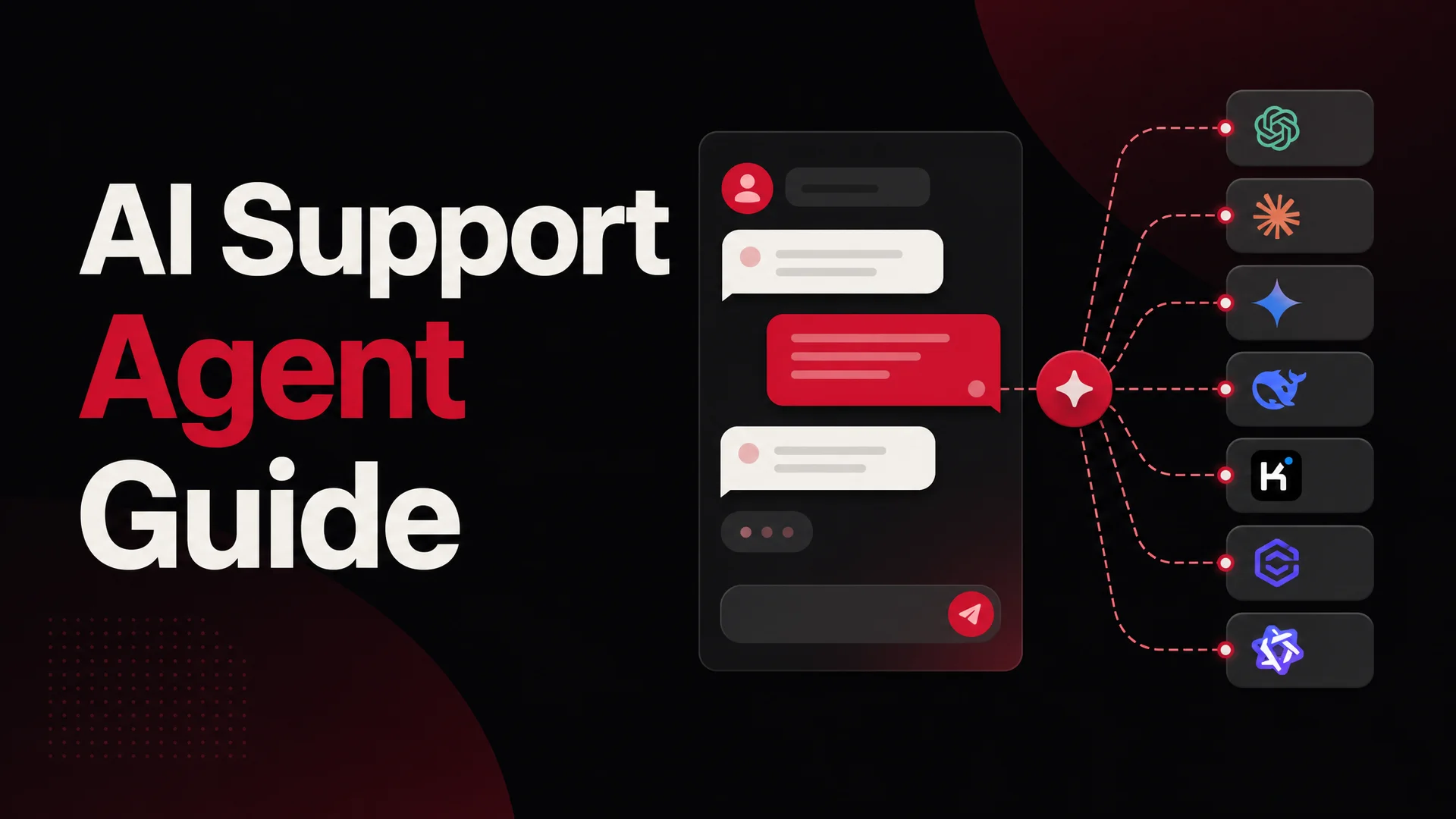
A platform that hard-locks you to one model is a platform that will charge you more next year. Insist on a vendor that lets you pick - and switch - between GPT, Claude, Gemini, DeepSeek, Kimi, GLM, Qwen, MiniMax, and others. Different models cost differently, behave differently on edge cases, and update on different cadences. Owning the routing decision matters more than picking "the best model" on day one, because the leaderboard rotates every quarter.
This is also where the open-weight story matters. If your data residency or compliance posture rules out sending tickets to closed US APIs, MIT-licensed Chinese open weights like GLM-5.1 or Qwen3.6-27B let you run on-prem or in a cloud VPC of your choosing.
3. Integrations with the stack you already run
The agent can't live in a glass box. It needs to slot into your help desk (Zendesk, Intercom, Freshdesk, HubSpot), your live chat, your email pipeline, your CRM, your internal tools (Slack), and your customer-facing channels (website, Discord, WhatsApp, Messenger). It also needs an Actions or function-calling layer with proper auth and audit so it can hit your own APIs - order systems, payment processors, booking engines, internal databases.
If a vendor lists "integrations" but every one is read-only data ingestion, you don't have an agent platform. You have a search box.
4. Control over tone, scope, and behavior
The model is powerful. You should still be the editor.
Concretely: can you set tone of voice and brand persona, write custom instructions that override default behavior, allow-list or deny-list topics the bot can answer, force specific phrasing on legally sensitive replies (refunds, medical, financial), and version your instructions so a Friday change can be rolled back on Monday? If the platform treats prompts as a black box, you're outsourcing too much.
5. Escalation, handoff, and the human-loop experience
A bot that handles 70% of tickets but botches the handoff on the other 30% will get worse CSAT than no bot at all. Evaluate: how clean is the handoff transcript? Does the human see the bot's reasoning? Can you route by intent, sentiment, or customer tier? Does the agent honor a "stop, give me a human" customer request immediately, or fight back twice first?
6. Pricing that doesn't punish growth
Watch for the trap. Some vendors charge per conversation, some per message, some per "AI credit," some per active monthly user, some bundle model costs and some pass them through. The honest framing: you should be able to model your unit economics on a back-of-envelope. If the pricing page requires a spreadsheet, your CFO will not be amused at month three.
Also check: free tier or trial without a credit card; whether team seats cost extra; whether each integration is metered separately; whether per-action invocations have hidden fees.
7. Analytics that drive improvement, not vanity metrics
Ticket count is a starting point, not an answer. The metrics that matter: deflection rate (resolved without human), escalation rate by topic, hallucination rate (flagged in review), CSAT by conversation type, average resolution time, fallback rate (when the bot says "I don't know"), and content gap reports - questions customers asked that your knowledge base couldn't answer. The last one is the most underrated; it tells you what to write next.
The 2026 ranking
Picking the "best" agent depends on your team, channels, ticket mix, and tolerance for setup work. Here's the field as of May 2026.
1. Berrydesk - best overall for AI support agents and fast setup
Why it leads. Berrydesk delivers the full agent platform without the integration tax. You can launch a branded support agent in four steps: pick a model, train it on your sources, brand the chat widget, and deploy. Most teams are live in under an hour.
- Training sources. Documents, websites, Notion, Google Drive, and YouTube - connect what you have.
- Model choice. GPT-5.5, Claude Opus 4.7 and Sonnet 4.6, Gemini 3.1 Ultra and Pro, DeepSeek V4, Kimi K2.6, GLM-5.1, Qwen 3.6, MiniMax M2.7, and more. Switch anytime; route different conversation types to different models.
- AI Actions. Bookings, payments, order lookups, refunds, custom API calls - all inside the conversation.
- Channels. Website widget, Slack, Discord, WhatsApp, and others.
- Customization. Tone, persona, scope, instructions, response style, branded widget.
- Analytics. Topic clustering, sentiment, fallback rate, source attribution, content-gap reports.
Best fit: startups, SaaS, e-commerce, and mid-market support teams that want frontier-model quality without re-architecting their stack.
Free to start. Paid tiers scale on usage and advanced features.
2. Intercom Fin - best if you already live in Intercom
If your support org is already deep inside Intercom, Fin slots in natively. It uses your Intercom help docs, runs inside the existing widget, and the handoff to human agents is the smoothest of any embedded option.
The trade-off: most of the value is locked to the Intercom ecosystem, model choice is narrower, and usage-based pricing climbs quickly once you scale beyond the free included resolutions.
3. Zendesk AI - best for large enterprises with complex routing
Zendesk AI shines when your support operation is already a maze of macros, queues, SLAs, and tagging rules. It pulls from your help center plus historical tickets, drafts replies for human agents, and embeds deeply into existing Zendesk workflows.
The trade-off: it's expensive, slower to deploy, and gated to premium Zendesk Suite plans. Smaller teams will find it overkill; large enterprises with existing Zendesk investment will find it the path of least resistance.
4. Forethought - best for triage and agent assist
Forethought isn't really a customer-facing chatbot first. It's an AI layer that predicts ticket intent, auto-routes, and assists human agents with suggested replies. If your bottleneck is human throughput rather than deflection, this is where the dollars work hardest.
The trade-off: the customer-facing chatbot exists but is less mature than the agent-assist side, and there's no self-serve free tier.
5. Tidio AI - best for small e-commerce teams
Tidio blends an AI chatbot with classic live chat in a way that fits Shopify stores and small businesses. Abandoned-cart recovery, product suggestions, and a friendly setup flow make it a sensible first step for solo founders and small support teams.
The trade-off: AI logic and integration depth are thinner than the higher-tier options. You'll outgrow it if your support volume scales fast.
Common pitfalls when rolling out a support agent
A few patterns show up over and over in deployments that stall.
Treating it as a one-time setup. A support agent is a living product. Customers ask new questions, your product changes, your policies update. Schedule a weekly review of fallback transcripts and content gaps for the first three months, then monthly after that.
Skipping the action layer. Teams that wire the agent to read-only sources and never plug in actions ship a glorified search bar. The leverage is in resolution, not deflection. Start with two or three high-volume actions (order lookup, refund, reschedule) and grow from there.
Locking into one model on day one. The leaderboard moved three times in the last six months. A platform that lets you A/B model choices and route by ticket type future-proofs the deployment. Don't pick the cheapest model for everything; don't pick the most expensive model for everything either.
Ignoring the handoff experience. If your live agents hate the AI agent - usually because handoffs arrive without context, or because the bot fights customer requests for a human - they will route around it and your deflection rate will collapse. Treat the human-loop UX as part of the rollout, not an afterthought.
Letting the bot answer questions it shouldn't. Refund policies, medical claims, legal questions, anything regulatory - scope these explicitly. Force the agent to escalate or use exact pre-approved phrasing. The cost of one bad reply on a sensitive topic is higher than the cost of a hundred handoffs.
Wrapping up
AI customer support agents are not a hype cycle anymore. They are infrastructure. The teams that adopted them early in 2024 have already moved on from "does it work?" to "which model do we route this conversation to, and how do we measure resolution quality?"
The 2026 landscape gives you more leverage than ever: frontier models that actually reason, open-weight options that crater the cost of routine traffic, million-token context windows that change what training looks like, and agentic tool-use that turns the chat widget into the resolution layer rather than the queue layer.
If you want to see what a properly modern support agent feels like - branded, multi-model, action-enabled, deployed across web, Slack, Discord, and WhatsApp - start free at berrydesk.com. Most teams are live the same afternoon.
 Berrydesk
Launch your AI agent in minutes
- Train on docs, websites, Notion, Drive, and YouTube
- Pick from frontier and open-weight models - switch any time
Set up in minutes

Chirag Asarpota is the founder of Strawberry Labs, the team behind Berrydesk - the AI agent platform that helps businesses deploy intelligent customer support, sales and operations agents across web, WhatsApp, Slack, Instagram, Discord and more. Chirag writes about agentic AI, frontier model selection, retrieval and 1M-token context strategy, AI Actions, and the engineering it takes to ship production-grade conversational AI that customers actually trust.