It is 11:47 PM. Somewhere on the other side of the world, a buyer has your pricing page open in one tab and a competitor's in another. They have a single, almost-trivial question - does your product integrate with the CRM their team already runs? - and a clean answer would close the deal tonight.
They click your live chat widget. "Our team is currently offline. We'll get back to you during business hours."
By morning, their card has gone to whoever answered first.
This is not a hypothetical scene. It is the arithmetic behind a stat that has stayed remarkably stable through the last three years of buyer research: roughly nine out of ten customers describe an "immediate" response as essential or very important when they have a support question. Human teams cannot staff that expectation across every time zone, every channel, and every spike in traffic without burning through budget. AI customer service agents can - and in 2026, the agents finally answer the way a senior support rep would.
Before we get to the five platforms worth a serious look, it is worth pausing on what changed under the hood, because the answers are no longer interchangeable.
Why 2026 is the year support teams actually deploy AI agents
For most of the last three years, "AI support agent" meant a fragile script wrapped around an aging language model with a knowledge base awkwardly bolted on. The bots could read FAQs aloud, but they could not actually do anything, and they hallucinated under any pressure.
That floor has lifted dramatically. By May 2026, a production support agent has the following toolbox to draw from:
- Frontier closed models with serious headroom. GPT-5.5 and GPT-5.5 Pro brought parallel reasoning to OpenAI's stack in April 2026. Claude Opus 4.7 leads SWE-bench Pro at 64.3% and is, in practice, the leader on hard, multi-turn reasoning. Gemini 3.1 Ultra ships with a 2M-token context window and native multimodality across text, image, audio, and video.
- Open-weight frontier models that collapse the per-resolution cost curve. DeepSeek V4 Flash runs at $0.14 / $0.28 per million input/output tokens with a 1M context. MiniMax M2.7 is roughly 8% the price of Claude Sonnet at twice the speed. Z.ai's GLM-5.1 (MIT license, 754B-param MoE) edges out GPT-5.4 and Claude Opus 4.6 on SWE-Bench Pro and runs on Huawei Ascend silicon - no Nvidia anywhere in the stack.
- Agentic tool-use that finally survives production. Moonshot's Kimi K2.6 sustains 12-hour autonomous sessions and orchestrates swarms up to 300 sub-agents. GLM-5.1 runs an 8-hour plan-execute-test-fix loop. Claude Opus 4.7, Qwen3.6, and Xiaomi MiMo-V2-Pro are all reasoning-first agentic models. The same skill set that lets these models patch code reliably is what makes "AI Actions" - refunds, bookings, order lookups, payment captures - work without smoke and mirrors.
- 1M–2M token context windows. Your entire knowledge base, the full conversation, the refund policy, and the last six tickets from this customer all fit in-context. RAG turns into a tuning lever instead of a hard architectural requirement.
The platforms below differ in how much of that leverage they pass to you, and how much friction you accept in return. Pricing, in particular, varies wildly: a routed open-weight setup can land at fractions of a cent per resolution, while a closed-model enterprise contract can run into six figures a year.
1. Berrydesk
Best for: Teams that want a branded AI support agent live in an afternoon, with the freedom to route traffic between frontier and open-weight models for cost control.
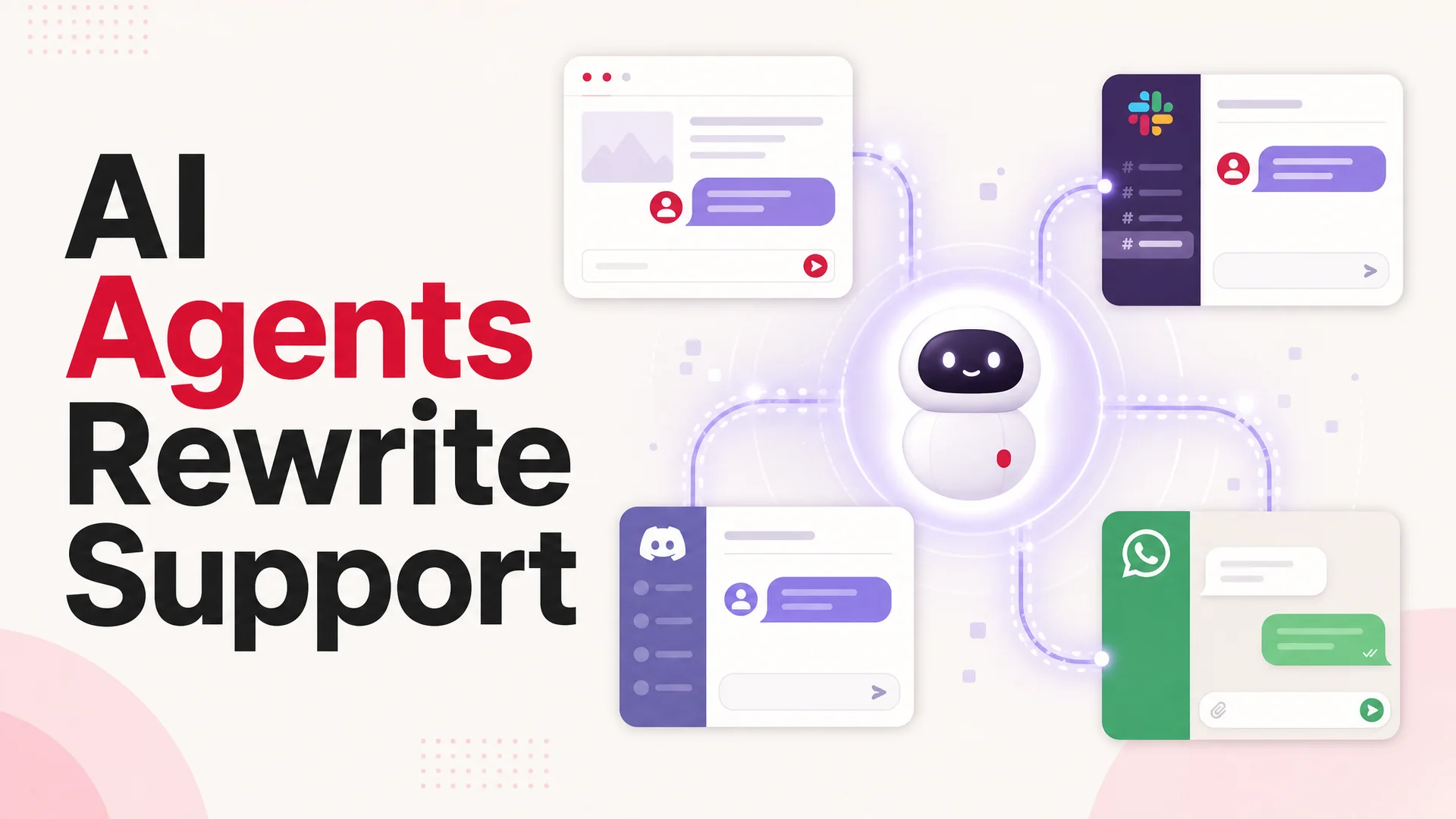
Berrydesk collapses the build into four steps. Pick a model. Train it on the sources your team already maintains - help center articles, your live website, a Notion workspace, a shared Google Drive folder, even a YouTube channel of product walk-throughs. Brand the chat widget so it looks like part of your product, not a stock bubble in the corner. Wire up AI Actions for the workflows that matter most to your team - bookings, refunds, payment capture, order status, account lookups. Then deploy to your website, Slack, Discord, WhatsApp, and the other channels customers already live in.
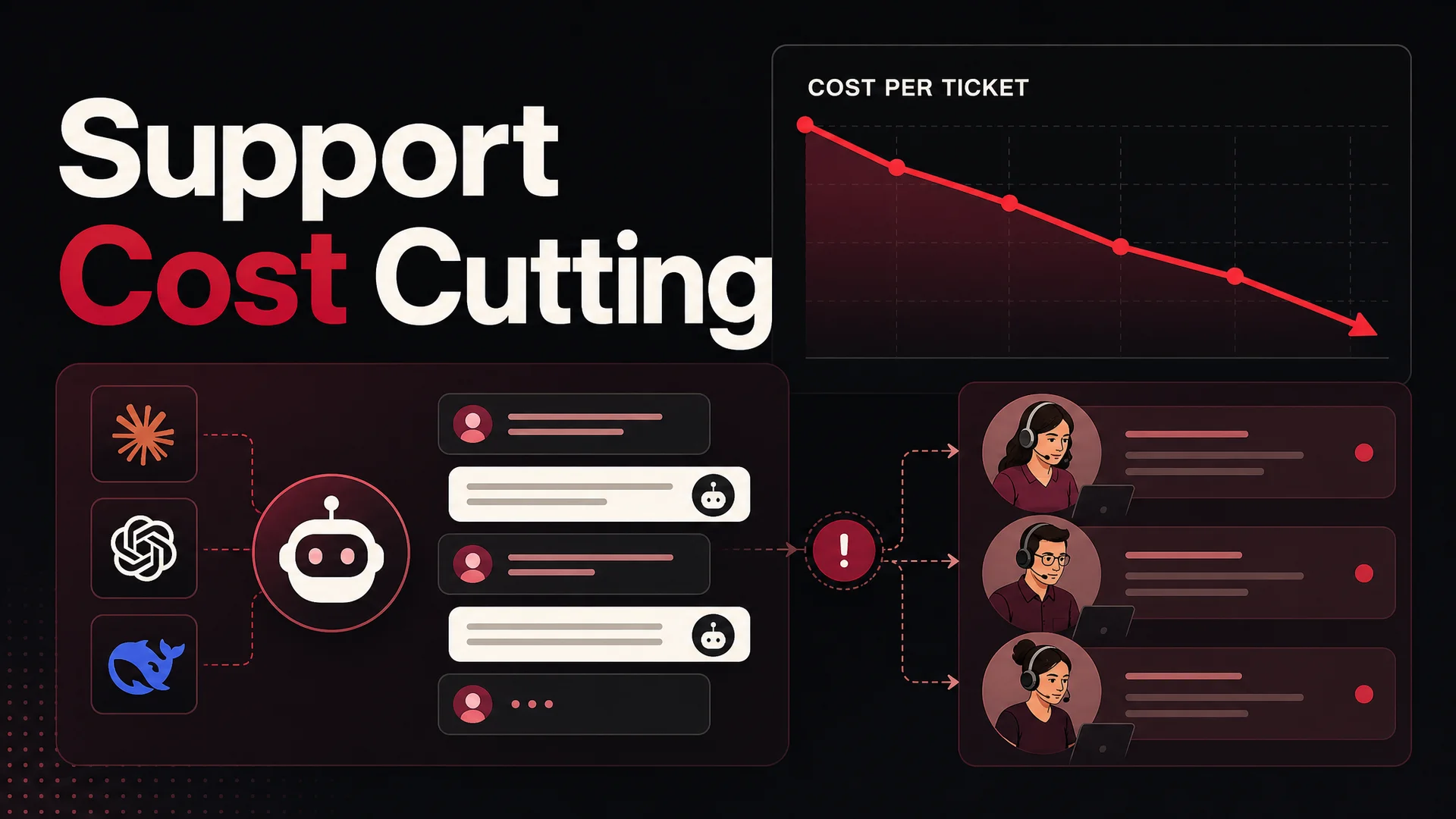
The reason model choice matters is simple. A password-reset question and a billing-dispute escalation are not the same workload. Routing the routine traffic to DeepSeek V4 Flash or MiniMax M2 - both open-weight, both inexpensive - and reserving Claude Opus 4.7 or GPT-5.5 for the hard escalations is the difference between an AI program that pays for itself in week one and one that quietly bleeds margin.
What makes it stand out
- Train on every source your team already uses. PDFs, your live site, Notion pages, a Google Drive folder of policies, even the transcript of a YouTube product walk-through. The agent learns from material your team is already maintaining, so it stays current as you do.
- Pick the right model per agent. GPT-5.5, GPT-5.5 Pro, Claude Opus 4.7, Sonnet 4.6, Gemini 3.1 Ultra, Gemini 3.1 Pro, DeepSeek V4, Kimi K2.6, Z.ai GLM-5.1, Qwen3.6, MiniMax M2, MiMo-V2-Pro - choose per use case, per region, or per cost tier.
- A branded widget without front-end work. Colors, copy, avatar, position, suggested questions, and CTAs are configurable from the dashboard.
- Real AI Actions, not just answers. Book demos, take payments, look up orders, trigger refunds, update CRM records. The agentic tool-use of the underlying models means actions complete reliably instead of getting stuck halfway through a flow.
- Deploy to the channels customers actually use. Website, Slack, Discord, WhatsApp, and more - one agent, many surfaces.
- Smart handoff with full context. When a conversation needs a human, the agent passes the entire transcript, the customer's intent, and any partial actions in flight, so your team is not starting from zero.
- Analytics tuned to the support job. See where the agent stalls, which questions trigger handoffs, and which answers are improving over time.
What to keep in mind
- Chat is the center of gravity. Voice-channel support is best handled through a dedicated voice partner integrated alongside Berrydesk, rather than out of the box.
- Deep custom integrations benefit from a developer. The drag-and-drop AI Actions cover the common workflows; bespoke internal systems will want a small amount of API work.
Pricing
Berrydesk publishes a free tier so you can validate the agent against real traffic before committing, with usage-based plans above it that scale with conversations and the model mix you choose. The economics are deliberately set up so that routing routine queries to open-weight models keeps per-resolution cost very low, with frontier models reserved for the conversations that need them. Current numbers live at berrydesk.com.
2. Ada
Best for: Mid-market and enterprise support orgs that need disciplined accuracy and complex automated workflows, and have the volume to justify the contract.
Ada has been working on AI support longer than almost anyone else in the category, and that maturity shows up most clearly in two places: a low hallucination rate, and a workflow builder you can drive in plain English ("collect order number, verify customer identity, issue refund, send confirmation email"). For a regulated industry or a high-volume team that gets paged when the bot says the wrong thing, both of those matter more than any flashy demo.
What makes it stand out
- Low hallucination rate. Ada has built a strong reputation for grounded, accurate responses, which is most of the battle in financial services, healthcare, and other industries where a wrong answer is a compliance event.
- Plain-text workflow builder. Describe automations in natural language; Ada converts them into runnable flows. This is a significant productivity unlock for ops teams that do not write code.
- Multi-channel coverage. Chat, email, SMS, and voice from a single platform, which is rare at this level of polish.
- Strong analytics. Performance tracking, gap analysis, and AI-generated suggestions for what to improve next.
- A well-funded, stable vendor. A 200+ person team and steady product velocity, which matters for procurement.
What to keep in mind
- Volume floor. Ada is built for organizations with thousands of conversations per month and is not designed for small teams or startups.
- Bring your own help desk. Ada plugs into Zendesk, Freshdesk, and similar - it does not replace them.
- Enterprise pricing model. Contracts typically run from the low five figures up to the mid five figures annually, depending on volume and customization.
- Setup is a project, not an afternoon. Plan for active configuration time and cross-functional involvement.
Pricing
Ada does not publish standard tiers; deals typically land between roughly $4,000 and $64,000 per year depending on scope, channels, and customization.
3. Tidio
Best for: Small businesses and DTC stores that want a single platform for AI chat, live chat, and basic email, without an enterprise budget.
Tidio bundles an AI agent (Lyro), live chat, and email marketing into one workspace. Lyro handles the repetitive questions in something close to a natural conversation, and when a query gets too thorny, it hands off to a human teammate. The pitch is "you do not have to choose between automation and human support" - and for a five-person store, that is the right framing.
What makes it stand out
- Visual drag-and-drop bot builder. Build flows without touching code, with a UX designed for non-technical operators.
- AI plus human in one inbox. Lyro fields the routine traffic, your team takes the hard stuff, and the conversation history travels with the handoff.
- Multi-channel inbox. Website chat, Facebook Messenger, Instagram, and email all flow into a single dashboard.
- Real-time visitor tracking. See who is on the site and what they are browsing, with the option to reach out proactively.
- eCommerce-friendly. Native integrations with Shopify, WooCommerce, and the rest of the usual stack.
What to keep in mind
- Conversation caps on lower plans. The starter tiers cap monthly conversations, which can squeeze growing teams.
- Lyro AI is metered separately. The headline plans cover the inbox; AI conversations are an add-on.
- Capabilities top out below enterprise. For genuinely complex workflows, you will outgrow it.
Pricing
Approximate annual-billed rates: Starter around $24/mo (100 conversations, 50 Lyro AI conversations, 10 seats), Growth around $49/mo (more conversations, advanced analytics), Plus around $749/mo (custom volumes, dedicated CSM), Premium custom-quoted with a managed-service component. Lyro stand-alone starts around $32/mo for 50 AI conversations.
4. Octocom
Best for: eCommerce brands that need omnichannel AI support across chat, email, SMS, social DMs, and voice, billed in a single currency: conversations.
Octocom is built around a deliberately simple economic model: one price per conversation, regardless of which channel that conversation came in through. A question on Instagram costs the same as a question on the site widget, which makes forecasting straightforward as social channels grow.
What makes it stand out
- Truly omnichannel. Chat, email, SMS, social, and voice (early access) under one roof.
- Channel-agnostic pricing. One per-conversation rate, no per-seat or per-channel surcharges to model out.
- Help desk included. Built-in ticketing, no need to bolt on a separate tool.
- Multi-brand support. Run separate agents for separate store brands from a single dashboard - a real benefit for portfolio operators.
- eCommerce integrations. Deep ties to Shopify, WooCommerce, and the rest of the usual stack.
What to keep in mind
- Hands-on setup. Expect a few days of active work to get the knowledge base in good shape.
- Younger company. Less of a track record than the longer-tenured competitors on this list.
- Customization ceiling. Fewer of the deep customization knobs you get with enterprise platforms.
Pricing
Basic around $100/mo (text) or $150/mo (voice) for 350 conversations. Advanced around $200/mo (text) or $250/mo (voice) for 350 conversations with omnichannel and order management. Custom tier for API access and enterprise needs. Volume tiers scale up to 5,001+ conversations. WhatsApp, Instagram, Facebook Messenger, email, and live chat are included as free add-ons.
5. Intercom (Fin)
Best for: Growing companies that want a complete customer engagement platform - messaging, help center, product tours, and AI automation - rather than a stand-alone chatbot.
Intercom is a full customer-communication suite, not a chatbot with extras. Live chat, in-app messaging, email campaigns, a help center, and product tours all sit on the same data model. Fin, Intercom's AI agent, sits on top and answers questions automatically by drawing on your help-center content. In 2026, Fin runs on frontier-class models and has caught up to specialist tools on accuracy for help-center-grounded answers.
What makes it stand out
- Fin grounded in your content. Pulls answers from your help center and documentation, with citations back to source articles.
- Smart routing. Conversations get assigned to the right teammate based on context, skills, and availability.
- Rich customer profiles. Full history, behavior data, and event timelines visible during every conversation.
- Product tours and onboarding. Guide users through your app in-product, not just in support.
- Robust integrations. Connects with effectively every CRM and marketing tool a growth team is likely to use.
What to keep in mind
- Costs add up quickly. Per-seat plus per-resolution pricing escalates as the team grows.
- Fin is metered separately. Each Fin resolution is billed on top of seat pricing.
- Steep learning curve. Worth it for the breadth, but plan for onboarding time before the platform pays back.
Pricing
Essential at $29/seat/mo plus $0.99 per Fin resolution, Advanced at $85/seat/mo plus $0.99 per resolution, Expert at $132/seat/mo plus $0.99 per resolution with SSO, HIPAA, and SLAs. Annual billing required, 14-day free trial available.
How to actually choose between them
The "best" platform on this list depends almost entirely on three variables: the volume of support conversations you handle, how regulated your industry is, and how much engineering time you can spend on the implementation.
- Lean teams that want to be live this week are best served by Berrydesk or Tidio. Berrydesk in particular is built so a non-technical operator can pick a model, point it at the documentation, brand the widget, and ship - without making any architectural decisions they will regret three months in.
- Mid-market and enterprise teams in regulated verticals should put Ada on the shortlist. The accuracy story and the workflow-builder maturity earn the price tag.
- eCommerce operators living in social DMs should look hard at Octocom for the channel-agnostic pricing.
- Companies that already run on Intercom will get the smoothest path to AI by enabling Fin, accepting the per-resolution metering as the cost of staying on a platform their team already knows.
If you do not fall cleanly into one of those buckets, the underrated move in 2026 is model routing. Put a frontier model on the conversations that need it (escalations, edge cases, anything customer-facing that involves money) and an inexpensive open-weight model on the long tail of routine questions. That is the architecture Berrydesk is set up to deliver out of the box, and it is the difference between an AI program that funds itself by month two and one that quietly inflates the support budget.
Frequently asked questions
Can AI support agents fully replace a human team?
No, and the teams that try this regret it. AI agents are excellent at the repetitive 60–80% of inbound - the password resets, the order lookups, the policy clarifications, the "where is my refund" loops. They do not replace the judgment a senior support rep brings to a billing dispute or a frustrated long-time customer. The right pattern is to let AI take the routine traffic so your team can spend more time on the conversations that actually need empathy.
How long does it take to set up an AI support agent?
It depends entirely on the platform. Berrydesk is designed to go live in under an hour - point it at your documentation, pick a model, brand the widget, deploy. Tidio sits in the same range. Octocom typically takes a few days to get the knowledge base into good shape. Ada is a multi-week implementation. Intercom Fin is fast if you already use Intercom, slower if you are migrating off a different help desk.
Do I need a developer to implement these tools?
For 2026's mainstream platforms, no. Berrydesk, Tidio, and Octocom are designed for non-technical operators. You will want developer time for advanced AI Actions that touch internal systems (custom CRM updates, bespoke billing flows), but the baseline "answer questions about my product" agent does not require any code.
Which platform should a first-time deployer start with?
Berrydesk is the easiest entry point. The free tier lets you validate against real traffic, the four-step setup avoids architectural decisions, and the multi-model routing means you do not lock yourself into one vendor's pricing as you scale.
How accurate are AI support agents in 2026?
Accuracy is now a function of two things: the model under the hood and the quality of your documentation. With current frontier models - Claude Opus 4.7, GPT-5.5, Gemini 3.1 Ultra - and a well-maintained knowledge base, mainstream platforms routinely answer 80–90% of inbound correctly. The remaining 10–20% should hand off cleanly to a human, with the full transcript and any partial actions in flight passed along.
The honest take
AI customer service agents are not a future technology any more. They are answering questions for buyers right now, often for direct competitors, often at 11 PM in a time zone where you have no team online. The platforms above each solve the problem at a different point on the cost-to-control curve.
The fastest way to find out which one fits your business is to put one in front of real traffic. Berrydesk is built specifically for that - train it on the documentation you already have, brand the widget so it looks like part of your product, wire up the one or two AI Actions that matter most to your funnel, and watch the inbox.
If you want to see what an AI support agent that actually fits your stack looks like, start with Berrydesk. No credit card. Live in an afternoon. The worst-case outcome is that you learn exactly how much of your inbound is routine - which is information worth having either way.
 Berrydesk
Launch your branded AI support agent in minutes
- Train on docs, sites, Notion, Drive, or YouTube - no code
- Choose from GPT-5.5, Claude Opus 4.7, Gemini 3.1, DeepSeek V4, Kimi K2.6, GLM-5.1, Qwen, and more
Set up in minutes

Chirag Asarpota is the founder of Strawberry Labs, the team behind Berrydesk - the AI agent platform that helps businesses deploy intelligent customer support, sales and operations agents across web, WhatsApp, Slack, Instagram, Discord and more. Chirag writes about agentic AI, frontier model selection, retrieval and 1M-token context strategy, AI Actions, and the engineering it takes to ship production-grade conversational AI that customers actually trust.