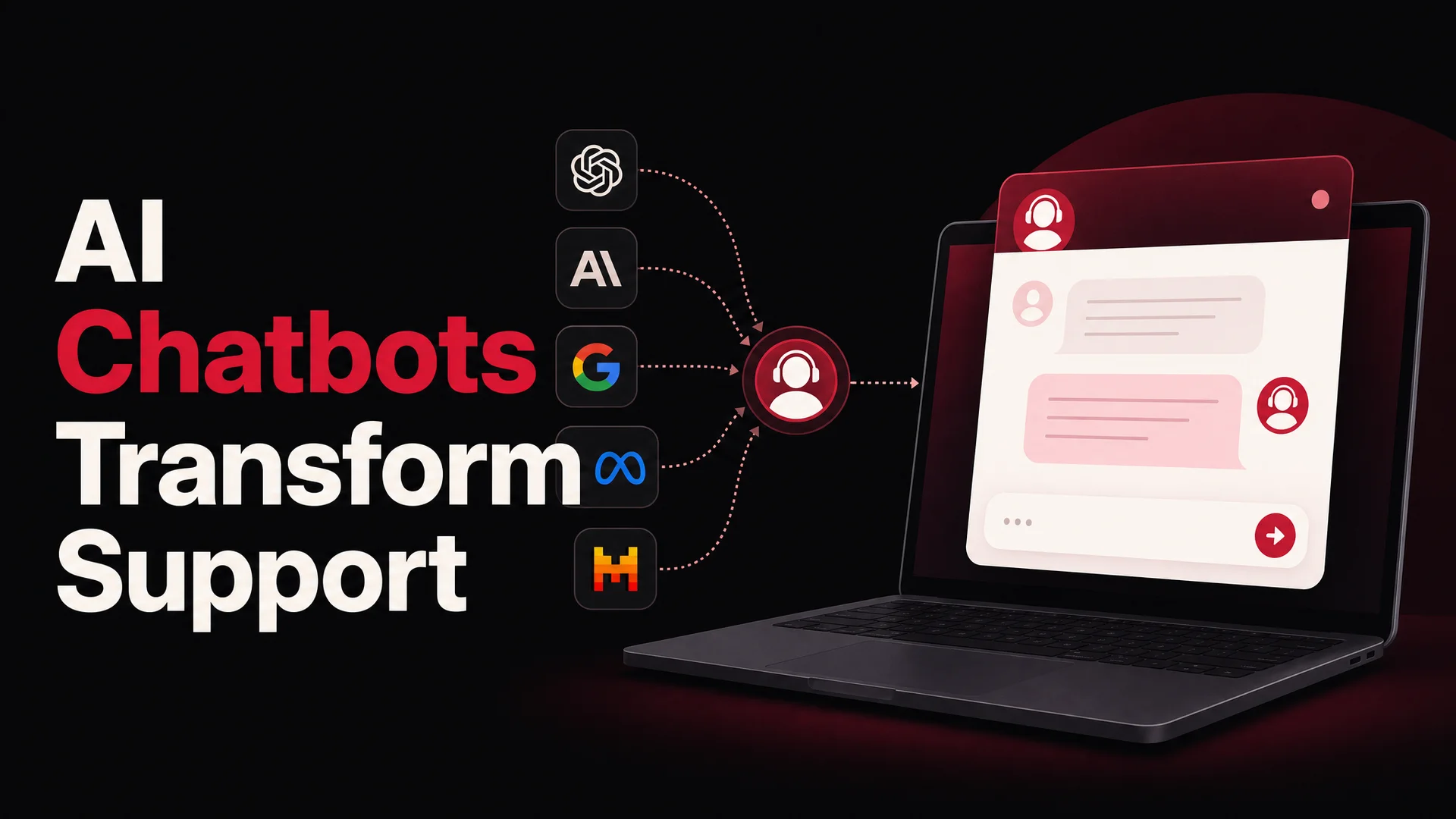
AI chatbots no longer sit at the edges of a support operation. In 2026, well-tuned agents resolve the majority of inbound conversations end-to-end - answering policy questions, looking up orders, processing refunds, scheduling appointments, and routing the rest to humans with full context attached. The economics changed too: between open-weight frontier models from DeepSeek, Z.ai, Moonshot, MiniMax, Alibaba, and Xiaomi, and 1M–2M-token context windows on the closed leaders, what cost a fortune to run a year ago now runs at fractions of a cent per resolution.
That shift reframes the conversation. The question is no longer "can a chatbot handle this?" but "which model do I route this ticket to, what tools should it have, and where does a human still belong in the loop?" This piece walks through what AI chatbots actually do for customer service today, where they shine, where they trip, and how to think about deploying one without burning a quarter on a science project.
From rule-based scripts to agentic conversation
The first generation of support bots ran on decision trees. You typed something, a regex matched a keyword, and the bot replied with a canned answer. They were brittle, frustrating, and the source of the "press 0 for an agent" reflex that still haunts customers today.
Modern conversational agents are a different species. They are built on large language models that understand intent, hold context across long conversations, switch languages mid-thread, and take real action through tool calls. The leap from "search my FAQ" to "diagnose, decide, and execute" happened in stages: better instruction-following, longer context windows, then native tool use, and most recently, autonomous agentic loops that can run multi-step workflows without supervision.
What this looks like in practice: a customer messages a furniture retailer at 2 a.m. about a delayed delivery. The agent identifies the order from a confirmation number in the chat history, queries the carrier's API, sees the package is stuck at a hub, applies the company's standard goodwill credit per the policy doc it was trained on, books a redelivery slot, and writes a clear summary to the CRM - all in one conversation, in the customer's preferred language, with no human touching the ticket. A year ago that scenario was a vendor demo. Today it is table stakes for any team running a current-generation agent.
What changed in the model landscape
The reason 2026 looks different from 2024 is the model layer underneath. Three things shifted at once.
Closed frontier got dramatically more capable
GPT-5.5 and GPT-5.5 Pro launched in April 2026 with parallel reasoning that lets the model run multiple solution paths and pick the strongest. Claude Opus 4.7 leads SWE-bench Pro at 64.3% on complex coding, but the same reasoning depth shows up in support work - fewer hallucinations on policy edge cases, cleaner refusals when the answer truly isn't in the knowledge base. Gemini 3.1 Ultra ships with a 2M-token context, which means an agent can carry an entire product manual, a customer's full purchase history, and a 200-message thread without ever needing to compress or truncate.
Open-weight frontier collapsed cost
This is the big one for support economics. DeepSeek V4 Flash, released April 24, 2026, runs at $0.14 per million input tokens and $0.28 per million output. That is cheap enough that even verbose, multi-turn support conversations cost a fraction of a cent. MiniMax M2.7 lands at roughly 8% the price of Claude Sonnet at twice the speed, and its self-evolving agent architecture means it gets better at your specific workflows over time. Z.ai's GLM-5.1 (754B-param MoE, MIT license) and Moonshot's Kimi K2.6 (1T-param MoE, agentic-first) both ship with serious tool-use chops, and both can be self-hosted if data residency is a hard requirement. Xiaomi's MiMo-V2-Pro (>1T total params, 1M context, MIT-licensed weights) and Alibaba's Qwen3.6-27B (Apache 2.0, dense, beats much larger MoE rivals on agentic coding benchmarks) round out a deep open bench.
Long context turned RAG into a tuning lever
When 1M and 2M-token windows are standard, you no longer have to chop your knowledge base into 500-token chunks and pray the retriever picks the right one. You can stuff the whole policy library, the relevant product pages, and the customer's history straight into the prompt. RAG still has a place - it controls token costs and improves attribution - but it stopped being a hard requirement. That is a meaningful simplification for teams who do not have a search-engineering bench.
For a Berrydesk deployment, the practical takeaway is straightforward: route routine traffic to a cheap, fast open-weight model, reserve frontier closed models for the hard escalations, and let the platform handle the model-selection plumbing.
Industry-specific deployments worth studying
The most interesting deployments in 2026 are not horizontal "we put a chatbot on our site" projects. They are vertical, opinionated, and deeply integrated.
In financial services, agents help self-employed contractors and small business owners navigate products that were genuinely confusing pre-AI: lines of credit with seasonal draw schedules, equipment financing with usage-based terms, business cards keyed to specific spend categories. A well-trained agent walks the customer through a structured intake - what does their cash flow look like, what is the project pipeline, what existing obligations matter - and recommends a short list of products with a plain-language explanation of why each fits. That kind of guided qualification used to require a 30-minute call with a specialist; an agent does it in five minutes at any hour of the day, then hands a complete profile to the human who closes the deal.
In e-commerce, agents own the long tail of "where is my order," size and fit questions, return initiations, and proactive outreach when a shipment slips. The interesting part is what happens when the agent has tool access: it can query the OMS, issue a partial refund within policy, generate a return label, and send the customer a tracking link without a human ever opening the ticket. Berrydesk's AI Actions cover exactly this - bookings, refunds, payments, lookups - wired up as named tools the agent can call.
In SaaS, agents handle technical questions by reading docs, code samples, and changelog entries that change weekly. Long context is decisive here: an agent that can hold the entire developer documentation and the customer's last 50 API requests in-context will diagnose far more accurately than one that has to retrieve from a chunked index.
In healthcare and regulated industries, the open-weight, MIT-licensed Chinese frontier (GLM-5.1, Qwen3.6, MiMo) is the unlock. Self-hosted on your own infrastructure, with weights you can audit and a license that does not encumber commercial use, on-prem and air-gapped deployments are finally viable for the kinds of teams that previously could not touch hosted LLMs.
What modern agents actually do
It helps to be specific about capabilities, because the term "AI chatbot" still gets used to describe everything from a 2018 decision tree to a fully autonomous agent.
Understand intent, not just keywords
Current models infer what a customer actually wants, even when the phrasing is messy, indirect, or buried under emotion. A message like "I cannot believe this is happening again, this is the third time" is correctly read as a frustrated repeat customer with a recurring issue, not a literal complaint about repetition. The agent adjusts tone, prioritizes resolution, and surfaces the customer's recent ticket history without being explicitly asked.
Hold context across long conversations
A 1M-token window is roughly 750,000 words of context. An entire conversation history, the full product knowledge base, the relevant policy documents, and the customer's account record fit comfortably with room to spare. The agent does not "forget" what was said in the third message when responding to the thirtieth.
Take action through tools
This is the agentic shift. Modern models - Kimi K2.6, GLM-5.1, Claude Opus 4.7, Qwen3.6, MiMo-V2-Pro - are reliably good at calling tools. In a Berrydesk deployment, an AI Action might be lookup_order(order_id), issue_refund(amount, reason), book_appointment(slot), or escalate_to_human(reason, summary). The model decides which to call, fills in the arguments, reads the response, and continues the conversation. Done well, the customer never sees the machinery.
Learn from every interaction
Every conversation is training signal. Tickets the agent handled cleanly become positive examples; ones a human had to take over flag gaps in the knowledge base or holes in the tool inventory. Over weeks, automation rates climb as the team feeds resolved escalations back into the agent's training material.
Personalization that actually feels personal
Generic personalization - "Hi, $FIRST_NAME!" - has been the default for a decade and customers tune it out. What works in 2026 is structural: an agent that genuinely knows the customer's history and adapts what it says and what it offers based on that context.
Concretely, an agent connected to a CRM and order system can:
- Recognize a returning customer and acknowledge their last interaction without being prompted
- Cross-reference recent purchases against the current question to suggest a relevant accessory or upgrade only when it actually fits
- Skip steps that have already been completed - if the customer is already verified in the session, do not ask them to verify again
- Adjust tone based on past sentiment - calmer and more apologetic for a customer who has previously escalated
The trick is restraint. The temptation is to use every signal you have on every interaction. The teams getting the highest CSAT are the ones whose agents feel attentive but not surveilled.
Multilingual, multichannel, and where customers actually are
Customers do not pick a channel before they pick a problem. They reach for whatever is closest. That means a serious 2026 deployment ships across:
- Website chat widgets, embedded in product pages, help centers, and inside authenticated app surfaces
- Mobile apps, with a consistent agent identity across web and native
- WhatsApp, Messenger, Instagram DMs, and the SMS fallback
- Slack and Discord for B2B and developer-tool customers
- Email, where the same agent that runs live chat can draft, send, and follow up on threaded conversations
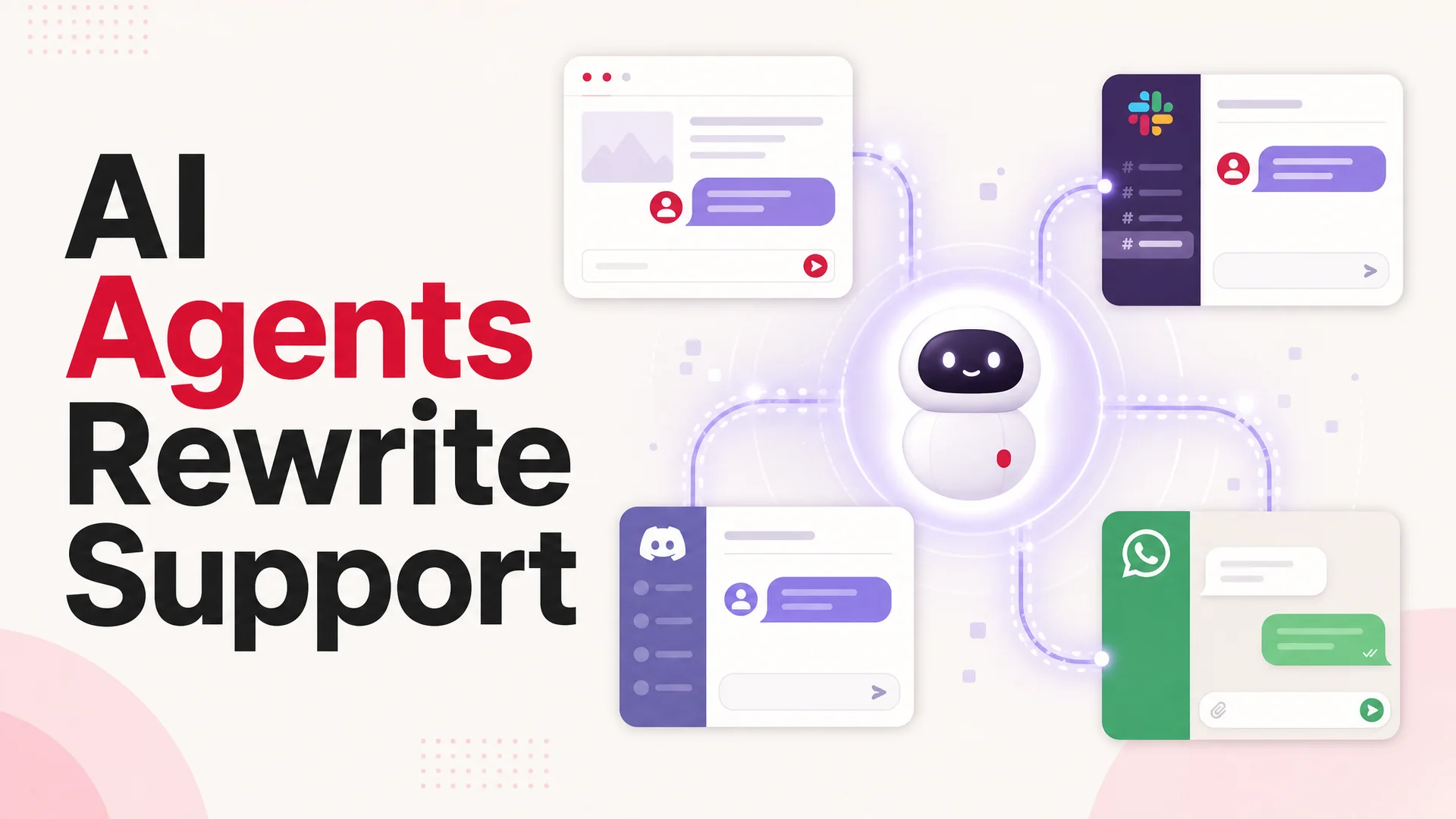
The win is not just presence on every channel - it is a single agent identity, trained once, that behaves consistently across all of them. A Berrydesk agent deploys to web, Slack, Discord, WhatsApp, and more from the same configuration; you do not rebuild it per surface.
Multilingual support is similar. Current frontier models handle 100+ languages out of the box, with quality high enough that a Spanish-speaking customer and an English-speaking customer get equally fluent help. The interesting choices are operational: which languages do you officially support, and which do you let the agent attempt with a clear "this is machine-translated" disclosure?
Cost and efficiency: what the numbers look like now
The cost story changed. A few years ago, running an AI agent at scale on closed frontier models was genuinely expensive - easily a meaningful line item for any company doing real volume. The combination of open-weight frontier and aggressive pricing on closed models flipped that.
Teams running Berrydesk-style deployments in 2026 typically see:
- A large majority of routine conversations resolved end-to-end, with no human involvement
- Average response times that drop from minutes (queued live chat) to seconds (agent-first)
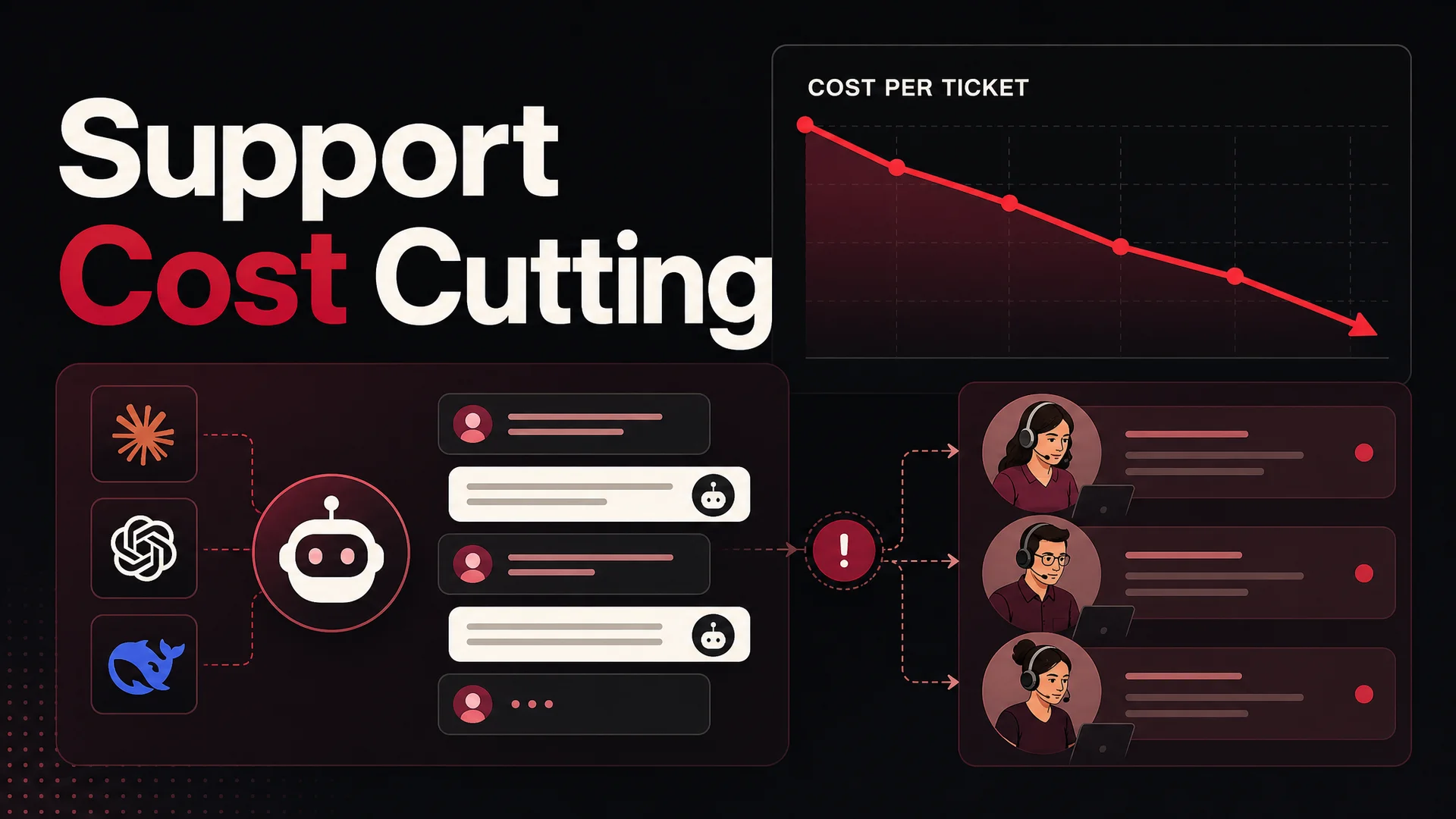
- Sharp reductions in deflection-cost-per-ticket, especially when routine traffic routes to a cheap open-weight model
- Higher CSAT on the conversations the agent handles cleanly, because customers value speed and 24/7 availability more than they value "talking to a human" when their question is routine
- Lower attrition in the support team, because human agents get to focus on complex, emotionally weighty work instead of password resets
The cost discipline is in the routing layer. Send the easy stuff to DeepSeek V4 Flash or MiniMax M2 at fractions of a cent per resolution. Reserve Claude Opus 4.7, GPT-5.5 Pro, or Gemini 3.1 Ultra for the conversations where reasoning quality genuinely changes the outcome.
Data, analytics, and the feedback loop
Every conversation is a data point. Aggregated, support transcripts are one of the highest-signal sources of product feedback a company has - they capture what real customers struggle with in their own words, in real time.
A useful program does three things with that data:
- Surfaces emerging issues fast. A spike in questions about a specific feature, error message, or pricing tier shows up in the agent's analytics before it shows up in revenue reports. Product and engineering can act on it the same week.
- Identifies knowledge-base gaps. Every escalation is a tagged failure mode - either the docs were missing, the tool inventory was incomplete, or the policy was ambiguous. Closing those loops compounds over time.
- Drives proactive outreach. If three customers asked about a shipment delay this morning, the agent can volunteer status updates to the next ten people with affected orders before they have to ask.
This is the part of the operation that gets neglected most often. Teams ship the agent, watch deflection numbers, and stop reading transcripts. The teams that keep reading transcripts - or, more realistically, set up automated tagging and review queues - are the ones whose agents keep getting better quarter over quarter.
Security, compliance, and the regulated-industry reality
For financial services, healthcare, and any team handling personal data, security is non-negotiable. Modern AI support platforms ship with the table stakes: encrypted transport and storage, role-based access, audit logs, anomaly detection, and compliance posture against GDPR, HIPAA, SOC 2, and the rest of the alphabet.
The harder question is data residency and model isolation. If you cannot send customer data to a third-party model API for regulatory reasons, your options used to be limited and weak. The 2026 open-weight frontier changes that. GLM-5.1 under MIT, Qwen3.6-27B under Apache 2.0, and MiMo under MIT can all be self-hosted on your own infrastructure - including air-gapped environments - with full weight access and no per-token billing relationship to a vendor. That is the unlock for regulated industries that previously had to settle for weaker, smaller models.
Berrydesk is built to support both modes: hosted models for teams that want fastest time-to-value, and the option to plug in a self-hosted open-weight model when compliance demands it.
The hybrid model: agents and humans, not agents instead of humans
The framing that AI replaces support teams is wrong, and the teams that have run with it for two years can tell you why. The right framing is that AI changes what humans do.
In a healthy 2026 support org:
- The agent owns the routine work - order status, password resets, return initiations, FAQ, basic troubleshooting
- Humans own the work that requires judgment, empathy, or authority - escalated complaints, retention conversations, refunds outside policy, sensitive accounts, anything genuinely novel
- The agent prepares the human handoff with full context: conversation summary, customer history, what was tried, what the agent thinks is going on
- Humans get AI-assisted suggestions in real time as they type - recommended responses, relevant policy snippets, sentiment cues - without being forced to use them
The ratio shifts. A team that used to be 20 agents handling 5,000 tickets a week might now be 8 agents handling the same volume, with the AI carrying the long flat tail and the humans handling the spicy 15%. The remaining humans are typically more senior, better paid, and more satisfied.
AI chatbots as a revenue surface
The other framing shift is that support is not just a cost center. A well-deployed agent is a revenue surface.
Specifically:
- It qualifies inbound leads in real time, asking the questions a sales rep would ask and routing only the qualified ones forward
- It surfaces upsell and cross-sell opportunities in context - only when the customer's current situation makes them genuinely relevant, not as a blanket pitch
- It recovers abandoned carts and stalled signups with informed, non-spammy nudges
- It collects voice-of-customer data that informs pricing, packaging, and roadmap decisions
The discipline here is to deliver value first. Customers can smell a bot whose first instinct is to upsell, and they punish it with low CSAT and high disengagement. The agents that monetize well are the ones that solve the actual problem first, then suggest something relevant only when the suggestion is genuinely in the customer's interest.
Common pitfalls to avoid
A few patterns show up repeatedly in deployments that under-perform.
Treating the agent as set-and-forget. The model improves; your product changes; your knowledge base drifts. An agent that was excellent at launch will be mediocre by month six if no one is reading transcripts and updating training material.
Skipping the tool layer. A read-only agent that can answer questions but not take action will deflect a fraction of what a tool-equipped agent does. The work to wire up lookup_order, issue_refund, book_appointment, and the other ten verbs your customers actually need is the highest-leverage work in the whole project.
Picking one model for everything. A single model is the simplest answer, but it is rarely the best one. Routing routine traffic to a cheap open-weight model and reserving frontier reasoning for the hard 10% is usually the right architecture and saves real money at scale.
Hiding the human handoff. Customers should always have a clear path to a human when they want one. Agents that bury escalation behind three layers of "are you sure?" tank trust and CSAT.
Over-personalizing. Using every signal on every message feels invasive. Restraint pays.
Open-weight vs closed frontier: a quick trade-off frame
The choice between open-weight and closed-frontier models is one of the most consequential architectural decisions in a deployment, and it comes up early. The honest answer is that most teams want both.
Closed frontier (GPT-5.5 Pro, Claude Opus 4.7, Gemini 3.1 Ultra) gives you the highest reasoning ceiling, the cleanest tool use, and the lowest hallucination rates on hard questions. You pay per token, you depend on a vendor's uptime and policy changes, and you cannot self-host.
Open-weight frontier (DeepSeek V4, GLM-5.1, Kimi K2.6, MiniMax M2.7, Qwen3.6, MiMo) gives you dramatically lower cost-per-conversation, the option to self-host for compliance or data-residency reasons, and weights you can audit. The trade-off is slightly less polished behavior at the absolute top of the difficulty distribution, though the gap closed materially in 2026 - GLM-5.1 actually beats Claude Opus 4.6 on SWE-Bench Pro, for example.
The pragmatic deployment is hybrid: open-weight for volume, closed for the hard tail, with the platform doing the routing transparently. Berrydesk lets you pick from GPT, Claude, Gemini, DeepSeek, Kimi, GLM, Qwen, MiniMax, and others, and switch or route between them without rebuilding.
What good looks like in 2026
Stepping back, the pattern across successful AI customer service deployments looks something like this:
- A clear scope, written down: which conversation types the agent owns, which it escalates, where the human review queue sits
- A current-generation model selected for the use case, with routing logic between a fast cheap workhorse and a deeper reasoner for hard cases
- A real tool inventory - not just "answer questions," but a named list of actions the agent can take with the right authorizations
- A live channel footprint that meets customers where they are: web, mobile, WhatsApp, Slack, Discord, email
- A weekly cadence of reading transcripts, tagging escalations, and updating training material
- Honest measurement: deflection rate, CSAT on automated conversations, escalation reasons, time-to-resolution, and revenue influenced
The companies that get this right are not the ones with the biggest AI budgets. They are the ones who treat the agent as a product - staffed, measured, iterated - rather than as a one-time procurement decision.
Build your AI support agent on Berrydesk
If you are evaluating AI customer service in 2026, the platform layer matters more than the model layer. Berrydesk lets you launch a branded support agent in four steps: pick a model from across the closed and open-weight frontier, train it on your docs, websites, Notion, Drive, or YouTube, brand the chat widget, wire up AI Actions for bookings, refunds, and lookups, and deploy to your website, Slack, Discord, WhatsApp, and more.
You get the routing flexibility, the tool layer, and the channel coverage in one place - without standing up infrastructure or stitching together half a dozen vendors. Build your agent for free at berrydesk.com and ship a real deployment this week.
 Berrydesk
Launch a branded AI support agent in minutes
- Pick from GPT-5.5, Claude Opus 4.7, Gemini 3.1, DeepSeek V4, Kimi K2.6, GLM-5.1, Qwen, MiniMax, and more
- Train on docs, websites, Notion, Drive, or YouTube - deploy to web, Slack, Discord, WhatsApp
Set up in minutes

Chirag Asarpota is the founder of Strawberry Labs, the team behind Berrydesk - the AI agent platform that helps businesses deploy intelligent customer support, sales and operations agents across web, WhatsApp, Slack, Instagram, Discord and more. Chirag writes about agentic AI, frontier model selection, retrieval and 1M-token context strategy, AI Actions, and the engineering it takes to ship production-grade conversational AI that customers actually trust.