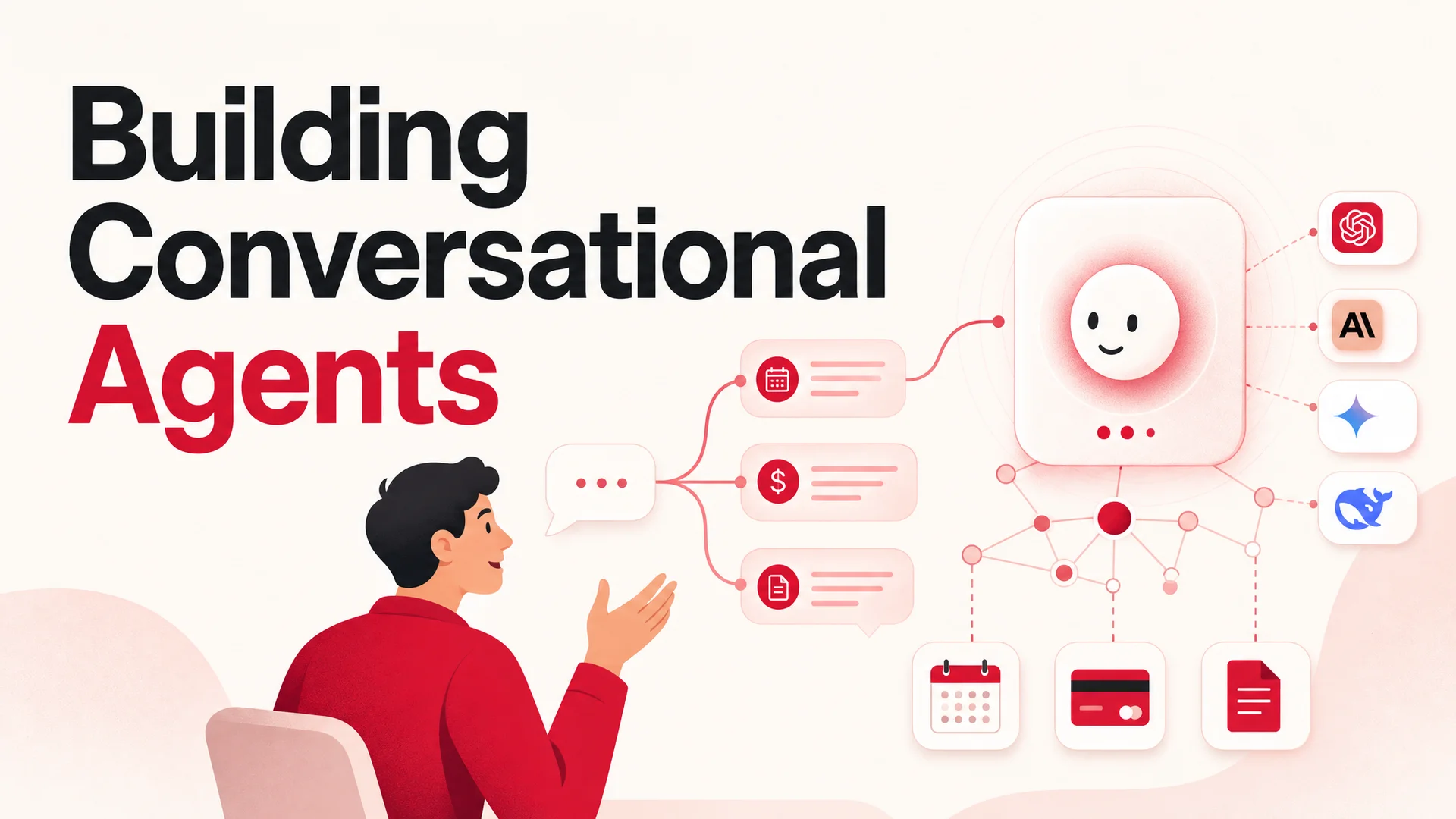
The word "chatbot" has aged badly. It still conjures the menu-driven assistants of the late 2010s - the ones that asked you to "type 1 for billing" and then routed you to a phone tree anyway. By 2026, that stereotype is doing real damage to the way support teams plan their automation roadmaps, because the systems available today are a different category of software entirely. They reason, they remember, they call APIs, and they finish the job. Calling them chatbots is like calling a self-driving car a horseless carriage: technically descriptive, completely wrong about what it actually is.
At the same time, vendors call almost everything an "AI agent" now, and buyers ask for a chatbot only to be shown platforms that can hold a million-token context, route between half a dozen frontier models, and run refunds end-to-end. Someone asks for "conversational AI" and gets a flowchart with a language model bolted on.
This piece pulls the vocabulary apart. We will cover where chatbots earned their place and where they topped out, what changed at the model layer between 2024 and now, what an agent can actually do that a bot cannot, the deployment patterns that are working in production, and the practical questions every support leader should be asking before signing another contract.
What "chatbot" actually means - and why it confuses everyone
A chatbot is any program that holds a conversational interface - text or voice - and responds to user input. That is the entire definition. The word is an umbrella, not a category, which is exactly why it causes so much confusion.
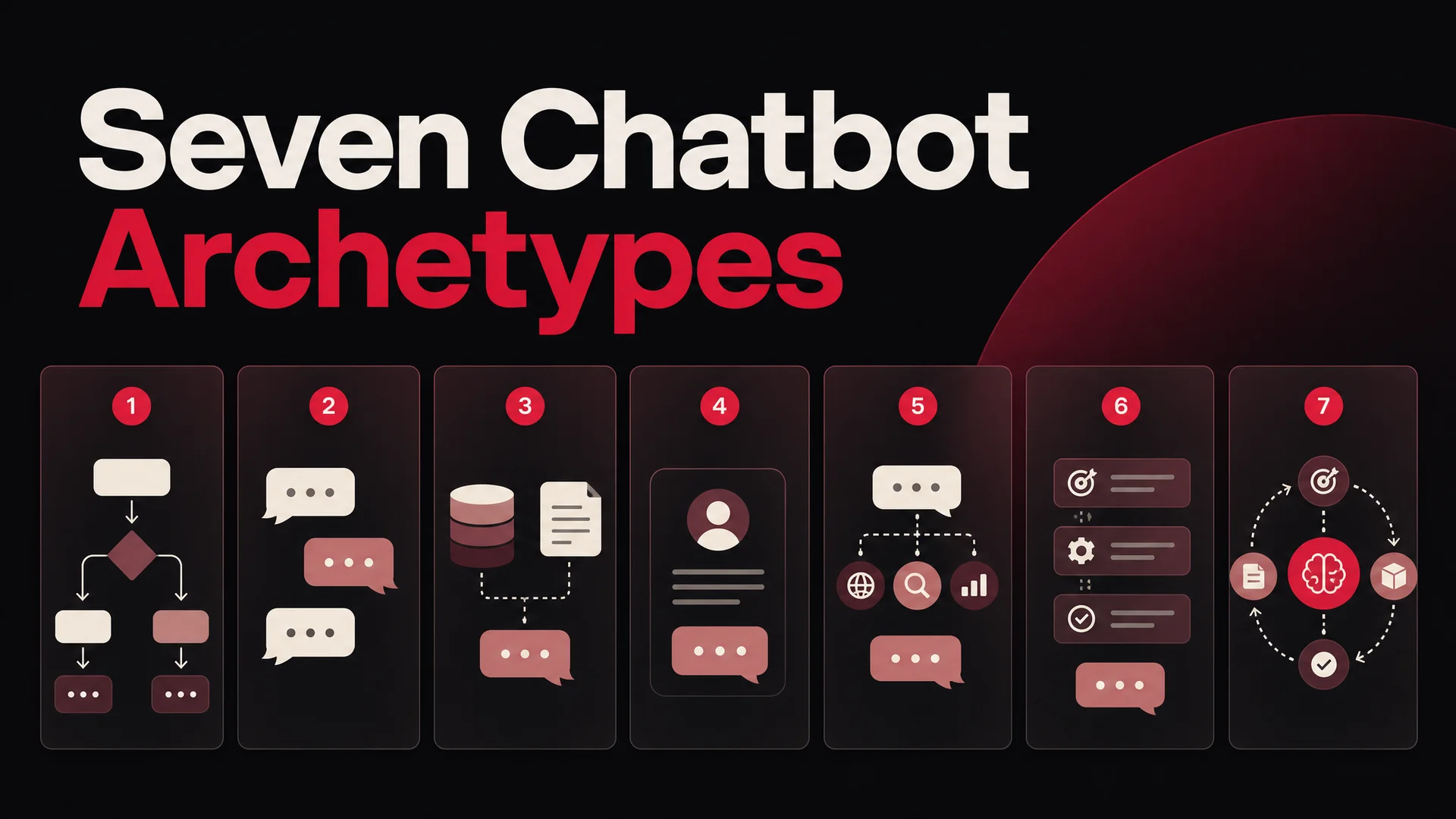
Underneath that umbrella sit at least three meaningfully different things:
Rule-based bots. Decision trees. The bot matches keywords or button taps against a script, and replies with the corresponding canned answer. They are cheap, predictable, and brittle. If a user phrases a question in a way the script did not anticipate, the bot fails - there is no clever fallback because there is no understanding to fall back on. Still useful for very narrow flows: a "where is my order" lookup with a known SKU, or a deflection menu that hands off to a human.
Retrieval bots. These look up answers in an FAQ index, sometimes with semantic search rather than literal keyword matching. They feel slightly smarter than rule-based bots because they can match a paraphrased question to the right canned answer, but they are still pulling from a fixed set of responses. The intelligence is in the retrieval, not the generation.
LLM-backed bots. A language model plugged into the chat surface, free to generate replies. This is where the line to "conversational AI" starts to blur, because most of what people now call a chatbot in 2026 is, technically, this. Quality varies wildly depending on grounding, prompt structure, and whether the bot can take actions or only talk.
The unifying property of "chatbot" as a category is that it is defined by the surface - the chat window - not by the depth of behavior behind it. That is the mistake buyers keep making: judging the tool by the interface and discovering, three months in, that the engine behind the window cannot do the job.
It is worth being fair to the chatbot. It earned its place. Before transformer-era language models were good enough to put in front of a paying customer, scripted bots offered something genuinely valuable: instant, 24/7 deflection of the easy 30% of tickets. Password resets, store hours, order status lookups, return policies - these tasks fit neatly into a decision tree, and a well-built bot could handle them at a fraction of the cost of a human agent.
The cracks were obvious to anyone who ever rephrased a question. If the user said "I cannot get into my account" instead of "password reset," the bot stalled. If the user explained context - "I am calling because my mom's account got locked while she is overseas" - the bot ignored everything except the keywords it knew. There was no working memory across sessions, no concept of who you were beyond a session ID, and no way to take an action other than handing you a link or opening a ticket.
The classic example is the customer who writes, "I have rescheduled this appointment three times because I am too anxious to go in." A scripted bot reads "rescheduled" and "appointment" and offers - sincerely, mechanically - to reschedule the appointment again. The reply is grammatically correct and operationally useless. The bot is responding to a substring; the customer is asking for understanding.
The deeper limitation was structural. Chatbots could only retrieve answers; they could not act. If your refund request involved actually processing a refund, the bot's job ended at "here is a link to our returns page." Everything after that link required a human, a different system, or both. That handoff is where most customer satisfaction goes to die.
What conversational AI - and an AI agent - actually is
Conversational AI is the engine, not the surface. It is a stack: a large language model, a way to ground that model in your specific knowledge, a memory of the ongoing conversation, and - increasingly in 2026 - a set of tools the model can call to do things in the real world.
A few capabilities mark the difference between conversational AI and a chatbot that happens to use an LLM:
Genuine understanding of intent. Conversational AI parses what a user actually means, not what keywords they used. "My laptop will not charge" and "the battery icon has a lightning bolt but the percentage keeps dropping" point to overlapping problems. A scripted bot treats them as two unrelated inputs. A conversational AI agent treats them as variants of the same diagnostic path.
Context across turns. It remembers what was said earlier in the conversation, ties pronouns to the right referents, and does not ask the user to repeat the order number they already gave. With Claude Opus 4.6 and Sonnet 4.6 now shipping a one-million-token context window at no surcharge, and Gemini 3.1 Ultra carrying two million, the practical ceiling on memory inside a single session is now measured in books, not paragraphs.
Grounding in your data. A conversational AI agent built for a specific business is trained or retrieval-augmented on that business's docs, policies, product catalog, ticket history, and macros. It does not improvise from the open web. When it does not know something, a well-built one says so rather than inventing.
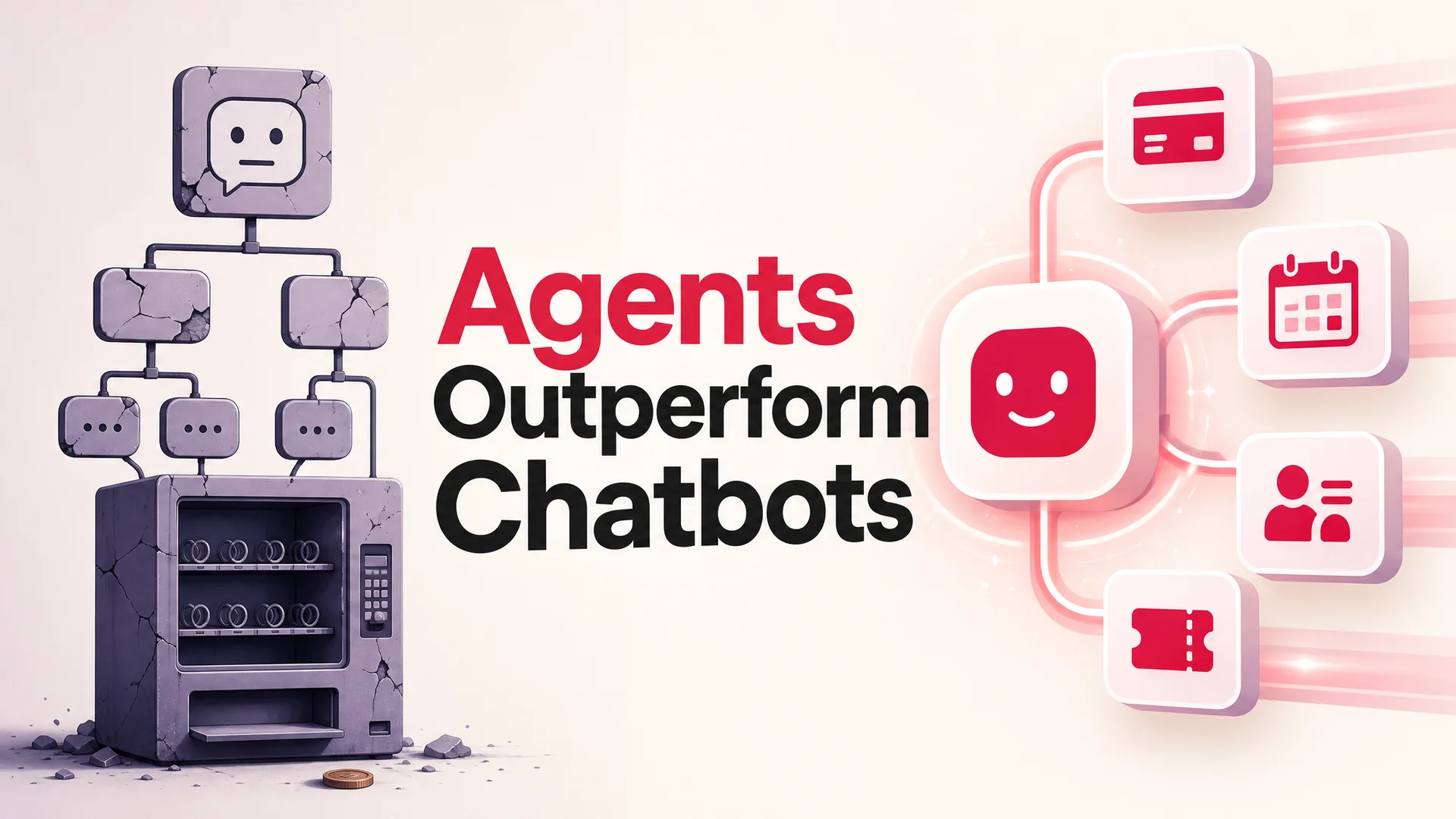
The ability to act. This is the biggest practical shift between 2024-era assistants and 2026-era agents. The cleanest mental model: a chatbot retrieves; an agent acts. Everything else flows from that distinction.
An agent plans. Given a goal - "the customer wants a refund and a replacement" - it decomposes the goal into steps, decides which tools to call in which order, and adjusts when something fails. A chatbot does not plan. It pattern-matches the input to a node in its decision tree.
An agent uses tools. It calls your billing API to issue the refund, your fulfillment API to ship the replacement, and your CRM API to log what happened. The 2026 generation of tool-use models - Claude Opus 4.7, GPT-5.5, Kimi K2.6, GLM-5.1, Qwen3.6, MiMo-V2-Pro - handle this reliably enough that production deployments no longer feel like demos. Misfires that used to require human review now happen rarely enough to write SLAs against.
An agent remembers. Conversation memory persists across sessions. The agent knows you contacted support twice last week about the same shipment. It knows your tier, your last purchase, your timezone, and that you tend to ask follow-up questions. A chatbot starts every conversation from zero.
An agent escalates intelligently. When something is genuinely outside its scope, it does not just throw the user at a human queue. It writes a structured handoff: what the customer wanted, what it tried, what failed, what context the human will need, and which engineer should pick it up. The human starts the conversation pre-loaded.
The clearest illustration is a damaged-package scenario. The customer types: "My order arrived damaged. I need a refund and a replacement shipped overnight." A scripted chatbot replies with a link to the returns page and creates a ticket. An agent looks up the order, confirms eligibility under your refund policy, processes the refund through Stripe, generates a replacement order with overnight shipping, emails the confirmations, and posts a note to the CRM - all in the same chat window, in under a minute, without a human touching it. That is not a faster chatbot. It is a different kind of system.
So: every conversational AI is, technically, a chatbot. Not every chatbot is conversational AI. The question is whether the system in front of you is doing genuine language understanding, holding state, grounded reasoning, and tool use - or just routing keywords through a model and hoping.
What actually changed at the model layer
The shift from chatbot to agent did not happen because someone renamed the category. It happened because the underlying models crossed several capability thresholds at roughly the same time, and the gap is wider in 2026 than most teams realize.
Reasoning got dramatically better. OpenAI's GPT-5.5 and GPT-5.5 Pro, released in April 2026, run parallel reasoning paths that turn what used to be a guess into a deliberate plan. Anthropic's Claude Opus 4.7 leads SWE-Bench Pro at 64.3% - a benchmark designed for complex, multi-file engineering work - which translates directly to an agent's ability to follow a multi-step support workflow without dropping context. Google's Gemini 3.1 Pro tops GPQA Diamond at 94.3%, and the Ultra variant carries a 2M-token context window with native multimodal input across text, image, audio, and video. None of those are chatbot-grade capabilities. They are agent-grade.
Context windows got large enough to change the architecture. Claude Opus 4.6 and Sonnet 4.6 ship with a 1M-token window at no surcharge. DeepSeek V4 - both the 1.6T-param Pro variant and the leaner V4 Flash - also carry 1M-token contexts. That length means a support agent can now hold an entire knowledge base, the customer's last six months of conversation history, your refund policy, your shipping policy, and the API spec for your billing system all in-context simultaneously. Retrieval-augmented generation stops being a hard requirement and becomes a tuning lever you reach for when you want to.
Cost collapsed for the routine tier. DeepSeek V4 Flash is priced at $0.14 per million input tokens and $0.28 per million output tokens, which puts the marginal cost of resolving a routine support ticket somewhere between a fraction of a cent and a rounding error. MiniMax M2 - open-weight, 230B total / 10B active parameters - runs at roughly 8% the price of Claude Sonnet at twice the speed. The cost story is what makes high-volume agentic deployment economically defensible at scale, and it is the single largest reason 2024-era pricing models for AI support are now obsolete.
Open weights from Chinese labs reset the regulated-industry conversation. Z.ai's GLM-5.1 - 754B-param MoE, MIT-licensed, trained entirely on Huawei Ascend 910B chips - beats GPT-5.4 and Claude Opus 4.6 on SWE-Bench Pro at 58.4. Alibaba's Qwen3.6-27B is Apache 2.0 and outperforms 397B-param MoE rivals on agentic coding tasks; the family also includes a 35B-A3B open MoE plus proprietary Plus and Max-Preview tiers. Xiaomi's MiMo-V2-Pro hit MIT-licensed open weights in April 2026, with a one-million-token context. Moonshot's Kimi K2.6 sustains 12-hour autonomous coding sessions and coordinates swarms of up to 300 sub-agents across 4,000 steps. The on-prem and air-gapped deployment story for healthcare, finance, and government customer support is now real, not theoretical.
Reliable tool use is the quiet but biggest change. A year ago, "AI Actions" demos worked in sales calls and broke in production. The 2026 generation - Claude Opus 4.7, Kimi K2.6, GLM-5.1, Qwen3.6, MiMo-V2-Pro - was trained to plan, call tools, recover from errors, and stay on task across long sequences. Refunds, bookings, order changes, and payment flows are reliable enough to ship without a human in the loop on every transaction.
If you architected your support automation against GPT-4 or even GPT-5.0–5.4 capabilities, you are working from outdated assumptions about what is possible per dollar.
How the industry is repositioning
Calling this category "AI agent" instead of "chatbot" is now table stakes for vendors that want to be taken seriously. Intercom rebranded its support AI as "Fin AI Agent." Zendesk frames its 2026 stack as an "Agentic AI" resolution suite. Salesforce, Freshworks, and Microsoft have all leaned into "agent" or "copilot" language. Every serious player wants to signal that the system in the chat box is not the FAQ widget customers learned to dread.
The market data tracks the shift. The global AI agents segment crossed $7.6 billion in 2025 and is on a roughly 45% CAGR trajectory through the end of the decade, roughly double the growth of the legacy chatbot market. Analyst surveys from early 2026 put enterprise adoption of agentic AI somewhere between 80% and 90%, depending on how strictly you define "agentic." Either way, the inflection has happened.
The change is more than marketing. Calling something a chatbot tends to anchor the team that builds it on FAQ thinking - what questions do we load in, what canned answers do we write. Calling it an agent reframes the design question - what jobs can it actually do, which systems should it touch, and how do we measure resolution end-to-end. That second question produces a more useful product. We have watched the same product team produce dramatically different outcomes depending on whether the spec said "chatbot" or "agent" at the top.
For support leaders, the practical implication is that "we have a chatbot" is no longer a defensible position in a 2026 RFP. Buyers are asking pointed questions about tool use, memory, multi-step task completion, and observability. Procurement teams want to see action logs, not just transcripts. The bar moved.
What this looks like in production
Theory aside, the interesting question is what AI agents are actually doing for support teams. None of these patterns is speculative - all are running in production today.
Banking and fintech: action-grade billing support
Klarna's AI agent handles roughly 75% of customer chats across 35 languages, with average response times in the two-minute range, down from eleven minutes when the work was fully human. The agent issues refunds, processes returns, and resolves payment disputes end-to-end. The pattern works because the agent has actual write access to the systems of record, not read-only retrieval. Customer satisfaction sits on par with human handling, and the cost savings run into the tens of millions annually. ING Bank's deployment follows a similar shape: the agent resolves routine queries autonomously and pre-stages handoffs for the rest, so customers never have to repeat themselves.
The pattern holds at much smaller scale too. A 50-person SaaS team with a $30/mo subscription product runs the same playbook with a Berrydesk agent connected to Stripe: cancellations, prorated refunds, plan changes, invoice resends, all completed inside the chat without a ticket ever being filed. A Berrydesk-shaped deployment in this space typically routes the high-volume routine tier to DeepSeek V4 Flash or MiniMax M2 - both open-weight, both priced at a fraction of frontier API costs - and reserves Claude Opus 4.7 or GPT-5.5 for the gnarlier escalation tier where the cost of a wrong answer dwarfs the cost of inference.
Retail and logistics: rescheduling at machine speed
Best Buy's agent troubleshoots product issues, reschedules deliveries, and updates installation appointments inside the chat. The customer never gets bounced to a phone line for a calendar change. Airlines run similar agents that automatically rebook passengers when flights cancel, comparing seat inventory, fare classes, and frequent-flyer status before presenting options. Hotel agents handle reservations and modifications without human touch. A clinic's agent moves appointments after checking provider calendars and notifying the right team.
The interesting design question for these deployments is how much agency to grant the agent. Booking changes that affect inventory, payment, or downstream logistics can ripple. The teams getting this right tend to give the agent broad autonomy on reversible actions and require human confirmation on irreversible ones, with the boundary explicitly modelled in the agent's tool definitions.
Multi-step troubleshooting with structured escalation
Software companies use agents to walk customers through diagnostic flows that would have eaten 20 minutes of a tier-1 rep's time. The agent runs the conversation, captures logs, asks the right follow-up questions, and only escalates when it has gathered enough context that the engineering ticket writes itself. Zendesk-shaped integrations let the agent open a Jira ticket directly, populated with the full conversation, the diagnostic outputs, and a suggested triage label. Insurance carriers run claims-intake agents that take a similar shape - collect, validate, route, and only escalate the genuinely ambiguous cases.
The throughput gain here is not just deflection. It is that the human engineer starts the work already oriented, instead of spending the first ten minutes reading the back-and-forth.
Personalised commerce and concierge use cases
Retail agents like H&M's blur the line between support and sales. They suggest sizes, surface alternatives, answer fit questions, and remember your preferences across sessions. Mercedes-Benz's assistant schedules test drives and shepherds the early phases of a vehicle purchase. The common thread is that personalization is no longer a nice-to-have garnish on top of FAQ retrieval - it is the entire point. An agent that does not know who you are and what you have done before is competing against an agent that does.
Healthcare and regulated services
This is where the open-weight side of the 2026 landscape matters most. A clinic that cannot send patient data to a third-party API can deploy Berrydesk against an on-prem GLM-5.1 or Qwen3.6 instance, ground the agent in their intake forms and protocols, and offer scheduled appointment booking, prescription refill triage, and pre-visit questionnaires - without any PHI ever leaving their network. A keyword bot in this setting is functionally useless; a conversational AI agent on open weights is the only architecture that meets both the clinical bar and the compliance bar.
Internal helpdesks
Less visible but growing fast. The same agent shape - long context, tool use, integrations into Jira, ServiceNow, Slack, Notion - works for IT, HR, and ops support inside the company. A new hire asks how to expense a flight to Tokyo on the new corporate card. The agent reads the policy, notes the user's office, checks the new card rules, points them to the right sub-clause, and offers to start the report. Onboarding times drop because new hires stop pinging Slack channels for things that are written down.
The thread tying all of these together is integration depth. The agent is not a widget bolted onto a marketing site; it is wired into the systems where the work actually happens. That is what separates the deployments that pay for themselves from the demos that look good and never ship.
Closed frontier vs open weights: how to pick
One of the most important decisions in 2026 is no longer "which AI vendor" but "which routing strategy." The right answer for most support deployments is some combination of the following:
Closed frontier models - GPT-5.5 / GPT-5.5 Pro, Claude Opus 4.7, Gemini 3.1 Ultra. Strongest reasoning, best tool-use reliability, highest per-token cost. Best for complex escalations, sensitive policy interpretation, and any case where the cost of a wrong answer is high. Claude Opus 4.7's lead on SWE-Bench Pro translates directly to better behavior on multi-step tool chains; Gemini 3.1 Ultra's 2M-token context and native multimodality make it the natural pick for video and image-heavy queries.
Open-weight frontier models - DeepSeek V4 Pro, Kimi K2.6, GLM-5.1, Qwen3.6 family, MiniMax M2.7, Xiaomi MiMo-V2-Pro. Frontier-class capability at a fraction of the price, with the option to self-host for regulated workloads. GLM-5.1's 58.4 SWE-Bench Pro score beating GPT-5.4 and Claude Opus 4.6 is the clearest signal that the open tier has arrived - for a support agent that orchestrates tools, that benchmark is directly relevant. MIT and Apache licensing on the Chinese open models opens up on-prem deployments that were impossible a year ago.
Open-weight efficiency models - DeepSeek V4 Flash ($0.14 / $0.28 per million tokens), MiniMax M2 (~8% the cost of Claude Sonnet at 2x speed), Qwen3.6-35B-A3B. The right pick for the 70%+ of routine traffic where the question is unambiguous and the action is well-defined. Cost-per-resolution at this tier is low enough that deflecting another 10% of routine tickets becomes economically obvious.
The teams getting the most leverage are the ones that route by query class. Routine billing question? Send it to V4 Flash. Multi-step refund-and-replacement workflow with policy ambiguity? Route to Claude Opus 4.7. Video-attached complaint? Gemini 3.1 Ultra. The chatbot era did not have this design space because there was only one decent model. The agent era does, and ignoring it is leaving a 5–10x cost-efficiency gain on the table.
RAG vs long context: the architecture has changed
Two years ago, every serious support deployment ran on retrieval-augmented generation. Documents got chunked, embedded, indexed, and pulled into the prompt at query time. RAG was load-bearing because context windows were small and models could not keep more than a few thousand tokens of useful information in mind at once.
In 2026, with 1M-token context standard across most frontier models and 2M available on Gemini 3.1 Ultra, the architectural question has flipped. You can fit your entire knowledge base, your full refund policy, your shipping policy, your pricing matrix, the customer's last 90 days of conversation history, and your tool specs in a single context. RAG becomes a tuning decision: use it when you need fresh data, when you are managing many tenants, or when you want explicit citation behavior. Skip it when long context is simpler, more accurate, and fast enough.
The trade-off is real. Long context is more expensive per query than a tight RAG retrieval. RAG gives you cleaner attribution and easier debugging. Many production deployments end up running both: a retrieval layer for the most authoritative facts, plus generous context for the conversational and policy material around them. The point is that "how do we do RAG" is no longer the first question. "Do we even need RAG for this query class" is.
Common pitfalls worth naming
The honest version of this story includes the failure modes, not just the wins.
Treating an agent like a chatbot during onboarding. Teams load their FAQ documents, smoke-test a few canned questions, and ship. Six weeks later they wonder why deflection numbers look flat. The answer is that they never wired up the tools. An agent without API access is just a chatbot that uses bigger words.
Permission scope. An agent that can issue refunds is also an agent that could issue the wrong refund. AI Actions need defined limits - maximum amounts, eligible accounts, required confirmation steps for high-impact moves. Treat agent capabilities the way you would treat a junior support rep's permissions. Trust grows with track record.
Hallucinated policy. A long-context model that has been shown your knowledge base will still occasionally invent a policy that sounds right but is not. The mitigation is to ground answers in retrieval even when the context window could fit everything, log the citations, and have a path for humans to audit a sample.
Skipping observability. Chatbots had simple transcripts. Agents have transcripts plus tool calls plus tool outputs plus internal reasoning traces. If you cannot see all four, you cannot debug, you cannot tune, and you cannot prove to compliance that the agent did the right thing. Pick a platform that surfaces the full trace.
Quiet failures. A scripted bot that does not understand a question hands off to a human. An agent that does not understand a question may confidently produce a wrong answer or run a wrong action. The instrumentation matters - what percent of conversations end with a thumbs-down, a refund reversal, a re-opened ticket, or a customer asking for a human after the agent's reply.
Single-model lock-in. Frontier capability has moved every quarter for two years running. The team that hard-coded against GPT-4o in mid-2024 is now two model generations behind. Architect for swappable models - and route by query class - so you can adopt new releases without re-doing your integration. Berrydesk's multi-model picker is built around exactly that assumption.
Underestimating the human handoff. Even the best agent will hand off some percentage of conversations. If the handoff is just "transferring you to an agent now," you have wasted the AI's context. Insist on structured handoffs that pre-populate the human queue with everything the agent learned.
Tone and identity. A capable agent that sounds like a stranger to your brand still feels off to customers. Branding the chat widget, tuning the voice, and giving the agent a consistent persona is not cosmetic - it is part of why customers engage rather than try to escape.
Believing the marketing. Every vendor now claims agentic AI. Most have wrapped a 2024-era chatbot in 2026 vocabulary. Ask for tool-use logs, multi-step task completion rates, and concrete examples of write actions executed without human review. The gap between the language and the substance is the gap you are buying into.
Rethinking the stack - and the vocabulary
To get real value from an agent, you need to rebuild parts of the stack the chatbot era let you ignore.
Integrations matter more than the model. The agent's reasoning quality is necessary but not sufficient. What makes the difference is whether it can read from your order database, write to your billing system, schedule against your calendars, post into your ticketing tool, and update your CRM. A platform that abstracts these as AI Actions - declarative tool definitions the agent can call without you writing glue code - is dramatically faster to deploy than wiring everything up by hand. This is exactly the design we built Berrydesk around.
Knowledge has to be live. Stale knowledge bases are the single biggest source of hallucinations in support agents. If your refund policy lives in a Notion doc that gets edited weekly, the agent needs a sync that picks up the edits. Same for product specs, shipping rules, and pricing. Trainable data sources that pull from your docs, websites, Notion, Google Drive, and YouTube are not a feature - they are the whole game.
Channel coverage is multiplicative. Customers will reach you on your website, in Slack, on Discord, over WhatsApp, and inside whatever community tool your product lives next to. The agent has to be the same agent in all of those places, with the same memory and the same tools. Bolting separate bots onto each channel was the chatbot pattern. The agent pattern is one brain, many faces.
Vocabulary shapes design. This sounds soft, but it is real. Teams that call their AI a chatbot tend to design it like a chatbot - narrow scope, FAQ-driven, deflection-as-success-metric. Teams that call it an agent tend to design it like a teammate - full task ownership, action-driven, resolution-as-success-metric. The naming influences the brief, and the brief influences the build.
There is a trust dimension here too. Customers learned over a decade to bypass chatbots as fast as possible. That habit is not undone with a press release. It is undone by the agent doing real work the first few times someone gives it a chance - issuing the refund, booking the slot, fixing the account - and by the company being honest in the welcome message about what the agent can and cannot do. Earned trust scales; promised trust does not.
Picking conversational AI for support, in 2026
If you have read this far, you are probably not asking "should I use a rule-based bot or conversational AI." That question is mostly closed. The real question is which conversational AI platform fits the way your team works.
The shortlist should look at:
- Model breadth. Does the platform let you choose between GPT-5.5, Claude Opus 4.7, Gemini 3.1, DeepSeek V4, Kimi K2.6, GLM-5.1, Qwen3.6, MiniMax M2, and others - and route between them? Or are you locked into one provider's stack?
- Training sources. Docs, websites, Notion, Google Drive, YouTube transcripts - the more first-class source types, the less stitching you will do yourself.
- AI Actions. Can the agent actually do things - book, refund, look up, charge - or is it stuck answering questions? The agentic-model generation makes real workflows reliable; you need a platform that exposes them.
- Channel reach. Web widget, Slack, Discord, WhatsApp, the rest. Customers do not all live on your website.
- Branding. A widget that looks like the vendor's product, not yours, undersells the experience.
- Open-weight on-prem option. If you are in healthcare, finance, government, or anywhere with data residency rules, you want a path to running Qwen3.6, GLM-5.1, or MiMo-V2 inside your own perimeter.
- Observability. Action logs, tool traces, escalation reasons - you cannot tune what you cannot see.
The platforms in this category vary in how many of those they cover. Berrydesk's pitch is that it covers all of them and does so without a steep learning curve.
Where Berrydesk fits
Berrydesk is built for the agent paradigm, not retrofitted from the chatbot one. The product takes you from a blank page to a deployed AI support agent in four steps. You pick the model - GPT-5.5, Claude Opus 4.7, Gemini 3.1 Ultra, DeepSeek V4, Kimi K2.6, GLM-5.1, Qwen3.6, MiniMax M2, and others - based on the cost-and-capability profile your traffic actually needs, or define a routing policy across several. You train the agent on your real knowledge: docs, websites, Notion, Google Drive, YouTube. You brand the chat widget so it looks like part of your product, not a third-party bolt-on. You add AI Actions for the things the agent should actually do - booking, payments, refunds, ticket updates, anything you can hit via API. Then you deploy: website, Slack, Discord, WhatsApp, and more.
The opinionated part is making sure the agent is action-capable from the start, not a glorified FAQ wrapper. The flexibility is making sure no part of the stack - model, integration, channel, persona - is locked in. You make the design decisions; Berrydesk does the wiring.
The honest takeaway
The "chatbot vs AI agent" framing risks sounding like a marketing distinction, but the underlying reality is hard. The 2026 generation of models - frontier and open-weight alike - can reason, plan, remember, and act in ways that the 2024 generation could not. The cost curve has fallen far enough that high-volume agentic deployment is economically defensible. The licensing situation has opened up on-prem options for regulated industries. The integration tooling has matured to the point that wiring up AI Actions is a configuration task, not an engineering project.
If you are still running a scripted bot in front of your support queue, you are competing against teams that have moved on from deflection to resolution. The customer experience gap shows up in CSAT, in time-to-resolution, in repeat-contact rate, and eventually in retention. The technology question is solved; the only remaining question is whether your team has rebuilt around it.
Ready to see the difference for yourself? Build your conversational AI agent on Berrydesk - pick a model, point it at your documents, wire a few actions, and ship. The chatbot era is over. The agent era is the work.
 Berrydesk
Launch a real AI support agent, not another reply bot
- Pick from GPT-5.5, Claude Opus 4.7, Gemini 3.1, DeepSeek V4, Kimi K2.6, GLM-5.1, Qwen3.6, MiniMax M2, and more
- Wire AI Actions for refunds, bookings, and ticket updates in minutes - train on docs, websites, Notion, Drive, and YouTube
Set up in minutes

Chirag Asarpota is the founder of Strawberry Labs, the team behind Berrydesk - the AI agent platform that helps businesses deploy intelligent customer support, sales and operations agents across web, WhatsApp, Slack, Instagram, Discord and more. Chirag writes about agentic AI, frontier model selection, retrieval and 1M-token context strategy, AI Actions, and the engineering it takes to ship production-grade conversational AI that customers actually trust.