AI chatbots stopped being novel a long time ago. They are now standard infrastructure - sitting between customers and product teams the same way CRMs and helpdesks did a decade earlier. What has changed in 2026 is the depth of what these agents can do. They book appointments. They process refunds. They read a customer's full order history, the relevant policy doc, and the last twelve months of conversation context, then take action without paging a human.
For customer support specifically, the case has tipped from "interesting experiment" to "the team without one is paying a premium for parity work." Routing FAQs, surfacing knowledge-base answers, qualifying leads, drafting follow-ups, escalating cleanly to a human when the conversation drifts outside the agent's confidence window - all of this is reliable work for a well-configured AI agent today. The harder question is no longer whether to deploy one. It is which one, on which model, with what guardrails, and how you measure whether it is actually earning its seat.
This guide walks through the reasons an AI agent belongs in your support stack, the criteria that actually matter when you compare platforms, and the trade-offs in the current model landscape so you can make a choice that holds up for more than a quarter.
Why an AI Support Agent Is Now Table Stakes
Before getting into selection criteria, it is worth being precise about the wins. Vague claims about "transforming support" tend to set up either disappointment or unfalsifiable success. Here is what actually moves when you deploy a competent AI agent on top of your support stack.
Always-on coverage without an offshore team
Support tickets do not respect time zones. A customer in Berlin running into a checkout error at 2 a.m. wants an answer at 2 a.m. - not a "we will get back to you in 14 hours" auto-reply. Historically the way to cover that was a follow-the-sun staffing model, which is expensive and surprisingly hard to maintain quality across. An AI agent answers at the same speed at 2 a.m. as it does at 2 p.m., on holidays, and during the spike that follows a marketing email. You still need a small on-call human bench for genuine escalations, but the long tail of routine questions - password resets, shipping status, plan comparison, where-do-I-find-this-setting - gets handled instantly without anyone watching a queue.
Cost per resolution that actually scales down
The economics of human-only support are linear: more tickets means more agents. The economics of AI-assisted support look different, and in 2026 they have shifted again. Open-weight frontier models have collapsed inference costs. DeepSeek V4 Flash runs at $0.14 per million input tokens and $0.28 per million output, with a 1M context window. MiniMax M2 and M2.7 are roughly 8% the price of Claude Sonnet at twice the speed. A typical support exchange runs a few thousand tokens. At those rates, a routine resolution on a routed open-weight model costs a fraction of a cent.
That does not mean every conversation should hit the cheapest model. The smart pattern is to route - handle the bulk of straightforward questions on a fast, low-cost model, then escalate hard reasoning, sensitive cases, or multi-step actions to Claude Opus 4.7, GPT-5.5, or Gemini 3.1 Ultra. Berrydesk lets you wire this kind of routing without rebuilding the agent, which is what makes the cost story durable instead of a one-month win.
Real efficiency, not just speed
Speed is the most visible win and the easiest to overstate. The bigger lift is consistency. Human agents have good days and rough days, varying levels of product depth, and personal phrasing habits that make audit and quality control harder. An AI agent answers the same way at the hundredth conversation as the first. When a policy changes, you change one source document and the next conversation reflects it. When a known bug ships a fix, the response shifts the same hour. The compounding effect is that your QA team stops chasing inconsistency and starts shaping the agent's behavior at the source - which is a much better use of senior support time.
A real data layer for product and CX
Support conversations are the most candid product feedback channel a company has. Customers report what is broken, what is confusing, what they wish existed, and which competitor they almost switched to - usually within their first three messages. Most teams cannot mine that channel because there is too much volume and the structure is too messy. AI agents fix both problems. They tag, cluster, and summarize at scale. You can ask, "what did churned customers complain about most in the last 30 days?" and get an answer grounded in actual transcripts rather than survey-shaped recall. That is a meaningful upgrade for product, marketing, and the support team itself.
Multilingual support without a translation budget
If your customer base spans more than two or three languages, hiring native-speaker agents in every market gets expensive fast. Modern AI agents handle dozens of languages out of the box, and they switch mid-conversation when a customer does. A French-speaking shopper writing in English because they assume that is faster gets a polished English answer; switch to French and the agent follows. For global D2C brands, B2B SaaS with international customers, or marketplaces operating across regions, the multilingual lift alone often pays for the platform.
What Actually Separates a Good Support Agent From a Mediocre One
Once you have decided to deploy, the platform you choose matters more than people expect. Most AI chatbot tools demo well in a five-minute walkthrough and reveal their seams in week three. Here is the checklist that holds up after the demo.
1. Be specific about the job you are hiring it for
The single most common mistake is starting with the platform instead of the job. "We need an AI chatbot" is not a brief. "We need an agent that resolves tier-1 product questions in English, Spanish, and Japanese, escalates billing disputes to humans, books demo calls for qualified leads, and never quotes a price for our enterprise plan" is a brief. The more concretely you can describe the conversations you want handled - and the conversations you want handed off - the easier every other choice becomes.
A useful exercise: pull 200 recent support tickets and tag them. What share are FAQ-style? What share need an action taken (refund, address change, plan switch)? What share are emotional or genuinely ambiguous and should always go to a human? The mix tells you which platform features to prioritize. A heavy "needs action" share means AI Actions and tool-use reliability matter more than chat polish. A heavy FAQ share means knowledge ingestion and grounding matter most. A heavy ambiguous share means escalation handling and live-handoff are the headline features.
Berrydesk is designed for the full mix. You can configure agents that purely answer questions from documentation, agents that take actions like booking and payments, agents that act as a triage layer on top of a human team, or all three at once. The role you assign on day one is not the role you are stuck with - but you should pick a starting role that maps cleanly to the tickets you actually have.
2. Customization that goes beyond the welcome message
Branding the widget is the easy part. The customization that pays off over time is behavioral: tone, refusal patterns, escalation thresholds, persona, the shape of an "I don't know" response, what the agent does when a customer is upset, what topics are off-limits. A platform that lets you change the avatar but not the system prompt or the routing logic will not survive contact with the messy edges of real support work.
When you evaluate, look for the ability to define and version the agent's persona, write your own guardrails, set per-source confidence thresholds, and adjust behavior per channel - a Slack DM should not read identically to a public help-widget reply. Berrydesk exposes all of these levers, so the agent that lives on your marketing site can be more conversational while the one in your authenticated app dashboard is terser and more action-oriented.
3. The model - and crucially, the ability to switch models
How smart is it? matters, but in 2026 it is the wrong framing. The right question is which model, for which conversation, at what cost? The model landscape has fragmented in a useful way:
- Closed frontier models like GPT-5.5 and GPT-5.5 Pro (with parallel reasoning), Claude Opus 4.7 (leading SWE-bench Pro at 64.3% - a coding benchmark, but a strong proxy for tool-use reliability), Claude Sonnet 4.6 (1M context, no surcharge), and Gemini 3.1 Ultra (2M context, native multimodal across text/image/audio/video) are still the most capable for the hardest reasoning and the most sensitive customer conversations.
- Open-weight frontier models are the cost story. DeepSeek V4 Flash (1M context, $0.14/$0.28 per million tokens). Moonshot Kimi K2.6 (agentic-first, 12-hour autonomous coding sessions, native video input). Z.ai's GLM-5.1 (754B-param MoE, MIT license, 58.4 on SWE-Bench Pro - beating GPT-5.4 and Claude Opus 4.6 on that benchmark, trained entirely on Huawei Ascend chips). Alibaba's Qwen 3.6 family (the dense 27B variant under Apache 2.0). MiniMax M2.7 (56.22% SWE-Pro at roughly 8% the price of Claude Sonnet). Xiaomi's MiMo-V2-Pro (>1T total params, 42B active, 1M context, MIT-licensed weights).
- Specialized agentic models - Kimi K2.6, GLM-5.1, Claude Opus 4.7, Qwen3.6, and MiMo-V2-Pro - make AI Actions like bookings, refunds, and payment flows production-grade rather than demo-grade. If your agent needs to take real action on a customer's behalf, this category is non-negotiable.
A platform that locks you to one provider is a platform that will be wrong the next quarter. Berrydesk lets you pick from GPT, Claude, Gemini, DeepSeek, Kimi, GLM, Qwen, and MiniMax - and route between them inside the same agent. Cheap models for simple FAQs, frontier models for the hard cases.
4. Multilingual depth, not just translation
Most platforms claim multilingual support. The signal you actually want is whether the agent can hold a conversation natively in the target language - including idiom, formal/informal register, and product-specific terminology - rather than round-tripping through English. Test this in your evaluation: take a real ticket from a non-English-speaking customer, run it through the agent, and have a native speaker on your team rate the response on tone, not just accuracy.
The frontier models do this well; quality drops fastest on smaller open-source models below the frontier tier. If you serve customers in CJK languages, French, German, Spanish, Portuguese, or Arabic, lean toward a platform that gives you access to the top-tier multilingual models - Gemini 3.1, Claude Opus 4.7, GPT-5.5, and Qwen3.6 are all strong here.
5. Time-to-value and ongoing maintenance burden
Most teams do not have a dedicated ML engineer to babysit a chatbot. The platform should let a non-technical owner - a support lead, a CX manager, a founder - stand up a working agent in an afternoon and improve it weekly without engineering tickets. Look for clean source ingestion (docs, websites, Notion, Google Drive, YouTube), an obvious way to test changes before pushing them live, simple analytics that surface what is working and what is not, and one-click deploys to the channels you actually use.
Berrydesk's four-step setup - pick a model, train it on your sources, brand the widget, deploy - is intentional. The four steps are the four levers that matter; everything else is configuration that can wait until you have data.
6. AI Actions and integrations, not just answers
The shift in 2026 is that AI agents do things, not just say things. A support agent that can look up a real order, issue a partial refund per your policy, reschedule a delivery, book a demo on the right rep's calendar, or trigger a Stripe action is doing fundamentally different work than one that can only paste in a help-doc snippet. Evaluate the platform on the actions it supports out of the box and the ease of adding custom ones for your stack - your CRM, your ecommerce backend, your scheduling tool, your payment processor.
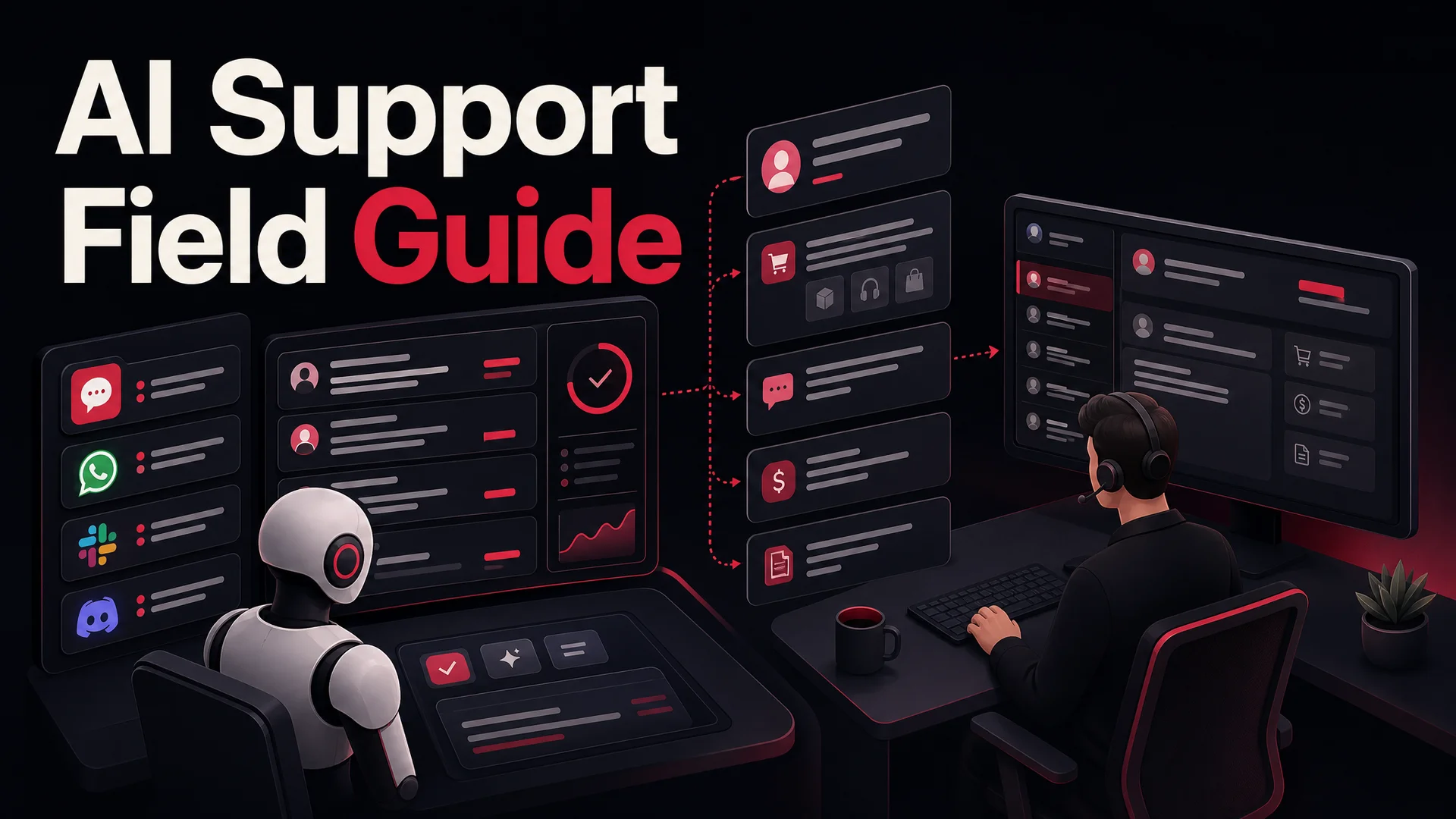
Berrydesk's AI Actions cover bookings, payments, and a growing library of common support workflows. Combined with deployment to Slack, Discord, WhatsApp, and standard web embed, this is what turns the agent from an FAQ layer into part of the operations team.
7. Security, privacy, and where the data lives
Support conversations contain PII, payment information, account details, and occasionally regulated data. Before signing up, get clear answers on where prompts and responses are logged, how long they are retained, whether the platform trains on your data (it should not, by default), and which model providers the data is forwarded to. For regulated industries - healthcare, finance, parts of the EU public sector - the MIT and Apache-licensed Chinese open-weight models (GLM-5.1, Qwen3.6-27B, MiMo) plus a self-hosted or air-gapped deployment path are increasingly the answer. Make sure the platform you pick can support that path if and when you need it, even if you do not need it on day one.
RAG, Long Context, and Routing: The Architectural Choices That Matter
A short, opinionated take on three architecture choices buyers ask about more than any others.
RAG vs. long-context
Two years ago, retrieval-augmented generation was the only way to put your knowledge base into a chatbot - context windows were tiny and you had to chunk and retrieve. In 2026, with Sonnet 4.6 and DeepSeek V4 at 1M tokens and Gemini 3.1 Ultra at 2M, you can fit an entire knowledge base, the full conversation history, and the relevant policy documents into a single context window for many businesses.
The pragmatic answer is "both, depending on the agent." For small-to-medium knowledge bases, long context is simpler and produces better answers because nothing is missed by a retriever. For enterprise-scale corpora - tens of thousands of documents - RAG remains the right default, but it becomes a tuning lever, not a hard requirement. Berrydesk supports both patterns; do not let a vendor convince you that one approach is universally correct.
Single model vs. routed multi-model
A single-model deployment is simpler. A routed deployment is cheaper and often higher-quality, because you can send the right conversation to the right model. A typical Berrydesk routing pattern: route 70–80% of routine traffic to DeepSeek V4 Flash or MiniMax M2 at a fraction of a cent per resolution, send action-taking conversations to Claude Opus 4.7 or Kimi K2.6, and reserve GPT-5.5 Pro or Gemini 3.1 Ultra for the longest, most complex escalations. Start single-model to keep your evaluation clean, then add routing once you have a clear picture of where cost and quality concentrate.
Open-weight vs. closed frontier
Closed frontier models are still ahead on the hardest reasoning. Open-weight models have caught up dramatically on cost, agentic tool use, and increasingly on raw capability. Treat them as complementary, not competitive. Open weights also unlock options that closed APIs cannot: on-prem deployments for regulated workloads, fine-tuning on your domain data, and protection from sudden pricing changes upstream. For most support teams, "use closed for hard, use open for easy, leave on-prem on the table for compliance" is a defensible default.
Common Pitfalls When Choosing
A few traps that show up over and over in deployments that disappoint:
- Optimizing for the demo, not the long tail. Every platform demos well on a polished knowledge base and scripted questions. Test with your messiest tickets - the ambiguous ones, the angry ones, the ones from customers using product names slightly wrong.
- Skipping the escalation design. The best support agents know when to hand off. If the platform makes escalation an afterthought, your customers will end up frustrated by the AI rather than helped by it.
- Locking in to one model provider. Six months from now, the price-performance leader will be different. Pick a platform where switching models is a settings change, not a re-platforming project.
- Underinvesting in evaluation. Stand up a small set of golden conversations - 50–100 real tickets with the correct outcome - and re-run them every time you change the agent. Without this, you cannot tell whether a tweak helped or hurt.
- Treating it as set-and-forget. A support agent improves the same way a human team does: with feedback loops. Spend an hour a week reviewing transcripts, tagging what went wrong, and updating sources or prompts. Teams that do this see compounding quality gains; teams that do not see flat performance and growing escalation rates.
A Quick Buyer's Checklist
When you are evaluating a platform, run through this list:
- Can I swap the underlying model - closed and open-weight - without rebuilding the agent?
- Can I ingest from the sources I actually use (docs, websites, Notion, Google Drive, YouTube)?
- Can I configure escalation rules and live-handoff to a human team?
- Do AI Actions cover the workflows my agent needs to complete (booking, payment, refunds, custom integrations)?
- Can I deploy to every channel my customers use - web, Slack, Discord, WhatsApp - without separate builds?
- Is the agent multilingual at the depth my customer base requires, not just a translation layer?
- Are the analytics good enough to tell me which conversations are succeeding and which are silently failing?
- Is the security posture compatible with my industry - and if I need on-prem later, is that a real path?
- Can a non-engineer on my team own the agent end-to-end?
If a platform clears all nine, you are in good shape. If it clears six or seven and the gaps are ones you can live with, that is also fine - just be honest about which gaps and how you will close them.
The Berrydesk Take
Choosing an AI support agent in 2026 is less about picking the right product and more about picking the right operating model. The platforms that will serve you for years let you swap underlying models as the landscape shifts, deploy to whichever channels your customers prefer, and take real action on the customer's behalf rather than just answering questions about doing it.
Berrydesk is built for that operating model. Pick from GPT-5.5, Claude Opus 4.7, Gemini 3.1, DeepSeek V4, Kimi K2.6, GLM-5.1, Qwen 3.6, MiniMax, and more. Train your agent on docs, websites, Notion, Google Drive, or YouTube. Brand the widget so it feels like part of your product. Add AI Actions for bookings, payments, and the workflows specific to your business. Deploy to web, Slack, Discord, WhatsApp, and the rest of the channels your customers actually use.
Spin up your first agent for free at berrydesk.com and have it answering customer questions before the end of the day.
 Berrydesk
Launch your AI agent in minutes
- Pick from GPT-5.5, Claude Opus 4.7, Gemini 3.1, DeepSeek V4, Kimi K2.6 and more
- Train on your docs, brand the widget, and ship to web, Slack, WhatsApp, Discord
Set up in minutes

Chirag Asarpota is the founder of Strawberry Labs, the team behind Berrydesk - the AI agent platform that helps businesses deploy intelligent customer support, sales and operations agents across web, WhatsApp, Slack, Instagram, Discord and more. Chirag writes about agentic AI, frontier model selection, retrieval and 1M-token context strategy, AI Actions, and the engineering it takes to ship production-grade conversational AI that customers actually trust.