Customer success used to be the polite cousin of sales and support. In 2026 it is the function. Every SaaS, e-commerce brand, and B2B service team is now graded on net revenue retention, expansion, and time-to-value, not just deflection rate. If your customers do not get the outcome they bought, they leave - and the next vendor is one search and one signup away.
That is the shift that makes "customer success tooling" a different category than it was even two years ago. The job is no longer about logging tickets and sending the occasional check-in email. It is about instrumenting every account: knowing who is healthy, who is at risk, who is ready to expand, and getting the right intervention to them before a human ever notices. Done well, success tooling pays for itself in churn that does not happen and renewals that close themselves.
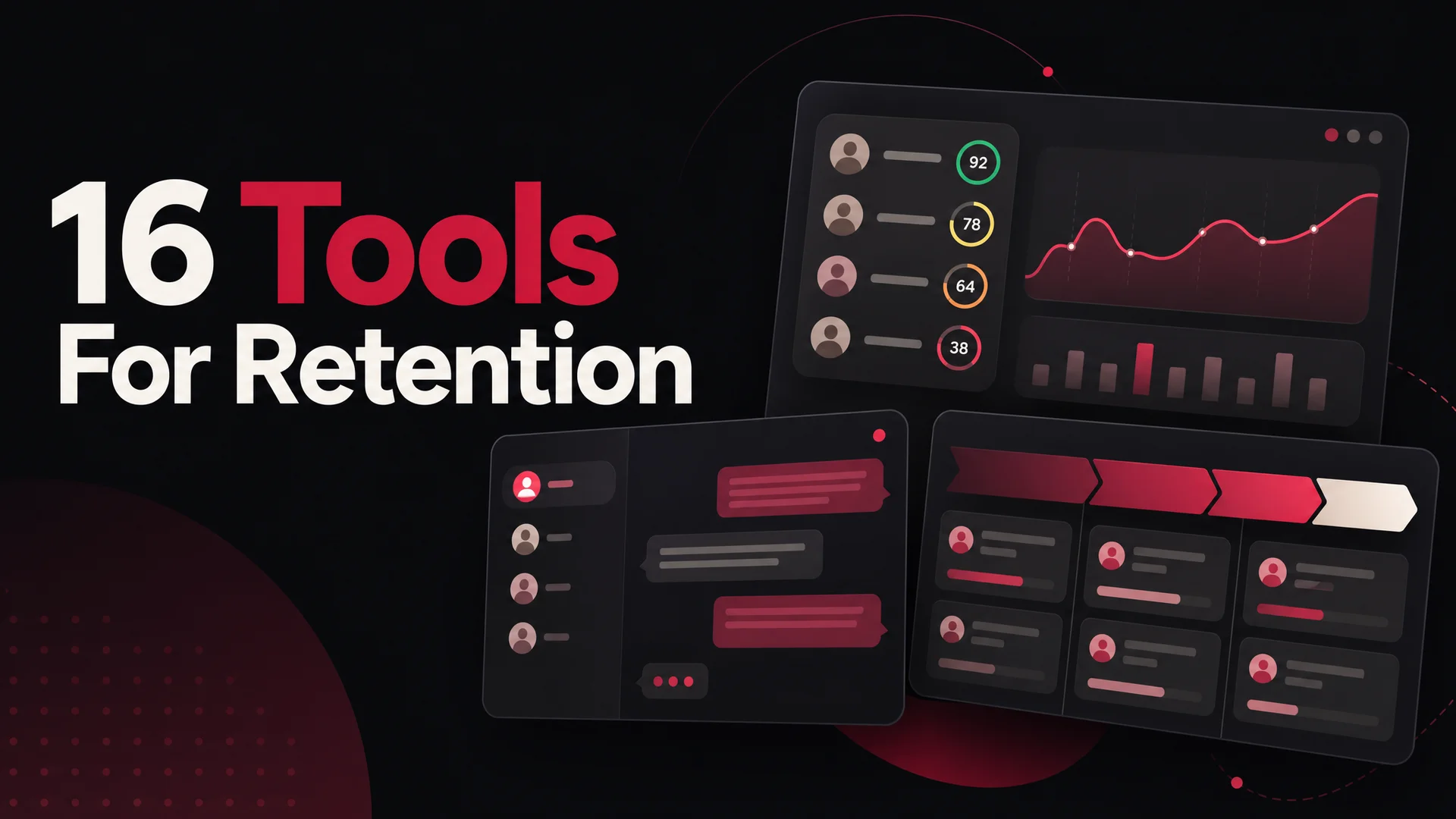
Below is the working stack that high-retention teams are actually deploying in 2026. The list mixes pure customer success platforms (CSPs) with the support, messaging, content, and AI tools that sit alongside them. Pick the two or three that fit how your team operates today, not all sixteen.
What separates a useful customer success tool from a spreadsheet
Every vendor in this space claims to "drive retention." Most of the difference comes down to five things - and they are worth pressure-testing in any demo before you swipe a card.
Time to first value. A customer success tool that takes a quarter to set up is a tool that ships ROI next year. The good ones get you a working health score, a usage feed, and a basic playbook in under a week. Ask for a sandbox you can populate with your own data, not a guided tour of someone else's.
Automation depth. Manual outreach does not scale past your first hundred accounts. The platforms that pay back their cost let you trigger emails, in-app messages, AI conversations, and CRM updates from product events ("user invited a teammate"), billing events ("plan downgraded"), and conversation events ("agent escalated to human"). The more events the tool can listen to, the more you can move from "we should reach out" to "we already did."
Integration with the systems you already pay for. Your CRM, your data warehouse, your support desk, your billing system, and your AI agents all hold pieces of the customer truth. A success tool that does not pull from at least three of those is just another silo. Look for first-class integrations with HubSpot, Salesforce, Stripe, Snowflake or BigQuery, and at least one major support desk.
Personalization that uses real signals. "Hi {{first_name}}" is not personalization. The bar in 2026 is dynamic content driven by lifecycle stage, plan tier, feature adoption, and recent conversation context. With 1M-token context windows now standard on Claude Opus 4.6, Gemini 3.1, and DeepSeek V4, the AI layer of your stack can hold an entire account history in a single prompt - your CSM tooling should feed that.
Insight you can act on without a data team. Pretty dashboards are easy. Insight is "this customer's health dropped from 82 to 64 because their three power users stopped logging in last week - here is the playbook." If a tool cannot tell you the why and the what next, you will end up paying analysts to do the same work.
The 16 tools worth knowing in 2026
1. Berrydesk
Berrydesk is an AI agent platform that customer success teams use to put a 24/7 expert in front of every account. You ship a branded agent in four steps: pick a model (GPT-5.5, Claude Opus 4.7, Gemini 3.1 Ultra, DeepSeek V4, Kimi K2.6, GLM-5.1, Qwen3.6, MiniMax M2 - or several, routed by intent), train it on your documentation, websites, Notion, Google Drive, and YouTube content, brand the chat widget to match your product, and deploy to your website, Slack, Discord, WhatsApp, or anywhere your customers already are.
What makes Berrydesk different from a generic chatbot is AI Actions. Your agent does not just explain how to upgrade a plan - it actually upgrades it. It does not just describe how to schedule an onboarding call - it books one, takes payment if needed, and writes the result back to your CRM. For customer success teams, that closes the gap between "the user got an answer" and "the user got the outcome." Routine traffic can run on a low-cost open-weight model like DeepSeek V4 Flash at $0.14 / $0.28 per million tokens, while complex escalations route to Claude Opus 4.7 (the current SWE-bench Pro leader at 64.3%) or GPT-5.5 Pro for harder reasoning.
Why teams pick it
- A single agent that handles onboarding, support, expansion questions, and account changes - across web, mobile, Slack, Discord, WhatsApp, and email
- Multi-model routing so you pay open-weight prices on easy traffic and frontier prices only when the conversation needs it
- Trained on your docs, help center, Notion, Drive, and YouTube - no custom RAG pipeline to maintain
- AI Actions for booking, payments, refunds, plan changes, and any custom workflow you can describe in an API call
- Hands off cleanly to human CSMs with full conversation context when an account needs it
Build your Berrydesk agent for free →
2. ClickUp
ClickUp started as a project management tool, but its CRM, automation, and AI features have made it a credible operations hub for smaller customer success teams. The strength is flexibility - you can model accounts, renewals, QBRs, and expansion plays as custom views without buying a dedicated CSP.
The trade-off is depth. If you need real product-usage telemetry and predictive health scores, ClickUp will need to be paired with something else (or with raw warehouse queries). For a team of three to ten CSMs running a manageable book of business, it is often enough on its own.
Why teams pick it
- Customizable workflows, views, and dashboards for the way your team actually works
- Native automations and AI assistants to reduce manual follow-ups
- Centralized customer notes, tasks, and timelines in one place
- Broad integrations with CRMs, helpdesks, and document tools
- Scales from a two-person team to a multi-region success org
3. Custify
Custify is a purpose-built customer success platform aimed squarely at SaaS. It pulls product usage, billing, and support signals into a single view per account, then turns them into health scores, lifecycle stages, and automated playbooks.
The product shines at the operational layer: setting up "if usage drops more than 30% in seven days, trigger a CSM task and a personalized in-app message" takes minutes, not weeks. For mid-market SaaS where every renewal counts, Custify is one of the easier ways to move from gut-feel to data-driven success.
Why teams pick it
- Configurable customer health scores tied to your product events
- Automated playbooks for onboarding, adoption, renewal, and churn risk
- A unified 360° view that pulls from CRM, billing, and support
- Native integrations with the usual SaaS stack
- A focus on early intervention rather than after-the-fact reporting
4. Zendesk
Zendesk remains the default support platform for a reason: it scales, it integrates with everything, and its agent workspace is mature. For customer success teams, it usually shows up as the system of record for tickets, while a dedicated CSP handles health and engagement on top.
In 2026, Zendesk's value is less about ticketing - that is commoditized - and more about being the place where conversations, knowledge, and automation converge. Pair it with a Berrydesk agent on the front line and Zendesk handles the human-in-the-loop work for the cases that escalate.
Why teams pick it
- A unified workspace for tickets, chat, voice, and messaging
- AI-assisted triage, summarization, and macro suggestions
- A robust knowledge base and customer-facing help center
- Mature integrations with CRMs, BI tools, and voice systems
- Multi-channel routing across email, chat, social, and messaging
5. HubSpot Service Hub
If your marketing and sales already run on HubSpot, Service Hub is the path of least resistance for customer success. The shared contact database means a CSM can see every email, every form fill, every deal note, and every support conversation without joining tables.
Service Hub will not replace a heavyweight CSP for a thousand-account enterprise team. But for product-led SaaS in the early scaling stage, it covers ticketing, knowledge base, NPS, and customer feedback in one place - and the same record updates roll into your sales and marketing automation for free.
Why teams pick it
- A single customer record across marketing, sales, and success
- Automated ticketing, surveys, and lifecycle workflows
- A clean self-service knowledge base
- In-product feedback collection (NPS, CSAT, CES) tied to records
- A natural step up for teams already deep in HubSpot
6. Intercom
Intercom is still the most-used messaging-first platform, especially for product-led companies that want proactive outreach inside the app. The mix of live chat, in-app messages, and product tours is hard to beat for onboarding-heavy use cases.
Intercom has leaned hard into AI in the last 18 months. Its Fin agent works well for first-line resolution, though for teams that want to choose their own model - say, route financial questions to Claude Opus 4.7 and product questions to a fine-tuned Qwen3.6-27B - a more model-agnostic platform like Berrydesk is a better fit. Either way, Intercom remains a strong choice for the human-and-bot blended motion.
Why teams pick it
- Best-in-class proactive messaging and product tour tooling
- Live chat that handles handoff between bot and human cleanly
- Detailed behavioral targeting for in-app campaigns
- Granular analytics on conversation outcomes and satisfaction
- A familiar UI that most CS hires already know
7. Gainsight
Gainsight is the enterprise CSP. If you run a global success org with hundreds of CSMs, segmented playbooks per region, and revenue targets tied to expansion, this is the tool most of your peers are using.
The depth comes at a cost: Gainsight implementations are projects, not weekend setups. But once it is in, the platform supports every motion a CS leader cares about - health scoring, success plans, executive business reviews, advocacy programs, and revenue forecasting - in one system.
Why teams pick it
- Sophisticated, configurable health scoring tied to outcomes
- Success plan and EBR templates that scale across teams
- Revenue forecasting tied to renewal and expansion pipelines
- Advocacy and community modules for post-sale growth
- The deepest integration ecosystem for enterprise SaaS
8. ChurnZero
ChurnZero is Gainsight's lighter, more focused sibling. It puts product usage and in-app messaging at the center of the platform, which is exactly what most growing SaaS teams actually need.
The "ZOE" assistant and journey automation make it easy for a small CS team to run sophisticated onboarding and adoption programs without writing custom code. Teams that want depth without enterprise-level deployment overhead tend to land here.
Why teams pick it
- Real-time usage signals turned into automated plays
- Native in-app messaging and walkthroughs
- Surveys, NPS, and feedback loops baked in
- Strong onboarding and adoption tooling out of the box
- A faster path to value than Gainsight for mid-market teams
9. Birdeye
Birdeye is built for multi-location and consumer-facing businesses. Reviews, surveys, mass texting, and reputation management sit alongside an AI assistant and a centralized inbox.
For a SaaS company, Birdeye is overkill. For a healthcare network, a real estate group, an automotive chain, or a regional services brand juggling reviews across hundreds of locations, it is one of the few tools that treats the problem as a single workflow rather than a dozen browser tabs.
Why teams pick it
- Centralized review and reputation management across locations
- AI-driven response suggestions across reviews and messages
- Mass SMS and bulk customer engagement at scale
- Survey and NPS tools tuned for local-business workflows
- Reporting that aggregates by location, region, and brand
10. Totango
Totango's modular ("SuccessBLOC") approach is its signature. Instead of buying one monolithic platform, you assemble pre-built programs - onboarding, adoption, renewal, advocacy - and customize them as you go.
That makes Totango especially attractive for teams that want CSP capabilities without the implementation timeline of a heavyweight platform. The trade-off is that the modular model can fragment if you do not invest in a coherent CS operating model up front.
Why teams pick it
- Pre-built programs you can deploy and tune in days, not months
- Real-time customer health and segmentation
- A clean, opinionated UI that CSMs adopt quickly
- Solid integrations with CRMs, support tools, and warehouses
- Pricing that scales gracefully from mid-market to enterprise
11. Freshdesk
Freshdesk is the Zendesk alternative that has aged well. The pricing is friendlier, the AI features are competitive, and the product is genuinely usable out of the box.
For customer success teams that need a support backbone alongside their CSP, Freshdesk handles the basics - ticketing, omnichannel inbox, knowledge base, automations - without the enterprise sprawl. It is also a popular pairing with Berrydesk, where the AI agent handles tier-1 and tier-2 in the channel of the customer's choice and Freshdesk owns the human queue.
Why teams pick it
- A unified inbox across email, chat, social, and voice
- AI-assisted ticketing and macro suggestions
- A solid knowledge base and community module
- Predictable, mid-market-friendly pricing
- A short ramp-up for new agents
12. Stonly
Stonly is a focused tool: interactive, branching guides that customers and agents step through to solve specific problems. Instead of a static help article, the user picks their situation and Stonly walks them through the right path.
For customer success teams, Stonly is most valuable in two places: complex onboarding (where a generic doc fails because every customer's setup differs) and self-service troubleshooting (where deflection rates jump when users can navigate to their exact issue). It also pairs well with an AI agent - Stonly handles structured walkthroughs, the agent handles the conversational gaps.
Why teams pick it
- Interactive, branching guides that adapt to the user's path
- Embeddable in apps, help centers, and websites
- Lower support volume by guiding users to self-resolve
- Solid analytics on where guides succeed or break
- A meaningful complement to AI-driven support
13. Planhat
Planhat is a customer platform that sits between CRM and CSP. Its strength is unifying the data: product usage, conversation history, contracts, billing, and CSM activity all live in one place, with a flexible data model that does not force you into someone else's schema.
The combination of customizable dashboards, automation, and a clean API makes Planhat a favorite of CS ops leaders who want to build a system, not just buy one.
Why teams pick it
- A flexible data model that fits your business, not the vendor's
- Real-time dashboards built on unified customer data
- Automation and AI insights for proactive engagement
- Solid API and integration story for custom workflows
- Scales from mid-market to large enterprise
14. ClientSuccess
ClientSuccess is purpose-built for CSMs managing a portfolio of accounts. The interface is account-centric: every CSM lands on their book of business, sees health and risk at a glance, and clicks into individual accounts for context.
It is less of an "ops platform" than Gainsight or Planhat, and more of an everyday workbench for the people actually doing the work. Smaller and mid-sized B2B SaaS teams tend to find the day-to-day usability worth the trade-off in raw configurability.
Why teams pick it
- An account-centric workspace built around the CSM's day
- Health scoring tuned to renewal and expansion outcomes
- Pulse, NPS, and feedback collection inside the platform
- Reporting that focuses on the metrics CS leaders actually present
- Faster adoption by CSMs than heavier platforms
15. Akita
Akita is a lightweight CSP for teams that want the fundamentals - segmentation, health, automation, alerts - without paying enterprise pricing. It does not try to be everything; it tries to do the basics well.
For startup and mid-market teams that have outgrown a spreadsheet but are not ready for a six-figure CSP contract, Akita is a sensible middle ground. It is also a reasonable starting point for teams that want to learn what a CSP does before committing to a heavier vendor.
Why teams pick it
- A focused feature set that covers the essentials
- Configurable customer segments and health rules
- Automated alerts and CSM tasks based on signals
- Integrations with the major CRMs and helpdesks
- Pricing that fits a growing team's budget
16. Podium
Podium consolidates messaging, reviews, and payments for local and brick-and-mortar businesses. SMS-based interactions, automated review requests, and text-to-pay flows are the headline features.
It is not a CSP in the SaaS sense, but for a hospitality group, a multi-clinic dental network, or a regional retail chain, Podium is the customer success layer - the place where reviews, follow-ups, and transactions all happen. Pair it with Berrydesk to add an AI agent that handles common questions inside the same SMS thread.
Why teams pick it
- Centralized customer messaging across SMS, web chat, and social
- Automated review requests that lift online reputation
- Text-to-pay flows that close transactions inside the conversation
- Local SEO and reputation features built in
- A workflow tuned for non-SaaS, location-based businesses
What to watch out for when you pick a customer success stack
A few patterns show up repeatedly in CS tooling postmortems. They are worth flagging before you sign anything.
Buying the platform before defining the operating model. A CSP only matters if you have decided what "healthy," "at risk," and "ready to expand" actually mean for your business. Teams that buy Gainsight or Planhat first and figure out the model afterwards almost always end up doing a re-implementation. Spend a week on a one-page CS playbook before you spend three months on a deployment.
Underestimating data plumbing. Every CSP is only as good as the product usage, billing, and conversation data flowing into it. Cheap integrations that pull a single field every 24 hours will give you a CSP that is wrong every morning. Budget for a real data integration - ideally event-level streaming from your warehouse - and you will get a real return.
Stacking AI tools that do not share context. It is easy to end up with three or four AI products - one in support, one in marketing, one in success, one in sales - each holding part of the customer's history and none of them talking. Either pick a platform like Berrydesk that lives across channels and shares context, or invest in a shared event layer (Segment, Customer.io, your own warehouse) that every tool reads from.
Choosing a closed model when an open one would do. With DeepSeek V4 Flash, MiniMax M2, GLM-5.1, and Qwen3.6-27B available at a fraction of frontier prices, paying GPT-5.5 rates for "what is your refund policy" is a budget leak. The right pattern is a routed setup: cheap open-weight models on routine traffic, frontier models on the hard escalations. Most modern AI agent platforms - Berrydesk included - let you do this without touching code.
Skipping the AI Actions question. A "smart chatbot" that can only answer is a deflection tool, not a success tool. The platforms that move retention are the ones whose agents can actually take an action - schedule a renewal call, apply a discount, change a plan, file a refund, push a CRM update. If a vendor's AI cannot do anything beyond text replies, it is not solving the customer success problem in 2026.
The short version
Customer success tooling has split into three roles in 2026: the CSP that owns health and lifecycle (Gainsight, Custify, Planhat, ChurnZero, ClientSuccess, Totango, Akita), the support and messaging layer that owns conversations (Zendesk, Freshdesk, Intercom, HubSpot Service Hub, Birdeye, Podium, Stonly), and the AI agent that owns the front line across every channel (Berrydesk).
You probably need one from each role. You almost certainly do not need all sixteen on this list. Start with the AI agent layer - it is the fastest to deploy and the easiest to measure - and add the CSP and support layers as the volume of accounts justifies it.
If you are starting that AI agent layer today, Berrydesk gives you a branded support and success agent live in an afternoon: pick your model, train on your content, wire AI Actions for renewals and account changes, and ship to wherever your customers already talk to you. Your CSMs get their time back. Your customers get instant answers. And your retention curve gets the help it has been asking for.
 Berrydesk
Launch a customer success agent in an afternoon
- Pick from GPT-5.5, Claude Opus 4.7, Gemini 3.1, DeepSeek V4, Kimi K2.6, GLM-5.1, Qwen3.6, MiniMax M2 - train on your docs and Notion.
- Wire AI Actions for renewals, upgrades, and account changes. Deploy to web, Slack, WhatsApp, and Discord.
Set up in minutes

Chirag Asarpota is the founder of Strawberry Labs, the team behind Berrydesk - the AI agent platform that helps businesses deploy intelligent customer support, sales and operations agents across web, WhatsApp, Slack, Instagram, Discord and more. Chirag writes about agentic AI, frontier model selection, retrieval and 1M-token context strategy, AI Actions, and the engineering it takes to ship production-grade conversational AI that customers actually trust.