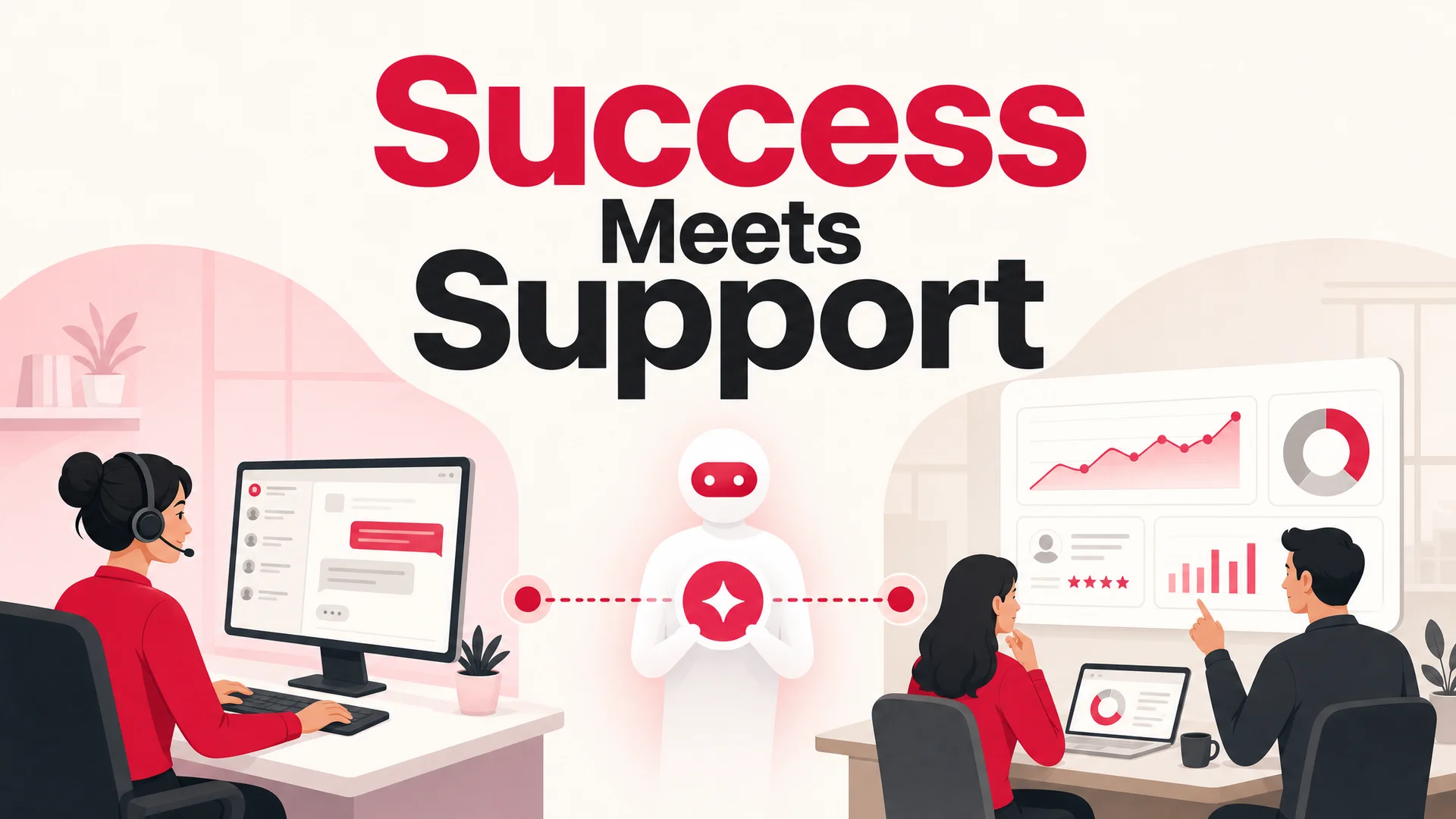
"Customer success" and "customer support" get treated like synonyms in job ads, org charts, and Slack channel names. They are not. They sit on different timelines, answer to different metrics, and break in different ways when you under-invest in either one. Conflating them is the reason a lot of post-sale orgs feel busy without feeling effective.
Support is operational. It is a queue and a clock. Someone is blocked, the timer starts, the goal is to clear the blocker and close the ticket without losing the customer's patience. Success is strategic. It is a relationship and a roadmap. The goal is for the customer to reach the outcome they bought the product to achieve - renewal, expansion, and advocacy fall out of that, not the other way around.
Drawing a clean line between the two is not a vocabulary exercise. It changes how you staff, how you measure, what you automate, and which AI models you point at which problem. This piece walks through the distinction, then through what changes in 2026 now that customer-facing AI agents can plausibly own large parts of both functions.
What customer support actually is
Customer support is the function that responds when something goes wrong. A user can't log in. A webhook stopped firing. An invoice double-charged. A feature is doing the opposite of what the docs imply. Support exists to absorb that friction, resolve the immediate issue, and return the customer to a working state as quickly as possible.
The shape of the work is reactive almost by definition. The customer surfaces a problem - through a chat widget, an email, a phone call, a Slack-connect channel, a community thread - and the support team picks it up, triages it, fixes it or routes it, and closes the loop. Most interactions are short and bounded. The best ones feel boring: ask, answer, done.
Because the workload is event-driven, the metrics are throughput-shaped:
- First response time (FRT). How long the customer waits before a human or AI agent acknowledges the message.
- Resolution time. How long until the issue is actually fixed, not just acknowledged.
- Customer satisfaction (CSAT). Did this specific interaction leave the customer feeling heard.
- Ticket volume and deflection rate. How many issues land in the queue and how many get resolved without a human touching them.
- Backlog age. How old the oldest unresolved tickets are getting.
Support's job is to keep frustration low at the moment it spikes. That matters enormously - a botched billing dispute or a 36-hour silence on an outage ticket can undo months of relationship building - but support, on its own, does not move the customer toward outcomes. It returns them to neutral. Whether they then go on to extract real value from the product is a different question, owned by a different team.
What customer success actually is
Customer success is the function that owns whether the customer reaches their desired outcome. It runs on a longer clock than support and accepts a different bargain: instead of waiting for a hand to go up, success watches the data and reaches out before the hand goes up.
In practice that looks like:
- Onboarding. Walking new accounts through their first value-creating workflow - connecting data sources, inviting teammates, hitting the activation milestone that predicts retention. A bad onboarding is a leading indicator of churn 90 days later, even if no ticket is ever filed.
- Adoption tracking. Watching which features each account is actually using, which ones they paid for and never touched, and which ones predict expansion. A success manager who notices that a key admin stopped logging in two weeks ago is doing more for retention than a support team that handles every ticket in under five minutes.
- Quarterly check-ins and business reviews. Especially in B2B and mid-market, sitting down with the customer to confirm the use cases that justified the contract are still being met, and to surface new ones.
- Expansion and renewal motions. Identifying when an account is ready for more seats, a higher tier, or an adjacent product - and equally, identifying when an account is at risk so the playbook can run before the cancellation email arrives.
- Voice-of-customer feedback into product. Success teams sit closer to outcomes than anyone else in the company, which makes them the natural pipe between what customers are actually trying to do and what the product roadmap reflects.
The metrics tell the same story. Success is measured on:
- Net revenue retention (NRR) and gross retention. The dollars that stay and grow inside the existing book.
- Churn rate, voluntary and involuntary. Both the ones who leave and the ones whose card silently fails.
- Customer lifetime value (CLV). The forecasted total a customer will spend over the relationship.
- Product adoption and time-to-value. How fast new accounts hit their first meaningful outcome.
- Net Promoter Score (NPS) and advocacy. Whether the customer would recommend you, and whether they actually do.
Where support is judged on resolving the moment, success is judged on shaping the arc. The work is fewer touchpoints per account, but each touchpoint is loaded with more context.
The differences that actually matter
It is tempting to flatten the comparison into "support is reactive, success is proactive" and stop there. That is true but useless - it doesn't tell you how to staff or how to operate. Four sharper differences are worth pulling out.
Trigger. Support is triggered by the customer. Something broke, and they reached out. Success is triggered by signals - usage data, milestone gaps, lifecycle stage, account health scores. If support waits until you raise your hand, success raises the hand on your behalf when it sees you struggling.
Time horizon. A support interaction is measured in minutes to days. A success engagement is measured in weeks to quarters. That single difference cascades into staffing ratios, comp plans, and tooling. A support agent might handle 40 tickets a day; a CSM might own 30 accounts at a time, with each account being a long-running conversation.
Definition of done. Support is "done" when the ticket closes and CSAT is positive. Success is never really "done" - it is a continuous loop of onboarding, adoption, expansion, and renewal. A support team that closes its queue every night is winning. A success team that thinks the work is finished is about to lose accounts.
Profile of the work. Support work is high-volume, mostly bounded, mostly answerable from the docs and the product state. Success work is lower-volume, more open-ended, more dependent on industry context, customer-specific goals, and political dynamics inside the customer's organization. The skill mix is different, and trying to staff one role with the other's profile usually produces the wrong outcomes in both.
The two functions share customers but not goals, share channels but not cadences, and share data but not metrics. Treating them as one team that does "both" is how mid-stage SaaS companies end up with a support org that drifts into half-hearted account management and a success org that gets dragged into ticket triage. Both functions get worse.
Why the line matters more in 2026
Three things have changed in the last 18 months that make the support–success distinction more consequential, not less.
First, buyer expectations leveled up everywhere at once. Customers used to extend grace to slow ticket queues; now they compare every support experience to the consumer apps they used over the weekend. They expect the agent to know who they are, what plan they are on, what they did yesterday, and what they are trying to do today - without being told. That expectation applies equally to a 2 a.m. password reset and an 11 a.m. business review.
Second, most churn is silent. The customer who complains is the customer who still cares. The customer who quietly stops logging in, drifts past renewal on auto-debit, and finally cancels six weeks later never filed a ticket. A support-only post-sale organization is structurally blind to that pattern. Success is the function that is supposed to see it - and increasingly, that visibility is the difference between a healthy NRR and a leaky one.
Third, support alone does not create growth. You can run a flawless ticketing operation, hit every SLA, and still watch your CLV stagnate because nobody on your side is helping accounts go from "we use it" to "we depend on it" to "we expanded our seat count." Support keeps customers from leaving angry. Success keeps them from leaving quietly, and gets them to spend more.
Layered on top of all three: experience is the moat. Features get cloned in a quarter. Pricing pages get matched in a week. The way your post-sale organization actually treats customers when something breaks at midnight, or when they're three weeks into onboarding and stuck, is what they remember and tell their peers about.
How AI agents redraw the map in 2026
This is where the picture has changed most. Up until very recently, AI in the post-sale stack meant a deflection chatbot bolted to the support function - handle FAQs, escape to a human, log a ticket. Two things made that limited. The models weren't reliable enough to handle real account context, and the agents couldn't take real actions on the customer's behalf.
Both of those constraints have collapsed.
On the model side, the frontier moved twice in 2026. Closed models - GPT-5.5 and GPT-5.5 Pro with parallel reasoning, Claude Opus 4.7 leading SWE-Bench Pro at 64.3%, Gemini 3.1 Ultra with a 2M-token context - handle the hardest reasoning. Just as importantly, the open-weight frontier from DeepSeek V4, Moonshot Kimi K2.6, Z.ai's GLM-5.1, Alibaba's Qwen 3.6 family, MiniMax M2.7, and Xiaomi's MiMo-V2-Pro is now genuinely competitive on agentic tasks at a fraction of the price. DeepSeek V4 Flash runs at $0.14 / $0.28 per million input/output tokens. MiniMax M2 sits around 8% the price of Claude Sonnet at roughly twice the speed. That cost curve makes it economically reasonable to put an AI agent in the loop for every interaction, not just the cheap ones.
On the action side, the same generation of models - Claude Opus 4.7, Kimi K2.6, GLM-5.1, Qwen 3.6, MiMo-V2-Pro - actually do tool use reliably. Bookings, refunds, plan changes, order lookups, payment flows: these stopped being demoware and started being production patterns. That is the unlock for blending support and success into a single customer-facing agent layer.
What that looks like in practice on Berrydesk:
- Reactive support, automated. A support-flavored agent on your site, app, Slack, Discord, or WhatsApp answers questions instantly, 24/7, in the customer's language. With 1M-token context windows on DeepSeek V4 Flash, Claude Sonnet 4.6, and Kimi K2.6, the agent can hold your full knowledge base, the customer's conversation history, and your policy docs in-context. RAG becomes a tuning lever for relevance, not a hard requirement for fitting content. Most routine traffic gets resolved without a human touching it.
- Proactive success, automated. The same agent platform can be pointed at usage signals - a key admin who has not logged in for ten days, an account that hit 80% of its plan limit, a customer who never finished onboarding step three - and trigger a personalized outbound message rather than waiting for a ticket. That is success-team behavior, executed at the scale of the support queue.
- AI Actions for the boring middle. Bookings, refunds, subscription changes, order lookups, payment captures - the things that used to require a human agent because the chatbot could only "answer" - now run end-to-end inside the agent. That collapses the handoff cost between support and success, because the agent that detects an at-risk account can actually do something about it.
- Clean human handoff when it is needed. Both functions still need humans for the hard cases - angry escalations, complex commercial conversations, anything political. The agent's job is to pass the human a fully contextualized conversation, not to force the customer to repeat themselves for the third time.
- Model routing by job. Route routine FAQs and confirmations to DeepSeek V4 Flash or MiniMax M2 to keep unit economics tight. Route long, multi-step diagnostic conversations and renewal-risk outreach to Claude Opus 4.7 or GPT-5.5 Pro where the reasoning quality justifies the price. Berrydesk lets you pick the model per use case rather than locking you into one.
The net effect is that the line between support and success doesn't disappear - it stays meaningful for staffing and metrics - but it stops being a hard wall in the customer's experience. From the customer's side, there is one agent, one history, and one place where things get resolved or anticipated.
Common pitfalls when teams blend the two
A few patterns to avoid as you bring AI agents into both functions.
Treating success as "support with a longer SLA." It isn't. If your CSMs are spending most of their week working tickets that escaped the queue, your support automation is too thin and your success function is being subsidized by the wrong work.
Letting the agent answer success-flavored questions with support-flavored brevity. A "how do I get more out of this product" conversation is not a "where do I click" conversation. The agent's tone, depth, and willingness to ask follow-up questions should change with the intent.
Picking one model for everything. A single-model strategy is the most expensive way to lose either on quality or on cost. If you route everything to a frontier closed model, you pay too much for the easy traffic. If you route everything to the cheapest open-weight, you cut corners on the conversations that decide renewals. Routed deployments are the default in 2026 for a reason.
Ignoring the data layer. AI agents are only as proactive as the signals they can see. If your product analytics, CRM, and billing data don't reach the agent, it can answer questions but it can't anticipate them. The success half of the job depends on that telemetry.
Forgetting compliance and on-prem options. For regulated industries - healthcare, finance, public sector - the open-weight frontier matters in a different way. MIT-licensed weights from GLM-5.1, Qwen3.6-27B, and MiMo make on-prem and air-gapped deployments viable in places where sending data to a frontier API is a non-starter. That is a real expansion of where AI-driven support and success can run, not a footnote.
Where to start
If you're earlier in the journey, it usually pays to over-invest in support automation first - that is the function with the highest volume, the most repeatable patterns, and the fastest unit-economics payoff. Get ticket deflection up, FRT down, and CSAT stable, then layer success-flavored proactivity on top of the same agent: onboarding nudges, adoption prompts, renewal check-ins, expansion flags.
If you're more mature, the bigger gain is usually on the success side. Most companies have a respectable support stack and a thinner success motion that depends on a small team of CSMs covering far too many accounts. AI agents are very good at the long tail of accounts that don't justify a dedicated CSM but still deserve more than a ticket queue.
Either way, the underlying point holds. Support and success are different jobs. They use different metrics, different cadences, and different parts of the model stack. The teams that win in 2026 are the ones that respect the distinction internally while presenting one coherent agent to the customer.
If you want to see what that looks like in practice, you can spin up a Berrydesk agent in a few minutes - pick the model, point it at your docs, websites, Notion, Drive, or YouTube content, brand the widget, wire up AI Actions for bookings and payments, and deploy to your site, Slack, Discord, or WhatsApp. Try it at berrydesk.com.
 Berrydesk
Run support and success from one AI agent
- Reactive ticket deflection and proactive nudges from the same widget
- Pick the model that fits the budget - GPT-5.5, Claude Opus 4.7, DeepSeek V4, GLM-5.1
Set up in minutes

Chirag Asarpota is the founder of Strawberry Labs, the team behind Berrydesk - the AI agent platform that helps businesses deploy intelligent customer support, sales and operations agents across web, WhatsApp, Slack, Instagram, Discord and more. Chirag writes about agentic AI, frontier model selection, retrieval and 1M-token context strategy, AI Actions, and the engineering it takes to ship production-grade conversational AI that customers actually trust.