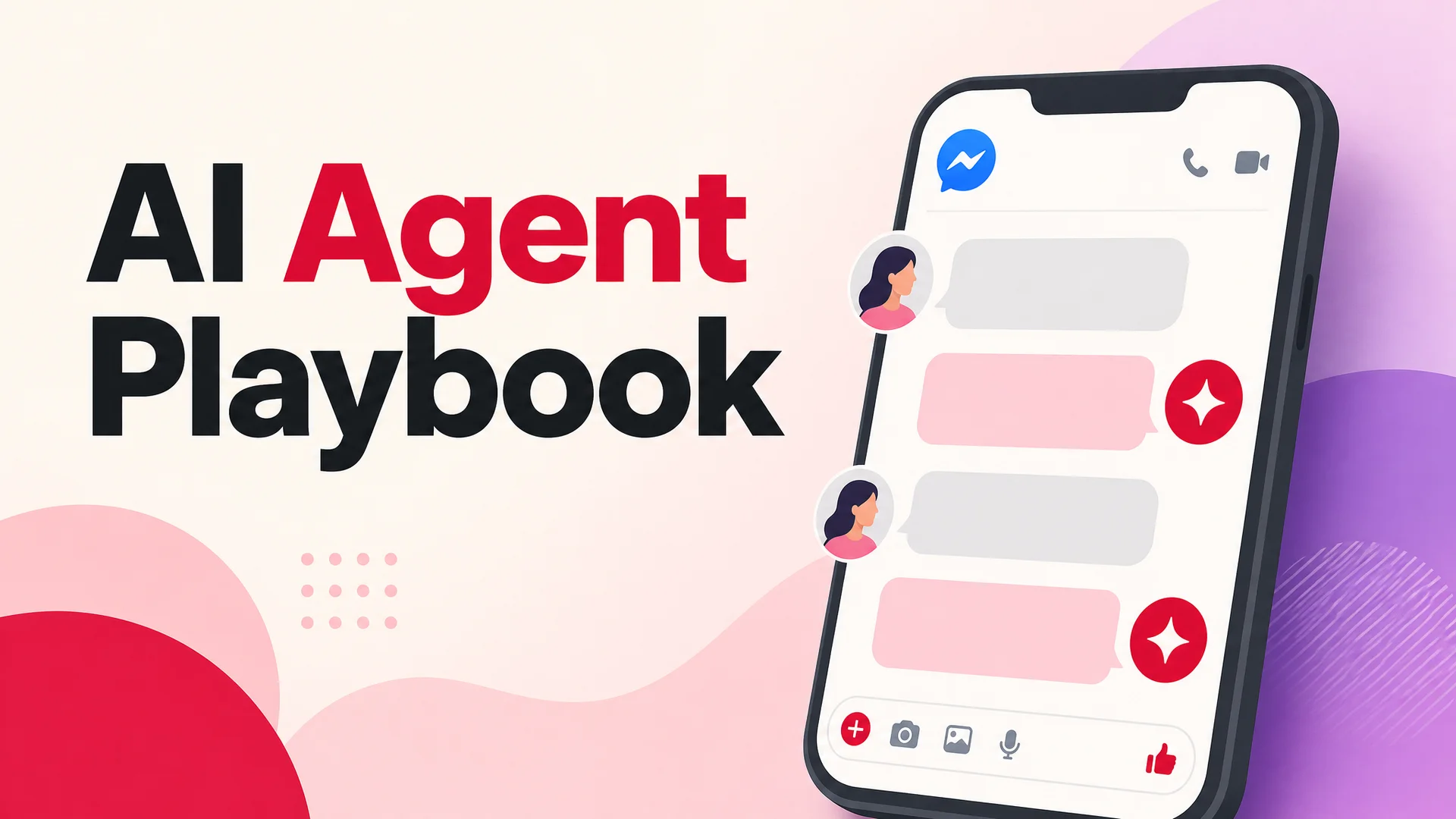
Facebook Messenger still moves more business conversations every day than almost any other channel on the open internet. With north of 1.3 billion monthly active users - and Meta steadily threading Messenger into Instagram DMs, WhatsApp Business, and click-to-chat ads - it remains the place where buyers actually expect a reply, fast. The bar is not "we got back to you on Tuesday." The bar is "we answered before the user closed the app."
That bar is essentially impossible to clear with a human-only team. Pre-sales questions arrive at 11 PM. Refund requests show up Sunday morning. A buyer who tapped on your Reels ad wants a price comparison in the next sixty seconds, not after an SLA timer. This is the gap a Messenger AI agent fills - and in 2026, with frontier models that genuinely reason, take actions, and hold an entire knowledge base in context, what was once a janky FAQ bot is now a credible front line of customer experience.
This guide walks through what a modern Facebook Messenger AI agent actually is, why it matters now, how to build one that doesn't embarrass you, which models to point it at, what to measure, and where the real pitfalls live.
What a Facebook Messenger AI Agent Really Is
A Facebook Messenger AI agent is an automated, language-model-powered participant inside Messenger conversations on your business page. It reads incoming messages, decides what to do, and either replies in natural language, takes a structured action (look up an order, book an appointment, send a payment link), or escalates to a teammate with the full conversation history attached.
The boundary that matters most is between scripted bots and reasoning agents. A scripted bot is a decision tree: if the user taps "Pricing," show pricing. If they type something the tree did not anticipate, it falls over. A 2026-era AI agent uses a model like Claude Opus 4.7, GPT-5.5, Gemini 3.1 Pro, DeepSeek V4, or GLM-5.1 to interpret intent, look up the right context inside your knowledge base, decide which tool to call, and write a reply that sounds like it was typed by someone who actually works at your company.
The practical difference is enormous. The scripted bot can answer the questions you predicted. The agent can answer the questions you didn't.
Why Messenger Agents Are Suddenly Worth Doing Properly
The case for putting a serious agent on Messenger in 2026 is no longer a hypothesis - the numbers are well-trodden territory at this point. A few patterns repeat across deployments.
Open rates that put email to shame. Messenger conversations are routinely cited at 70–80% open rates versus the ~20% you can expect from a marketing email. People have notifications on; messages from a brand they already opted into reach the home screen, not a tab they will declare bankruptcy on next quarter.
Response time that matches the channel's expectations. A buyer messaging a brand on Messenger expects something close to real time. An AI agent answers in under a second, every hour of every day, in whatever language the user wrote in.
Conversion lift that pays for itself. E-commerce teams that wire AI agents into Click-to-Messenger ad funnels regularly report a roughly 20% conversion uplift. The mechanics are simple: instead of dropping a paid click onto a landing page where the user has to fill out a form, the click opens a conversation, and the agent qualifies, recommends, and closes inline.
Better lead capture. Conversational qualification - asking three relevant questions inside a chat - converts noticeably better than a static form. Reported lift sits around 28% versus traditional capture pages.
Lower deflection cost. Teams typically see ticket volume drop by roughly a third after an agent handles tier-one questions: order status, return policy, hours, sizing, account access, password resets, and so on. The savings compound, because the tickets that reach humans are now the genuinely complex ones.
Scalability without headcount. A human agent might run four chats in parallel before quality drops. An AI agent runs hundreds without breaking a sweat, and the marginal cost of one more conversation, on the right model, is fractions of a cent.
The combined effect is that Messenger stops being a channel you reluctantly staff and starts being a revenue and retention surface you actively invest in.
The 2026 Model Landscape Behind a Good Agent
The single biggest change between a Messenger bot built two years ago and one built today is what's running underneath it. The model layer matured fast, and the cost curve collapsed.
Closed frontier. GPT-5.5 and GPT-5.5 Pro from OpenAI now ship with parallel reasoning. Anthropic's Claude Opus 4.7 leads SWE-bench Pro at 64.3% and is the most reliable model on the market for taking real actions inside a conversation - refunds, bookings, account changes - without freelancing. Claude Opus 4.6 and Sonnet 4.6 both ship with a 1M-token context window at no surcharge, which is enough to hold an entire mid-size knowledge base in memory. Google's Gemini 3.1 Ultra goes further still with a 2M-token context and native multimodal understanding across text, image, audio, and video.
Open-weight frontier. This is the real cost story. DeepSeek V4 (released in April 2026) ships in two variants: V4 Pro at 1.6T parameters with 49B active, and V4 Flash at 284B / 13B active. V4 Flash is priced at $0.14 / $0.28 per million input/output tokens. MiniMax M2 and M2.7 deliver near-frontier coding and reasoning at roughly 8% the price of Claude Sonnet at twice the speed. Z.ai's GLM-5.1 (MIT-licensed, 754B-parameter MoE) is now beating Claude Opus 4.6 and GPT-5.4 on SWE-Bench Pro and was trained entirely on Huawei Ascend chips. Moonshot's Kimi K2.6 can run agentic sessions for up to twelve hours coordinating swarms of sub-agents. Alibaba's Qwen 3.6 family covers everything from a 27B Apache-licensed dense model to the proprietary Qwen3.6-Max.
For a Messenger agent, the practical implication is a routing strategy. Send the long tail of "where's my order?" and "what's your return policy?" to a cheap, fast open-weight model - DeepSeek V4 Flash or MiniMax M2 - and reserve a frontier closed model for the conversations where stakes, ambiguity, or compliance demand it. Berrydesk lets you wire this exact pattern in without writing routing glue.
The other quiet revolution: 1M and 2M-token context windows mean that for a lot of mid-size businesses, retrieval is no longer a hard requirement. You can drop your full help center into the prompt and let the model reason over it directly. RAG becomes a tuning lever for very large knowledge bases, not a precondition.
How to Build a Facebook Messenger AI Agent
The end-to-end build is shorter than most teams expect - typically a long afternoon for the first usable version. Here is the path.
1. Pick a Platform That Owns the Hard Parts
You can wire Messenger's Send API to a model directly, but you'll spend the next six months building knowledge ingestion, conversation memory, evaluation, model routing, escalation, and analytics yourself. A purpose-built agent platform like Berrydesk handles all of that and lets you stay focused on conversation quality. Berrydesk supports GPT-5.5, Claude Opus 4.7, Gemini 3.1, DeepSeek V4, Kimi K2.6, GLM-5.1, Qwen, MiniMax, and others, so you're not locked to a single vendor.
2. Connect Your Facebook Business Page
Authorize the platform via Facebook Login and grant Messenger permissions on your Business Page. Personal profiles can't run Messenger automation - you need a Page tied to a Meta Business account. Most platforms walk you through the OAuth flow and verify the page in under five minutes.
3. Train the Agent on Your Real Knowledge
This is the step that makes or breaks the project. Point the agent at the sources customers actually ask about: your help center, product pages, pricing, policies, Notion workspaces, Google Drive folders, and even YouTube tutorials. Berrydesk handles each of these as a first-class source so the agent answers from documents you control, not from whatever the underlying model happened to memorize during training.
4. Brand the Experience
Set the agent's name, tone, persona, and welcome message. Configure ice breakers - the tappable conversation starters that show on first contact, like "Track my order," "Talk to sales," or "Book a demo." Good ice breakers triple first-message engagement because they remove the "what do I even type?" hurdle.
5. Wire Up AI Actions
The line between a chatbot and an agent is whether it can do things. Set up actions for the workflows that drive your business - order lookup, refund initiation, appointment booking, payment links, lead-to-CRM push, ticket creation. With models like Claude Opus 4.7, GPT-5.5, Kimi K2.6, and Qwen3.6 in the loop, tool use is finally reliable enough to put in front of customers without a human babysitter on every call.
6. Test Like You Mean It
Before flipping it live, role-play your top twenty customer scenarios, plus a dozen weird ones: typos, mixed languages, multi-question messages, attempts to jailbreak the agent into talking about a competitor. Test on mobile, since the overwhelming majority of Messenger traffic is on phones and the layout of carousels and quick replies behaves differently from desktop previews.
7. Launch, Then Watch
Push it live and instrument everything. Read the first few hundred conversations end to end. You will spot phrasing your knowledge base does not cover, edge cases your action handlers fumble, and ice breakers nobody taps. Iterate weekly for the first month, then settle into a steadier rhythm.
What to Watch Out For: Common Pitfalls
Most failed Messenger agent projects fail in predictable ways. Avoiding them is easier than fixing them after launch.
Boiling the ocean on day one. Teams that try to handle every possible question on launch end up with an agent that does ten things badly. Start with the five questions that account for half your inbound volume. Get those right, then expand.
Hidden human escalation. If users have to fight to reach a real person, your CSAT will collapse and your app store / Trustpilot reviews will tell on you. A clear "talk to a human" pathway is non-negotiable.
Treating it like a marketing megaphone. Messenger is a help channel first. Promotional messages without a clear in-thread purpose tank engagement and attract spam reports, which damage your page health.
Skipping the 24-hour rule. Meta only lets you send free-form messages within 24 hours of the user's last reply. Outside that window you need approved Message Templates or sponsored messages. Build re-engagement flows that respect this from day one - getting flagged for policy violations on a business page is genuinely painful to recover from.
Letting the knowledge base drift. An agent that confidently quotes last quarter's return policy is worse than no agent at all. Wire your sources to refresh automatically on a schedule, and review hallucination signals weekly.
Picking one model and hoping. A single-model setup either overpays for trivial questions or underdelivers on hard ones. Route by task: cheap open-weight for FAQ and intent classification, frontier for ambiguous reasoning and sensitive actions.
Best Practices That Actually Move the Needle
A handful of patterns separate the agents that customers love from the ones they tolerate.
Lead with help, not pitch. The opening message should feel like a useful concierge, not a salesperson. Conversion will follow as a side effect of being useful first.
Personalize where you can. Use the user's name. Reference the order they're asking about. Pull purchase history into the prompt. Modern long-context models can hold the whole customer record without breaking a sweat - use that.
Use the rich UI Messenger gives you. Carousels, quick replies, persistent menus, and image attachments dramatically reduce the number of turns a conversation takes. A good agent shows a product card with a buy button instead of describing the product in three paragraphs.
Be honest about what you are. Tell users they're talking to an AI. Trust goes up, not down - most users prefer it to being lied to, and the disclosure is also good policy hygiene under emerging EU AI Act rules.
Test on mobile, real devices. Messenger renders differently on iOS, Android, and desktop. The fastest way to look unprofessional is to ship a carousel that wraps weirdly on a Pixel.
Observe, then adjust. Treat every conversation log as a free QA report. The agent will tell you which sections of your knowledge base are thin, which products generate the most pre-sale doubt, and which workflows people abandon.
High-Leverage Use Cases on Messenger
Messenger AI agents earn their keep in a wide range of scenarios. The ones below pay back fastest.
Tier-one customer support. Returns, shipping, account access, password resets, hours, store locations, warranty checks. These are high-volume, low-complexity, and deeply repeatable - exactly where automation shines.
E-commerce assistance. Product discovery, recommendations based on stated preferences, in-chat product cards, real-time stock checks, abandoned cart recovery, post-purchase order tracking. With AI Actions wired to your order system, a single Messenger conversation can take a buyer from "what do you have?" to "thanks for the order" without leaving the thread.
Click-to-Messenger advertising. This is the highest-ROI play on Meta's ad surface today. Your ad opens a Messenger conversation directly into a qualifying flow. The cost-per-qualified-lead is typically a fraction of what you'd pay for landing-page conversions, and the user experience is dramatically better.
Lead qualification and routing. Ask three good questions, push the qualified leads into your CRM with full context, and only ping a human seller for the ones that clear the bar.
Appointment and reservation booking. Salons, clinics, restaurants, consultants, and B2B sales teams all benefit from letting the agent see calendar availability and book directly inside the conversation. Reminders sent through Messenger have far better delivery rates than email.
Restaurant and food service. Menus as carousels, orders as quick replies, delivery updates as proactive messages within the 24-hour window.
Travel and hospitality. Itinerary lookups, gate changes, room upgrade offers, day-of-trip support - the categories where customers most need fast answers in moments of low patience.
Surveys, feedback, and CSAT. A two-question conversational survey completes at multiples of the rate you'd see from a static form embedded in an email.
Event ticketing and attendee support. Pre-event FAQs, ticket purchases, schedule lookups, on-site help - all in a thread the attendee already had open.
How to Measure a Messenger AI Agent
A few metrics tell you almost everything you need to know.
Containment rate. The share of conversations the agent fully resolves without a human. A healthy support agent on a typical e-commerce or SaaS deployment lands somewhere between 70% and 85% once it has been tuned for a few weeks.
First response time. Should be sub-second. If it isn't, your model routing or function calls are the bottleneck.
Conversation completion rate. For each defined goal - order placed, lead captured, appointment booked - measure the rate at which conversations actually reach the goal versus drop off mid-flow. Drops cluster, and the clusters tell you what to fix.
Handoff rate and reason. Track not just how often the agent escalates, but why. "User asked for a human" is different from "agent could not answer," and they call for different fixes.
Conversion rate. For revenue-driving deployments, the share of conversations producing a sale or qualified opportunity.
CSAT or thumbs-up/thumbs-down. A one-tap reaction at the end of a conversation, surfaced in your dashboard, is the lightest-weight quality signal you can collect and it's surprisingly representative.
Cost per resolution. Token cost plus platform cost divided by resolved conversations. With routing to open-weight models like DeepSeek V4 Flash or MiniMax M2 for the long tail, this number drops to fractions of a cent for most support deployments - orders of magnitude below per-resolution pricing on legacy enterprise platforms.
Retention. The share of users who return to chat with the agent again. Users only come back to channels that worked for them last time.
Trade-offs Worth Thinking Through
A few real tensions are worth deciding on consciously rather than by default.
Open-weight vs closed frontier. Open-weight models have collapsed in price and many now match or beat closed peers on agentic benchmarks. But closed frontier models still have an edge on the hardest reasoning tasks and on safety alignment. The right answer is rarely "all of one." Route by task complexity.
Long context vs RAG. With 1M-token windows now standard on Claude Sonnet 4.6 and DeepSeek V4, you can simply load your entire knowledge base into context for many use cases. RAG is still cheaper at very large scale and gives you tighter source attribution, but the operational overhead has dropped sharply.
Single model vs routed. Single-model setups are simpler to reason about and easier to evaluate. Routed setups are cheaper at scale and give you graceful degradation when one provider has an outage. Most production deployments end up routed within their first six months.
Build vs buy. Building from raw model APIs is tempting, especially for engineering teams who want full control. But it usually means re-implementing knowledge ingestion, conversation memory, evaluations, escalation, multi-channel deployment, and analytics. Platforms like Berrydesk exist because that work is non-trivial and not where customer support teams want to spend their roadmap.
Limitations to Stay Honest About
No 2026-era agent is magic, and pretending otherwise is the fastest way to lose customer trust.
Genuinely complex multi-system queries - "I was charged twice but only one of the orders shows in my account, and one of the items I did receive arrived damaged, and I want to keep that one but return the other" - still benefit from a human. The agent should pre-summarize and stage the work, then escalate.
Meta's policies and Messenger APIs evolve. The 24-hour messaging window, sponsored message rules, and template approval flows all change periodically. Your platform should track and surface these for you, not leave you reading developer changelogs.
Privacy and compliance are real obligations. GDPR, CCPA, and the EU AI Act all touch chat data. For regulated industries, MIT-licensed open-weight models like GLM-5.1 and Qwen3.6-27B make air-gapped, on-prem deployments viable in a way they weren't twelve months ago.
Knowledge bases drift. If you don't refresh them, your agent's answers go stale. Wire automatic re-syncs on whatever cadence your content actually changes.
Where This Is All Heading
A few directional bets feel safe to make for the next twelve months.
Voice messages on Messenger will become first-class agent input. Models that already ingest audio natively, like Gemini 3.1 Ultra, will let your agent treat a voice note exactly like a text message.
Personalization will deepen. Long-context models can hold a customer's entire order history, prior conversation transcripts, and behavioral signals in a single prompt, producing recommendations that feel genuinely tailored rather than templated.
Cross-channel context will become table stakes. Users will start a conversation in Messenger, continue it on WhatsApp, and finish on your website - and they will expect the agent to remember.
Proactive engagement will get more useful and less spammy. Agents will reach out at moments where outreach is genuinely welcome - order delays, restocks the user asked about, a class spot opening up - not just to push promotions.
Conversational commerce will close the loop. Discovery, recommendation, payment, and post-purchase support will increasingly happen entirely inside chat, no website redirect required.
Wrapping Up
Facebook Messenger remains one of the largest direct-to-customer surfaces a business has access to. In 2026, with frontier reasoning models on tap, 1M-token context windows, reliable tool use, and open-weight pricing in the cents, there is no longer a credible reason to leave that channel under-served. The question is not whether to deploy a Messenger AI agent - it is how soon you can stand one up that genuinely represents your brand.
Berrydesk lets you do exactly that. Pick a model - GPT-5.5, Claude Opus 4.7, Gemini 3.1, DeepSeek V4, Kimi K2.6, GLM-5.1, Qwen, MiniMax, or others - train it on your docs, site, Notion, Drive, or YouTube, brand the chat experience, wire AI Actions for bookings and payments, and deploy to Facebook Messenger, your website, WhatsApp, Slack, Discord, and beyond. The whole loop, from sign-up to live agent, is a single afternoon.
If your customers are already messaging your Page, give them an answer worthy of the channel. Start building at berrydesk.com.
 Berrydesk
Ship a Messenger AI agent your customers actually like
- Train on your docs, site, Notion, Drive, and YouTube in minutes
- Deploy to Messenger, WhatsApp, Slack, Discord, and your site
Set up in minutes

Chirag Asarpota is the founder of Strawberry Labs, the team behind Berrydesk - the AI agent platform that helps businesses deploy intelligent customer support, sales and operations agents across web, WhatsApp, Slack, Instagram, Discord and more. Chirag writes about agentic AI, frontier model selection, retrieval and 1M-token context strategy, AI Actions, and the engineering it takes to ship production-grade conversational AI that customers actually trust.