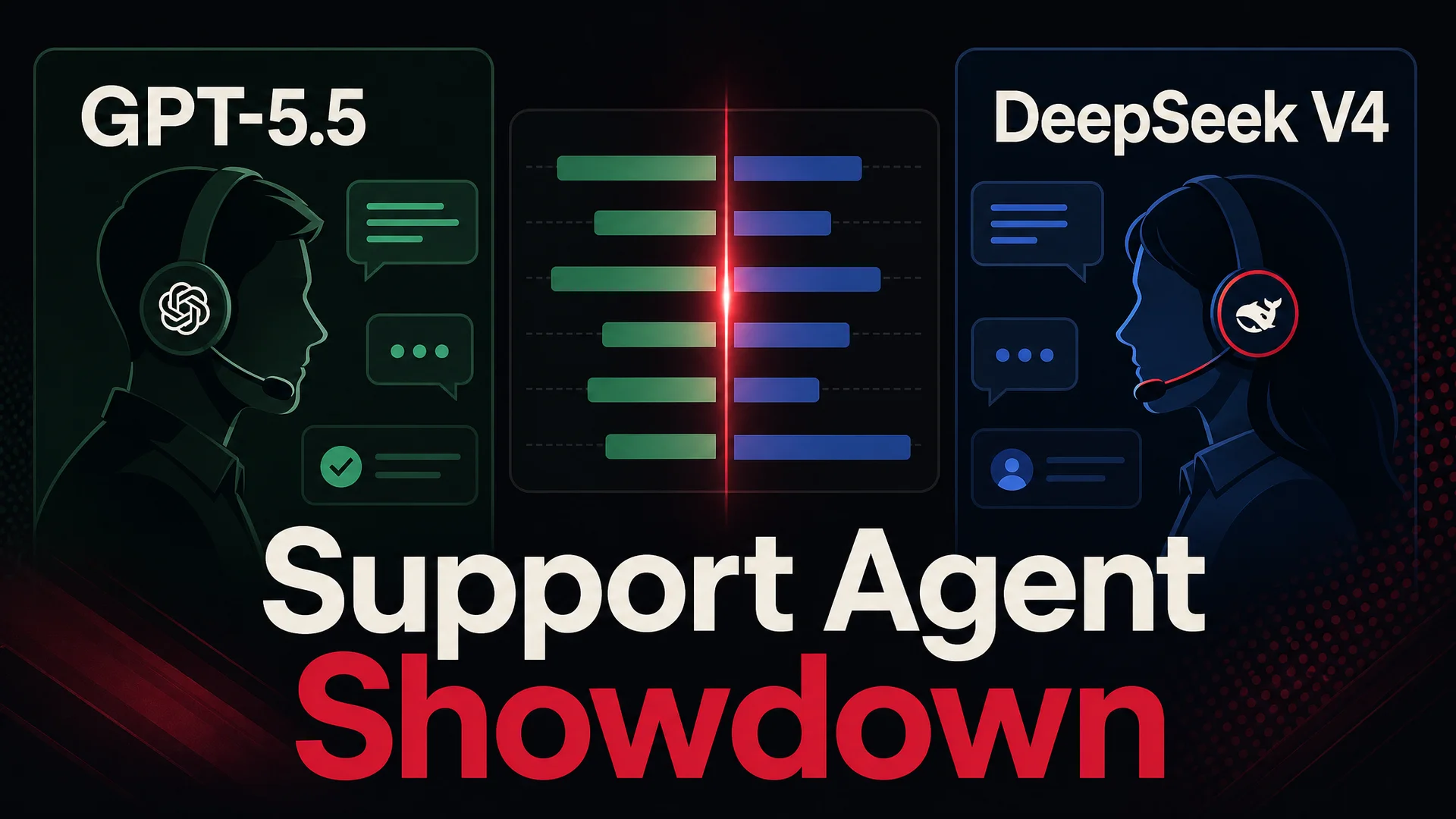
The "ChatGPT versus DeepSeek" debate has not gone quiet - it has gotten louder, and the stakes are higher. A year ago, picking between OpenAI and a Chinese open-weight model was mostly a developer curiosity. In May 2026, with DeepSeek V4 out the door, GPT-5.5 in production, and support teams paying real money per resolution, it is a budget-line decision that lands on a CFO's desk.
We have run both, in production, behind support widgets handling real ticket volume. The honest answer is that neither one wins outright. They are built for different jobs, priced for different scales, and constrained in different ways. What follows is a sharper look at where each one earns its keep - and how to think about the choice if you are about to wire one into a customer-facing agent.
1. The Models Behind the Brands
When people argue about ChatGPT versus DeepSeek, they are really arguing about two different families of models, made by two different labs, with two very different release philosophies. OpenAI ships closed models behind a paid API. DeepSeek ships open weights you can download, audit, and self-host. That single difference cascades into everything else.
The GPT-5.5 family
OpenAI's lineup as of May 2026 centers on the GPT-5.5 generation, released in April 2026. There is no longer a "GPT-4o versus o1 versus GPT-4.5" matrix to navigate - that tangle has collapsed into a much cleaner stack:
- GPT-5.5 - The default frontier model. Strong general reasoning, broad world knowledge, multimodal across text, image, and audio. This is what most teams reach for when they want a single model that can carry a conversation, summarize a knowledge base, and call tools without falling over.
- GPT-5.5 Pro - The parallel-reasoning variant. Pro spawns multiple reasoning paths in parallel and reconciles them before answering. It is slower and more expensive, but it is the right pick when a wrong answer is worse than a slow one - think refund policy interpretation, contract questions, or compliance-sensitive replies.
- Codex on the GPT-5 stack - OpenAI's coding-specialized variant, optimized for the kinds of structured, tool-heavy tasks that a developer support agent runs into constantly: parsing logs, drafting code snippets, walking a user through SDK errors.
What you get with GPT-5.5 is consistency. The reasoning is strong across creative writing, structured analysis, and tool calling. The multimodal handling is genuinely useful when a customer pastes a screenshot of an error. The tool-calling reliability is high enough that an AI Action - a refund, a booking, an order lookup - actually completes most of the time on the first try.
The DeepSeek V4 family
DeepSeek went a different direction. The V4 release on April 24, 2026 is built around a Mixture-of-Experts architecture that lets them ship enormous total parameter counts while keeping the active compute per token small. Two variants matter:
- DeepSeek V4 Pro - A 1.6T-parameter MoE with 49B active per token, and a 1M-token context window. This is the model you reach for when you want frontier-grade reasoning without paying frontier prices, and when you want the option to self-host if your security team insists.
- DeepSeek V4 Flash - A 284B-parameter MoE with 13B active, also at 1M context. This is the workhorse for high-volume support traffic. At $0.14 per million input tokens and $0.28 per million output tokens, it is roughly an order of magnitude cheaper than GPT-5.5, and the quality gap on routine support work - order status, account questions, FAQ-style answers - is small enough that most users will not notice.
Both V4 variants are open source. You can pull the weights, run them on your own hardware, and never send a query to a third-party server. That changes the calculus entirely for regulated industries.
What each family is actually good at
- GPT-5.5 wins on polish. It handles long, nuanced conversations more gracefully, and it is the safer default for brand-facing copy where tone matters as much as correctness.
- DeepSeek V4 wins on cost-per-resolution. Once you tune it on your knowledge base, the per-ticket economics are dramatically better, especially at the kind of volumes a mid-market support team sees.
- Both have a 1M-token context window. That is a quiet revolution - you can drop an entire help center, the customer's full conversation history, and your refund policy into the prompt without thinking about retrieval.
The real question is not which family is "better." It is which one fits the slice of your traffic you are about to point it at.
2. API Access and Pricing in 2026
Pricing is where the two philosophies diverge most visibly. OpenAI sells access; DeepSeek gives away the model and sells convenience.
DeepSeek: open weights, near-zero per-token cost
DeepSeek's pitch has not changed in a year - it has only sharpened. The V4 weights are downloadable. You can self-host on your own GPUs (or rent capacity from a third-party inference provider) and pay only the underlying compute. For teams that do not want to operate inference infrastructure, DeepSeek's hosted API is priced aggressively:
- DeepSeek V4 Flash - $0.14 / $0.28 per million input/output tokens.
- DeepSeek V4 Pro - Higher than Flash but still substantially below frontier closed-model pricing.
The free web and mobile apps remain generously usable for individual users, with the model serving most queries at no cost. For a support team running thousands of conversations a day, the math is hard to argue with: even if you route 100% of traffic through V4 Flash, the inference bill is often less than the human time spent reviewing the analytics dashboard.
OpenAI: premium pricing, premium ecosystem
OpenAI's API still operates on tiered pricing, with no free tier outside the consumer ChatGPT app. GPT-5.5 and GPT-5.5 Pro carry a meaningful premium over DeepSeek's pricing. In return, you get a polished platform, enterprise contracts, multimodal handling that is genuinely best-in-class, and a SOC 2 / data-residency story that holds up under procurement review at most large enterprises.
For a high-traffic AI support agent, the pricing gap matters. A support team handling 50,000 conversations a month at an average of 4,000 tokens per conversation can see their inference bill swing by an order of magnitude depending on whether they route to GPT-5.5 or to V4 Flash. That is not a rounding error - it is the difference between AI being a budgeted line item and AI being a margin lever.
The verdict on cost
- DeepSeek wins on raw economics, hands down. If price-per-resolution is the metric, V4 Flash is hard to beat.
- OpenAI wins on the surrounding ecosystem - SDKs, observability, enterprise procurement paperwork, and the sheer breadth of integrations that already exist for GPT models.
- The smartest deployments use both. Route the easy 80% of traffic to V4 Flash. Reserve GPT-5.5 - or Claude Opus 4.7, or Gemini 3.1 Ultra - for the escalations where a wrong answer costs you a customer.
This is exactly the routing pattern Berrydesk is built around. You are not locked into a single model; you pick one per intent, per channel, or per customer tier, and let the cheap model take the volume while the premium model handles the edge cases.
3. Censorship, Safety, and Where Your Data Goes
Both OpenAI and DeepSeek apply content moderation. The shape of those policies is different, and for a support agent, the differences matter less than people think - until they suddenly matter a lot.
What gets refused
- OpenAI (GPT-5.5, GPT-5.5 Pro) moderates harmful and high-risk content but tends to handle politically sensitive or controversial topics in a context-dependent way. Factual, neutral discussion is generally allowed. Harassment, illegal activity, and explicit instructions for harm are refused.
- DeepSeek V4 enforces stricter refusals on topics sensitive in the Chinese regulatory environment - political dissent, certain historical events, religious debates. Even neutral, factual queries on these subjects can hit a hard refusal.
For most customer support deployments - a SaaS company answering account questions, an e-commerce store handling orders, a fintech walking users through a transaction flow - neither set of refusals will ever fire. The censorship gap only becomes a problem if your product itself touches geopolitics, journalism, or regulated speech.
Where the data actually goes
This is the question your security team will ask first.
- DeepSeek's hosted API routes queries through DeepSeek's infrastructure, which is subject to Chinese data law. Whether that is acceptable depends entirely on your industry and jurisdiction. The mitigation is real: because the weights are open, you can self-host V4 on your own infrastructure (in your own region) and the data never leaves your perimeter. This is a genuine option, not a theoretical one - Berrydesk customers in regulated industries do this today.
- OpenAI's API runs on US-based infrastructure under Western data regulations. OpenAI offers data-retention controls, zero-retention endpoints for enterprise contracts, and the documentation trail most procurement teams expect. Logs are processed in a way that meets the compliance baseline most US and EU enterprises require out of the box.
The trade-off in plain English
- GPT-5.5 is the low-friction choice for most enterprises. The data story is straightforward, the contract templates exist, and the security review is short.
- DeepSeek V4 is the right choice for two cases: teams optimizing aggressively on cost, and teams in regulated or air-gapped environments who want to self-host and never send customer data to a third party at all.
- The "Chinese model" objection is mostly about the hosted endpoint, not the model itself. A self-hosted V4 deployment on your own infrastructure is, by construction, no more or less of a data risk than any other on-prem inference workload.
4. Where Each Model Earns Its Keep in Customer Support
It helps to stop thinking of this as a winner-take-all fight and start thinking of it as a routing problem.
Reach for GPT-5.5 when:
- The reply will be read by a paying customer in a brand-sensitive moment - onboarding, churn-risk conversations, complaint handling.
- Multimodal input matters - a customer is pasting screenshots, voice notes, or images.
- You need the "obviously polished" tone that closed frontier models are still slightly better at.
- You are processing a refund, a booking, or another AI Action where reliability of tool-calling matters more than the marginal token cost.
Reach for GPT-5.5 Pro when:
- The wrong answer is materially worse than a slow answer - policy questions, contract interpretation, regulated industries.
- Parallel reasoning genuinely improves correctness on the kind of ambiguous, multi-step questions your team gets.
Reach for DeepSeek V4 Flash when:
- The volume is large and the questions are routine - order status, password resets, FAQ-style answers, shipping queries.
- The cost-per-resolution metric is what your CFO actually cares about.
- You want a competent first-pass model that hands off cleanly to a premium model on hard tickets.
Reach for self-hosted DeepSeek V4 when:
- You are in a regulated industry - healthcare, finance, government, defense - and data residency is a hard requirement.
- You have the infrastructure team to run inference, and the volume to justify it.
What about everyone else?
It is worth saying explicitly: GPT-5.5 and DeepSeek V4 are not the only games in town as of May 2026. Claude Opus 4.7 leads SWE-bench Pro at 64.3% and is the strongest pick when your support agent has to debug code with customers. Gemini 3.1 Ultra has a 2M-token context window and best-in-class native multimodal handling. Moonshot Kimi K2.6, Z.ai's GLM-5.1, and Alibaba's Qwen 3.6 family all offer agentic-first open-weight alternatives with their own cost and capability trade-offs. MiniMax M2.7 runs at roughly 8% the price of Claude Sonnet at twice the speed.
In practice, "ChatGPT versus DeepSeek" is yesterday's frame. The right frame is: which model, for which intent, at which price, with which data-residency constraint?
5. Common Pitfalls When Choosing
Three traps to avoid, because we see them constantly.
Picking on benchmarks alone. SWE-Bench Pro and GPQA Diamond are useful signals, but they do not measure how a model handles your specific knowledge base, your tone, or your edge cases. Run a pilot on your actual ticket history before you commit.
Locking in a single model. Models change every few months. The model that wins your bake-off in May may not be the right pick in November. Build on a platform that lets you swap and route models without rewriting your agent.
Treating cost and quality as opposite ends of one dial. They are not. With routed deployments, you can have both - cheap on the easy 80%, expensive on the hard 20%. Teams that flatten everything to a single model leave money or quality on the table, often both.
Build with the Model That Fits the Job
The honest takeaway from running both models in production: GPT-5.5 and DeepSeek V4 are both excellent, and the right answer is almost never to pick one and ignore the other. Use the closed frontier model where polish, multimodal handling, and brand-safety matter most. Use the open-weight model where volume, cost, and data residency matter most. Route between them based on what each ticket actually needs.
Berrydesk is built for exactly this. You can stand up a branded support agent in four steps, point it at your docs, websites, Notion, Google Drive, and YouTube content, and pick from GPT, Claude, Gemini, DeepSeek, Kimi, GLM, Qwen, MiniMax, and more - switching the underlying model whenever a better one ships. Add AI Actions for bookings, refunds, and payments, and deploy to your website, Slack, Discord, WhatsApp, and beyond.
If you want to stop arguing about which model is "best" and start running the one that actually fits your traffic, start at berrydesk.com.
 Berrydesk
Run GPT-5.5, DeepSeek V4, or both in one support agent
- Pick any frontier model - closed or open-weight - and switch any time
- Route routine tickets to cheaper models, escalate to premium ones automatically
Set up in minutes

Chirag Asarpota is the founder of Strawberry Labs, the team behind Berrydesk - the AI agent platform that helps businesses deploy intelligent customer support, sales and operations agents across web, WhatsApp, Slack, Instagram, Discord and more. Chirag writes about agentic AI, frontier model selection, retrieval and 1M-token context strategy, AI Actions, and the engineering it takes to ship production-grade conversational AI that customers actually trust.