Microsoft Copilot has become one of the most familiar AI assistants on the planet, mostly because Microsoft has done an exceptional job of weaving it into the fabric of Word, Excel, PowerPoint, Teams, and Outlook. If your day starts in Outlook and ends in Excel, Copilot will quietly shave hours off your week. It drafts emails, summarises meetings, generates slides from notes, and answers questions about documents you forgot you owned.
But Copilot is also a deliberately scoped product. It is built to be excellent inside the Microsoft 365 perimeter and good-but-not-special outside of it. Plenty of teams live outside that perimeter. Some run on Google Workspace. Some need an AI that talks to customers, not employees. Some want to swap models depending on the task - Claude Opus 4.7 for hard reasoning, DeepSeek V4 Flash for cheap routine work, GPT-5.5 for general use - and Copilot does not give them that lever.
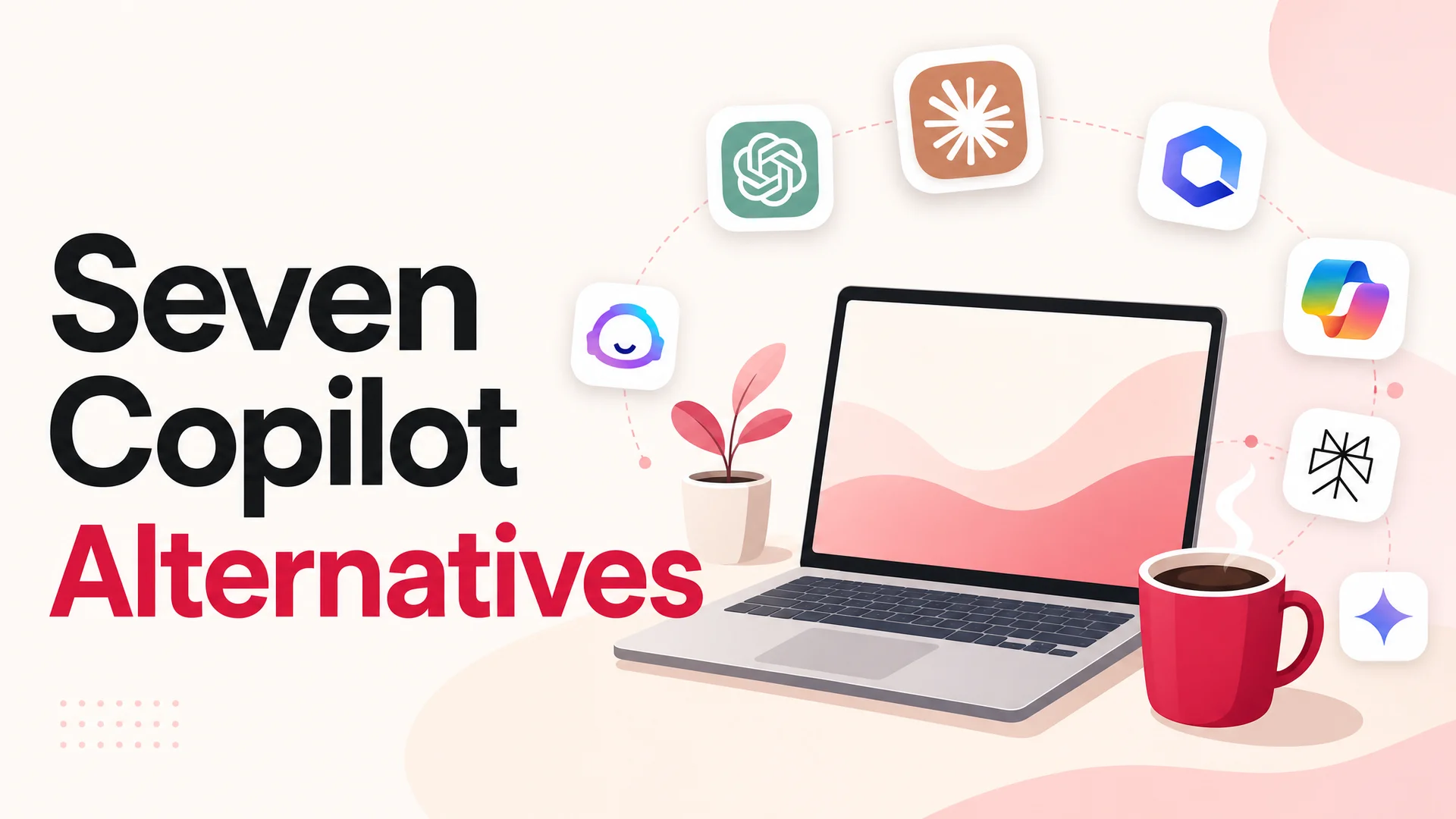
So the question is not "is Copilot good?" - it clearly is - but "what should you use when Copilot is the wrong shape for the job?" Below are seven alternatives that we think are doing interesting work in 2026, organised by the kind of problem they actually solve. One of them is almost certainly a better fit than Copilot for at least one part of your stack.
1. Berrydesk - when the assistant needs to talk to your customers
Microsoft Copilot is an assistant for the people who work at your company. Berrydesk is the assistant for everyone else - the customers asking where their order is at 11pm, the leads trying to figure out whether your product handles their edge case, the existing accounts trying to upgrade without going through a sales call.
That is a meaningfully different job. A support agent has to know your product cold, follow your brand voice, refuse to make things up, and actually do things - book a call, refund an order, look up a shipment, change a plan - not just describe how to do them. Berrydesk is built around that loop. You pick a model (GPT-5.5, Claude Opus 4.7, Gemini 3.1, DeepSeek V4, Kimi K2.6, GLM-5.1, Qwen3.6, MiniMax M2.7, and others), train the agent on your help centre, your website, your Notion, your Drive, and your YouTube channel, brand the widget so it looks like part of your product, wire up AI Actions for the work it should be allowed to do, and ship it to your site, Slack, Discord, WhatsApp, or wherever your customers already are.
The model choice matters more in 2026 than it did even a year ago. With Claude Opus 4.7 leading SWE-bench Pro at 64.3%, with Gemini 3.1 Pro on top of GPQA Diamond at 94.3%, and with open-weight contenders like DeepSeek V4 Flash priced at $0.14 / $0.28 per million tokens, "which model" is now a real per-conversation cost and quality decision. Berrydesk lets you route the easy 80% of tickets to a cheap, fast model and reserve a frontier one for the genuinely hard escalations - a pattern that often cuts inference cost by an order of magnitude without anyone on the customer side noticing.
If you have ever wished Copilot could be your external face - the thing your customers talk to first - Berrydesk is the closer fit. You can build one for free at berrydesk.com and have a working agent on your site the same afternoon.
2. ChatGPT - the obvious general-purpose alternative
ChatGPT is the assistant you reach for when you do not know what kind of help you need yet. Powered by the same GPT family that sits underneath Copilot, ChatGPT is broader, more flexible, and less wedded to a single workflow. It will draft, analyse, summarise, code, brainstorm, transcribe, translate, look at images, look at PDFs, run small web searches, and rewrite anything you give it.
The free tier is genuinely useful, which is more than was true two years ago. The paid tier (ChatGPT Plus) is where you get GPT-5.5 and GPT-5.5 Pro - the latter being OpenAI's parallel-reasoning model released in April 2026 - along with image generation, voice mode, and the more capable browsing and analysis tools. Codex, OpenAI's coding agent, also runs on the GPT-5 stack and is closely paired with ChatGPT for technical workflows.
The honest pitch for ChatGPT over Copilot is neutrality. Copilot has opinions about where your work lives. ChatGPT does not. If you spend half your time in Google Docs, half in Notion, and the rest pasting between random web tools, ChatGPT slots in everywhere with no friction. It is the lowest-commitment alternative on this list and a sensible default for individuals and small teams.
3. Gemini - Copilot, but for the Google universe
If Copilot is Microsoft's bet, Gemini is Google's. The pitch is structurally identical: an AI woven into the apps you already use. The difference is which apps. Gemini lives inside Gmail, Docs, Sheets, Slides, Calendar, Drive, Meet, Maps, and YouTube. If your team has standardised on Google Workspace, switching from Copilot to Gemini removes a layer of context-switching that you stop noticing only when it is gone.
Underneath, Google has spent the last year stretching what a frontier model can hold. Gemini 3.1 Ultra has a 2-million-token context window and is natively multimodal across text, image, audio, and video - meaning it can sit on top of an entire shared drive, a folder of meeting recordings, and last quarter's spreadsheets without choking. Gemini 3.1 Pro, the workhorse model, currently leads GPQA Diamond at 94.3%, which is a fancy way of saying it handles graduate-level technical reasoning unusually well.
Whether you go with the Workspace integration or Gemini Advanced standalone, the appeal is the same as Copilot's: the assistant is already where your work is, so adoption costs basically nothing. The choice between Copilot and Gemini is mostly a choice between Microsoft and Google, not between two different ideas of what AI should do.
4. Notion AI - the assistant for teams that live in Notion
Notion has quietly become the default workspace for a generation of startups, design teams, and remote-first companies. If your wiki, your roadmap, your meeting notes, your hiring loops, and your project trackers all live in Notion, Notion AI is the most ergonomic assistant you can use, full stop.
It does the obvious things - drafts, rewrites, tone changes, summarisation, translation, brainstorming - but the feature that makes it sticky is Q&A across your entire workspace. Ask "what did we decide about pricing in Q1?" and it will answer with citations to the actual pages it pulled from, the same way a new hire would if they had read everything you wrote last quarter. That capability has gotten dramatically better as the underlying models have absorbed longer contexts; with Claude Opus 4.6 and Sonnet 4.6 now shipping with a 1M-token context window at no surcharge, retrieval over a medium-sized Notion workspace is more accurate and less RAG-dependent than it used to be.
The trade-off is the obvious one: Notion AI is excellent inside Notion and absent everywhere else. That is fine if Notion is genuinely your work surface. It is a problem if half your team lives in Linear, Slack, and Figma and only opens Notion when forced to.
5. Perplexity - when the answer needs a citation
Perplexity is the alternative for the work that Copilot's web mode is not quite serious enough for. It is part search engine, part chatbot, and the thing it does better than almost anyone else is show its work. Every answer comes with a list of the sources it pulled from, in order, with the relevant passages quoted. You can click through to verify, dig deeper, or notice when the model is leaning on a source you do not trust.
That citation discipline is what makes Perplexity the default tool for analysts, journalists, lawyers, and anyone whose output gets fact-checked by someone less forgiving than themselves. The Pro tier adds image and document analysis, longer-running "Deep Research" agents that compose multi-step investigations into a single brief, and your choice of underlying model - you can route a query to GPT-5.5, Claude Opus 4.7, or Gemini 3.1 Ultra depending on what you want from the answer.
In 2026, the gap between "ask the AI a question" and "ask the AI to do an hour of research and write you a memo" has collapsed. Perplexity is the cleanest expression of that shift. If your relationship with Copilot is mostly "give me a quick answer about something I will then verify," Perplexity skips the verification round-trip.
6. Wordtune - the focused alternative for writers
Most of the tools on this list are generalists. Wordtune is not. It is an AI editor - a single-purpose assistant for people whose actual job is to make sentences land. If you spend most of your day writing emails that need to be read, blog posts that need to convert, LinkedIn updates that need to travel, or product copy that needs to sell, Wordtune is the alternative that takes that job seriously instead of treating it as one feature among twenty.
The interaction model is different from Copilot's. Instead of a chat that produces text in one shot, Wordtune sits next to your writing and offers rewrites, length adjustments, tone shifts, and inline suggestions for any sentence you select. You write. It edits. You decide what to keep. That tighter loop is what writers actually want from an assistant - not a draft generator that produces something average to be heavily revised, but a fast second pair of eyes that helps you converge on the version you meant to write all along.
If "Copilot" to you mostly means "the assistant in Word that helps me draft," Wordtune is a sharper tool for the same job.
7. Open-weight assistants - the option you did not know you had
This entry is less a single product and more a category that did not really exist as a Copilot alternative two years ago: assistants you can run yourself, on your own infrastructure, using open-weight frontier models from DeepSeek, Z.ai, Moonshot, Alibaba, MiniMax, and Xiaomi.
The April 2026 wave was decisive here. DeepSeek V4 (a 1.6T-param MoE on the Pro tier, 284B on Flash, both with 1M-token context) shipped on April 24 with V4 Flash priced at $0.14 / $0.28 per million tokens. Z.ai's GLM-5.1 (754B-param MoE under MIT license) hit 58.4 on SWE-Bench Pro, beating Claude Opus 4.6 and GPT-5.4 on that benchmark, and was trained entirely on Huawei Ascend chips. Moonshot's Kimi K2.6 added 12-hour autonomous coding sessions and swarms of up to 300 sub-agents. Alibaba's Qwen3.6-27B (dense, Apache 2.0) beat 397B-param MoE rivals on agentic coding benchmarks. MiniMax M2.7 came in at roughly 8% the cost of Claude Sonnet at 2x speed. Xiaomi's MiMo-V2-Pro open-sourced its weights under MIT.
Why does this matter as a Copilot alternative? Because for any team that cares about data sovereignty, regulatory exposure, or simply not paying frontier-model rates for routine work, the open-weight stack is now genuinely competitive. Regulated industries - health, finance, legal, government - can run a capable assistant air-gapped on their own hardware. Cost-sensitive teams can route the easy 80% of work to an open-weight model running for fractions of a cent and only call out to GPT-5.5 or Claude Opus 4.7 when they need it. This is exactly the routing pattern Berrydesk uses internally, and it is the single biggest reason customer support economics have changed in 2026.
If your hesitation about Copilot is "I do not want my data leaving my perimeter and I do not want to be locked into one vendor's model," this is the alternative worth taking seriously. The trade-off is operational complexity - you are now running infrastructure - but the gap between "buy Copilot" and "self-host an open-weight assistant" has narrowed dramatically.
What to actually pick
The honest answer is that none of these are universal replacements for Copilot, and Copilot is not a universal replacement for them. The decision is about which job you are trying to do:
- Customer-facing work - your support, sales, and onboarding conversations - belongs in a product built for that job. That is where Berrydesk fits, and it is the part of your stack Copilot was never trying to address.
- General writing, research, and ad-hoc work - go with ChatGPT or Gemini, depending on which ecosystem you already live in.
- Workspace-internal Q&A and knowledge - Notion AI if you live in Notion, Gemini if you live in Workspace, Copilot if you live in Microsoft 365.
- Cited research that survives scrutiny - Perplexity.
- Sentence-level writing craft - Wordtune.
- Cost, sovereignty, or air-gapped deploys - an open-weight assistant on your own infrastructure.
The teams getting the most value out of AI in 2026 are not the ones that picked one assistant and standardised. They are the ones that picked the right assistant for each job and let those assistants specialise. Copilot is great at one of those jobs. The other six are taken.
If the "talking to your customers" job is the one you are trying to fill, start a free Berrydesk agent - pick a model, point it at your docs, and have it on your site the same afternoon.
 Berrydesk
Build the support agent your customers actually want to talk to
- Pick from GPT-5.5, Claude Opus 4.7, Gemini 3.1, DeepSeek V4, Kimi K2.6, GLM-5.1 and more
- Train on docs, websites, Notion, and Drive - deploy to web, Slack, WhatsApp in minutes
Set up in minutes

Chirag Asarpota is the founder of Strawberry Labs, the team behind Berrydesk - the AI agent platform that helps businesses deploy intelligent customer support, sales and operations agents across web, WhatsApp, Slack, Instagram, Discord and more. Chirag writes about agentic AI, frontier model selection, retrieval and 1M-token context strategy, AI Actions, and the engineering it takes to ship production-grade conversational AI that customers actually trust.