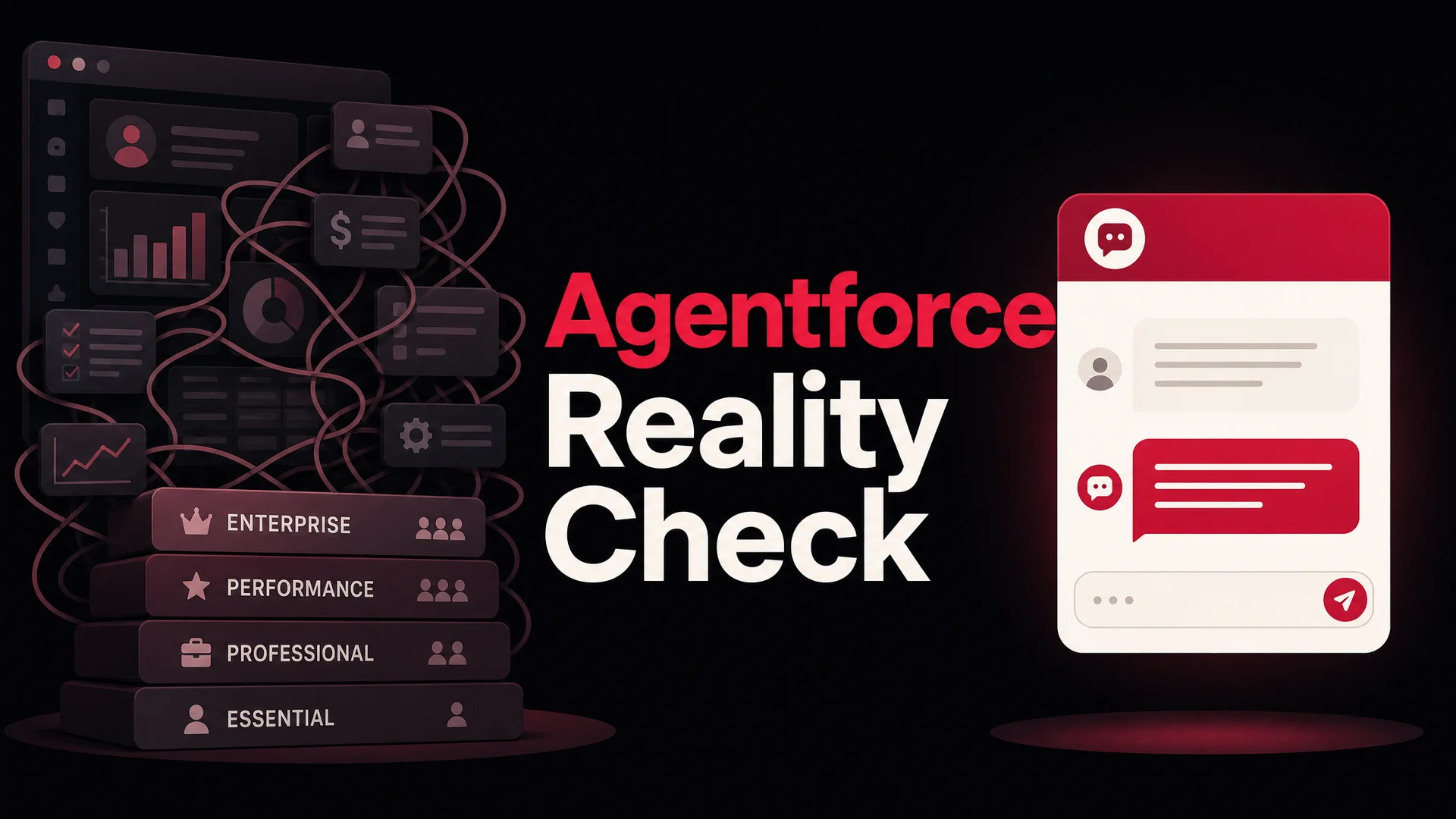
Salesforce barely needs an introduction. It defined modern CRM, and for two decades it has been the default place to put your customer data. But its conversational AI offering has been through more rebrands than most products go through in a lifetime - Einstein Bots became Einstein Copilot became Agentforce became Agentforce 1 - and the bill at the end of all that has only gotten heavier.
If you are evaluating Salesforce as a way to add an AI agent to your support stack in 2026, this piece is for you. We will walk through what is actually shipping today, where Agentforce shines, where it stalls, and what the alternative looks like when you are not already paying Salesforce six or seven figures a year.
What we cover:
- What Salesforce's AI agent platform really includes in 2026
- The honest tradeoffs - speed of deployment, lock-in, and total cost
- How a model-agnostic platform like Berrydesk compares for support teams that just want a working agent
From Einstein Bots to Agentforce: a quick history
Salesforce's first chatbot product, Einstein Bots, still exists. It is a rule-based and lightly AI-assisted bot that lives inside Service Cloud, handles deflection on FAQ-shaped tickets, and routes the rest to humans. Most Einstein Bots deployments today are doing what they did in 2022 - collecting case fields, answering shipping questions, occasionally pulling a known order status from the CRM record.
The center of gravity, however, has moved. Since the late-2024 launch of Agentforce, Salesforce has pushed almost all of its conversational AI investment into autonomous agents - bots that don't just answer, but execute. Agentforce 1, the all-in bundle introduced for the 2026 fiscal year, is what every Salesforce account executive is selling now.
Einstein Bots - the legacy product
Einstein Bots are still a viable option for high-volume, low-complexity support inside Service Cloud. They handle web, mobile, SMS, WhatsApp, and the major messaging apps, and they ship with templates for the most common service flows.
What they do well:
- Tight, native access to the CRM record - case data, contact data, order data without a custom integration.
- Pre-built blueprints for routing, identity verification, and case creation.
- Clean handoff to a Service Cloud agent because the conversation context is already in the same tenant.
Where they fall short:
- They cannot natively reach knowledge that lives outside Salesforce. If your help center is in Notion, your product docs are in Google Drive, and your runbooks are in Confluence, you are paying integrators to pipe that into Data Cloud before the bot can use it.
- They depend on Service Cloud Enterprise or higher as a prerequisite, so the total bill scales with your service-agent headcount whether or not those agents touch the bot.
- The built-in NLP feels dated next to what you can stand up on top of GPT-5.5 or Claude Opus 4.7 in an afternoon.
Agentforce - the new flagship
Agentforce is Salesforce's bet on autonomous agents. It is built around what they call the Atlas Reasoning Engine, layered on top of a mix of Salesforce's xGen models and partner LLMs (OpenAI and Anthropic predominantly, with Gemini integration on the roadmap). The promise is multi-step task execution: an agent that can read a ticket, decide what to do, look up the customer, issue a refund, update the case, and post a follow-up - all without a human touching the keyboard.
Where it earns its keep:
- Genuinely orchestrates work across Service Cloud, Sales Cloud, and Commerce Cloud rather than just answering questions.
- The Atlas planner handles branching workflows reasonably well once the actions and topics are configured.
- For organizations already running Salesforce as their system of record, the data plumbing is a real advantage.
Where it stumbles:
- Agentforce effectively requires Data Cloud - Salesforce's data lake product - to perform well. That is another $25–$50 per user per month on top of everything else.
- Implementation is not a self-serve experience. Most production deployments lean on a partner SI or a dedicated internal admin team and run weeks to months.
- Adoption is thin. Heading into 2026, internal Salesforce numbers reported by industry analysts pegged active Agentforce usage at roughly 5% of the customer base, and a Valoir study from earlier this year found that more than three-quarters of B2B Agentforce pilots stalled before going live, with data quality cited as the dominant blocker. Of the deployments that did launch, only about a third were still in active production six months later.
The gap between Salesforce's marketing and the operational reality is the single most important thing to understand before signing.
Salesforce AI pricing in 2026: a layered system
Salesforce's pricing is not a single line item. It is a stack, and each layer assumes the one underneath. Here is what the 2026 menu looks like for a customer support use case.
Layer 1 - base Service Cloud license (required):
- Service Cloud Enterprise: $165 / user / month
- Service Cloud Unlimited: $330 / user / month
Layer 2 - AI add-ons:
- Einstein Bots add-on (on top of Enterprise): $75 / user / month
- Agentforce add-on: $125 / user / month
- Industry editions (Financial Services Cloud, Health Cloud, etc.): $150 / user / month
Layer 3 - consumption pricing for customer-facing AI:
- Flex Credits at roughly $0.10 per AI action, sold in pre-paid blocks
- Or a flat $2 per "automated conversation" inside a 24-hour window
- You commit to one model per org
Layer 4 - Agentforce 1 Service Edition:
- $550 / user / month, bundling Service Cloud Unlimited, Agentforce, and one million Flex Credits per year
And the costs that don't fit neatly on a price sheet:
- Data Cloud: $25–$50 / user / month, in practice mandatory for Agentforce
- Implementation: typically $50,000–$150,000 for a serious rollout
- Training: $2,000–$5,000 per service agent for the new tooling
- Ongoing partner consulting: $10,000–$25,000 / month for any non-trivial deployment
For a 25-seat support team, the realistic floor for an Agentforce deployment plus Data Cloud plus first-year setup is north of $30,000 per year, and that is being charitable. Mid-market deployments routinely clear $200,000 in their first twelve months. Enterprise rollouts can run into the millions.
So is Salesforce's chatbot worth it?
If you already live inside Salesforce - your CRM is clean, your product is heavily B2B, your support is structured around case objects, and you have an internal admin team that speaks Apex and Flow - then Agentforce is a defensible investment. The CRM-native context is genuinely valuable when the data underneath is in good shape.
For everyone else, it is a harder sell, and there are four recurring reasons.
Lock-in. Salesforce's chatbot tooling is at its best when the data lives in Salesforce. The moment your knowledge is spread across Notion, Google Drive, your help center, your public docs, your YouTube tutorials, and a Postgres instance somewhere, you start paying for connectors, jobs, and Data Cloud ingestion to make the agent useful. That work is rarely cheap and almost never finished.
Setup time. Even with templates, anything past the demo flow needs Salesforce-specific expertise. Realistic timelines for a custom Agentforce deployment run from six weeks to six months. For most support teams, that is a quarter or two of waiting before the first message hits a customer.
Unpredictable scaling. The combination of per-seat licensing, consumption-based AI charges, and Data Cloud usage fees makes month-over-month forecasting harder than it should be. A spike in ticket volume can quietly turn into a five-figure overrun.
Adoption risk. The numbers are public and they are not flattering. When two-thirds of pilots stall and a third of launched deployments are gone within six months, you are paying not just for the platform but for the probability that it works.
What changed underneath: the 2026 model landscape
The Agentforce pricing made more sense in 2024, when running a capable agent meant paying frontier-lab token rates and absorbing the cost of every retrieval call. That economics has collapsed.
In April 2026 alone, the open-weight frontier shifted in three meaningful ways. DeepSeek released V4, with V4 Flash priced at $0.14 / $0.28 per million input/output tokens and a 1M-token context window - orders of magnitude cheaper than running the same volume on a closed frontier model. Moonshot's Kimi K2.6 brought 12-hour autonomous coding sessions and 4,000-step agent runs into open weights. Z.ai's GLM-5.1 (MIT-licensed) posted 58.4 on SWE-Bench Pro, edging out GPT-5.4 and Claude Opus 4.6. Alibaba's Qwen 3.6-27B and the 35B-A3B MoE made strong, locally-deployable agents practical for regulated industries. MiniMax M2.7 lands at roughly 8% of Claude Sonnet's price at twice the throughput.
At the closed frontier, OpenAI shipped GPT-5.5 and GPT-5.5 Pro with parallel reasoning. Anthropic's Claude Opus 4.7 leads SWE-Bench Pro at 64.3%, with Sonnet 4.6 and Opus 4.6 carrying a 1M-token context window at no surcharge. Google's Gemini 3.1 Ultra carries a 2M-token window and natively handles audio and video inputs.
The practical consequence for a support team: you no longer need a single model and you definitely don't need to be tied to one vendor's stack. A well-built agent platform routes routine conversations to a cheap, fast open-weight model, escalates the hard ones to Opus 4.7 or GPT-5.5 Pro, and uses the long context windows to put your entire knowledge base in front of the model directly - no fragile RAG required for most queries.
That is the world Berrydesk was built for.
Berrydesk: a leaner alternative
Berrydesk is an AI agent platform purpose-built for customer support. You pick a model, train it on your sources, brand the widget, configure AI Actions for the things that need to actually happen (refunds, bookings, payments, order lookups), and deploy. There is no Service Cloud license to buy first.
Choose any frontier model - closed or open. Berrydesk supports GPT-5.5 and 5.5 Pro, Claude Opus 4.7 and Sonnet 4.6, Gemini 3.1 Ultra and Pro, DeepSeek V4, Moonshot Kimi K2.6, Z.ai GLM-5.1, Alibaba Qwen 3.6, MiniMax M2.7, and Xiaomi MiMo-V2. Match the model to the workload - and route within a single agent if you want cheap deflection on routine tickets and frontier reasoning on the rest.
Train on whatever you actually have. Upload PDFs, point at your website, connect Notion, sync Google Drive, ingest YouTube transcripts, or paste in Q&A pairs by hand. Your knowledge does not need to be migrated into a CRM-flavored data lake before the agent can read it.
Deploy where customers already are. Embed the chat widget on your site, push to Slack and Discord, hook up WhatsApp, expose a clean API for your own apps. No channel-by-channel licensing.
AI Actions that do real work. Wire up bookings, refunds, password resets, order lookups, payment flows, or anything else your backend exposes. The agentic generation of models - Kimi K2.6, GLM-5.1, Opus 4.7, Qwen 3.6 - makes these reliable in production rather than impressive only in demos.
Real setup time, measured in minutes. Sign up, ingest, brand, deploy. Most teams have a working agent live the same day, with no Salesforce administrator on the payroll.
Pricing you can read on one screen. A free plan to start, transparent paid tiers as you scale. No layered prerequisites, no Flex Credit blocks, no implementation invoice from a partner SI.
Ecosystem-friendly. Native integrations and Zapier / Make connectors plug into the CRM, helpdesk, billing system, and data warehouse you already use, including Salesforce itself if that is where your customer data lives. You can keep Salesforce as your system of record without paying for the chatbot version of it.
Enterprise controls. SOC 2, GDPR, role-based access, audit trails, and on-prem / air-gapped options powered by MIT-licensed open weights for regulated workloads.
Common pitfalls when evaluating either platform
Whichever direction you go, a few things tend to derail support-AI projects before they ship. Worth flagging:
- Treating the bot like a feature instead of a product. The teams that succeed assign someone to own deflection rate, CSAT, and escalation patterns week over week. The teams that don't end up with a chatbot nobody trusts.
- Ignoring data quality. Both Salesforce and Berrydesk feed on your knowledge base. Stale, contradictory, or fragmentary docs will produce stale, contradictory answers regardless of which model you pick.
- Overestimating the value of full autonomy. A confident handoff to a human at the right moment is worth more than a heroic five-step automation that quietly resolves a ticket the customer will reopen tomorrow.
- Underestimating long context. With 1M–2M-token windows now table stakes, RAG is a tuning lever, not a hard requirement. Many teams over-engineer retrieval pipelines they no longer need.
The bottom line
Salesforce's AI tooling can work - for the narrow set of companies that already run on Salesforce, have clean structured data, a budget that absorbs six-figure rollouts, and the patience for a multi-quarter implementation. For everyone else, the math has stopped making sense, especially as open-weight frontier models have collapsed the cost of running production agents in the last twelve months.
If you want a support agent that ships this week, runs on the model that fits your workload, draws from the knowledge sources you actually have, and doesn't require a CRM upgrade to exist, take a look at Berrydesk. Build a free agent, point it at your docs, and see what an honest ten-minute setup looks like.
 Berrydesk
Skip the six-figure CRM upgrade
- Launch a branded AI support agent in under 10 minutes
- Pick GPT-5.5, Claude Opus 4.7, Gemini 3.1, DeepSeek V4, GLM-5.1, Kimi K2.6, or Qwen 3.6
Set up in minutes

Chirag Asarpota is the founder of Strawberry Labs, the team behind Berrydesk - the AI agent platform that helps businesses deploy intelligent customer support, sales and operations agents across web, WhatsApp, Slack, Instagram, Discord and more. Chirag writes about agentic AI, frontier model selection, retrieval and 1M-token context strategy, AI Actions, and the engineering it takes to ship production-grade conversational AI that customers actually trust.