What customers say about you in private DMs, public posts, app store reviews, and one-line support tickets is the most honest research budget you will ever have. The trouble is volume: a mid-sized SaaS company easily produces tens of thousands of free-text touchpoints a quarter across Intercom threads, X replies, NPS surveys, Reddit posts, and YouTube comments. No human team reads all of that, and the patterns that actually matter - the early signal of a churn-driving bug, a regional pricing complaint, a feature people are quietly delighted by - get lost in the noise.
Sentiment analysis tools exist to surface that signal. The category has grown up considerably in 2026: large language models with million-token context windows can now hold an entire month of conversations in a single prompt, agentic models like Claude Opus 4.7, Kimi K2.6, and GLM-5.1 can act on what they read, and open-weight frontier models from DeepSeek, Z.ai, MiniMax, Alibaba, and Xiaomi have collapsed the cost of running this kind of analysis to fractions of a cent per document.
This guide walks through the tools support and CX teams should know about, what each one is genuinely good at, and where the real first-party advantage sits - inside your own customer conversations.
What Sentiment Analysis Actually Does
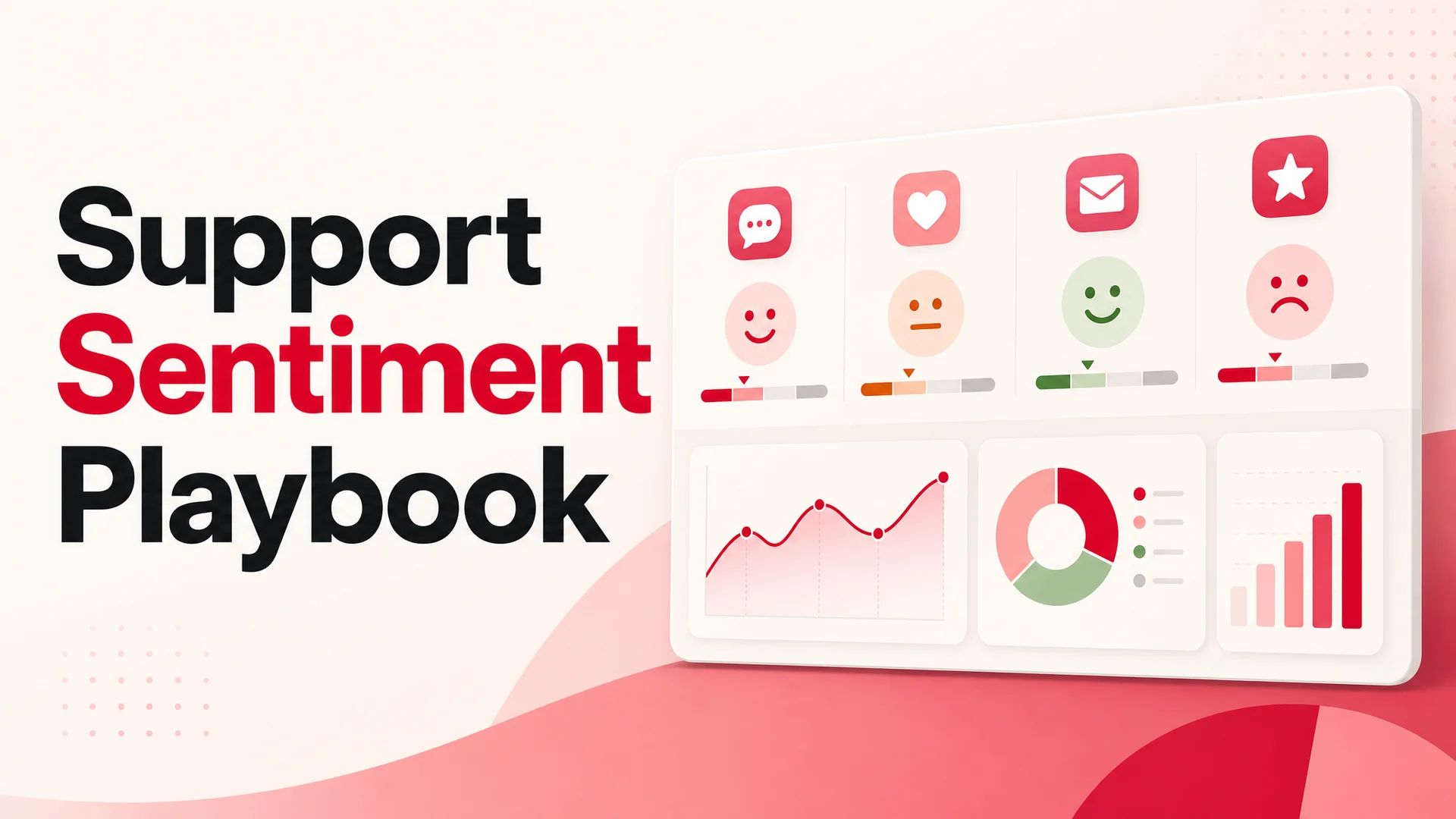
Strip away the marketing language and sentiment analysis is straightforward: a model reads a piece of text and decides whether the emotional charge is positive, negative, or neutral, often with a confidence score and sometimes with a finer-grained emotion label like frustrated, delighted, confused, or resigned.
The mechanics that get you there have changed dramatically over the last two years. Older tools relied on lexicon-based scoring (counting "good" and "bad" words) or small classifiers trained on labelled corpora. Modern tools lean on large language models - GPT-5.5, Claude Opus 4.7, Gemini 3.1 Pro, DeepSeek V4, GLM-5.1 - and they can do things older systems simply could not:
- Read sarcasm. "Great, another outage on a Friday afternoon. Love it." used to score positive on word match alone. Modern models read it the way a human would.
- Hold context. "The product is fine, but the onboarding email made me feel like I was being shouted at." The sentiment shifts mid-sentence, and the model needs to attribute the negativity to onboarding, not to the product overall.
- Pick out aspect-level signal. A single review can contain praise for shipping speed, a neutral remark about packaging, and a complaint about return policy - and a good tool tags each one separately rather than averaging them into a meaningless "mostly positive."
- Work across languages. Gemini 3.1 Ultra and Claude Opus 4.7 handle multilingual sentiment without a separate model per language, which matters if you support customers in more than one country.
What you actually do with sentiment data is what separates teams that get value from teams that don't.
Why It Matters for the Business
A few honest reasons to invest in this, with no fluff:
Catching reputation problems early. Negative sentiment usually spikes hours before a thread goes viral. If you can detect a 3x jump in negative mentions on a Tuesday morning, you have time to triage, post a status update, or reach out to a vocal customer. If you find out from a screenshot in your CEO's inbox the next day, you are already on defense.
Tightening marketing feedback loops. Campaigns are expensive. Knowing within 48 hours whether a launch is landing - and why - lets you reallocate spend or kill a creative before the second wave fires. Aggregate sentiment across replies, quote-tweets, and Reddit threads gives you that read.
Reducing support volume at the source. When the same complaint shows up in chats, tickets, and reviews, it is almost always cheaper to fix the underlying product issue than to keep answering it. Sentiment analysis surfaces those clusters in a way ad-hoc reading does not.
Benchmarking against competitors. Tracking sentiment around competitors tells you where the market is genuinely unhappy with the incumbents, which is often the most reliable input to a positioning decision.
Replacing gut feel with measurement. "The vibes are good this quarter" is not a metric. Sentiment scores trended over time, broken out by channel and customer segment, are.
The Best Sentiment Analysis Tools in 2026
The tools below cluster into four rough categories: first-party conversation tools (your own chat and support data), social listening, customer experience platforms, and developer-facing text analysis. Pick based on where your most useful signal actually lives - most teams need one from category one or three, plus one from category two.
1. Berrydesk - Sentiment Analysis from Your Own Customer Conversations
Berrydesk is an AI agent platform for customer support, and the sentiment analysis story is a side-effect of how it works rather than a bolted-on feature. Every conversation your support agent handles - across the website widget, Slack, Discord, WhatsApp, and any other deployed channel - produces structured transcript data with the agent's actions, the customer's messages, and the resolution outcome. That is first-party sentiment data, captured at the moment of intent, not scraped from public posts where bias and selection effects distort the picture.
How It Works
- Picks the model that fits your cost and accuracy needs. Route routine sentiment classification through DeepSeek V4 Flash at $0.14 / $0.28 per million tokens, and reserve Claude Opus 4.7 or GPT-5.5 for the longer, more ambiguous threads where nuance matters.
- Reads the whole conversation, not just the last message. With 1M-token context windows on Sonnet 4.6 and DeepSeek V4, the model can score the arc of a conversation: did the customer arrive frustrated and leave satisfied, or the reverse?
- Surfaces clusters automatically. Recurring complaints, common confusion points, and emerging product requests show up as themes you can act on rather than as raw transcripts to wade through.
- Triggers AI Actions on negative sentiment. A customer expressing frustration mid-chat can be auto-escalated, offered a refund through a connected payment flow, or routed to a human - all configured as Actions inside Berrydesk.
Why It's a Strong Sentiment Signal
The honest argument for first-party conversation sentiment is that it is the highest-quality data you have access to. A customer typing into your support widget has high intent and is talking specifically about your product; a public tweet might be about you, a competitor, or a general gripe with the category. If you only run one sentiment program, run it against your own conversations first.
→ Launch a Berrydesk agent and start capturing conversation sentiment.
2. Sprout Social - Multi-Platform Social Listening
Sprout Social is a mature social media management platform with sentiment analysis baked into its listening product. It is the right pick for marketing-led teams that already manage publishing through it.
How It Works
- Tracks brand mentions across X, Instagram, Facebook, LinkedIn, TikTok, and YouTube.
- Trends sentiment over time with daily, weekly, and campaign-level views.
- Benchmarks your sentiment against named competitors so you can see where the gap is.
- Generates scheduled reports for marketing leadership without manual data pulling.
Why It Holds Up
Sprout's strength is that it is built for working teams, not analysts. The sentiment view sits next to the publishing calendar, so the same person writing the tweet can see whether the previous one landed badly. If your social team is already in Sprout, turning on sentiment is a much smaller change than adopting a separate listening tool.
3. InMoment - Direct Customer Feedback with Emotion Detection
InMoment is a customer experience platform aimed at companies with serious survey and review programs. It is less about social chatter and more about the structured and semi-structured feedback you ask for directly.
How It Works
- Ingests survey responses, review-site content, call transcripts, and support tickets.
- Runs emotion detection beyond positive/negative - anger, joy, frustration, urgency, gratitude - which gives a richer picture than a single polarity score.
- Identifies recurring themes and the drivers behind sentiment shifts, not just the shifts themselves.
- Sends real-time alerts when sentiment in a particular segment falls off a cliff.
Why It Holds Up
InMoment is built for the moment when leadership asks "why are NPS scores down this month?" and you need a better answer than "people seem unhappy." The drivers and emotion features get you to a specific, testable hypothesis: it is the post-purchase email cadence, the checkout step, the new pricing page. If your business runs on direct feedback rather than social, this is the right tier of tool.
4. Brandwatch - Large-Scale Listening and Crisis Detection
Brandwatch tracks billions of online sources - social, blogs, forums, news, review sites - and applies sentiment analysis on top. It is heavier than Sprout and aimed at brands with serious reputation exposure.
How It Works
- Monitors mentions across an extremely broad source set, including Reddit, Discord (where allowed), niche forums, and global news.
- Uses LLM-backed sentiment that handles sarcasm, irony, and slang considerably better than older keyword-driven systems.
- Flags spikes in negative sentiment as crisis alerts, not just dashboard updates.
- Lets you compare your brand's sentiment trajectory against an industry cohort.
Why It Holds Up
For consumer brands and any company that has been on the receiving end of a viral thread, Brandwatch's source breadth and alerting are the actual product. The trade-off is cost and complexity - this is not a tool a two-person marketing team should reach for first.
5. Medallia - Full-Stack Customer Experience
Medallia is one of the two enterprise CX heavyweights (the other is Qualtrics) and treats sentiment as one input into a broader Voice of Customer program.
How It Works
- Pulls feedback from every reasonable touchpoint: surveys, email, live chat, call centers, in-store kiosks, mobile apps.
- Runs intent and emotion detection on unstructured text and audio.
- Produces predictive views - not just "people are unhappy" but "this segment is at elevated churn risk and here is why."
- Centralizes everything in a single VoC dashboard role-permissioned for executives, analysts, and frontline managers.
Why It Holds Up
Medallia's predictive layer is what separates it from cheaper sentiment tools. If you can credibly tell a CFO "we expect a 6-point CSAT drop in the SMB segment next quarter unless we change the renewal flow," you are using sentiment data the way it was meant to be used. That kind of analysis only works on top of a clean, multi-channel feedback infrastructure, which is the part Medallia is selling.
6. Qualtrics - Research-Grade Sentiment and Survey Analytics
Qualtrics overlaps with Medallia but tilts more toward research-driven organizations: insights teams, academic-style methodology, and large-scale survey design.
How It Works
- Applies LLM-based text analytics to open-ended survey responses, which is where the real qualitative gold lives in any survey.
- Tracks sentiment along the customer journey rather than as a snapshot - first touch, onboarding, mid-life, renewal.
- Converts findings into recommended actions, with confidence ranges, not just charts.
- Forecasts customer behavior using sentiment as one of several model inputs.
Why It Holds Up
If your team takes survey design seriously - control groups, statistical significance, longitudinal studies - Qualtrics will feel native in a way most other tools do not. For everyone else it is overkill, and that is fine.
7. Buffer - Lightweight Social Sentiment for Smaller Teams
Buffer is primarily a scheduling tool, but its engagement and analytics features include enough sentiment context to be useful for small teams.
How It Works
- Tags post-level engagement with positive, neutral, or negative skew based on comments and reactions.
- Highlights which content formats and topics resonate best with your audience.
- Lets you reply to comments inline, which matters because closing the loop on negative comments is most of the work.
Why It Holds Up
Buffer is the right answer when the honest constraint is "we have one marketing person, we cannot afford Brandwatch, and we need to know if this week's post bombed." It is not a serious sentiment platform, but it is a perfectly reasonable on-ramp.
8. Agorapulse - Mid-Tier Social Sentiment with Inbox Workflow
Agorapulse sits between Buffer and Sprout in terms of depth. It is a social management tool with stronger sentiment categorization than the lightweight options.
How It Works
- Categorizes incoming social messages into positive, neutral, and negative buckets so the team can triage their inbox.
- Listens for brand and keyword mentions across major platforms.
- Compares your sentiment scores to named competitors at a high level.
- Supports a labeled-inbox workflow that scales reasonably well to 5-15 person teams.
Why It Holds Up
The sentiment-tagged inbox is the actual feature that earns its keep. When a community manager opens their queue and sees the negative messages already triaged to the top, response times on the things that matter most drop significantly.
9. Awario - Real-Time Listening Beyond Social
Awario is a dedicated social listening tool with genuine real-time chops and broader source coverage than the social management suites.
How It Works
- Monitors social platforms, blogs, forums, news sites, podcasts, and review sites for keyword and brand mentions.
- Pushes real-time alerts when negative sentiment spikes around a tracked term.
- Profiles influencers in your category and tracks their sentiment toward your brand specifically.
- Tracks competitor sentiment alongside your own, which is often more revealing than tracking your brand alone.
Why It Holds Up
Awario punches above its price point on coverage. If your reputation exposure stretches outside the major social networks - into industry forums, niche blogs, Reddit communities - Awario sees more of it than tools that only watch the big platforms.
10. Aylien - News and Long-Form Text Sentiment
Aylien specializes in news, blog, and long-form text rather than social posts. It is built for PR, financial services, and industry-watching use cases.
How It Works
- Processes news articles, blogs, regulatory filings, and analyst reports.
- Applies aspect-level sentiment that maps emotion to specific entities, executives, or topics within an article.
- Tags entities (people, companies, products, places) and links sentiment to each one separately.
- Supports broad multilingual coverage for global monitoring.
Why It Holds Up
Long-form content is genuinely different from a tweet, and tools tuned for one usually do badly on the other. A 1,500-word article can contain twelve different sentiment signals tied to different entities, and Aylien is built to disentangle them.
11. MonkeyLearn - Customizable Models and APIs
MonkeyLearn lets you build custom text classification and sentiment models without writing model training code. It is the right fit for teams that want a tailored model for industry-specific language.
How It Works
- Lets you train a sentiment classifier on your own labeled examples, which matters when generic models miss your jargon.
- Handles email, ticket, and review sentiment in addition to the obvious social use cases.
- Exposes everything via API so it slots into existing CRM, ticketing, and analytics workflows.
- Updates classifications in real time as new feedback arrives.
Why It Holds Up
Generic sentiment is good enough for most use cases now, thanks to LLMs. Where MonkeyLearn earns its keep is in industries where vocabulary is dense and unusual - clinical text, legal language, technical support for highly specialized products - and a model fine-tuned on your data outperforms a general-purpose LLM on the things that actually matter to you.
12. Meltwater - Enterprise Media Intelligence
Meltwater is one of the older enterprise listening platforms and is still the default at many large PR and comms teams.
How It Works
- Tracks news, blogs, broadcast, and social with global coverage including local-language sources.
- Applies sentiment classification with attention to nuance: sarcasm, mixed tone, partial endorsements.
- Benchmarks brand sentiment against competitors in real time and over rolling windows.
- Surfaces sentiment spikes as media intelligence alerts directly to comms leads.
Why It Holds Up
Meltwater is the tool that gets purchased after a company has had its first real reputation incident. The feature set is wide, the source coverage is enormous, and it integrates with existing comms workflows. The trade-off is the price tag.
13. Erase - Sentiment Plus Active Reputation Defense
Erase is a different shape of tool: it monitors sentiment around individuals and brands, then actively pursues takedowns of harmful content where legal and policy grounds allow.
How It Works
- Scans search results, news, blogs, forums, and social for high-risk mentions tied to your name or brand.
- Flags hostile sentiment spikes in real time so you can intervene before they propagate.
- Initiates takedown and suppression workflows against content that violates platform policies, privacy laws, or other legal grounds.
- Tracks the lifecycle of harmful content from detection through resolution in a single dashboard.
Why It Holds Up
Most sentiment tools stop at "here is what people are saying." Erase keeps going. For executives, public figures, and brands with active reputation threats, the combination of monitoring and response is structurally different from a pure listening tool.
How to Pick - A Practical Framework
The list above looks like thirteen options, but for any given team only two or three are real candidates. Three questions narrow it fast.
Where does your most useful signal actually live? If it is in your own support conversations, start there - first-party data wins on quality and your sample size grows with your business. If your customers are loud on social, you need a listening tool. If your business runs on surveys (regulated industries, B2B with formal QBRs), the CX platforms are the right tier.
How much volume do you actually have? Brandwatch and Meltwater are overkill for a Series A startup with 200 mentions a month. Buffer is overrun at 200,000 mentions a month. Match the tool to the volume, not the marketing copy.
What are you going to do with the data? Sentiment dashboards that nobody reads are a waste. The tools worth paying for are the ones that route signal directly into someone's workflow - the community manager's inbox, the support lead's escalation queue, the comms director's morning brief.
What Changed in 2026 That Actually Matters
The category has been around for a decade, but the underlying technology has shifted enough in the last 18 months that you should be skeptical of older comparisons.
Long context changes the unit of analysis. Gemini 3.1 Ultra has a 2M-token window. Claude Opus 4.6 and Sonnet 4.6 ship with 1M tokens at no surcharge. DeepSeek V4 and Kimi K2.6 also offer 1M. That means a single model call can analyze an entire month of one customer's conversations at once and produce a coherent narrative - this customer started skeptical, was won over by the second interaction, and is now showing renewal-risk signals after the recent pricing change - instead of scoring each message in isolation. RAG over a sentiment archive becomes a tuning lever, not a hard requirement.
Open-weight models collapsed the cost. DeepSeek V4 Flash at $0.14 / $0.28 per million tokens, MiniMax M2 at roughly 8% of Claude Sonnet's price, and MIT-licensed weights from GLM-5.1 and Qwen3.6-27B mean classifying millions of documents a month is now a line item rather than a project. For routine positive/negative/neutral scoring on high volume, the open-weight models are the right call. Reserve Claude Opus 4.7 or GPT-5.5 for ambiguous, long-form, or business-critical analysis where accuracy outweighs the per-token cost.
Agentic models make sentiment actionable. Kimi K2.6 supports up to 300 sub-agents and 4,000 coordinated steps. Claude Opus 4.7 leads SWE-bench Pro at 64.3%. GLM-5.1 runs an 8-hour autonomous loop. What this looks like for sentiment is that the model does not just classify a piece of text - it can take action on it. A negative sentiment trigger can fire an AI Action that pulls the customer's order history, drafts a personalized response, escalates to a senior agent if needed, and logs the interaction in your CRM, all without a human writing the orchestration logic.
On-prem and air-gapped deploys are now serious. GLM-5.1 (MIT), Qwen3.6-27B (Apache 2.0), and the open weights of Xiaomi MiMo-V2-Pro give regulated industries - healthcare, finance, defense - a real path to running modern sentiment analysis on data that cannot leave the network. That was a fantasy a year ago.
Common Pitfalls to Avoid
A few things teams routinely get wrong on their first sentiment program.
Treating the score as the answer. A sentiment score is a question, not a conclusion. Why is sentiment shifting? Which segment, which product, which interaction? The teams that get value out of these tools are the ones that drill from the score to the cause.
Mixing inbound and ambient signal in the same metric. A support chat (high intent, your product specifically) and a tweet about your industry (low intent, possibly tangential) are not the same signal and should not be averaged into one number. Track them separately or you will mislead yourself.
Ignoring sample bias. Public reviews skew toward extremes - people who loved you and people who hated you. Survey responses skew toward people willing to take surveys. Conversation logs skew toward people who needed help. Read each source with its bias in mind.
Underweighting non-English content. If you sell internationally and your sentiment tool only works well in English, you are flying blind in your second-largest market. Confirm multilingual support before you commit.
Buying enterprise capability you cannot operate. A tool that produces 40-page reports nobody reads is a worse outcome than a simpler tool whose output ends up in a Slack channel the team actually checks every morning.
Closing the Loop
The honest case for sentiment analysis in 2026 is not that it lets you measure customer mood - it is that it gives you a structured way to feed customer reality back into the parts of the business that change things. Marketing decisions, product decisions, support staffing, executive priorities. Without it, those decisions get made on selection bias and the loudest voices in the room. With it, they get made on a representative read of what customers are actually experiencing.
If the most useful sentiment signal in your business is buried in your support conversations - and for most companies, it is - start there. Launch a Berrydesk agent, point it at your docs, websites, Notion, or Drive, and turn every customer interaction into structured data you can actually learn from.
 Berrydesk
Turn every support conversation into sentiment data
- Deploy a branded AI agent in minutes across web, Slack, WhatsApp, and Discord.
- Capture first-party sentiment from real customer chats, not guesses.
Set up in minutes

Chirag Asarpota is the founder of Strawberry Labs, the team behind Berrydesk - the AI agent platform that helps businesses deploy intelligent customer support, sales and operations agents across web, WhatsApp, Slack, Instagram, Discord and more. Chirag writes about agentic AI, frontier model selection, retrieval and 1M-token context strategy, AI Actions, and the engineering it takes to ship production-grade conversational AI that customers actually trust.