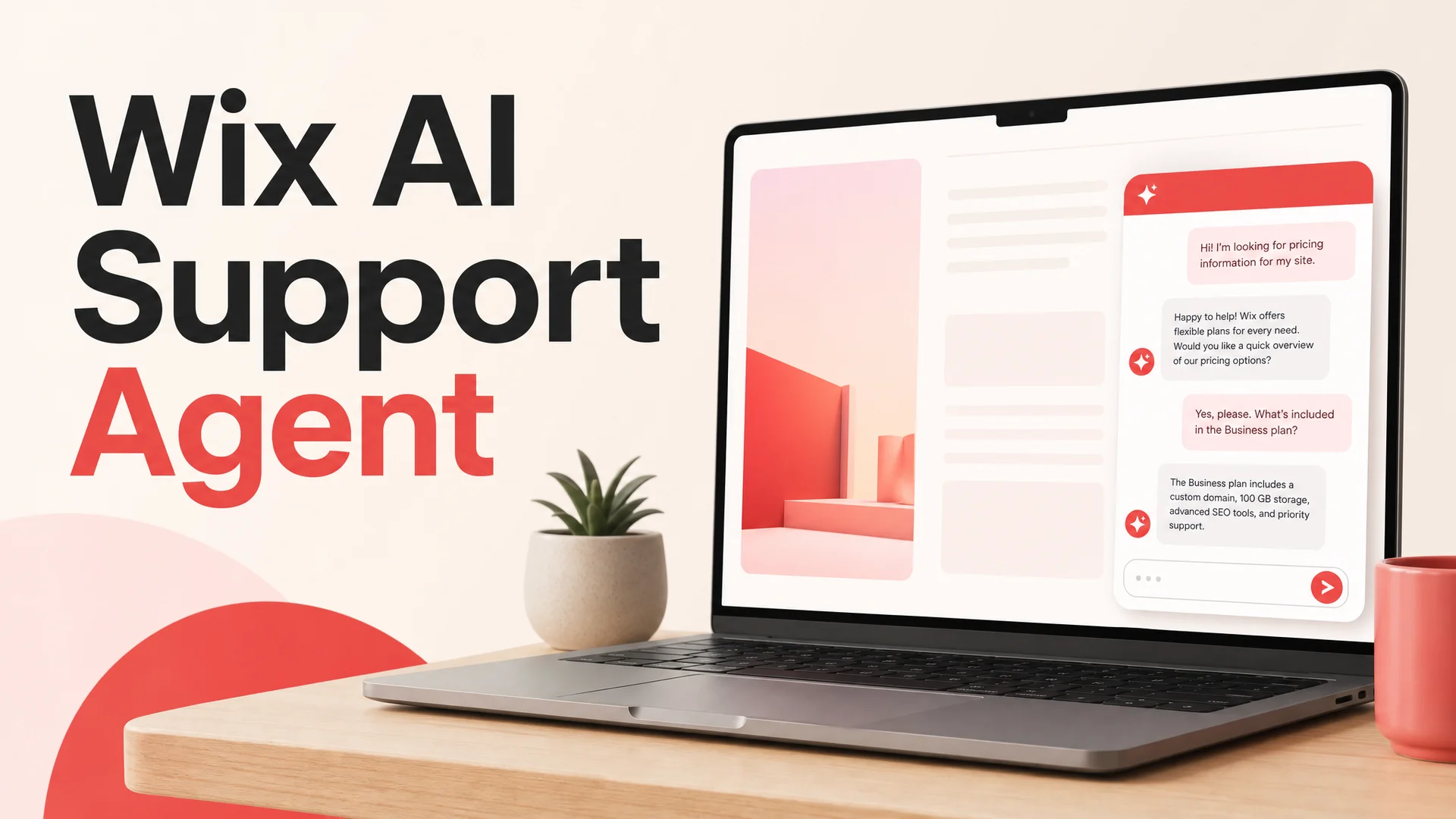
A shopper opens your Wix store at 11 p.m. with three quick questions about sizing, returns, and whether you ship to their country. Your live chat is offline. Your support inbox will not be checked until the morning. They tab away to a competitor that answered them in twelve seconds.
That single missed conversation is not unusual - it is the default outcome on most Wix sites. Email queues accumulate. Tickets get stale. Visitors with high purchase intent quietly leave, and you never see the funnel data because the conversation never started. Multiplied across a year, this is one of the largest invisible leaks in a small-to-mid-sized online business.
The good news is that the economics of fixing this changed in 2026. The frontier models that power modern AI support agents - Claude Opus 4.7, GPT-5.5, Gemini 3.1 Ultra, and the new wave of open-weight challengers like DeepSeek V4, Kimi K2.6, GLM-5.1, and MiniMax M2.7 - can hold full conversations, look up an order, schedule a call, process a refund, and hand off to a human when they should. You no longer need an in-house engineering team or a six-figure budget to put one of these on your Wix site.
This guide walks through how to choose the right AI support agent for Wix, why Berrydesk is the most direct way to deploy one, and the two embed methods that will get a working agent live on your site today.
Why a Wix site needs more than a contact form in 2026
The bar for "good support" on a small-business website has moved. Five years ago, a contact form and a 24-hour reply window were acceptable. Today, visitors compare your response speed to the agent on the last site they visited, and that agent probably answered them instantly with the right information.
A modern AI support agent on a Wix site does four jobs at once:
- It answers product, pricing, and policy questions in seconds, drawing on your help center, product pages, and policy docs rather than a static FAQ list.
- It captures and qualifies leads - name, email, intent, urgency - and pushes them into your CRM or notifies you on Slack.
- It performs actions, not just chats: booking a call on your calendar, looking up an order, starting a return, or taking a Stripe payment for an upsell.
- It hands off cleanly to a human when the question is too sensitive, too ambiguous, or simply outside its lane.
Notice how few of these are pure conversation. The interesting work in 2026 is action. Models like Claude Opus 4.7 (64.3% on SWE-bench Pro), Kimi K2.6 (with native tool-use across thousands of coordinated steps), and GLM-5.1 (purpose-built for multi-step agentic workflows) make this kind of tool-use reliable enough to put in front of a paying customer. That is the shift: the chatbot stopped being a deflection layer and became a lightweight employee.
How to choose the right AI agent for your Wix website
Not every chatbot is equipped for what a serious Wix site needs. Before you pick one, run candidates through the following checklist. The order roughly matches what tends to bite teams later.
1. Embedding into Wix should be one paste, not a project
Wix offers Custom Code (head/body injection) and an embed-HTML widget. Any agent worth installing should give you a single script tag that drops into either. If a vendor asks you to install a Wix App Market app, edit page-specific code, or wire up a webhook before the bot will say hello, that is a red flag - you will hit the same friction every time you redesign a page.
2. Model choice should be yours, not the vendor's
The 2026 model landscape moves quickly, and one model is rarely best at everything. A finance question may be best answered by Claude Opus 4.7 (deep reasoning, careful tone). A high-volume FAQ deflection flow runs cheaper on DeepSeek V4 Flash at roughly $0.14 per million input tokens. A multilingual store may benefit from Qwen 3.6's strong non-English performance, while a regulated business that needs on-prem deployment looks at the MIT-licensed GLM-5.1 or Qwen3.6-27B. A platform that locks you to a single proprietary model is a platform whose cost curve and capability ceiling you do not control.
Berrydesk is built on the opposite assumption: you pick the model, swap it whenever a better one ships, and route different conversation types to different models if you want to.
3. Training data should match how a real Wix site is structured
Most Wix sites do not have a dedicated knowledge base. Their content lives in a mix of product pages, blog posts, a Notion workspace, a Google Drive folder of PDFs, sometimes a YouTube channel, sometimes a help center on a different subdomain. The agent has to ingest that range natively. Crawl-the-website-only tools cover maybe half of what your support team actually needs to know.
4. The widget has to look like part of your brand
A floating bubble that screams "powered by VendorX" is a tax on every visitor. The widget should accept your brand colors, fonts, custom avatar, custom welcome messages, and ideally a starter prompt that mirrors the page the visitor is on. Bonus points for theme controls that adapt to dark mode, since many Wix templates now ship with dark variants.
5. AI Actions decide whether this is a chatbot or an agent
This is the line. A chatbot can answer "what's your return policy?" An agent can take "I want to start a return for order #4421" and actually start it, fetching the order, validating eligibility, generating the label, and emailing the customer. Booking demos, processing payments, looking up shipping status, escalating to a human ticket - these are AI Actions, and 2026's agentic-tool-use models finally make them production-grade. If a vendor cannot show you a working booking or order-lookup demo, you are looking at a chatbot dressed as an agent.
6. Multilingual coverage that is not a translation hack
Real multilingual support means the model thinks in the user's language, not that it round-trips through English with Google Translate. The frontier models - Gemini 3.1 Ultra, Claude Opus 4.7, GPT-5.5 - are natively strong across the major business languages. Qwen 3.6 is exceptional in Chinese, Japanese, Korean, and Arabic. Choose a platform that exposes those models so your Spanish-speaking visitors do not get a worse experience than your English-speaking ones.
7. Analytics that tell you what to fix
You want to see which questions the agent answered, which it failed, which led to a booked demo, and which were handed off. Without this, you cannot tell whether the agent is helping or quietly hallucinating its way through critical pre-sale conversations.
8. A real free tier so you can pressure-test before committing
You will not know whether an agent is right for your site until your real visitors talk to it for a week. Any vendor that gates that behind a paid plan is asking you to buy blind.
Why Berrydesk is the most direct fit for Wix
Berrydesk is a no-code AI agent platform designed to put a production support agent on a website in four steps: pick a model, train it on your content, brand the widget, and deploy. For a Wix site, that workflow is almost frictionless because the embed is a single script tag.
A few reasons Berrydesk is well-matched to Wix specifically:
- Multi-model by default. You can run on GPT-5.5, Claude Opus 4.7, Gemini 3.1 Ultra, DeepSeek V4, Kimi K2.6, GLM-5.1, Qwen 3.6, MiniMax M2.7, and others. Route routine pre-sale questions to a cheap open-weight model and reserve frontier models for billing or technical escalations. A typical Berrydesk deployment lands routine traffic at a fraction of a cent per resolution.
- Long-context training. With Claude Opus 4.6 and Sonnet 4.6 shipping with 1M-token context windows at no surcharge, and Gemini 3.1 Ultra at 2M, your agent can hold a meaningful chunk of your site, policies, and conversation history in-context. RAG becomes a tuning lever, not a hard requirement.
- Source ingestion that matches a Wix stack. Crawl your live Wix site, upload product PDFs, connect Notion or Google Drive, point at a YouTube channel for product demos. The agent absorbs all of it.
- AI Actions out of the box. Calendar booking, Stripe payments, order lookups, ticket creation, lead capture into your CRM, structured hand-off to email or Slack. These are configured from the dashboard, not coded.
- Deploy beyond the widget. The same agent runs on your Wix site, in Slack for your team, in Discord for your community, on WhatsApp for mobile-first customers, and via API anywhere else.
- 80+ languages and a free plan to validate the agent on real traffic before you commit.
How to add a Berrydesk AI agent to your Wix website
The full path from sign-up to live agent is three steps. Plan on roughly 20–30 minutes for the first deploy, most of which is content ingestion running in the background.
Step 1: Create your agent in Berrydesk
Go to berrydesk.com and sign up - Google sign-in or email, free plan, no credit card. You land in the dashboard, where you create a new agent and pick the underlying model. If you are unsure, start with Claude Sonnet 4.6 for a balance of quality, speed, and cost; you can switch later from the same dashboard without retraining.
Next, train the agent. Add the URL of your Wix site so Berrydesk can crawl public pages, then attach any extra sources: PDF policies, a Notion workspace of FAQs, a Google Drive folder of product manuals, YouTube product demos. The system processes these in the background - typically minutes, sometimes longer for very large knowledge bases - and surfaces what it ingested so you can verify nothing important was missed.
Finally, brand the widget. Set your primary color to match your Wix theme, upload an avatar, write a welcome message, and define a few starter prompts ("Where is my order?", "Book a call", "Talk to a human"). If you want to wire in AI Actions, this is the moment: connect your calendar for bookings, your Stripe account for payments, and your support inbox or Slack for human hand-off. For a deeper walkthrough, see the agent-building guide in the Berrydesk docs.
Step 2: Grab your embed snippet
Open your agent, go to the Deploy tab, and choose the website embed option. Berrydesk generates a single small <script> tag that loads the chat widget asynchronously so it does not slow your page. Copy the snippet to your clipboard.
If you want the agent to appear only on certain Wix pages (for example, the pricing page and the contact page, but not the blog), you can scope it later in the Berrydesk dashboard with URL rules - no Wix-side changes required.
Step 3: Drop it into Wix
There are two clean ways to install the snippet on a Wix site. Use Method 1 by default; it covers every page and survives redesigns. Use Method 2 only when you specifically want the chat to be visually pinned in a layout slot rather than floating.
Method 1 - Custom Code (recommended)
This is the equivalent of a global head injection. The widget loads on every page automatically.
- Sign in to your Wix dashboard.
- In the left sidebar, open Settings.
- Scroll to the Advanced section and click Custom Code.
- Click + Add Custom Code.
- Paste the Berrydesk script into the code box.
- Under Add Code to Pages, choose All pages and Load code once.
- Under Place Code In, choose Head (or Body - end if your theme has script-ordering quirks; both work).
- Give it a recognizable name like "Berrydesk Agent" and click Apply.
- Toggle the snippet Enabled if it is not already.
Refresh your live Wix site in a new tab. The chat bubble should appear in the bottom-right corner. Send it a test message - your agent should respond in your brand voice, drawing from the sources you trained it on.
Method 2 - Embed HTML element
Use this if you want a chat experience pinned to a specific layout slot rather than floating across the whole site.
- From the Wix dashboard, click Edit Site (or Design Site).
- In the editor, click the + button on the left toolbar to open the elements panel.
- Scroll to Embed Code, then choose Popular Embeds → Embed HTML.
- Click + Add to Page.
- In the HTML settings panel, select Code and paste the Berrydesk snippet.
- Click Update to make it live.
- Optionally fill in What is in the embed box? with a short description - Google uses this for accessibility and search context.
- Resize and reposition the embed element to fit your layout, then right-click it and choose Pin to Screen if you want it anchored.
- Publish the site.
Either method is reversible - if you decide the agent is not pulling its weight, removing the snippet (or toggling the Custom Code entry off) takes the widget off the site instantly.
Common pitfalls - and how to avoid them
A working install is only the start. The teams that get the most out of an AI agent on a Wix site avoid a small set of recurring mistakes.
Underfeeding the model. A bot that has only seen your homepage and pricing page will hallucinate the moment a real customer asks about a niche product variant. Spend the time to upload your full policy PDFs, your product spreadsheets, and any internal docs your support team actually uses. Long-context models like Claude Opus 4.6 (1M tokens) and Gemini 3.1 Ultra (2M tokens) tolerate large knowledge bases gracefully - give them the material.
Skipping AI Actions. A bot that only chats is half a product. Even adding a single action - book a call, create a ticket, look up an order - pushes the value of the agent up a step-function because it stops deflecting and starts resolving.
No human escalation path. Some questions should never be answered by an AI: account closures, refunds above a threshold, legal questions, anything emotionally charged. Configure clean hand-off rules in Berrydesk so those conversations land with a human, with full transcript context attached.
Choosing the wrong model for the wrong job. Routing every conversation to a frontier model is wasteful. Routing every conversation to the cheapest open-weight model is risky. The pattern that works: a fast, cheap model handles the first message and most follow-ups, a frontier model is invoked when the conversation is flagged as complex or high-value. Berrydesk lets you set this up without writing any routing code.
Treating launch as the end. Look at your analytics weekly for the first month. The questions the agent failed, the conversations that ended without resolution, the topics it confidently got wrong - these tell you exactly what to add to your training sources. Most of the lift from an AI agent comes from the second month, not the first day.
Open-weight vs frontier - what to actually pick
A quick sketch of how teams are choosing in mid-2026:
- Default for small Wix sites: Claude Sonnet 4.6 for primary traffic. Strong reasoning, 1M context, good tone, sensible cost.
- Cost-sensitive, high-volume: DeepSeek V4 Flash on routine traffic ($0.14 / $0.28 per million in/out), with Claude Opus 4.7 or GPT-5.5 reserved for escalations. Often 80%+ cost savings versus a single-frontier setup.
- Agentic-heavy use cases: Kimi K2.6 or GLM-5.1 if your support flows are dominated by multi-step actions like complex returns, multi-leg bookings, or order-modification chains.
- Regulated or air-gapped: GLM-5.1 (MIT license), Qwen3.6-27B (Apache 2.0), or MiMo-V2 (MIT) for on-prem deploys where data cannot leave your infrastructure.
- Multilingual / global: Gemini 3.1 Ultra for breadth, Qwen 3.6 for Asian languages, Claude Opus 4.7 for tone-sensitive Western markets.
You do not have to commit to one. A serious Berrydesk setup mixes them.
A small change that compounds
Adding an AI agent to a Wix site is not a project. It is a script tag and a couple of hours of training-data prep. The compounding effects, though, are real: every late-night question gets answered, every qualified lead gets captured, every routine ticket gets resolved before it becomes a support email, and every visitor lands on a site that responds at the speed they have come to expect from the rest of the web.
If you are ready to put a real AI support agent on your Wix site, start a free Berrydesk account, pick a model, train it on your content, and paste the snippet. Your next late-night visitor will be glad you did.
 Berrydesk
Launch your Wix support agent in minutes
- Train it on your docs, FAQs, and Notion in a few clicks
- Embed once, run booking, refund, and hand-off flows out of the box
Set up in minutes

Chirag Asarpota is the founder of Strawberry Labs, the team behind Berrydesk - the AI agent platform that helps businesses deploy intelligent customer support, sales and operations agents across web, WhatsApp, Slack, Instagram, Discord and more. Chirag writes about agentic AI, frontier model selection, retrieval and 1M-token context strategy, AI Actions, and the engineering it takes to ship production-grade conversational AI that customers actually trust.