For most of the last decade, live chat was the obvious upgrade over email and phone. A widget in the corner of your site, a person on the other end, answers in seconds instead of days. It worked because the alternative - leaving a customer waiting overnight for a reply - was clearly worse. Live chat became a default checkbox on every support stack.
That default has shifted. The AI agents available in 2026 are not the brittle, scripted "are you a human?" bots of five years ago. They are full reasoning systems built on frontier models like GPT-5.5, Claude Opus 4.7, Gemini 3.1 Ultra, and a fast-moving wave of open-weight competitors - DeepSeek V4, Z.ai's GLM-5.1, Moonshot's Kimi K2.6, MiniMax M2.7, Alibaba's Qwen 3.6 family, Xiaomi's MiMo-V2-Pro. They handle ambiguity. They take actions. They run a refund flow end-to-end. And they cost a fraction of a cent per resolution when routed correctly.
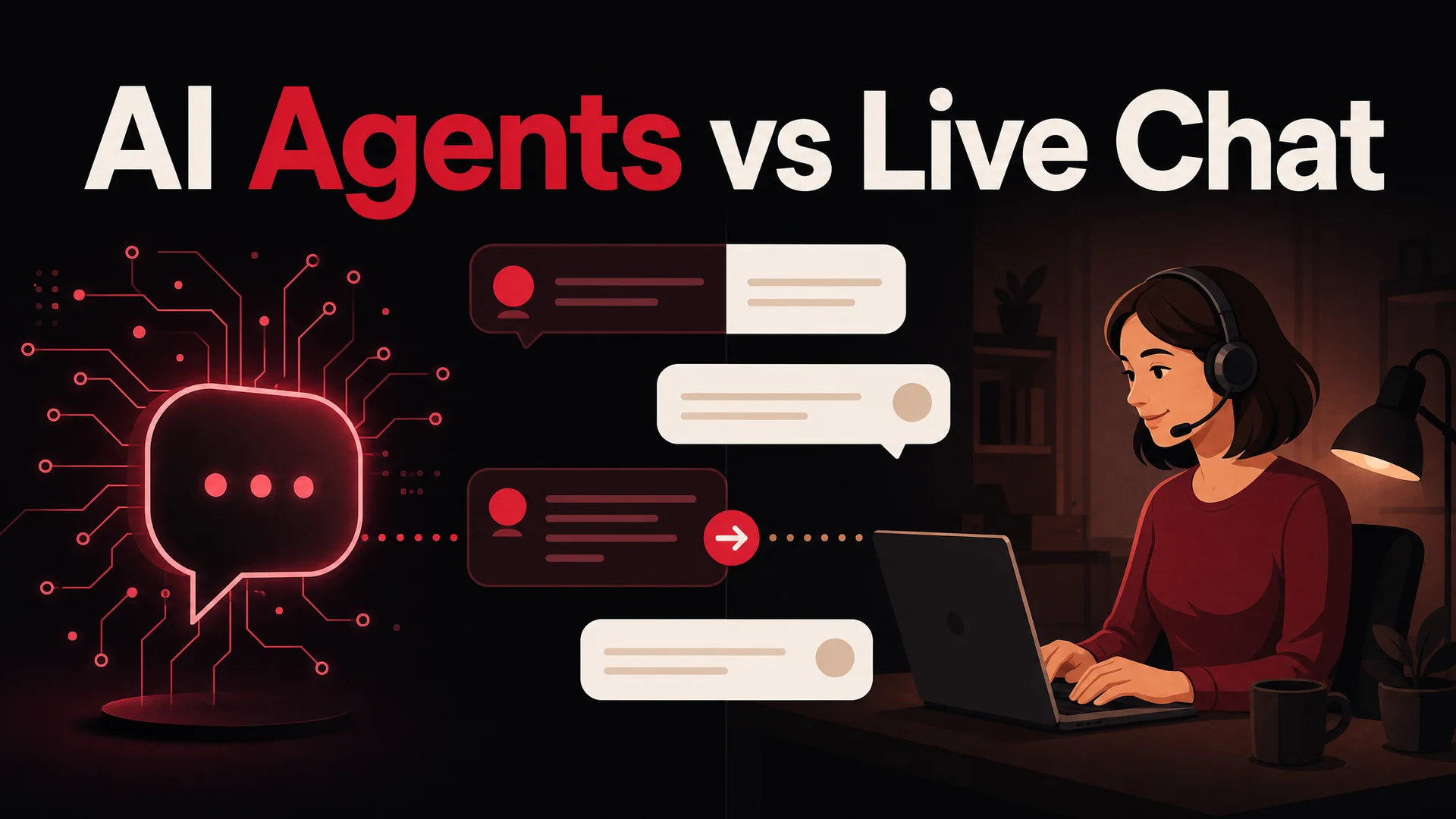
So the question stops being "AI or live chat?" and starts being "what does each layer actually do best, and how do they fit together?" The clean answer that holds up in 2026 is the hybrid one. The support orgs winning on CSAT, first response time, and cost per resolution at the same time are not picking a side. They are letting AI agents own the volume and shaping their human team around the conversations that genuinely deserve a person.
But that is a conclusion, not a strategy. To build it well you have to be honest about where each side wins, where each side falls flat, and what has actually changed under the hood. Let's walk through the dimensions that decide most of the argument.
How live chat actually works
Live chat is real-time, human-to-human conversation through a widget on your site, app, or product. A visitor clicks the chat icon, types a question, and an agent on your team answers from a shared dashboard. That part hasn't changed in years. What sits underneath has.
The widget and the inbox. The visible piece is the chatbot bubble - Intercom, Zendesk, Tawk, HubSpot, or one of dozens of competitors. Underneath, a queueing system pushes new messages into a unified inbox where your support agents pick them up. If nobody is online, the system collects an email and converts the chat into an async ticket.
Routing logic. Behind the inbox there is almost always a routing layer. New conversations get distributed by round-robin, by team specialization (billing vs. technical vs. sales), by customer tier, or by language. CRM integrations let your platform pull in the customer's plan, lifetime value, and past tickets so an agent has context before they type their first reply.
Real-time, human-led resolution. Once the agent is connected, the conversation flows naturally. They ask clarifying questions, pull up the customer's order, check internal systems, and either solve the problem on the spot or take it offline for follow-up. Live chat genuinely shines for situations like a frustrated customer disputing a charge, an enterprise admin trying to debug an SSO integration, a high-value buyer comparing two plans before pulling the trigger, or a shipping mishap that requires reading between the lines. The strength is human context - empathy, tone, and the ability to invent a workaround.
Where live chat strains. The trade-offs are structural, not fixable with better software. You need people online across the time zones your customers live in. Your cost rises roughly linearly with ticket volume. Even your best agent can hold maybe one or two concurrent conversations without quality dropping. And during peak hours, queue times stretch from a minute to ten to thirty, which is exactly when customers are most likely to bounce or escalate to social media.
Live chat is reactive, human-powered, and best for conversations that need real reasoning. It does not scale gracefully when you start fielding the same five questions a hundred times a day.
How modern AI customer support actually works
AI customer support replaces (or fronts) the human in the widget with an agent built on a large language model, trained on your specific knowledge, and wired to your systems. The 2026 generation is meaningfully different from the FAQ-style bots that dominated 2022–2024. Three things changed: the underlying models got smarter, context windows got long enough to hold real knowledge bases, and tool-use reliability hit a level where AI Actions actually work in production.
Training the agent on your knowledge. The agent needs context before it can answer anything useful. On Berrydesk you point it at the sources where your support knowledge already lives - help center articles and FAQs, product documentation and release notes, past chat transcripts and resolved tickets, internal Notion or Confluence pages, Google Drive folders, PDFs, policy documents, public site URLs and YouTube product walkthroughs. With Gemini 3.1 Ultra's 2M-token window or the 1M-token windows on Claude Opus 4.6, DeepSeek V4, and MiMo-V2-Pro, you can hold a startup's entire knowledge base in-context. RAG becomes a tuning lever for huge corpora rather than a hard architectural requirement for everyone.
Real-time understanding, not pattern matching. Once live, the agent reads each incoming message, infers intent, and generates a response. Because it is a reasoning model rather than a keyword matcher, the same underlying intent reaches the same answer across very different phrasings:
- "Do you guys do refunds?"
- "I want my money back."
- "What's your return policy on opened items?"
- "If I changed my mind after 12 days can I still send it back?"
All four trigger the same well-grounded response, citing your actual return window and conditions, with no scripting required from your team.
AI Actions: doing things, not just answering. The biggest jump in the last twelve months is reliability of tool use. Agentic models - Kimi K2.6 (designed for 12-hour autonomous coding sessions), GLM-5.1 (running 8-hour plan-execute-test-fix loops), Claude Opus 4.7, Qwen3.6 - are now dependable enough to execute multi-step support workflows without an engineer babysitting them. In Berrydesk this shows up as AI Actions. The agent can look up an order in Shopify, Stripe, or your custom OMS, issue a refund up to a configurable threshold without needing approval, reschedule an appointment via Calendly or your booking system, update a customer's email or shipping address in your CRM, create or update a Linear, Jira, or HubSpot ticket from the conversation, or trigger a payment link for an upgrade and walk the customer through it.
That moves AI from "answering questions" to "resolving tickets." A customer who would have generated a five-message thread with a human agent - "where is my order, can you cancel it, can I get a refund instead, can you send a new one?" - now gets the whole workflow in 90 seconds.
Routing and human handoff. The strongest AI deployments are not trying to eliminate the human team. They are trying to filter the queue. A well-built agent should answer cleanly when it has high confidence and grounded sources, ask a clarifying question when intent is ambiguous, escalate to a human the moment the customer requests it or the model's confidence drops or the conversation hits a defined trigger (refund > $X, churn risk language, legal mention, VIP tier), and hand off with the entire conversation, the customer's account context, and a one-paragraph summary of what was already tried.
The honest comparison, dimension by dimension
Choosing between the two is the wrong frame. The real comparison is about what each layer is structurally good at.
1. Always-on coverage
This one isn't close. AI agents win.
An AI agent on Berrydesk doesn't sleep. There is no skeleton night shift, no weekend rotation, no apology email when a customer pings you on a public holiday. A shopper in Singapore asking about return windows at 2am gets the same answer with the same speed as a buyer in New York at 11am.
Human teams can technically run 24/7, but the economics rarely justify it outside of large enterprises. Multi-shift staffing, overnight pay differentials, weekend premiums, training duplicated across rotations, and the management overhead of running follow-the-sun operations all compound quickly. For a support org under, say, 15 agents, the math almost never works.
A single AI agent will quietly handle thousands of overnight conversations a month. With 1M-token context windows now standard on Claude Sonnet 4.6 and DeepSeek V4 Flash, that agent can hold your entire policy library, the full conversation history, and active order context in a single prompt - which means the 3am answer is just as informed as the one your senior rep would give at noon. If always-on coverage is even mildly important to your buyers, this isn't a debate.
2. Time-to-first-response
AI agents, by an order of magnitude.
Speed is one of the few support metrics that correlates almost linearly with conversion, retention, and CSAT. Customers in 2026 don't grade you against your peers - they grade you against the fastest experience they had this week, which is increasingly an AI one.
A modern AI agent answers in two to four seconds. There is no queue, no "let me check on that," no apology for the wait. Whether ten people are in queue or ten thousand, the response curve is flat.
Human agents are bounded by attention. The best ones can carry maybe two or three live chats at once before quality drops; phone is strictly one. When ticket volume spikes - a launch, an outage, a Black Friday surge - the queue grows nonlinearly and so does abandonment. Five reps facing forty simultaneous chats means thirty-five customers staring at a typing indicator, and a meaningful share of them are gone before a rep ever types back.
3. Languages and locales
AI has the structural advantage and it keeps growing.
Frontier models are now natively multilingual to a degree that simply wasn't true two years ago. Gemini 3.1 Ultra handles text, image, audio, and video across major languages out of the box. Qwen3.6 has unusually deep coverage across East Asian and South Asian languages. Claude and GPT-5.5 cover the long tail of European, Middle Eastern, and Latin American locales fluently. A Berrydesk agent inherits all of that - pick the model, point it at your knowledge base, and you serve customers in dozens of languages without staffing a single new role.
Replicating that with humans is brutal. You either hire native speakers in every market - which is expensive and slow - or you outsource to BPOs and accept variable quality and latency. For most companies under enterprise scale, the cost ladder breaks somewhere around the third or fourth language. There is a quieter benefit too: tone calibration. A well-prompted agent will localize idioms, formality, and even emoji use per locale, instead of running every conversation through an English-default voice.
4. Sales and lead generation
AI scales the funnel. Humans close the deals that matter.
AI agents are very good at the top of the sales funnel. They can greet every visitor, ask qualifying questions, capture intent, recommend products, and book a demo - all of it in parallel, all of it captured as structured data. They never miss a hand-raise because they were on another call. With agentic tool-use models like Kimi K2.6, Claude Opus 4.7, and Qwen3.6, they can also actually do things - pull live inventory, check pricing tiers, generate a quote, kick off a Stripe checkout - instead of just talking about them.
Where human reps still win is the high-stakes, high-context end of the funnel. Six-figure annual contracts. Multi-stakeholder buying committees. Renewals where the relationship is half the product. A skilled AE reads the silence on a call, the unsaid objection, the phrasing that signals the buyer is actually weighing two competing priorities internally. Models are getting better at sentiment, but they are not negotiating an enterprise procurement cycle for you in 2026.
5. Conversation data and insight
AI wins, and the gap is getting wider.
Every conversation an AI agent runs is structured by default. Topic, sentiment, resolution status, escalation reason, products mentioned, deflection rate, time-to-resolution - all captured, all queryable, all auditable from day one. You can ask "what are the top five reasons people churned out of onboarding last week" on a Tuesday and have an answer before lunch.
Human agents can generate this kind of data, but only if you build the discipline to enforce it: tagging conventions, post-call notes, mandatory disposition codes. In practice, taxonomies drift between agents, notes are skipped on busy days, and the data you actually pull at quarter-end is patchy.
There is a second layer that gets underweighted. Long-context models change what "conversation analytics" can mean. With a 1M- to 2M-token window, you can drop a quarter of full conversations into a single prompt and ask for thematic clusters, recurring product complaints, or wording patterns that correlate with successful upgrades. That used to require a data team and a pipeline. Now it's a Tuesday afternoon.
6. Cost per resolution
AI is dramatically cheaper, and the open-weight model wave widened the gap in 2026.
Human support cost scales close to linearly with volume. Salaries, benefits, training, QA, tooling seats, real estate or remote stipends, manager overhead - every additional thousand tickets per month requires more humans, and the cost per ticket barely budges with scale.
AI cost behaves differently. Beyond a flat platform fee, the marginal cost is just inference. And inference got radically cheaper this year. DeepSeek V4 Flash is priced at roughly 14 cents per million input tokens and 28 cents per million output tokens. MiniMax M2 is open-weight, runs at about 2x the speed of Claude Sonnet, and lands at roughly 8% of the price. For a typical support resolution - a few thousand tokens of context, a few hundred of response - you are looking at fractions of a cent.
That economics shift is why a smart deployment in 2026 isn't single-model. On Berrydesk, you can route the bulk of routine traffic to a cheap, fast open-weight model like DeepSeek V4 Flash or MiniMax M2.7. You reserve Claude Opus 4.7, GPT-5.5 Pro, or Gemini 3.1 Ultra for the conversations that actually need them: ambiguous complaints, multi-step troubleshooting, sensitive billing disputes. The blended cost per resolution drops by a factor that wasn't achievable on closed-only stacks 18 months ago, with no measurable hit to quality on the easy traffic.
Most teams that adopt this routed pattern see support costs drop 40–60% inside two quarters, and that is before counting the deflected tickets that never reach a human at all.
7. Time to launch and consistency
AI wins. With Berrydesk you can ingest your knowledge sources, brand the widget, wire up your AI Actions, and ship to your site, Slack, Discord, or WhatsApp inside an afternoon. The agent answers from the same source of truth every time. No agent-to-agent drift on what the refund policy actually says, no "I think it's 14 days" when it's actually 30.
Where humans still win cleanly
It would be dishonest to imply AI agents are uniformly better. There are domains where humans hold a real, durable advantage and where pretending otherwise costs you customers.
Genuine empathy. When somebody is angry, scared, grieving, or dealing with a sensitive issue - a chargeback after a divorce, a missing delivery for a sick parent, a fraud alert at midnight - what they need first is a human who can hear them. Models are increasingly good at sounding warm. They are not good at sitting with discomfort for the few extra beats it takes to make someone feel heard.
Genuinely novel problems. Multi-system issues that span your product, a third-party integration, and a misconfigured customer environment, where the answer is not in the docs and the path forward requires creative judgment. Agentic models like Kimi K2.6 and GLM-5.1 are remarkable at multi-step reasoning, but the further a problem is from anything in your training data, the more likely a senior human is to actually solve it.
Strategic accounts. For your top 1–5% of customers by revenue, the relationship is the product. They want a named CSM who knows their roadmap, remembers their last QBR, and will pick up the phone when something is on fire. AI is the support layer underneath that relationship, not a substitute for it.
Policy judgment calls. Knowing when to bend a refund policy for a long-time customer, when to escalate, when a customer is asking the wrong question, when to offer something they didn't think to ask for - these are judgment calls that bake in business context, brand voice, and gut feel. You want a human in that seat.
Cross-system creativity. When a resolution requires hopping across three internal tools, calling a vendor, or improvising a workaround, humans still have a creativity edge. Agents will close this gap, but slowly.
Upsell and consultative selling. A skilled live agent can read buying intent and turn a support question into an expansion conversation. AI can flag the opportunity and tee up a script, but the actual close is still better human-led.
Where AI agents struggle, plainly
Garbage in, garbage out. An agent trained on a stale, contradictory, or thin knowledge base will produce stale, contradictory, thin answers. The investment is in the source material more than in the model selection.
Off-script complexity. If a question lands outside the agent's training and the model can't reason its way to an answer, you get either a confident-but-wrong response (the worst case) or a vague one. Good guardrails make this visible; poor ones hide it.
Regulated answers need constraints. In finance, healthcare, or legal contexts, you'll want hard limits on what the agent will say, with policy templates and escalation triggers. Berrydesk supports this through scoped instructions and topic gates, but it's not a "set and forget" decision.
When to use which: three real scenarios
Scenario 1: lean team, high volume of repeat questions
You sell a digital product or run a SaaS subscription. Your inbox is flooded daily with the same questions: how do I reset my password, what's your refund policy, can I change my billing address, do you offer a discount for nonprofits, where do I download the invoice.
If 70 to 90 percent of your incoming questions can be answered by content that already exists somewhere on your site, AI support should be your first move and your default layer. The math is unambiguous. Your team's time is wasted answering questions a model can answer perfectly in two seconds. Customers are waiting in a queue for an answer that doesn't require human judgment.
A Berrydesk deployment for this profile typically takes a couple of hours to launch: connect your help center and Notion, pick a model (DeepSeek V4 Flash is hard to beat on cost-per-resolution for this use case, with Claude Sonnet 4.6 as the upgrade tier when you need stronger reasoning), brand the widget, and turn on AI Actions for the workflows you want automated. The fallback to your human team handles the small share of edge cases.
Scenario 2: high-touch product, complex onboarding
You sell enterprise software, professional services, or anything with a long onboarding flow and a high price tag. Your inbound looks more like: "My Salesforce sync started failing after your release on Tuesday. Here's the error log." Or: "We need to roll out SSO across three subsidiaries with different IdPs. What's the right architecture?"
These are not FAQ questions. They demand back-and-forth, screen-sharing, judgment about your customer's specific environment, and sometimes a senior engineer pulled in. Live chat - or even better, scheduled video calls - should be the primary mode here.
But AI still earns its keep, even for this profile. It can triage incoming chats and route by topic so the right specialist picks up, pull together account context and recent activity for the human agent before they start typing, answer the smaller share of routine questions even enterprise customers ask, and draft response suggestions the human can edit and send, cutting average handle time. AI is the layer underneath the human team, not a replacement.
Scenario 3: fast-growing company, mixed traffic
This is the most common situation, and it's where the hybrid setup shines. Ticket volume is climbing faster than you can hire, but you still have plenty of complex conversations that need human attention.
The pattern that works:
- AI agent as the front line. It greets the visitor, understands the intent, answers from your knowledge base, and runs AI Actions for the well-defined workflows - order lookups, address changes, plan upgrades, refunds within policy.
- Smart escalation triggers. The agent hands off to a human when the customer asks for one, when sentiment turns negative, when the conversation touches a sensitive topic (legal, billing dispute over $X, churn signals, account security), or when the model's own confidence drops below a threshold you set.
- Context-rich handoff. The human picks up with the full conversation history, the customer's account snapshot, and a short summary of what's been tried. They don't start from zero. Average handle time drops because the discovery work has already happened.
- A feedback loop. Every escalated conversation is a training signal. Where did the agent fall short? What knowledge was missing? Berrydesk makes it easy to flag bad answers, add the missing source material, and improve the agent over time.
This is what most production support stacks look like in 2026. The AI handles 60 to 80 percent of conversations end-to-end, your human team handles the rest with full context, and your average resolution time drops while your team gets to spend its energy on conversations that actually need a human.
Where most hybrid setups quietly break
Before getting to what good looks like, it's worth naming the failure modes most teams hit on the first build, because they are predictable and avoidable.
The handoff is a hard cut. The AI says "let me transfer you to a human," the chat goes quiet for nine minutes, and the human eventually arrives without context and asks the customer to start over. Every time this happens, you have effectively trained the customer to skip the AI next time.
Escalation triggers are too eager or too stingy. Too eager and your humans get buried in trivial questions; too stingy and frustrated customers can't reach one. Both fail differently and both kill CSAT.
The AI is trained on stale knowledge. A pricing page changed in March, the AI is still quoting February numbers in May. Without a sync mechanism - Berrydesk's continuous training on websites, docs, Notion, and Drive sources - you are slowly poisoning your own bot.
No feedback loop from humans back to the AI. Your senior reps see the AI's mistakes every day in escalated chats. If that signal isn't captured and used to retrain, you are paying twice for the same lesson.
Launching with thin source material. If your help center is half-written and contradictory, the agent will mirror that. Spend time on the knowledge before launching the agent.
Picking one model and never revisiting. The frontier moves quarterly now. A Berrydesk deployment that picked GPT-5 a year ago should probably be evaluating Claude Opus 4.7 or DeepSeek V4 today, both for capability and cost.
Letting the agent answer questions it shouldn't. Anything tied to legal advice, medical guidance, or contractual specifics should be scoped and gated. Better to escalate than to answer wrong.
Treating launch as the finish line. The first version of your agent will be 70 percent of the way there. The remaining 30 comes from reviewing real conversations, patching weak answers, and tightening the prompts. Plan for that work, not against it.
Each of these is fixable, but only if you design for them at the start.
What "good" hybrid looks like in 2026
The teams getting this right share a handful of patterns. None of them are exotic.
AI absorbs the volume. Order tracking, account questions, password resets, returns, FAQ, booking, payment status, simple troubleshooting, lead qualification. In a typical support org, that is 70–85% of inbound. A well-trained Berrydesk agent on a frontier or near-frontier model resolves it in seconds, in dozens of languages, on every channel - web widget, Slack, Discord, WhatsApp, email - without ever paging a human.
Humans get the conversations that need them. Escalations, sensitive cases, strategic accounts, anything tagged complex by sentiment or topic. Because the AI cleared the easy 80%, your human team gets to actually do the work they are good at. They are less burned out, response times on the hard stuff drop, and CSAT on the conversations that matter most goes up.
Handoffs carry full context. The single biggest lever in hybrid support is handoff quality. When a Berrydesk agent escalates, the human receives the full transcript, the customer's order and account state, the AI's best guess at the issue, and the specific reason for escalation. There is no "can you walk me through it again." The customer feels like the company, not the channel, is helping them.
Models are routed by job, not chosen once. Cheap, fast open-weight models for the bulk of routine answers. Frontier closed models - Claude Opus 4.7 for nuanced complaints, GPT-5.5 Pro for tricky reasoning, Gemini 3.1 Ultra when the conversation includes images or video - for the conversations where quality moves the needle. Berrydesk lets you wire this up without writing routing code.
Humans train the AI back. Every escalation is a labeled example of where the AI fell short. Every QA review on an AI conversation is a signal. Build the loop so those signals flow back into the agent's instructions, knowledge base, and AI Actions over the following week. The agent that ships in May should be visibly better by July, and that improvement should be the result of your team's daily work, not a quarterly retraining project.
This isn't a compromise between two worse options. Done right, it is genuinely better than either alone. Customers get instant, accurate answers when they want speed and a thoughtful human when they want care. Your reps stop drowning in repetitive tickets and start owning the work they were hired for. And the cost curve flattens just as your volume goes up.
Build the hybrid stack on Berrydesk
Berrydesk was designed for exactly this shape of support. You pick the model - GPT-5.5, Claude Opus 4.7, Gemini 3.1, DeepSeek V4, Kimi K2.6, GLM-5.1, Qwen3.6, MiniMax M2, and more - or route between them by conversation type. You train on your docs, websites, Notion, Google Drive, and YouTube. You brand the chat widget, wire up AI Actions for booking, refunds, lookups, and payments, and deploy across your website, Slack, Discord, WhatsApp, and the channels your customers actually use.
A few of the pieces that matter most for hybrid teams:
- Train on the sources you already have. Upload PDFs, point at your docs site, connect Notion or Drive, drop in a YouTube channel. The agent is grounded in your actual knowledge, not a generic foundation model's guess.
- Seamless human handoff with full context. When an escalation happens, your reps inherit the transcript, customer state, and the AI's reasoning, on every channel - not just web chat.
- Multi-model routing. Pair a cheap open-weight model for the easy 80% with a frontier model for the hard 20%. The cost math takes care of itself.
- Deep multilingual coverage. Serve global customers without hiring out a global support team.
- Omnichannel deployment. One agent, one knowledge base, one set of AI Actions - across web, Slack, Discord, WhatsApp, and more.
- Analytics built for hybrid. See what the AI handled, what it escalated, why, and where the next round of training should go.
- Free to start. Build the first version of your agent without a credit card, then scale when it earns the upgrade.
For regulated industries where data cannot leave the building, the MIT-licensed open weights from Z.ai (GLM-5.1), Alibaba (Qwen3.6-27B), and Xiaomi (MiMo-V2-Pro) make on-prem and air-gapped deployments viable in a way they weren't even a year ago.
The takeaway is simple. AI agents and live chat aren't competing - they're two layers of the same support workflow. AI handles speed, scale, and the long tail of repeat questions. Humans handle nuance, escalation, and the conversations where the relationship is on the line. The platforms that win in 2026 are the ones that make the boundary between the two invisible to the customer.
If you are weighing AI agents against humans as an either/or, you are answering the wrong question. The right one is how to wire them together so each does what it does best. That is the build you can stand up on Berrydesk in an afternoon, and the one your customers will quietly thank you for over the next year.
Try Berrydesk free → and see how much lighter your support load gets when the right layer answers the right question.
 Berrydesk
Launch a hybrid support team in an afternoon
- Deploy an AI agent across web, Slack, WhatsApp, and Discord
- Hand off to humans with full conversation context, on every channel
Set up in minutes

Chirag Asarpota is the founder of Strawberry Labs, the team behind Berrydesk - the AI agent platform that helps businesses deploy intelligent customer support, sales and operations agents across web, WhatsApp, Slack, Instagram, Discord and more. Chirag writes about agentic AI, frontier model selection, retrieval and 1M-token context strategy, AI Actions, and the engineering it takes to ship production-grade conversational AI that customers actually trust.