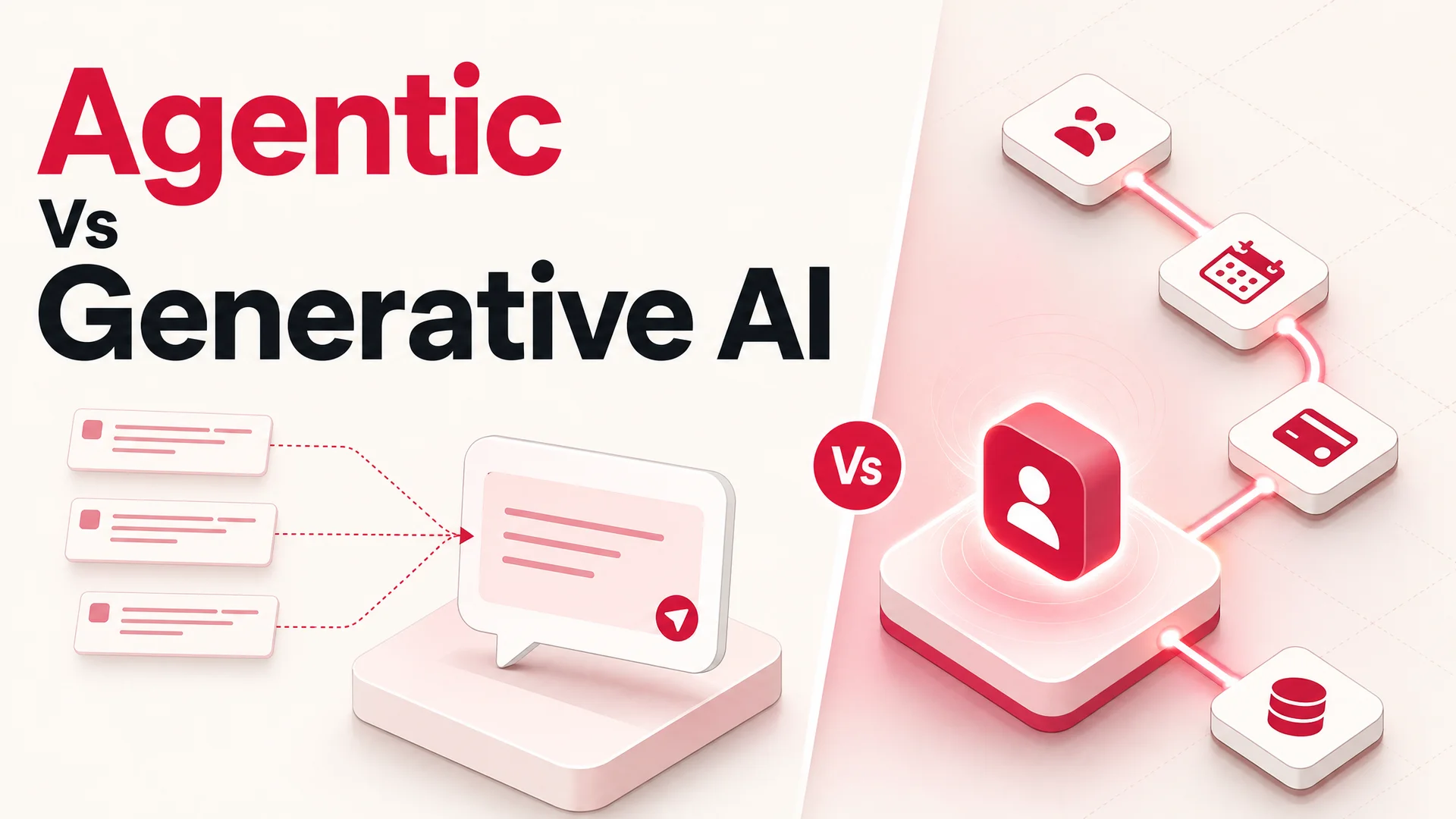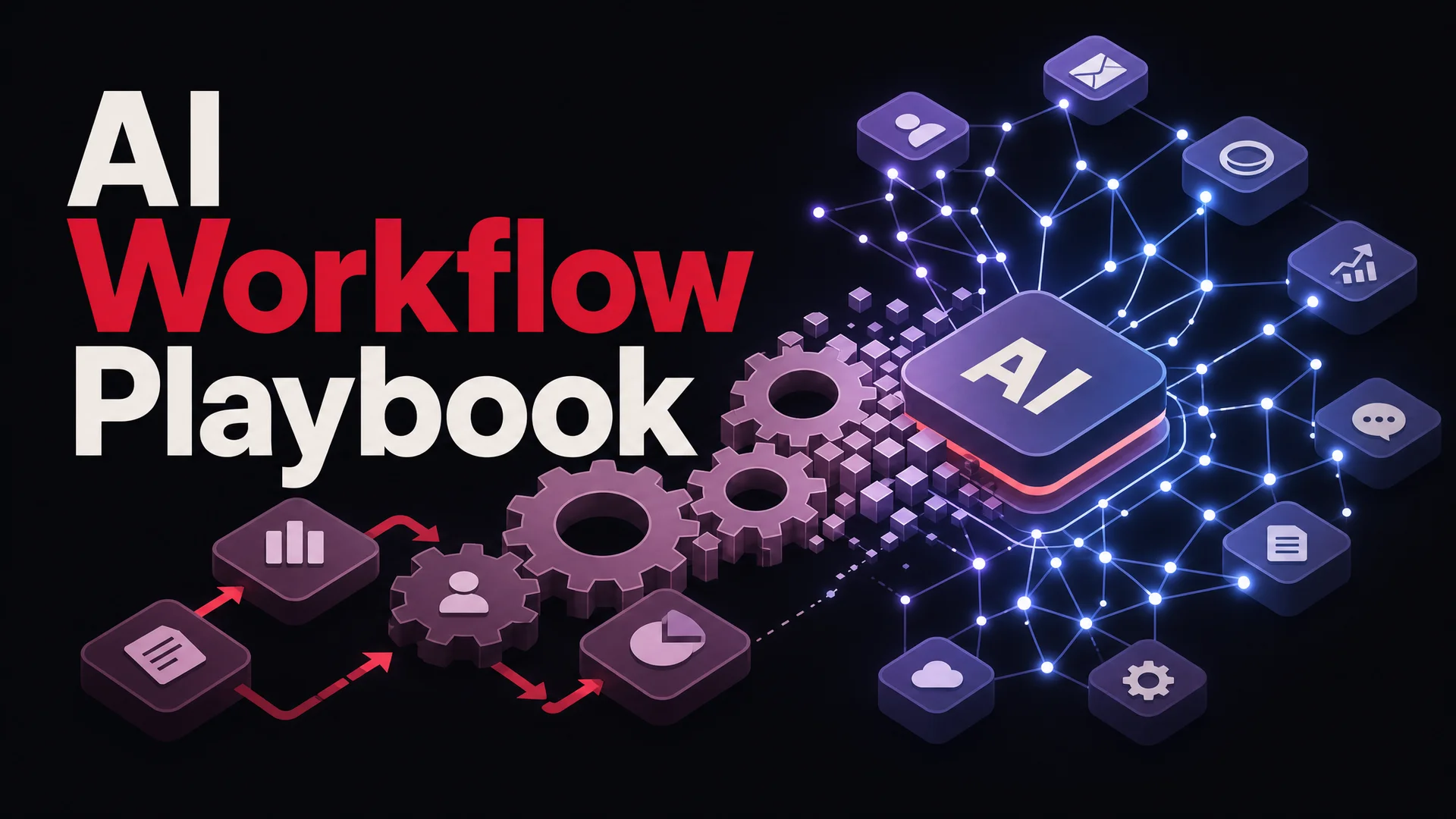
A decade ago, "business automation" meant a macro that filed expense reports or a script that copied rows between spreadsheets. In 2026, it means an agent that reads a customer's order history, refunds a damaged item, books a replacement delivery, and posts a Slack note to the warehouse - all before the support manager has finished her coffee.
The shift is not incremental. The new generation of AI agents thinks, reasons, and acts. The companies that figure out where to point them will pull away from the ones still treating automation as a cost-cutting exercise. AI has reshaped how companies run, but the most consequential shift is not larger models or smarter chat interfaces - it is the move from automation that follows instructions to automation that figures out what to do.
A few years ago, the conversation was about whether AI could responsibly handle a customer-facing workflow. Today, that question is largely settled. With models like Claude Opus 4.7, GPT-5.5, Gemini 3.1 Ultra, DeepSeek V4, Kimi K2.6, and GLM-5.1 in production, AI agents read intent, hold an entire policy library in context, take action against external systems, and escalate cleanly when they cannot. The more interesting question is which workflows to hand over first, and how much autonomy to give the agent once it is there.
This guide is for operators who want a clear-eyed look at what AI-driven business automation actually delivers in 2026, what the trade-offs are, and how to roll it out without the project becoming yet another stalled IT initiative.
What business automation looks like now
The textbook definition still applies: business automation means using software to handle the repeatable parts of an operation so that people can focus on the non-repeatable parts. What has changed is the shape of "repeatable." A rules engine could automate "if invoice over $5,000, route to manager." It could not handle "read the inbound email, decide if it's a refund request, look up the order, check the return policy, draft a response in the customer's language, and either send it or escalate." That second loop - perception, reasoning, action - is what modern AI agents do natively.
AI automation is the combination of artificial intelligence and process automation. Rather than executing a fixed script when a known trigger fires, an AI-driven workflow interprets the situation, reasons about the right next step, performs that step against the systems it has access to, and updates its behavior based on what worked.
The cleanest way to understand the difference is to look at how each style handles a real ticket. Imagine a customer emails support saying, "I was charged twice for my March renewal - can you fix it?"
A traditional automation reads that email looking for keywords. If a rule matches "refund" or "charged twice," it routes the ticket into a queue, sends an acknowledgment, and waits for a human. If the keyword does not match, it sits.
An AI automation reads the message in full. It identifies the customer from the email address, retrieves their billing history, confirms there are two charges on the same SKU within twenty-four hours, checks the refund policy, issues the credit through the payment processor, posts a note to the helpdesk, and replies with a confirmation in the customer's preferred language. If the case is ambiguous - say the second charge was for a different plan tier - it escalates to a human with a full summary, a recommended action, and a draft reply.
That is the line. Traditional automation handles the predictable. AI automation handles the messy middle, which is where most real customer interactions live.
Most companies now run a portfolio of automations. Some are old-school rule engines, some are robotic process automation flows, and an increasing share are AI agents that handle ambiguous inputs end to end. The interesting strategic question is no longer "should we automate?" but "where do we draw the line between deterministic scripts and reasoning agents?"
Why the 2026 model landscape changes the math
The "AI automation" label has been around for years, but the substance under it has changed completely in the last twelve months. The economics of running AI in production cracked open this year. Three shifts matter for any team building on top of it.
Frontier reasoning is now table stakes. OpenAI's GPT-5.5 and GPT-5.5 Pro, released in April 2026, brought parallel reasoning into the mainstream. Anthropic's Claude Opus 4.7 leads SWE-bench Pro at 64.3% on complex multi-step coding work. Google's Gemini 3.1 Pro tops GPQA Diamond at 94.3%. The kinds of multi-step decisions that used to drift or hallucinate halfway through - a refund that requires checking three systems, a booking that depends on inventory plus calendar plus customer tier - are now routine.
Context windows ate RAG's lunch for most use cases. Claude Opus 4.6 and Sonnet 4.6 ship with a 1M-token window at no surcharge. Gemini 3.1 Ultra goes to 2M tokens, natively across text, image, audio, and video. DeepSeek V4 and Kimi K2.6 also hit 1M. For an agent, this means the entire knowledge base, conversation history, account context, and policy documents can sit in-context together. Retrieval is still useful as a tuning lever, but it is no longer a hard architectural requirement.
Open-weight frontier models collapsed the unit cost. DeepSeek V4 (released April 24, 2026) ships in two flavors: V4 Pro at 1.6T parameters and V4 Flash at 284B, with V4 Flash priced at $0.14 per million input tokens and $0.28 per million output tokens - a price point that lets a routine resolution land at a fraction of a cent. MiniMax M2.7 hits roughly 8% of Claude Sonnet's price at twice the speed. Z.ai's GLM-5.1, released April 7 under the MIT license, scores 58.4 on SWE-Bench Pro - beating GPT-5.4 and Claude Opus 4.6 on that benchmark - and runs on Huawei Ascend hardware with no Nvidia dependency. Alibaba's Qwen3.6-27B, an Apache 2.0 dense model, beats 397B-parameter MoE rivals on agentic coding work. Moonshot's Kimi K2.6 runs 12-hour autonomous coding sessions and coordinates swarms of up to 300 sub-agents. Xiaomi's MiMo-V2-Pro rounds out a remarkably crowded open tier.
The net effect for operators: pilots that were technically possible but financially borderline 18 months ago are now obvious. A six-figure annual contact-center contract can plausibly be displaced by a few thousand dollars of inference per month plus a software platform. A typical AI automation deployment routes routine traffic to something like DeepSeek V4 Flash or MiniMax M2 at fractions of a cent per resolution and reserves Claude Opus 4.7, GPT-5.5, or Gemini 3.1 Ultra for the hard cases that need top-of-the-line reasoning. The blended cost of the same workload that ran on GPT-4 in 2024 is now an order of magnitude lower for higher quality.
AI automation vs traditional automation
The headline difference is adaptability. A rule engine breaks when reality drifts from the rules; an AI agent updates its behavior as it sees more cases. But there are several other practical differences worth naming.
Coverage breadth. A rule-based workflow covers exactly what was scripted. An AI agent generalizes from a few examples and handles long-tail variations the team never explicitly mapped. The first weeks of a deployment usually surface ticket types nobody knew were that common.
Failure mode. Rule engines fail silently - the ticket sits, the alert never fires, the customer waits. AI agents fail loudly and verbosely - they explain why they could not act, what they tried, and what they would need to proceed. That makes them easier to debug and improve.
Scaling cost. Adding a new case to a rule engine means a developer writing a new condition. Adding a new case to an AI agent often means uploading a help article or appending a few lines to a policy doc.
Action surface. Modern AI agents are not text-only. With AI Actions wired up - bookings, refunds, payment captures, order lookups, CRM writes - the same agent that answers a question can complete the task the question implied.
This is the category Berrydesk operates in. A Berrydesk agent is trained on your business content, picks the model best suited to your traffic and budget, takes action across your stack through AI Actions, and gets handed off cleanly to humans when it should.
The technologies doing the heavy lifting
Several technical building blocks combine to make modern AI automation work. Each one matured significantly in the last eighteen months.
Reasoning-first foundation models
The center of gravity has moved from generic LLMs to reasoning models that plan, reflect, and self-correct. Claude Opus 4.7, GPT-5.5 Pro, Gemini 3.1 Ultra, GLM-5.1, and Kimi K2.6 are all built around this shift. For business automation, that means agents that can break "process this refund" into sub-steps, retry when a tool call fails, and explain their work in an audit log.
Natural language understanding
What used to require a dedicated NLP pipeline - intent classification, entity extraction, sentiment analysis - is now a side effect of using a frontier model. The agent reads a message and produces structured outputs (intent, entities, urgency, recommended action) as part of its normal response. This collapses what used to be three or four separate systems into one.
Agentic tool use and AI Actions
Models are nothing without hands. Tool use - the ability for an agent to call APIs, query databases, and take real actions - is now reliable enough to deploy in production. Claude Opus 4.7, Qwen 3.6, MiMo-V2-Pro, and Kimi K2.6 are all explicitly trained for this. Kimi K2.6 can run autonomous coding sessions for up to twelve hours and coordinate up to 300 sub-agents across 4,000 steps. GLM-5.1 runs an eight-hour plan-execute-test-fix loop. In a customer-support context, this is the difference between an agent that says "I'd recommend rebooking your flight" and one that actually rebooks it.
Long context and memory
A 1M-token window holds roughly 750,000 words of context. That is enough for an entire product manual, a year of conversation history, and the full set of internal SOPs at the same time. Instead of sharding your help center into 800-token chunks and hoping vector search finds the right one, you can drop the entire help center, the customer's last twenty conversations, and the relevant policy document directly into the prompt. RAG is still useful for very large corpora, but for most mid-market teams, long context is now the simpler answer.
Multimodal perception
Computer vision and audio are no longer separate stacks. Gemini 3.1 Ultra natively ingests text, image, audio, and video, and Kimi K2.6 supports native video input. Practically: a customer can send a photo of a damaged product, a screen recording of a bug, or a voice note in their native language, and the agent can act on it without a separate OCR or transcription step.
Workflow orchestration and RPA, reframed
The glue layer - what triggers an agent, what it can call, what to do when it fails - has matured. Modern platforms handle queues, retries, human handoff, audit logs, and SLA tracking out of the box. Classic RPA - clicking through GUIs, scraping screens, moving data between systems - is still useful for legacy environments without APIs. Layered with an AI orchestrator, it gets smarter: the agent decides which RPA flow to trigger, and steps in when the flow hits an unexpected screen state.
Agentic AI: the real 2026 story
Within AI automation, the segment that has moved fastest is agentic AI - systems that plan, decide, and execute multi-step tasks without a human in the loop for each step.
A 2024 chatbot read a question and produced a sentence. A 2026 agent reads the question, identifies the customer, checks subscription status, runs a diagnostic against logs, applies a fix, sends a confirmation, and files a follow-up ticket if the fix needs to be verified later - all autonomously. The behavior shifts from "respond" to "resolve."
Several factors made this real:
- Reliable tool use. Models like Claude Opus 4.7 and Kimi K2.6 fail far less often when chaining multiple API calls than their predecessors. The error rate on a five-step workflow is now low enough to run unattended.
- Self-evolving behavior. MiniMax M2.7 is built around the idea of an agent that learns from its own runs, adjusting strategies based on outcomes.
- Long autonomous windows. GLM-5.1's eight-hour and Kimi K2.6's twelve-hour autonomous sessions mean the agent can handle workflows that span the equivalent of a full human shift without intervention.
For customer support specifically, agentic AI is what separates a system that deflects FAQs from one that actually closes tickets.
Seven concrete benefits - and where each one breaks
It is easy to list "efficiency, accuracy, scalability" and call it a day. The interesting part is when each benefit actually shows up.
1. Throughput without headcount
Agents resolve work in seconds rather than minutes or hours. A support team that previously closed 1,200 tickets a week with eight agents can route routine traffic through an AI agent on DeepSeek V4 Flash or MiniMax M2 and free those eight agents to focus on escalations. Unit economics flip: each routine resolution costs a fraction of a cent in inference instead of a dollar in labor. The catch: throughput only matters if downstream systems can keep up. Automating ticket triage is pointless if the fulfillment team still works in batches.
2. Lower operating cost at higher scale
Open-weight model pricing means the cost curve flattens as volume grows. DeepSeek V4 Flash at $0.14 / $0.28 per million tokens lets a typical deployment run thousands of conversations a day for the cost of a single engineer-hour. Real, but the savings rarely come from headcount - they come from doing more work without growing headcount and from collapsing tools. A team that previously juggled a knowledge-base tool, a macro tool, a chatbot tool, and an analytics tool can frequently consolidate three or four of them into a single agent platform.
3. Accuracy and consistency
A well-instructed agent on Claude Opus 4.7 or Gemini 3.1 Pro is more consistent than a tired junior on hour seven. Humans copy account numbers wrong. They mistype refund amounts. They send the wrong template. AI agents do not, provided their tools are wired correctly. In regulated industries - healthcare, finance, anything with audit requirements - that consistency is a measurable risk reduction. But "more consistent" is not "infallible." The gain shows up in median performance and tail risk; you still want human review for high-stakes outputs.
4. Customer experience
This is the largest under-the-radar benefit. With 1M–2M token context windows, an agent can hold a customer's entire history - every prior ticket, every order, every product they own - and respond as if a senior account manager remembered them personally. RAG used to be the only way to do this. Now it is one tuning lever among several. AI agents do not sleep, take holidays, or backlog overnight. A customer in Sydney asking a question at 2 AM gets the same response time as a customer in San Francisco at 10 AM.
5. Decision-grade insights
AI is now good enough to summarize a quarter of customer conversations and surface the three product issues driving 40% of complaint volume. That insight loop, fed back into product and ops, is often more valuable than the deflection itself. Many teams treat the agent's transcript log as a continuously updating voice-of-customer dataset.
6. Linear scalability
A burst of holiday traffic or a viral spike no longer needs frantic hiring. The same agent that handles 200 conversations an hour can handle 20,000, with cost scaling roughly linearly to volume. Just confirm your model provider's rate limits in advance.
7. Round-the-clock coverage with compliance-friendly deploys
Always-on operations are now table stakes for any consumer-facing brand. The interesting question is whether your escalation path is also 24/7. An agent that can solve 70% of overnight tickets but cannot reach a human for the other 30% is half a solution. For teams that cannot send customer data to third-party APIs, MIT and Apache-licensed open weights - GLM-5.1, Qwen3.6-27B, MiMo-V2-Pro - make on-prem and air-gapped deployments viable. The capability gap between hosted and self-hosted has narrowed to the point where regulated industries can run frontier-quality automation inside their own perimeter.
Where to apply it first
AI automation can be aimed at almost any business process. These are the use cases that consistently produce the cleanest payback.
1. Customer support
The clearest, fastest ROI lives here. The volume is high, the workflows are structured, the success criteria are measurable, and the cost of a bad outcome is bounded. In 2026, well-configured AI agents resolve 60–80% of inbound support volume without human intervention, and they do it across every channel a customer might use.
A Berrydesk deployment looks like this: pick a model - GPT-5.5, Claude Opus 4.7, Gemini 3.1, DeepSeek V4, Kimi K2.6, GLM, Qwen, MiniMax, or another - based on your accuracy and cost targets. Train the agent on your help center, product documentation, Notion workspace, Google Drive folders, website, and YouTube videos. Brand the chat widget. Wire up AI Actions for the workflows that actually matter to your customers - bookings, refunds, order lookups, payment links, subscription updates. Deploy to your website, Slack, Discord, WhatsApp, or wherever your customers already are. The whole loop takes an afternoon.
2. Sales and marketing
Sales teams use AI automation to score, route, and respond to inbound leads in real time. The agent reads the form submission, enriches against the CRM, scores fit and intent, books a meeting if the lead is qualified, or routes to nurture if not. Reps spend their time on the calls that close, not on triage.
Lead scoring, outbound personalization, demo qualification, and pricing experiments all benefit from agentic automation. The interesting move in 2026 is hybrid agents that own a lead from first inbound touch through to a booked sales call, pulling enrichment data, drafting personalized emails, and managing the calendar without a human in the middle. Sales reps end up running fewer, higher-quality conversations.
AI also handles the mechanical parts of marketing - campaign sequencing, content variant generation, audience segmentation, performance reporting - leaving humans on strategy and brand. Long-context models help here too: an agent can read every customer interaction over the last quarter and recommend campaign angles grounded in actual feedback rather than gut feel.
3. Finance and back office
Invoice ingestion, AP/AR matching, tax compliance, expense audits, and fraud detection are now bread-and-butter agent workloads. The economics are particularly stark when you can route 95% of invoices through a $0.14-per-million-input-tokens model like DeepSeek V4 Flash and reserve Claude Opus 4.7 for the 5% of edge cases that need real reasoning.
4. People operations and recruiting
HR teams run agents to triage candidate applications, answer benefits questions, run new-hire onboarding flows, and gather pulse-check feedback. Resume screening, scheduling, candidate communication, and structured interview note-taking are all natural fits. The bias risk is real, so most teams keep AI in the assistive layer for hiring decisions and use it primarily to compress administrative load.
The cultural lift matters here: employees can tell when an HR agent is a glorified FAQ versus a genuinely helpful colleague that can actually adjust your beneficiaries or pull a payslip.
5. Analytics and reporting
Weekly business reviews used to require a data analyst pulling, joining, and visualizing data. An AI agent with database access can do that on demand: "Show me churn by cohort for Q1, broken down by acquisition channel, and summarize the three biggest takeaways." The analyst then spends time on the questions that need actual judgment.
6. Operations and supply chain
Demand forecasting, inventory replenishment, route optimization, predictive maintenance, and supplier communication are all good agent territory. Long-context models help enormously when an agent needs to reason over months of demand history alongside live inventory and shipping data. Forecasts pull historical sales, weather, promotional calendars, and external signals into a single model rather than three separate spreadsheets.
A six-step rollout that does not stall
1. Pick a process, not a vision
The biggest reason automation projects die is that they start as "transform our operations" rather than "automate this specific workflow that costs us 200 hours a month." Find the boring, repetitive, high-volume process that everyone agrees is a candidate, and start there.
2. Define what success looks like - in numbers
Pick two or three measurable targets before you write a line of configuration. Examples: cut average handle time by 40%, deflect 60% of L1 tickets, reduce invoice processing cost from $4 to $0.40. Without a number, you will not know when to ramp, kill, or expand the pilot.
3. Choose a model strategy, not just a model
For most workloads, a routed approach beats a single-model approach. Use a fast, cheap model - DeepSeek V4 Flash, MiniMax M2, Qwen 3.6 - for the high-volume routine work, and escalate to Claude Opus 4.7, GPT-5.5 Pro, or Gemini 3.1 Ultra for the genuinely hard reasoning. A platform like Berrydesk lets you switch between models without re-architecting the agent, which means your model strategy can evolve as new releases land.
4. Start narrow, then widen
Run a tightly scoped pilot for two to four weeks on a slice of real traffic. Read the transcripts. Find the failure modes. Tune the prompts, training data, and tools. Only then should you widen the funnel. Companies that try to launch broad and tune later almost always end up with a half-trained agent and a frustrated team.
5. Train your humans, not just your agent
Automation works best as a force multiplier for skilled people, not a replacement. Invest in workflow redesign so that humans handle the work where their judgment matters most: high-stakes decisions, edge cases, and the kind of empathy-heavy moments that make customers loyal.
6. Measure, retrain, repeat
Conversation transcripts and tool-call logs are the new training data. Set up a weekly review where the operations lead and a product owner read the bottom 10% of agent interactions and propose fixes. Most platforms make it trivial to push prompt or knowledge updates and roll forward.
Common pitfalls
A few patterns to avoid when rolling out AI automation:
Skipping the action layer. Many teams deploy a chat agent that can answer questions but cannot do anything. The result is a more articulate FAQ. The win comes from connecting the agent to the systems where the work actually happens - billing, CRM, calendar, helpdesk.
Picking one model for every workload. Routing matters. Use a frontier closed model for ambiguous escalations where accuracy is worth the price; use an open-weight model like DeepSeek V4 Flash or MiniMax M2 for routine volume where cost dominates. A single-model deployment leaves either money or quality on the table.
Treating long context as a substitute for clean knowledge. A 1M-token window does not save you if the source content contradicts itself. Cleaning up help articles before training is still the highest-leverage thing you can do.
Data hygiene. Agents inherit your knowledge base. If your help articles are out of date, contradictory, or written in marketing-speak, your agent will be too. Invest a week cleaning up source material before the pilot.
Integration debt. Most automation projects fail at the seams between systems, not inside any single system. Audit your integrations early. If your CRM API is unreliable or your order system has weird permissioning, those issues will surface as agent failures.
Compliance and on-prem requirements. Regulated industries - healthcare, finance, public sector - increasingly need air-gapped or on-prem deployments. The MIT-licensed open-weight frontier (GLM-5.1, Qwen 3.6 dense, MiMo-V2-Pro) makes this dramatically easier in 2026 than it was even a year ago. If your legal team has historically blocked AI projects on data residency grounds, this is worth a fresh conversation.
Underinvesting in handoff. The 20% of cases the agent should not handle deserve as much design as the 80% it should. A clean escalation - full context, clear reason, suggested next step - is often the difference between customers loving the agent and resenting it.
Over-automation. Some processes should not be automated, or should only be partially automated. Crisis support, executive escalations, and high-empathy moments are usually better with a human in the lead. The agent's job is to make sure the human shows up faster, with the right context.
Forgetting evaluation and drift. Production behavior drifts. Models change. Tools change. Customer behavior changes. An agent that worked beautifully in February will silently degrade by August if no one is watching. Treat agents like any other production system: monitoring, alerting, regression tests, and a human owner.
Open-weight or closed frontier?
A frequent question: should we run on closed frontier APIs or open-weight models? In 2026, the honest answer is "both, routed."
The closed frontier - Claude Opus 4.7, GPT-5.5 Pro, Gemini 3.1 Ultra - still has the edge on the hardest reasoning, the most ambiguous escalations, and the cases where a single mistake costs real money. The open-weight frontier - DeepSeek V4, Kimi K2.6, GLM-5.1, Qwen3.6, MiniMax M2.7, MiMo-V2-Pro - is now genuinely competitive on most production support work, at a fraction of the cost, with the option of self-hosting.
A well-designed deployment routes by case complexity. The agent triages incoming messages, sends routine traffic to an open-weight model, and reserves the frontier models for cases where the additional capability is worth the unit cost. Berrydesk supports this kind of routing natively, so you do not have to commit to one model family for the lifetime of the deployment.
What is coming next
A few trends are already visible in the 2026 release cycle and worth tracking:
- Long-horizon agents. Models like Kimi K2.6 already coordinate 4,000-step plans across 300 sub-agents. The same pattern is creeping into business workflows: agents that own a multi-day project, not a single task.
- On-prem frontier. As open-weight Chinese models close the gap with closed frontier, more enterprises are bringing inference inside their own perimeter. Expect "we run our own agents on our own hardware" to become a normal mid-market posture, not just a Fortune 500 luxury.
- Native multimodal workflows. Voice, video, and screen-share inputs become first-class. A customer recording a 30-second screen video of a checkout error becomes the trigger for an automated agent that diagnoses, fixes, and confirms - no transcription middleware required.
- Agent observability as a category. Just as APM and log management became must-haves for backend engineering, agent-specific observability - tool call traces, reasoning replays, regression evals - is becoming standard.
AI automation is the default now
The window where AI automation was a competitive advantage is closing. In another year, it will be the baseline expectation, the way responsive web design or mobile-first UX became baseline before it. The companies that move first are not just lowering costs - they are rebuilding their operations around what intelligent systems can do, while their competitors are still trying to figure out which rule engine to buy.
The companies pulling ahead in 2026 are not the ones with the biggest AI budgets. They are the ones who picked one or two boring, expensive workflows, automated them properly, and then did it again. AI is finally good enough that the bottleneck is no longer the model - it is operational discipline. Pick the workflow. Define the metric. Pick the right model for the job. Watch the transcripts. Iterate.
Customer support is the natural starting point. Volume is high, ROI is measurable, and the technology is more than ready. If you are ready to get an AI agent into your customer support, sales, or operations stack, Berrydesk is the fastest path. Pick a frontier model, train it on your knowledge base, brand the experience, wire up the AI Actions that matter - bookings, payments, refunds - and deploy to your site, Slack, Discord, or WhatsApp in a single afternoon. Start building at berrydesk.com.
 Berrydesk
Ship an AI agent that actually does the work
- Train on your docs, sites, and tools in minutes - no engineering required
- Pick the right model for every job: GPT-5.5, Claude Opus 4.7, DeepSeek V4, and more
Set up in minutes

Chirag Asarpota is the founder of Strawberry Labs, the team behind Berrydesk - the AI agent platform that helps businesses deploy intelligent customer support, sales and operations agents across web, WhatsApp, Slack, Instagram, Discord and more. Chirag writes about agentic AI, frontier model selection, retrieval and 1M-token context strategy, AI Actions, and the engineering it takes to ship production-grade conversational AI that customers actually trust.