If you run a small business, your operating constraint is rarely ambition. It is hours in the day. You are the head of marketing, the support queue, the bookkeeper, and the person who actually packs the boxes. Generative AI changed the math on that constraint, and the changes that landed in the past twelve months are the ones that matter most for owner-operators.
The 2026 model landscape looks very different from the GPT-3.5 days that most "AI for small business" guides were written around. OpenAI's GPT-5.5 and GPT-5.5 Pro now reason in parallel. Anthropic's Claude Opus 4.7 leads SWE-bench Pro at 64.3% and ships with a 1M-token context window at no extra charge. Google's Gemini 3.1 Ultra carries a 2M-token window and is natively multimodal across text, image, audio, and video. Open-weight frontier models from DeepSeek, Moonshot, Z.ai, Alibaba, MiniMax, and Xiaomi have collapsed the price of inference - DeepSeek V4 Flash sits at $0.14 per million input tokens and $0.28 per million output tokens, which makes routine support traffic almost free in unit-economics terms.
What that means for a small shop is simple. The same kinds of automations that big companies have been quietly building all year are now within reach of a one- or two-person team. Below are nine concrete ways to use a modern AI agent in a small business, with the mechanics of how each one actually works in 2026 - and where to be careful.
1. Run frontline support with an AI agent that escalates well
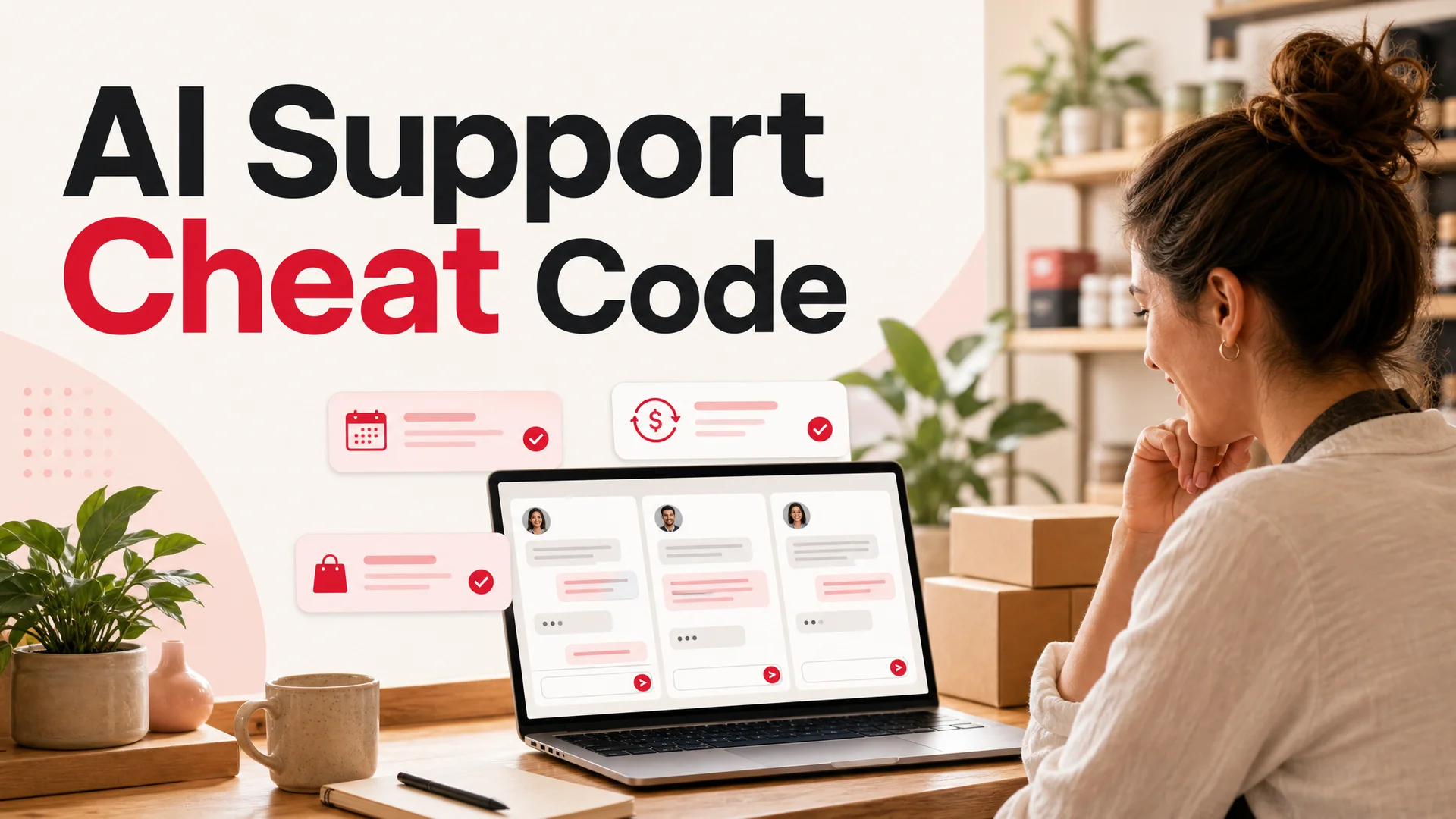
The single highest-leverage use case for a small business is letting an AI agent take the first pass at every inbound support message. The 2024-era version of this was a brittle FAQ widget that tripped over anything off-script. The 2026 version is a real agent: a model with tools, memory of the customer, and the ability to act on policy.
A clothing brand using Berrydesk, for example, can train a single agent on its returns policy, sizing chart, shipping FAQ, and live order data, then have it answer "where is my order?", "how do I exchange a medium for a large?", and "is this fabric machine washable?" with the same fluency a long-tenured rep would. Because Berrydesk lets you pick the model, you can route the bulk of those conversations through DeepSeek V4 Flash or MiniMax M2 - both open-weight and roughly 8% of the price of Claude Sonnet - and reserve Claude Opus 4.7 or GPT-5.5 for the messy edge cases where reasoning quality actually shows up in resolution rate.
The benefits compound for a small business specifically:
- Round-the-clock coverage without round-the-clock staff. A two-person founding team can credibly offer 24/7 first response.
- Resolution, not just deflection. With AI Actions, the agent can issue a refund, reschedule a delivery, or update a subscription instead of handing the ticket back to you.
- Consistency. The agent gives the same answer at 9am Tuesday and 11pm Saturday, so customers stop getting different answers from different reps.
- Real escalations. When the agent does hand off, it hands off with a clean summary, the relevant order context, and a clear reason - which makes the human reply faster than if the customer had emailed cold.
The pitfall to watch: do not bury the escalation path. The fastest way to ruin goodwill is to trap a frustrated customer in a chat loop. Configure your agent to offer "talk to a human" plainly when sentiment turns negative, when a refund exceeds a threshold, or when a question repeats.
2. Draft marketing copy that sounds like your brand, not like a model
Every small business owner has stared at a blank Instagram caption box at 11pm. Modern models are very good at getting you out of that hole. The shift in 2026 is that the output is good enough that the bottleneck is no longer "is this usable" but "does this sound like us."
A small bakery can give the model a short brand brief - playful, regional, slightly self-deprecating, never uses the word "delicious" - and a list of this week's specials, and get a month of grid captions, two email newsletters, and a draft of a flyer in one sitting. With long-context models like Claude Opus 4.6 or Gemini 3.1 Ultra, you can paste in your last fifty captions as a style anchor and the model will actually pick up your voice instead of regressing to the bland mean.
Concrete formats AI is useful for in a small business marketing stack:
- Product descriptions for new SKUs, written in the same cadence as your existing catalog.
- Social posts and reply drafts across Instagram, TikTok captions, LinkedIn updates.
- Email newsletter outlines and full drafts when you give it the week's events to cover.
- Blog post structures, H2-by-H2, before you sit down to write.
- Ad copy variants for Google and Meta, one per audience segment.
- Landing page copy that you can iterate on by swapping the angle prompt.
Two small things make a big difference here. First, feed the model your actual brand voice document, not a paragraph of vague adjectives. Second, treat the output as a first draft. A human edit pass is what separates "AI marketing copy" from "marketing copy that happens to be AI-assisted."
3. Do market research without paying for a research firm
Understanding your competitors and your customers used to require either a lot of evenings on Google or a five-figure consulting engagement. Frontier models with tool use can compress that work meaningfully.
If you run a pet grooming business, you can ask an agent to gather every competitor within ten miles, summarize their service menus and price ranges from their websites, pull recent customer reviews, and surface common complaints. With Gemini 3.1 Ultra's 2M-token window or DeepSeek V4's 1M context, the model can hold the entire dataset in one conversation and answer follow-up questions like "which of these competitors are weak on cat-only services?" or "what do reviewers complain about most?" without losing the thread.
This same loop applies to customer sentiment. Drop a quarter of customer reviews, support transcripts, and social mentions into the agent and ask for the top five recurring frustrations and the top five things customers love. The signal you get is rough, but it is honest, and for a business that has never run a structured research project, that is a real upgrade. Use the output to guide product decisions, retire a dead service, or sharpen your differentiation.
The catch: models can hallucinate competitor details if their web access is shaky. Pin them to sources you provide, and treat anything they cannot cite back to a URL or a document as a hypothesis to verify.
4. Tighten HR and ops paperwork
Hiring, onboarding, and people ops eat hours that a small business owner does not have. Modern agents are very good at the writing-heavy parts of this work, especially when you give them your existing materials as a style anchor.
Tasks where AI carries real weight in a small team:
- Job descriptions. Hand the model the role's responsibilities, your team values, and one of your existing JDs as a template, and you get a polished posting in a few minutes.
- Employee handbooks and policies. Sections like remote work, expense reimbursement, and time-off policy are tedious to draft from scratch and easy for a model to produce a strong first version of.
- Onboarding checklists and welcome emails. Tailored to the role, the start date, and the team they're joining.
- Internal HR Q&A. Train an agent on your handbook and let employees ask "how many vacation days do I have left?" or "how do I expense a software subscription?" themselves.
- Performance review prompts. A neutral, structured set of questions to use as a scaffolding for self-reviews and manager reviews.
The way to think about it: the model is not replacing judgment, it is replacing the blank page. A founder who takes ninety minutes to draft a job description from scratch can spend fifteen minutes prompting and twenty-five minutes editing, and end up with something better.
5. Personalize recommendations without a recommendation engine
Personalization used to require either a lot of data infrastructure or a SaaS bill that did not pencil for a small store. Long-context models change the trade-off. You can hand the model a customer's order history, browsing behavior, and recent support messages directly, and ask for a tailored recommendation - no embedding pipeline, no vector database, no retraining.
A vintage clothing seller can wire this into the chat widget itself. When a returning customer opens the agent, it has the context of their last three orders, their saved sizes, and the styles they have asked about before, and can recommend three new arrivals that fit. Pair that with AI Actions and the agent can hold an item in their cart, apply a small returning-customer discount, or schedule a styling call.
Other places personalization shows up well in small business workflows:
- Discount codes triggered when a known high-LTV customer hesitates at checkout.
- Email replies tuned to that specific customer's interests and prior purchases instead of generic templates.
- Bundle and upsell suggestions that complement what they just bought, not what is on promotion this week.
- Re-engagement messages timed to typical repurchase cadence - pet food, coffee beans, supplements all benefit from this.
Be careful with the line between personalized and creepy. Reference what the customer told you, not what you inferred from passive tracking, and give them a way to say "stop suggesting things."
6. Produce SEO content that ranks because it is actually useful
Search has changed enough in the last year that the old "spin up keyword pages" playbook does not work. Google's AI Overviews and the rise of generative search mean shallow content gets summarized away rather than clicked. Long, useful content that answers a real question still wins, and that is exactly the kind of writing AI is now good at scaffolding.
A local plumber can hand a model a list of services, the questions they get asked most often by phone, and the cities they serve, and get back a fully outlined service page per neighborhood, an FAQ section for each, and a set of blog posts answering things like "how do I know if my water heater is dying" or "what to do when your sink backs up at 11pm." With Claude Opus 4.7's reasoning quality on long-form writing, the drafts hold together as actual articles, not as keyword stew. The plumber edits them so they sound like a plumber, adds photos from real jobs, and publishes.
Where AI helps across the SEO stack in 2026:
- Keyword and topic research, especially clustering related queries into single pillar pages.
- Competitor content audits - paste in their top-ranking pages and ask where the gaps are.
- Meta descriptions and title tags drafted in batches.
- Internal linking suggestions when the model can see your existing posts.
- Outreach copy for backlinks that does not read like a template.
- FAQ schema content built directly from your real customer questions.
The pitfall: shipping AI drafts unedited. Search engines and readers can both tell. Treat AI as a way to ship 3x more content at the same quality bar, not as a way to ship the same volume at lower quality.
7. Turn raw data into decisions
Most small businesses sit on more data than they realize - Shopify exports, Stripe charges, Google Analytics, support transcripts, ad platforms - and use almost none of it because making sense of it is a separate job. A general-purpose AI agent is now competent enough to do the analyst's first pass.
For an e-commerce store, you can hand the model a CSV of last quarter's orders and ask:
- What were the top ten SKUs by revenue and by margin, and how do those lists differ?
- Which days of the week and hours of the day produce the most orders, and which produce the highest AOV?
- How did conversion change month-over-month, and is the change correlated with traffic source or with promotions we ran?
- Which acquisition channels return positive ROAS after refund rates are factored in?
You will get a written summary, a few charts if the agent has code execution available, and - this is the actually useful part - concrete suggestions to test. Increase ad spend on the channel with the best ROAS. Move your best-margin product to the homepage hero. Run a Tuesday-night promo because that is when AOV is lowest.
Other places this maps well:
- Cleaning messy spreadsheets that took forever to maintain by hand.
- Surfacing themes from a quarter of customer feedback in fifteen minutes.
- Sales and inventory forecasting from your own historical data, with the model showing its assumptions.
- Calculating KPIs you have been meaning to track - payback period, repeat rate, churn - but never sat down to build.
The watchout: models will confidently produce wrong numbers if your data is dirty. Always spot-check totals against the source system before acting on a finding.
8. Use AI Actions to actually finish jobs, not just answer questions
The biggest practical change in 2026 versus prior years is that AI Actions - agents calling tools, hitting APIs, and completing tasks end-to-end - are reliably production-ready, not demoware. Models like Kimi K2.6 (with swarms of up to 300 sub-agents and 4,000 coordinated steps), GLM-5.1 (an 8-hour autonomous plan-execute-test-fix loop), Claude Opus 4.7, Qwen3.6, and Xiaomi's MiMo-V2-Pro were all trained agentic-first, and the difference shows up in tool-call reliability.
For a small business, what this unlocks is the difference between "the bot answered the question" and "the bot resolved the ticket."
- A salon agent can show available slots, book the appointment, charge a deposit, and send the confirmation, all from inside a chat.
- An online store agent can look up an order, issue a partial refund within policy, generate a return label, and email it.
- A B2B service agent can qualify a lead, book a discovery call on the founder's calendar, and post the lead into the CRM with a short summary.
- A subscription business agent can pause, downgrade, or skip the next box without bouncing the customer to a form.
Because Berrydesk lets you wire AI Actions into Slack, Discord, WhatsApp, your website, and more, the same agent can finish those jobs across every channel a customer reaches you on. Start with one or two high-volume actions where the policy is clear and the failure mode is bounded - refunds under a threshold, appointment booking, order lookup - and add more as you build confidence in the workflow.
9. Keep an eye on where the real cost line is
A specific 2026 point that earlier guides missed: model selection is now an operating cost lever. The price gap between frontier closed models and open-weight frontier models is large enough to be material for a small business doing real volume.
A practical routing setup looks like this:
- Routine traffic - order status, shipping policy, simple FAQs - runs on DeepSeek V4 Flash or MiniMax M2. Both are open-weight, both are dramatically cheaper, and both are more than capable for this category of question.
- Mid-difficulty work - multi-turn troubleshooting, recommendation conversations, content drafting - runs on Sonnet-class or open MoE models like Qwen3.6-35B-A3B or DeepSeek V4 Pro.
- Hard escalations - complex reasoning, sensitive disputes, multi-step actions across systems - gets routed to Claude Opus 4.7, GPT-5.5 Pro, or Gemini 3.1 Ultra.
For a regulated industry - healthcare, legal services, financial advice - Apache- and MIT-licensed open weights from GLM-5.1, Qwen3.6-27B, and MiMo make on-prem and air-gapped deploys realistic, which used to be a six-figure infra project. That trade-off used to live only in enterprise procurement decks; in 2026 it lands in small business roadmaps too.
A few things to get right before you ship
A small business deploying AI usually wins or loses on operational discipline, not on model choice. A short list of things worth doing on day one:
- Define what "good" looks like. What is a successful resolution? What gets escalated? Write these down before you turn on the agent.
- Train on real material. Upload your actual help docs, your policy PDFs, your Notion pages, your YouTube tutorials. The 2026 long-context models can hold all of it; you do not need to over-engineer a knowledge base.
- Review the first hundred conversations by hand. Patterns will jump out - bad answers cluster around two or three specific topics, almost every time.
- Watch the metrics that matter. Resolution rate, escalation rate, customer satisfaction, average handle time. Do not optimize for "deflections."
- Be transparent. Tell customers they are talking to an AI, give them a clean human handoff, and respect data preferences. The brands that win on AI in 2026 are the ones whose customers do not feel tricked.
The frontier moved fast in 2025 and 2026, and a lot of it moved in directions that specifically favor small operators - cheaper inference, longer context, better tool use, and an open-weight ecosystem that makes the unit economics work. The right move now is to pick one of the use cases above where you already feel the pain, run it for two weeks, and decide what to expand from there.
If you want to skip the wiring and ship a branded AI support agent today, Berrydesk lets you pick a model, train on your existing content, brand the widget, add AI Actions for booking and payments, and deploy across your site, Slack, Discord, and WhatsApp in a few minutes.
 Berrydesk
Launch a branded AI support agent for your small business
- Pick from GPT-5.5, Claude Opus 4.7, Gemini 3.1, DeepSeek V4, Kimi K2.6, and more
- Train on your docs, site, Notion, Drive, or YouTube and ship in minutes
Set up in minutes

Chirag Asarpota is the founder of Strawberry Labs, the team behind Berrydesk - the AI agent platform that helps businesses deploy intelligent customer support, sales and operations agents across web, WhatsApp, Slack, Instagram, Discord and more. Chirag writes about agentic AI, frontier model selection, retrieval and 1M-token context strategy, AI Actions, and the engineering it takes to ship production-grade conversational AI that customers actually trust.