Generative AI is everywhere - GPT-5.5, Claude Opus 4.7, Gemini 3.1, the image and video tools your marketing team can't stop posting about. Agentic AI shows up in the same conversations, and most people quietly assume the two terms are interchangeable.
They aren't. The gap between them decides what you can actually automate, how much human review you still need, and whether your "AI rollout" is a productivity demo or a P&L line item.
If you're choosing tools, designing internal workflows, or scoping a customer support deployment, the distinction is the difference between buying a writer and hiring an operator.
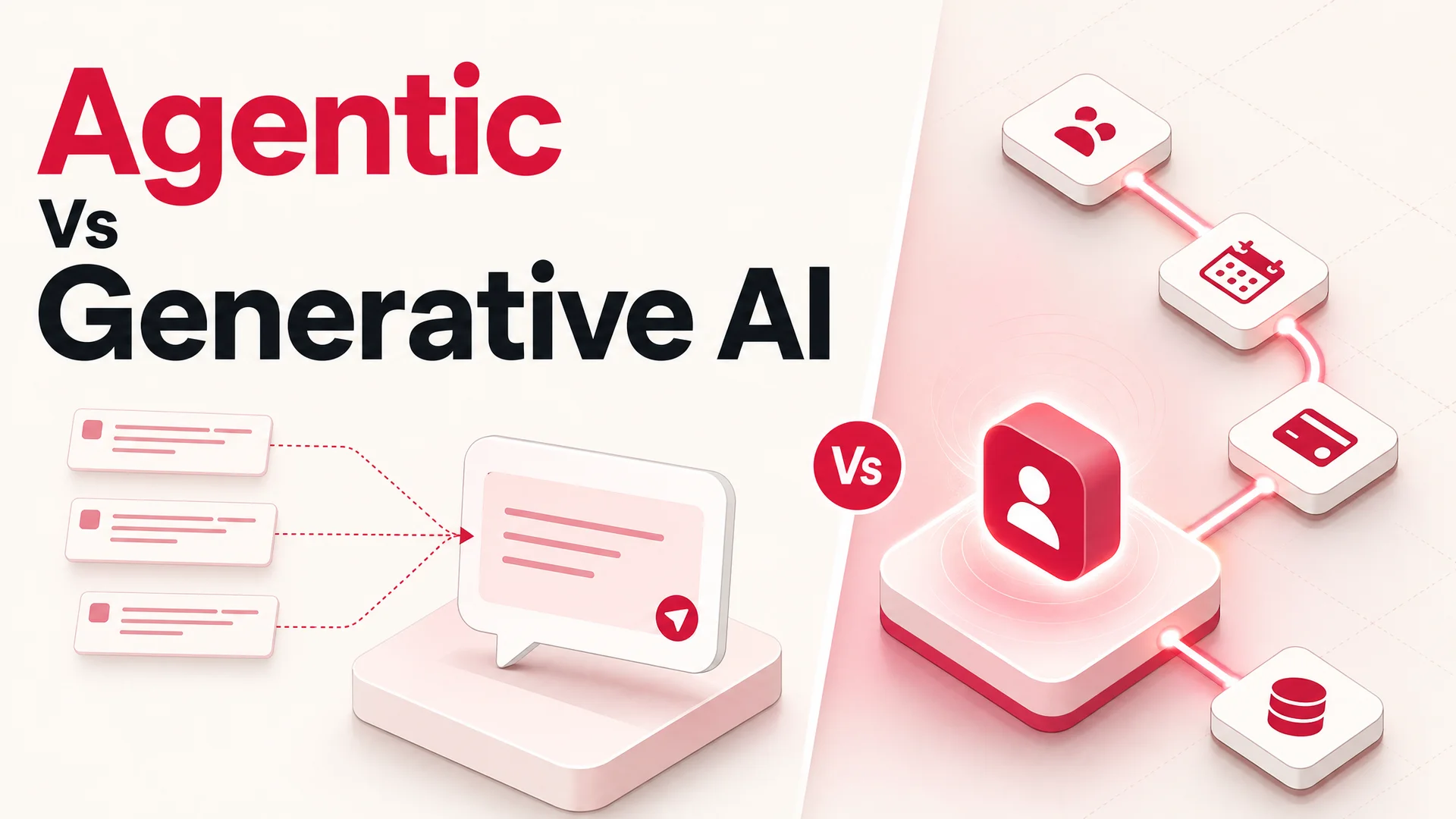
Generative AI: a system that produces output
Generative AI's job is to make something. Text, code, images, audio, video - whatever the modality, the contract is the same: prompt in, artifact out.
Ask GPT-5.5 for a product description. Ask Claude Opus 4.7 to summarize a 200-page contract. Ask Gemini 3.1 Ultra to draft a video storyboard from a brief. Each one reads your input and returns a finished piece of content.
That's it. The model doesn't open another tab, query a database, or push a record into your CRM. It generates. The follow-through is yours.
In a support context, generative AI looks like this:
A customer types, "What's your return policy?"
The model replies, "You can return any unworn item within 30 days. Original packaging required. Refunds post within 5 business days."
Polished, accurate, on-brand. And entirely passive - no order looked up, no return started, no record updated.
Generative AI is the right tool when the deliverable is the words: copy, summaries, explanations, brainstorms, translations, drafts. It is fast, flexible, and ends at a sentence.
Agentic AI: a system that takes action
Agentic comes from agent - something that acts on the world. Agentic AI doesn't stop at the response. It plans, calls tools, makes decisions, and completes a job.
That might mean checking inventory, processing a refund, scheduling a meeting after a back-and-forth, scraping a competitor's pricing page, or running a multi-step troubleshooting flow against a customer's account.
Same support question, agentic version:
"Your order #48219 shipped on April 28. I've started the return for the navy hoodie and emailed your prepaid label. Refund will hit your card within five business days of us receiving it."
Notice what changed. The agent looked up the order, called the returns API, generated a label, and sent the email - then summarized the work it did. The human's job was one sentence; the agent's job was the rest of the loop.
This used to be demoware. In 2026 it isn't. Models like Claude Opus 4.7, Kimi K2.6 (which can sustain 12-hour autonomous coding sessions and coordinate up to 300 sub-agents), GLM-5.1, Qwen3.6, and MiMo-V2-Pro are explicitly trained for tool use and long-horizon planning. The reliability gap that kept agents in pilot purgatory for two years has finally closed.
Six differences that actually matter
Strip the marketing language and the practical contrast looks like this:
- Output vs outcome. Generative AI ends at a sentence. Agentic AI ends at a result.
- Turns vs flows. Generative AI replies once and waits. Agentic AI runs a sequence - listen, decide, act, verify, report.
- Prompt-driven vs goal-driven. You hand a generative model a prompt. You hand an agent a goal and a set of tools.
- Stateless vs stateful. A generative call rarely remembers what happened last turn. An agent tracks the task across calls, sometimes across days.
- Advisor vs operator. Generative AI tells you what to do. Agentic AI does it.
- Content engine vs workflow engine. One produces material; the other moves work through your stack.
They're not opposites - they're layers
The two stop looking like rivals the moment you build something real.
Almost every useful agent runs a generative model inside it. The agent uses the model to interpret the user's request, choose the next tool, draft the email it's about to send, and explain the result back in human language. The agent is the planner; the generative model is the language layer it thinks and speaks in.
Going the other way, generative experiences get sharper when an agent sits behind them. A "chatbot" that can pull live order data, kick off a refund, and update a CRM record beats a chatbot that can only quote your help center - every single time.
A working mental model: generative AI is the brain, agentic AI is the hands. You want both, and you want them connected.
When to reach for each
Default to generative AI when the deliverable is content:
- Drafting product descriptions, blog posts, ad copy, or outbound emails
- Summarizing meetings, transcripts, or long documents
- Translating between languages
- Generating images, voiceovers, or video assets
- Brainstorming names, taglines, hypotheses, test plans
Default to agentic AI when the deliverable is a state change:
- Resolving a support ticket end-to-end (lookup, action, confirmation)
- Scheduling, rescheduling, and confirming meetings against a live calendar
- Running multi-step ops: stock check → shipping calc → order update → confirmation
- Pulling data across CRM, billing, and product systems and pushing back the answer
- Triggering internal workflows when a condition is met
A faster heuristic: if the goal ends in a sentence, you want generative. If it ends in a result, you want agentic.
Why this matters more in 2026 than it did a year ago
Two shifts make this conversation urgent rather than academic.
First, context windows blew open. Gemini 3.1 Ultra ships with 2M tokens. Claude Opus 4.6 and Sonnet 4.6 ship with 1M at no surcharge. DeepSeek V4 and Kimi K2.6 do the same. An agent can hold your entire knowledge base, the customer's full history, and your refund policy in-context simultaneously. RAG becomes a tuning lever, not a hard requirement.
Second, inference got cheap enough to run agents at scale. DeepSeek V4 Flash sits at $0.14 / $0.28 per million input/output tokens. MiniMax M2 runs at roughly 8% of Claude Sonnet's price at twice the speed. You can route routine support traffic to an open-weight model and reserve Claude Opus 4.7, GPT-5.5 Pro, or Gemini 3.1 Ultra for the hard escalations - without your finance team flagging the bill.
Combined: you can build agents that do real work, on real volumes, against real systems, without a research budget.
What an agentic support stack actually does
Think about the ticket categories your team handles every day. The vast majority aren't information problems - they're action problems with a thin layer of conversation on top.
- "Track my shipment" → look up the order, return live tracking
- "Cancel my subscription" → check entitlement, apply retention offer, cancel, confirm
- "Update my billing address" → authenticate, write to billing system, send confirmation
- "Reschedule my appointment to next Tuesday" → query calendar, propose slots, book, send invite
- "Send me my last invoice" → look up account, fetch PDF, deliver
- "Revoke access for our intern" → check permissions, remove user, log the change
Generative AI gives you a polite reply for each of these. Agentic AI closes the ticket.
That gap - reply vs resolution - is the entire ROI story.
How Berrydesk puts both layers in your hands
Berrydesk is built around exactly this split. You point it at your knowledge - docs, websites, Notion, Google Drive, YouTube - and it stands up an agent that talks like your brand. That's the generative layer.
Then you wire AI Actions: bookings, payments, refunds, order lookups, CRM writes, custom API calls. That's the agentic layer. Same conversation, real outcomes.
You also pick the brain. Berrydesk lets you choose from GPT-5.5, Claude Opus 4.7, Gemini 3.1, DeepSeek V4, Kimi K2.6, GLM-5.1, Qwen3.6, MiniMax M2 and more - so you can route routine traffic to a fast open-weight model and reserve frontier closed models for high-stakes turns. Deploy the same agent to your website, Slack, Discord, and WhatsApp.
The point isn't to replace generative AI with agentic AI. It's to stop shipping AI that only talks. Customers don't want better answers - they want their problem fixed.
Spin up an agent that does both at berrydesk.com.
 Berrydesk
Ship an agent that does more than answer
- Pick from GPT-5.5, Claude Opus 4.7, Gemini 3.1, DeepSeek V4, Kimi K2.6 and more
- Wire AI Actions to your CRM, payments, scheduling and order systems
Set up in minutes

Chirag Asarpota is the founder of Strawberry Labs, the team behind Berrydesk - the AI agent platform that helps businesses deploy intelligent customer support, sales and operations agents across web, WhatsApp, Slack, Instagram, Discord and more. Chirag writes about agentic AI, frontier model selection, retrieval and 1M-token context strategy, AI Actions, and the engineering it takes to ship production-grade conversational AI that customers actually trust.