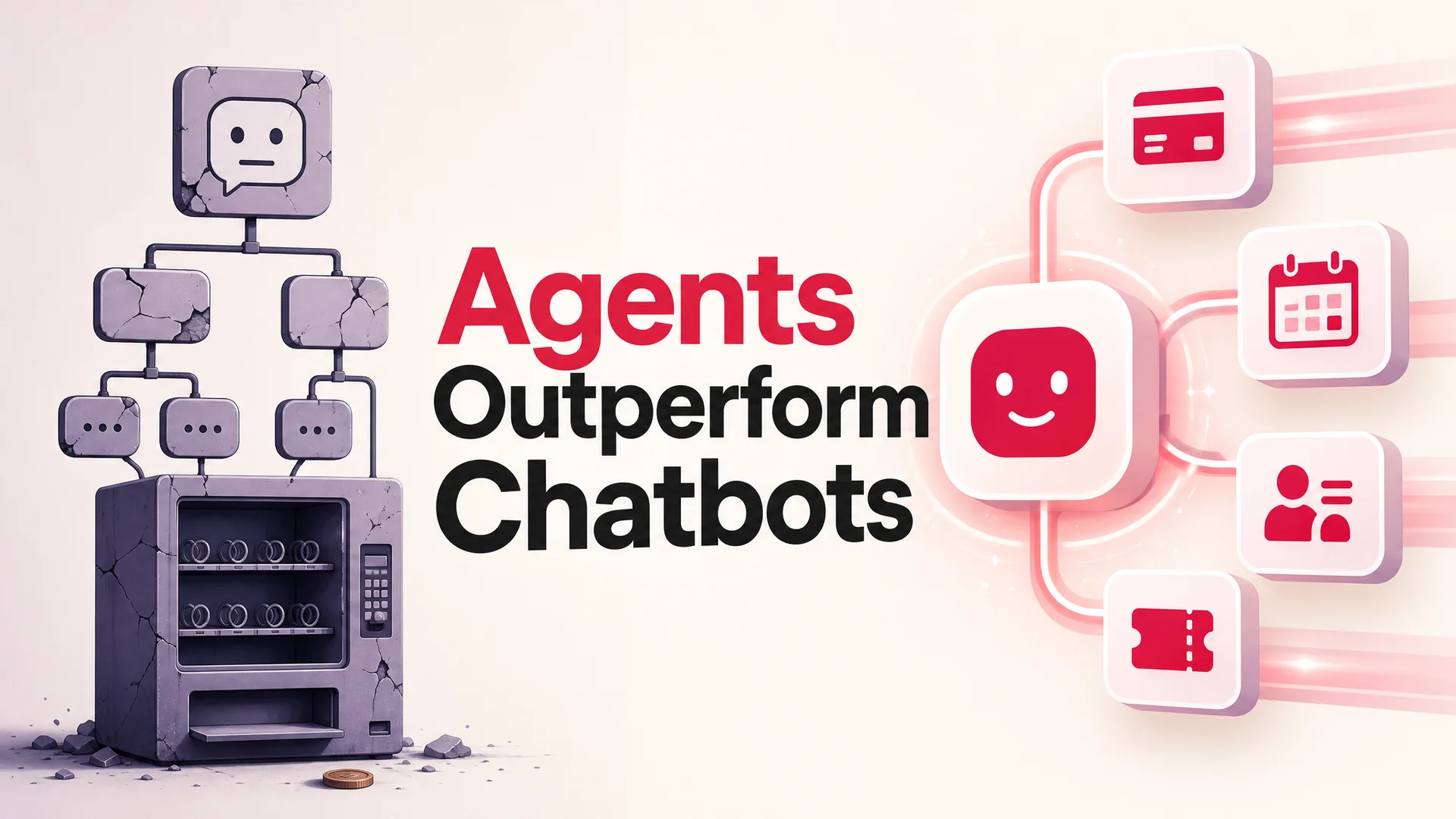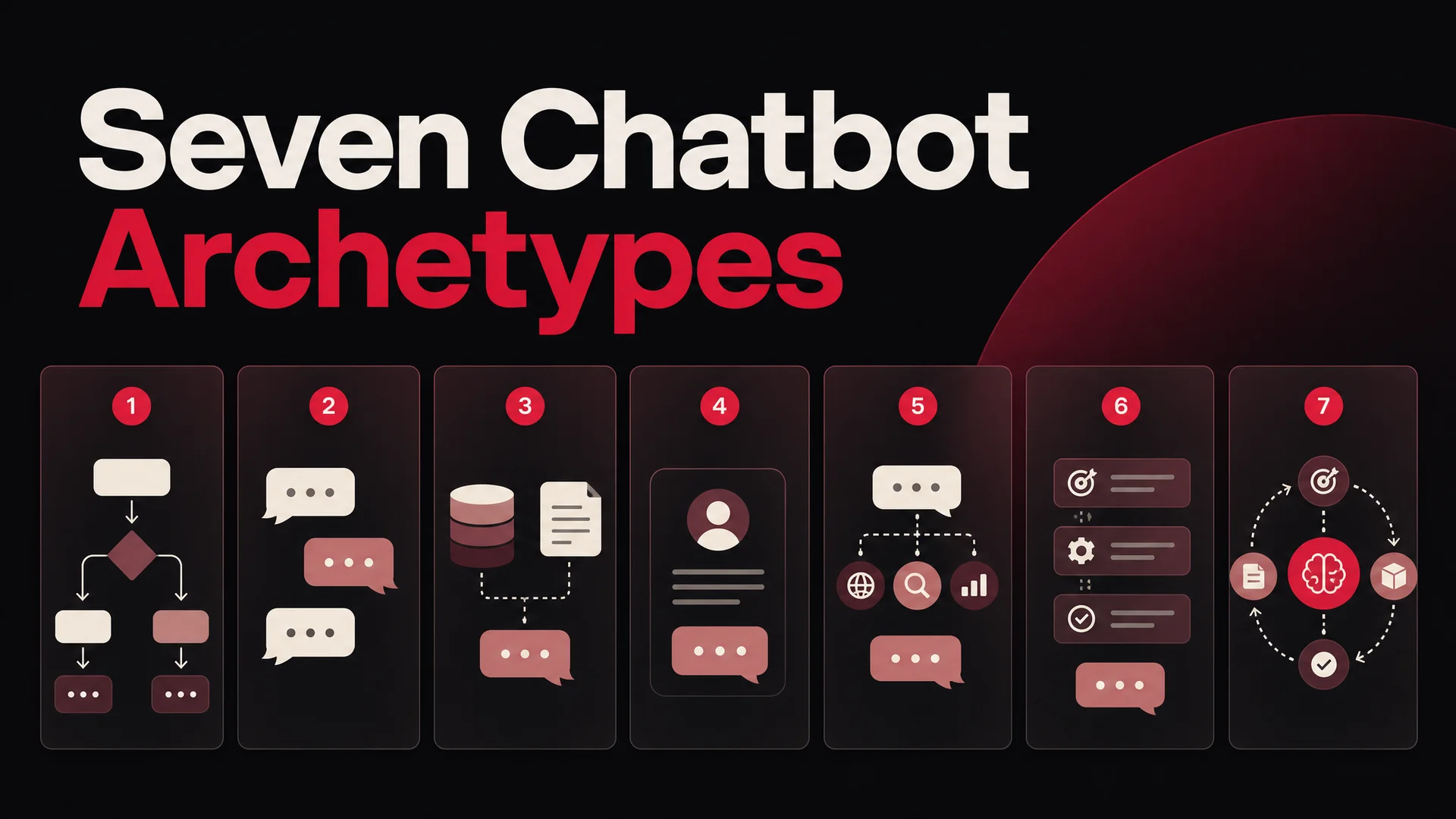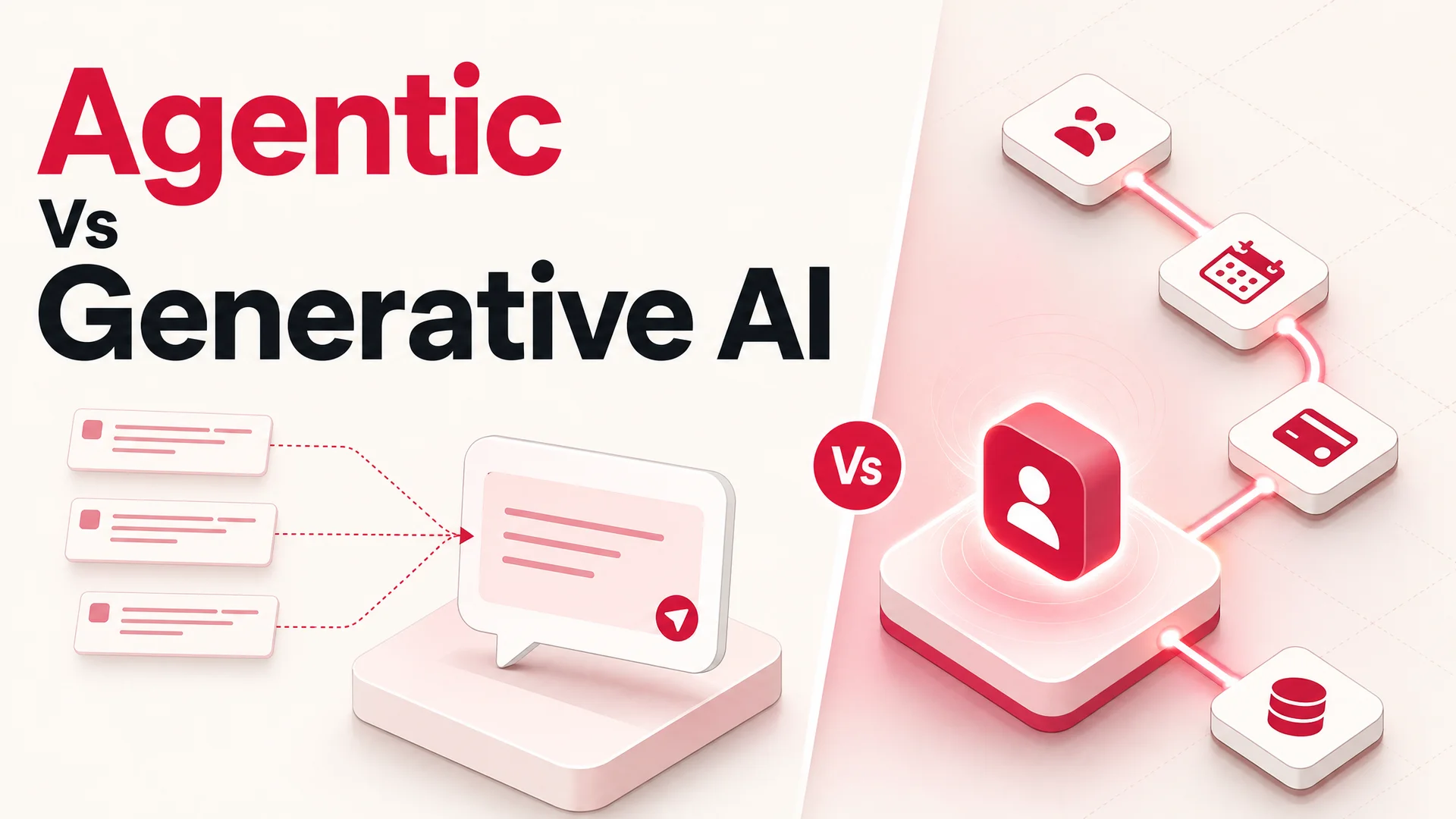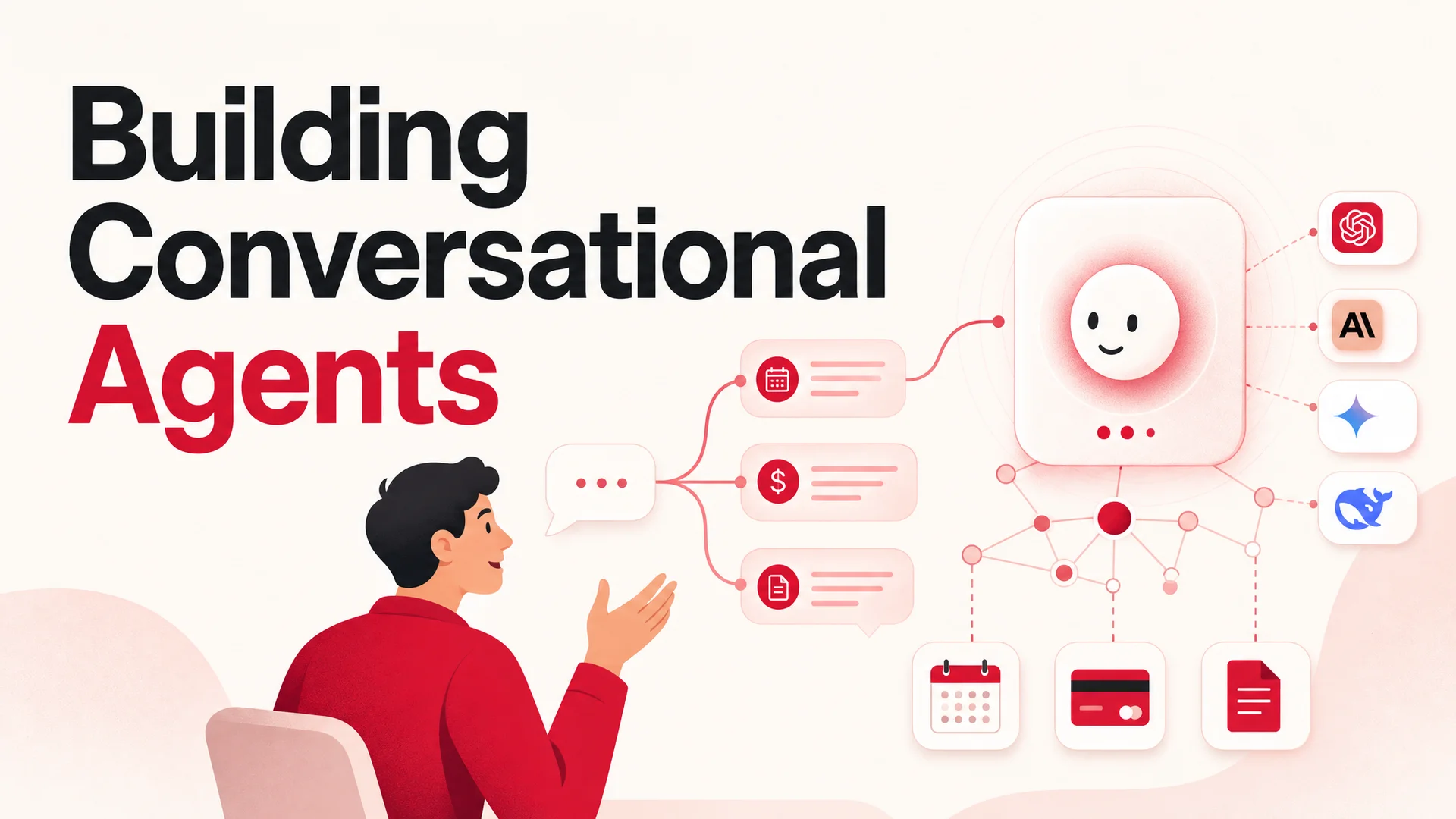
The word "chatbot" hides a huge range of software. The scripted FAQ widget your bank put on its homepage in 2018 is technically a chatbot. So is the autonomous agent that resolves a refund, updates the order in Shopify, posts a note to Slack, and drafts a follow-up email - all without a human in the loop. Same word, very different machines.
Two years ago, talking to software still felt like talking to software. You got menus, scripted replies, and the unmistakable sense that the bot was trying very hard to keep you inside a decision tree. In 2026 that experience is starting to feel like a museum piece. The agents that customers now interact with - on websites, in Slack, on WhatsApp, inside your e-commerce checkout - listen, reason, take action, and remember context across long conversations. They are no longer chatbots that pretend to converse. They are conversational systems that actually do.
Frontier models like GPT-5.5, Claude Opus 4.7, and Gemini 3.1 Ultra now reason across millions of tokens, and a wave of open-weight models - DeepSeek V4, Moonshot Kimi K2.6, Z.ai's GLM-5.1, Alibaba's Qwen 3.6 family, MiniMax M2, Xiaomi MiMo-V2-Pro - have collapsed the cost of running production agents to a fraction of what it was a year ago. The question for any business has stopped being "should we use a chatbot?" and started being "which kind, on which model, doing what work, measured against which goal?"
This guide is the long version of the answer. It walks through what conversational AI really is in 2026, the components that make modern agents work, the agentic shifts that changed the architecture, where it pays off, where it fails, and how to deploy one through a platform like Berrydesk without spending a quarter on a custom build.
What conversational AI actually is
The phrase "conversational AI" gets used loosely. In a strict sense, it refers to any software system that can carry on a meaningful dialog with a person in natural language - written or spoken - and act on what it understands. In practice, that bundles together several distinct capabilities, and it helps to look at them one at a time.
A chatbot is software that holds a conversation. That conversation can happen over text in a website widget, inside Slack or Discord, on WhatsApp, or by voice. Modern chatbots - the ones worth building - sit on top of large language models and a layer of orchestration. The model handles language understanding and generation. The orchestration layer pulls in the right context from your knowledge base, calls the right APIs ("AI Actions" in Berrydesk parlance), keeps track of what has happened earlier in the conversation, and decides when to hand off to a human. None of these pieces are new individually; what is new is how cleanly they now compose, and how strong the underlying models have become.
A few traits define this generation:
- Real language understanding. Today's models follow nuance, sarcasm, multi-step requests, and code-switching across languages. Claude Opus 4.7 leads SWE-bench Pro at 64.3% - the same reasoning depth shows up in a support thread when a customer pastes an error log and asks "is this why my charge failed?"
- Long memory in-context. Claude Opus 4.6 and Sonnet 4.6 ship with 1M-token context windows at no surcharge, and Gemini 3.1 Ultra extends that to 2M. An agent can hold an entire knowledge base, a customer's full history, and the conversation so far without juggling.
- Tool use that works. Agentic models like Kimi K2.6, GLM-5.1, Qwen 3.6, and MiMo-V2-Pro were trained for multi-step tool calls. That makes booking flows, refunds, order lookups, and payment links reliable enough to ship to customers - not a demo.
- Always on, parallel, multilingual. A single agent handles thousands of concurrent conversations across time zones and languages without queueing or quality drift.
- Branded. A modern agent looks and sounds like your company, not a generic assistant. The widget, name, tone, and escalation behavior are all yours.
A short history, and what changed recently
Chatbots are old. ELIZA at MIT in 1966 simulated a Rogerian therapist with pure pattern matching. PARRY in 1972 played a paranoid patient. A.L.I.C.E. in the mid-90s was the first chatbot most people on the early web ever talked to. SmarterChild brought the form to mainstream IM in 2001. Siri made voice assistants normal in 2011. Facebook Messenger opened the door to business chatbots in 2016, and a thousand decision-tree builders bloomed.
For thirty years, every one of those systems shared a limitation: they could only do what someone had explicitly scripted. The conversations felt like phone trees because, structurally, they were phone trees.
The break came when transformer-based language models started handling open-ended text well enough to be useful. From GPT-3 onward, "chatbot" stopped meaning "branching script" and started meaning "model that reasons." By 2026 that shift is complete. The current frontier - GPT-5.5 and 5.5 Pro with parallel reasoning, Claude Opus 4.7, Gemini 3.1 Ultra - handles ambiguity, context, and multi-turn reasoning at a level that makes scripted bots feel archaeological. And the open-weight wave (DeepSeek V4, Kimi K2.6, GLM-5.1, Qwen 3.6, MiniMax M2, MiMo-V2-Pro) has made deploying that intelligence at scale dramatically cheaper. DeepSeek V4 Flash, for example, runs at $0.14 per million input tokens and $0.28 per million output tokens - small enough that a typical support resolution costs a fraction of a cent.
The core components of a conversational AI system
Natural language understanding (NLU). This is the layer that turns raw user input into structured meaning. It tokenizes the message, parses grammar, identifies intents like "I want a refund" or "what time does your store open," and extracts entities - names, dates, order numbers, locations. In 2024-era systems this was usually a separate model trained on tagged data. In 2026 it is mostly handled inside a single large language model, which has read enough text to do all of these jobs implicitly.
Natural language generation (NLG). The flip side: turning the system's intended action or answer back into fluent, on-brand prose. Modern LLMs are remarkably good at this - to the point where the engineering challenge has shifted from "make it sound human" to "make it sound like our brand and stay within policy."
Dialog management. The piece that decides what happens next. Should the agent answer directly, ask a follow-up, call an API, or hand off to a person? In an older rule-based bot, this was a hand-coded state machine. In an agentic system, it is the LLM itself reasoning over a tool catalog and conversation state.
Context and memory. The ability to track what has been said, what the user already told you, and what is true about them across sessions. This used to be one of the hardest pieces to get right. With Claude Opus 4.6 and Sonnet 4.6 now offering a 1M-token context window at no surcharge, and Gemini 3.1 Ultra reaching 2M tokens natively, an agent can comfortably hold an entire knowledge base, the user's full ticket history, and a long policy document in working memory at once.
Tool use and AI Actions. The piece that turns conversation into outcomes. A 2026-era agent does not just describe how to reschedule your appointment - it reschedules it, by calling the booking API, confirming the new slot, and emailing a receipt. This is what people mean when they call a system "agentic."
Sentiment and emotional read. Detecting that a customer is frustrated, confused, or in a hurry, and adjusting tone and escalation accordingly. This is improving but still imperfect; we will return to its limits later.
How a modern conversational exchange actually works
When a customer types "I never got my package, order #84210," a sequence of steps fires off in the background. The order matters; understanding it is what separates teams that ship good agents from teams that ship frustrating ones.
1. Input capture and processing
The user types, speaks, or in some cases gestures into a camera. The message arrives and gets normalized - whitespace, encoding, attachments separated from text. Voice input is transcribed into text by a speech model - modern transcription is good enough that this step is no longer a meaningful source of errors for most languages. Channel metadata travels with the message: which surface (web, Slack, WhatsApp), which user, which session.
2. Intent and context resolution
The model reads the message together with the running conversation, the user's profile if available, the system prompt, and any tools it has been given. Where 2023-era systems explicitly classified the message into one of N intents, today's models reason over the message in one pass and figure out what the user wants implicitly. The brittle "sorry, I didn't catch that" loop is largely a thing of the past.
What it does need is context retrieval: pulling the right slice of the knowledge base, the customer's previous tickets, the order record, and any policy documents that might apply. Long context windows have changed how this works in practice. With 1M–2M tokens available, you can stuff far more into the prompt directly and let the model reason over it, instead of doing brittle top-k vector search and praying the right chunk made the cut.
3. Entity extraction
Order numbers, dates, email addresses, SKUs, phone numbers - these get pulled out and structured. Some platforms still do this with separate NER models; the modern approach is to ask the LLM to return structured JSON alongside its response, validated against a schema.
4. Dialog and tool decisions
Now the agent decides what to do. Answer from the knowledge base? Ask a clarifying question? Look up an order? Cancel a subscription? Hand off to a human? Each of these is exposed to the model as a tool with a typed schema. The model writes a structured tool call, the runtime executes it, the result is returned, and the loop continues until the task is done.
This is the part of the stack that most depends on an agentic model. In Berrydesk this is an AI Action: a typed function that hits your order system, your payment processor, your booking engine, your CRM. The model decides when to call it, what arguments to pass, and how to interpret the result. Agentic models like Kimi K2.6 (which can run autonomous sessions of up to 12 hours and coordinate up to 300 sub-agents across 4,000 steps) and GLM-5.1 (built explicitly for plan-execute-test-fix loops) make this reliable enough that "the agent actually did the thing" is the default outcome, not a happy accident.
5. Response generation
With context, retrieved facts, tool results, and conversation history in hand, the model writes the reply. Tone, length, formality, language, and brand voice are usually controlled through the system prompt. Cite-the-source patterns, where the agent quotes the document that backs its answer, are common in regulated industries.
6. Delivery
The response goes back through the channel adapter - rendered as Markdown in the web widget, as Slack blocks in Slack, as a plain WhatsApp message with maybe a quick-reply button. The plumbing matters: a great answer rendered slowly in the wrong channel still loses the customer. The same agent, different surface, consistent behavior.
7. Learning loop
Every conversation feeds back into evals: which answers got thumbs-down, which conversations escalated, which tool calls failed. This data drives prompt iteration, knowledge-base updates, and - for teams running their own fine-tunes - training signal. The continuous improvement loop is now mostly about content and configuration, not retraining the underlying model.
The taxonomy: types of chatbots and agents you'll actually encounter
Not every situation calls for a frontier model. Picking the right type matters as much as picking the right model.
Rule-based bots
A decision tree of predefined responses. Cheap, predictable, and useful for small workflows where the input space is genuinely tiny - a kiosk that asks two questions, a parking garage chat that handles three intents. They break the moment a user phrases something the tree didn't anticipate, which in customer support is roughly always.
Retrieval bots
Answer from a fixed knowledge base, often using vector search to find relevant chunks and a smaller LLM to phrase the response. Faster and cheaper than full agentic systems, and a good fit for high-volume FAQ-style support where you don't need actions.
AI agents (the current default)
A frontier or strong open-weight model plus retrieval, tool use, memory, and escalation logic. This is what Berrydesk produces by default. AI agents handle ambiguous, multi-step requests - "I want to swap my order for a different size and apply the promo code I forgot to use at checkout" - and they get more useful, not more brittle, as the requests get more complex.
Hybrid stacks
A rule layer in front of an LLM. The rules handle a small number of high-stakes flows where you want guarantees (legal disclaimers, regulated medical disclaimers, payment confirmations), and the LLM takes everything else. Most production deployments end up here in some form.
Voice and phone agents
Voice agents have leapt forward as transcription has gotten cheap and latency has dropped. They are now common on inbound support lines, outbound reminder calls, and inside cars and smart speakers. The interesting design challenge is interruption handling: a good voice agent lets the customer cut in mid-sentence, the way a real person would, instead of forcing them to wait for the bot to finish.
Internal copilots
Many companies now run a conversational agent for their own employees - answering questions about HR policy, kicking off a procurement request, summarizing a Salesforce account, or routing a Slack message into the right Linear project. These look like external support agents but pull on internal data sources and are usually deployed inside Slack or Microsoft Teams.
Vertical task agents
Specialized agents for one workflow - an e-commerce returns agent, a healthcare intake agent, a real-estate viewing-scheduler agent. Same underlying technology, focused training data, narrower tool surface, sharper evals.
Embodied and avatar agents
Conversational agents with a face - virtual receptionists in hotel lobbies, on-screen guides in retail, characters in games and educational tools. These are still niche but moving fast as image and video generation get good enough to give them realistic non-verbal cues.
The right choice is usually "agent for the bulk of conversations, with a few hard-coded rule paths for the things that absolutely cannot go wrong." A platform like Berrydesk lets you compose these without rebuilding the underlying machinery each time.
The components that make an agent good
A chatbot is only as good as the parts feeding it. The model gets most of the press, but in production these other pieces matter as much.
The model layer
What unifies everything in 2026 is the large language model at the center of the stack. The frontier closed models - OpenAI's GPT-5.5 and GPT-5.5 Pro with parallel reasoning, Anthropic's Claude Opus 4.7 (which leads SWE-bench Pro at 64.3%), and Google's Gemini 3.1 Ultra and Pro - are now joined by a deep bench of open-weight competitors. DeepSeek V4 Flash runs at $0.14 per million input tokens. Moonshot's Kimi K2.6 can swarm up to 300 sub-agents through 4,000 coordinated steps. Z.ai's GLM-5.1, MIT-licensed and trained entirely on Huawei Ascend chips, scores 58.4 on SWE-Bench Pro. Alibaba's Qwen 3.6, Xiaomi's MiMo-V2-Pro, and MiniMax's M2.7 round out an open frontier that did not exist in any meaningful form two years ago.
For a conversational AI builder, this matters in one very practical way: you no longer pick a model. You pick a routing strategy. Routine tier-one questions go to a fast, cheap open-weight model. Hard escalations and long-context reasoning go to Claude Opus 4.7 or GPT-5.5 Pro. Visual tasks go to Gemini. The whole pipeline becomes elastic on cost.
The knowledge base
Your docs, your help center, your product catalog, your Notion workspace, your Google Drive, your YouTube tutorials. Berrydesk ingests all of these and keeps them in sync as they change.
Dialog and memory
The agent needs to remember what happened earlier in this conversation, and ideally across sessions for known customers. Long context handles within-session memory cleanly; cross-session memory requires either a memory store you maintain or a model with native persistence.
AI Actions / tool integrations
The list of things your agent can actually do. Look up an order. Issue a refund up to a limit. Book a meeting. Create a ticket in Linear. Tag a contact in HubSpot. Send a payment link. The depth of this list - and the safety constraints around it - is usually what separates a useful agent from a glorified FAQ.
Channels
Where the conversation happens. Web widget, mobile app, Slack, Discord, WhatsApp, Microsoft Teams, SMS, email, voice. A single agent should be deployable across all of them without rebuilding.
Brand layer
Name, avatar, color, tone of voice, persona instructions, escalation message. This is what makes the agent feel like your product instead of a generic AI bolted onto your homepage.
Analytics and evals
You can't improve what you don't measure. Track resolution rate, escalation rate, customer satisfaction (CSAT), response time, cost per resolution, and the categories of question that the agent fails on. The good platforms surface this automatically.
Why teams are building agents - concrete benefits
The case for chatbots used to be "deflection" - handling tickets so humans don't have to. That's still real, but the more interesting wins in 2026 sit elsewhere.
Around-the-clock coverage. A SaaS company with customers in Tokyo, Berlin, and São Paulo can't reasonably staff humans across all three. An agent gives every customer a substantive first response in seconds, regardless of hour. For most B2C businesses this alone is a step-change in CSAT.
Real cost reduction. Routing routine traffic through DeepSeek V4 Flash or MiniMax M2 (at roughly 8% of Claude Sonnet's price at twice the speed) brings the marginal cost of a resolution to a fraction of a cent. Teams that used to budget $4–$8 per ticket now run blended costs in the cents range, and reserve human agents - and frontier models - for the work that actually warrants them.
Faster, more consistent answers. Humans get tired, distracted, and inconsistent. Agents don't. Every customer gets the same accurate answer, sourced from the same up-to-date documentation. For teams that care about brand voice, this is a win, not a loss.
Real scalability. A single agent handles ten thousand concurrent conversations as easily as ten. Black Friday, a viral moment, a product-launch day - these used to require frantic seasonal hiring. They no longer do.
Customer insight as a side effect. Every conversation is a structured signal about what customers want, what confuses them, and where your product is failing them. Berrydesk surfaces these patterns automatically - the questions you're getting most often, the topics where the agent is failing, the moments where customers escalate.
Human time freed up for the hard work. When the agent handles 70–80% of incoming volume, your human team gets to focus on the 20–30% that needs them - angry customers, edge-case bugs, high-LTV accounts, refund disputes, anything emotionally charged. The job gets more interesting, not less.
Lead qualification and revenue work. Outside of support, the same architecture qualifies leads, books demos, recovers abandoned carts, and answers pre-sales questions. An agent that knows your product can carry a sales conversation further than most chat widgets ever could.
Personalization at scale. With customer data flowing into the prompt, an agent can address known customers by name, reference their plan, recall their prior tickets, and tailor recommendations to their history.
Multilingual coverage by default. Modern frontier models handle dozens of languages well. A single agent serves your French, German, Japanese, and Portuguese customers without a separate per-language deployment.
Brand consistency. Every conversation sounds like you. No drift, no off-brand tangents.
What can go wrong - and how to avoid it
The honest version of this guide includes the failure modes. Most of them are well-understood by now, and most of them have a clean answer.
Hallucination and overconfidence. A model that doesn't know an answer should say so, not invent one. The fix is grounding: tie answers to retrieved sources, instruct the model to refuse when the knowledge base doesn't cover the question, and review failure cases. Berrydesk surfaces ungrounded responses for review automatically.
Limited emotional read. Models are getting better at sentiment, but they still occasionally miss when a customer is genuinely upset. A model can recognize that a customer is upset and mirror appropriate language. It cannot actually feel anything. In sensitive cases - bereavement, medical anxiety, financial distress - the right design choice is often to detect the emotional context and route to a human, not to have the agent lean in.
Privacy and security. Support conversations contain personal data, sometimes regulated data. You need encryption in transit and at rest, clear data-retention policies, role-based access, and - for some industries - the ability to keep data on-prem. Open-weight models with permissive licenses (GLM-5.1 under MIT, Qwen 3.6-27B under Apache 2.0, MiMo-V2-Pro under MIT) make air-gapped and on-prem deployments newly viable for regulated industries that previously couldn't touch a hosted LLM. Prompt injection attacks, where a user tries to trick the agent into ignoring its instructions, are a real risk too.
Bias and fairness. Models inherit biases from their training data. In customer-facing applications this can show up as inconsistent service across demographic groups or culturally tone-deaf phrasing. The teams that handle this well treat it as an ongoing audit, not a one-time check.
Disclosure. Customers should know when they are talking to an AI. Beyond the ethical case, a growing number of jurisdictions now require it. The good news is that being upfront about it does not seem to hurt - done well, it actually raises trust.
Integration complexity. The agent is only useful if it can act on your systems. Plan the integration surface up front: which systems need read access, which need write access, what the auth model looks like, what the rate limits are.
Maintenance drift. Knowledge bases get stale, products change, prompts decay. Build a review cadence - weekly at first, monthly when stable - to look at failure cases, update sources, and tune prompts. Treat the agent like a product, not a one-time deploy.
Over-permissioning AI Actions. The most expensive failure mode is an agent with too much authority issuing the wrong refund or canceling the wrong subscription. Scope tools tightly: limits on refund amounts, confirmation steps for irreversible actions, sandboxes for destructive operations.
Where conversational AI is paying off, by industry
The pattern across industries is the same: the agent handles volume and routing, humans handle judgment and exceptions. The specifics differ.
E-commerce. Order status, shipping questions, returns, exchanges, sizing, recommendations, abandoned cart recovery. A mid-sized retailer running Berrydesk on top of Shopify can deflect 70–80% of pre- and post-purchase questions, and the AI Action layer handles the actual returns and refunds end-to-end. The agent that says "I've issued a refund for $42.50 to your original card, you'll see it in 3–5 business days" is dramatically more valuable than the one that says "please contact support."
Healthcare. Symptom checkers, appointment scheduling, medication reminders, post-visit follow-ups, and triage for mental health support. Long-context models matter here in particular - an agent that can hold a patient's recent history while answering a question is meaningfully more useful than one that cannot. Compliance is the gating factor - HIPAA in the US, GDPR in the EU. The open-weight, permissively-licensed models (GLM-5.1, Qwen 3.6, MiMo-V2-Pro) have made on-prem deployments practical for clinics and hospital networks that need to keep PHI inside their own infrastructure.
Banking and finance. Balance inquiries, transaction questions, card management, fraud alerts, basic financial education. The integration surface is huge here - core banking systems, card networks, identity providers - and the safety bar is high. Long-context models let an agent reason over a customer's entire transaction history without an explicit RAG pipeline, which simplifies the architecture considerably.
Travel and hospitality. Booking, rebooking, cancellations, recommendations during a trip, real-time disruption handling. A chain of regional RV-rental locations, for example, can run one agent that handles availability, pricing, location-specific questions, and the booking itself, across phone, web, and WhatsApp.
Education. Personalized tutors, language conversation partners, and student-facing administrative agents. The agent that can adapt to a student's level and pace turns out to matter more than any specific subject expertise - a pattern that translates well to corporate training too.
Human resources. Internal HR questions - PTO balance, benefits, policies, IT access, onboarding. This is one of the highest-ROI internal deployments because the questions are repetitive, the knowledge base is finite, and the answers are usually unambiguous.
Real estate. Property search, viewing scheduling, mortgage pre-qualification questions, post-tour follow-up. Agents that integrate with MLS data and a calendar system can shorten the time from "interested" to "booked viewing" from days to minutes.
Customer support. Across every category above, the pattern is the same: the agent is the front door, and humans handle the long tail. Done well, this raises CSAT and lowers cost simultaneously.
How to think about platforms
You can build an agent from scratch on top of model APIs. For most teams this is the wrong call - the orchestration, retrieval, channel adapters, action framework, evals, and analytics are months of work, and they're not where your business differentiates.
The better question is: which platform fits the way you want to operate?
The criteria that matter:
- Model choice. Are you locked to one provider, or can you route across the frontier and the open-weight ecosystem? Lock-in costs you both money and resilience.
- Training surface. How easily can you connect docs, sites, Notion, Drive, YouTube? How quickly does it re-sync when the source changes?
- AI Actions. How easy is it to give the agent real tools, with safe scoping?
- Channels. Where can you deploy without rebuilding?
- Branding. Can the widget actually look like your product?
- Analytics. Do you get the data you need to improve, or just vanity charts?
- Compliance posture. GDPR, SOC 2, HIPAA - depending on what you do.
- Pricing alignment. Per-message, per-resolution, per-seat - what scales the way your usage scales?
Berrydesk is built around these criteria as defaults: pick a model, train on your sources, add AI Actions, brand the widget, deploy across web and chat platforms, watch the analytics. You can also bring your own keys and route across providers.
Build vs. buy. The platforms have caught up to most custom builds for 90% of use cases, and the model layer changes too quickly for most internal teams to keep up. Build only if you have a genuine differentiator that requires it - most often a deeply proprietary integration, a regulated environment, or an unusual modality. Otherwise buy, and put your engineering hours into the AI Actions and the evals.
Open weights vs closed frontier: a practical framing
Closed frontier models (GPT-5.5, Claude Opus 4.7, Gemini 3.1 Ultra) lead on the very hardest reasoning tasks, are easiest to integrate, and ship as managed services with strong reliability. They are the right default for the small fraction of conversations where reasoning quality is the whole game.
Open-weight frontier models (DeepSeek V4, Kimi K2.6, GLM-5.1, Qwen 3.6, MiMo-V2, MiniMax M2.7) are dramatically cheaper, have closed most of the quality gap on routine tasks, and can be deployed on-prem under MIT or Apache licenses. For volume traffic, regulated industries, and any team that has been burned by per-token pricing, they are now serious contenders rather than experiments.
A real production stack usually mixes both. A Berrydesk deployment routinely routes 80–90% of traffic to a fast open-weight model and reserves a frontier model for hard escalations and long, multi-step reasoning. The economics shift dramatically when you do this.
RAG vs long context: a quieter shift
A subtler change worth flagging. For three years, the default architecture for grounding an agent in your data was retrieval-augmented generation - chunk your documents, embed them, retrieve the relevant chunks, stuff them into the prompt. With 1M-token context windows now table stakes and 2M available on Gemini 3.1 Ultra, the architecture is shifting. For many support deployments, you can simply load the entire knowledge base into context and skip the retrieval layer altogether.
This does not eliminate RAG - for very large corpora it is still essential - but it turns it into a tuning lever rather than a hard requirement. The right default for a typical support deployment in 2026 is "try long context first, add retrieval only if you need to."
What is coming next
A few trends are worth watching, because they will shape what "good" looks like over the next twelve months.
Agents that act, not just answer. The line between "chatbot" and "autonomous agent" has nearly disappeared. Models like Kimi K2.6 (12-hour autonomous sessions, swarms of up to 300 sub-agents, 4,000 coordinated steps) and GLM-5.1 (8-hour plan-execute-test-fix loops) are designed for sustained agentic work. Expect support agents to handle more multi-step resolutions end-to-end - diagnose, fix, verify, follow up - without a human touching the loop.
Even longer context, used more naively. With 1M tokens table-stakes and 2M readily available, the engineering complexity of retrieval pipelines is going to keep falling for medium-sized deployments.
Native multimodality. Gemini 3.1 is natively multimodal across text, image, audio, and video. Kimi K2.6 added native video input. Customer support starts to include "show me your screen" and "send a photo of the broken part" as first-class inputs.
Open-weight on-prem becomes mainstream. GLM-5.1 (MIT), Qwen 3.6-27B (Apache 2.0), MiMo-V2-Pro (MIT) are frontier-quality models with permissive licenses. For regulated industries - healthcare, finance, government, defense - this is a meaningful unlock.
Cheaper everything. DeepSeek V4 Flash at $0.14/$0.28 per million input/output tokens, MiniMax M2 at roughly 8% of Claude Sonnet's price at 2x speed - the per-conversation cost floor keeps dropping.
Voice as a first-class surface. As speech models get faster and more natural, voice agents stop being a novelty. Phone-based support, IVR replacement, drive-through, in-car - all become viable surfaces for the same agent that lives in your web widget.
Stronger evals and oversight. The flip side of more autonomous agents is more rigorous evaluation. Expect the discipline around prompt evaluation, regression testing, and human-in-the-loop review to mature quickly across the industry.
Explainability as a first-class feature. Customers and regulators alike want to know why an agent did what it did. Expect to see "show me how you got that answer" become a standard interaction pattern.
A practical implementation playbook
If you're standing up a conversational AI agent in 2026, this is the shape of the work that actually matters.
- Define the job, not the technology. What conversations should the agent own end-to-end? What should it triage and escalate? What should it never touch? Write this down before you pick a model. Most failed deployments fail here.
- Pick channels first. Where do your customers already talk to you? If they're on WhatsApp, start there. If they're on your website, start there. Don't deploy to five channels on day one - pick the highest-volume one, get it right, then expand.
- Choose a model strategy, not a model. Routing matters more than picking the single best model. A typical Berrydesk deployment uses DeepSeek V4 Flash or MiniMax M2 for the vast majority of turns and reserves Claude Opus 4.7 or GPT-5.5 Pro for hard escalations. Decide your routing rules up front.
- Build the knowledge base honestly. Audit your existing documentation. Most teams find their help center is half-stale. Fix it, then ingest it. Garbage in, garbage out applies to agents as much as to anything else.
- Scope AI Actions tightly. Start with read-only tools. Add write tools with strict limits. Add destructive tools last, with confirmation flows. Every tool the agent has is a thing that can go wrong; treat the surface like a security boundary.
- Design the human handoff. The agent should know when it is in over its head. A clean, fast handoff to a human, with the full conversation context preserved, is more important than nudging the deflection rate up by another point.
- Brand the experience. Name, avatar, tone, colors, microcopy. The agent should feel like part of your product, not like an AI bolted onto your homepage.
- Instrument from day one. Resolution rate, escalation rate, CSAT, cost per resolution, top failure categories. Set up the dashboard before launch, not after the first complaint.
- Run a soft launch. Ship to 10% of traffic. Watch what breaks. Fix it. Ramp.
- Iterate weekly, then monthly. The first month is intense - daily reviews of failure cases, weekly prompt updates, weekly knowledge base patches. After that it stabilizes. But the work never fully stops, and the teams that treat the agent as a living product rather than a one-time deploy get dramatically better outcomes.
Frequently asked questions
What is the difference between a chatbot and a conversational AI agent? A chatbot in the older sense was a rule-based system that picked from pre-written responses based on keyword matches. A conversational AI agent uses a large language model to understand intent, reason over context, and generate responses dynamically. Modern systems also call tools to take real actions, which the older chatbots could not do. The vocabulary still overlaps in marketing - but technically, "chatbot" and "agent" are now quite different things.
Can a conversational AI agent really understand emotion? It can detect signals - frustrated language, urgent phrasing, confusion - and adjust tone and escalation accordingly. It does not actually feel anything, and in genuinely sensitive situations the right design pattern is usually to recognize the emotional context and route to a human, not to have the agent try to handle it alone.
How does a conversational agent improve over time? Through a feedback loop. Conversation logs flag the cases where the agent was uncertain, escalated, or got a low rating. Teams use those logs to expand the knowledge base, refine the system prompt, harden tool definitions, and occasionally swap to a better-suited model. The base model itself usually does not need to be retrained.
Will conversational AI replace human support agents? In practice, no. What it does is take over the high-volume, repetitive layer - password resets, order status, common product questions - so that human agents spend their time on the conversations that actually need judgment.
How long does it take to deploy? For a focused first use case on a platform like Berrydesk, hours to days, not months. The longest part is almost always cleaning up the source knowledge, not configuring the agent.
The bottom line
Conversational AI in 2026 is no longer an aspirational technology with caveats. It is a working layer in the customer experience stack, with a clear cost story, a deepening bench of models, and a maturing playbook for deploying it well. The frontier models reason at a level that makes most prior automation look toy-like. The open-weight ecosystem has crashed the cost of running them at scale. Agentic tool use has made "the bot actually did the thing" the default outcome rather than a demo trick. And the deployment surface - web, Slack, Discord, WhatsApp, voice, in-app - has expanded enough that the same agent can meet customers wherever they already are.
For a customer support team in 2026, the question isn't whether to deploy an AI agent. It's whether to spend months building one from scratch, or use a platform that ships you to production this week. Berrydesk is built for the second path: pick a model from the full frontier and open-weight roster, train on your sources, add the AI Actions that matter to your business, brand the widget to look like your product, and deploy. The agent handles the volume; your team handles the work that actually needs them.
Build your first agent for free at berrydesk.com.
 Berrydesk
Launch a conversational AI agent your customers actually trust
- Pick from GPT-5.5, Claude Opus 4.7, Gemini 3.1, DeepSeek V4, Kimi K2.6, GLM-5.1, Qwen 3.6, MiniMax M2 and more
- Train on your docs, sites, and tools, then deploy to web, Slack, WhatsApp, and Discord
Set up in minutes

Chirag Asarpota is the founder of Strawberry Labs, the team behind Berrydesk - the AI agent platform that helps businesses deploy intelligent customer support, sales and operations agents across web, WhatsApp, Slack, Instagram, Discord and more. Chirag writes about agentic AI, frontier model selection, retrieval and 1M-token context strategy, AI Actions, and the engineering it takes to ship production-grade conversational AI that customers actually trust.