The word "chatbot" has carried a lot of weight for a long time. It used to describe everything from a 1990s IRC script that yelled back at you to the kind of slick, multi-step support agent that now resolves seventy percent of tickets without a human in the loop. That stretch is too wide to be useful. Since the wave of AI-native assistants that started in late 2022 and accelerated through every model release in 2025 and 2026, the word has split into at least two very different things, and treating them as one is how teams end up with the wrong tool for the job.
The phrases you hear most often - "chatbot" and "conversational AI" - get used interchangeably in marketing copy, on procurement spreadsheets, and inside RFPs. They are not the same. The differences are subtle in name but enormous in what they can actually do for a business, and the gap has widened sharply in 2026 with the arrival of frontier models like GPT-5.5, Claude Opus 4.7, Gemini 3.1 Ultra, DeepSeek V4, Kimi K2.6, and GLM-5.1.
Picture a familiar situation. A growing company decides it is time to automate front-line customer support. Someone in the room says, "let's get a chatbot." A week later, a vendor demo introduces "conversational AI agents," and someone else asks whether that is a different category or just a buzzier label. Procurement asks for a comparison. Engineering asks about model providers. The CX team asks whether it can refund an order. Suddenly the simple decision is anything but.
Sorting out what each term actually means is the fastest way to get unstuck - and to make sure the platform you pick can carry the weight of real customer conversations.
What a chatbot really is
A chatbot, stripped to its essentials, is software that simulates a conversation. It accepts user input through text or voice, it produces a response, and it lives inside a website widget, a mobile app, a messaging channel, or a phone tree. The whole point is to automate replies so that a human does not have to type the same answer for the thousandth time.
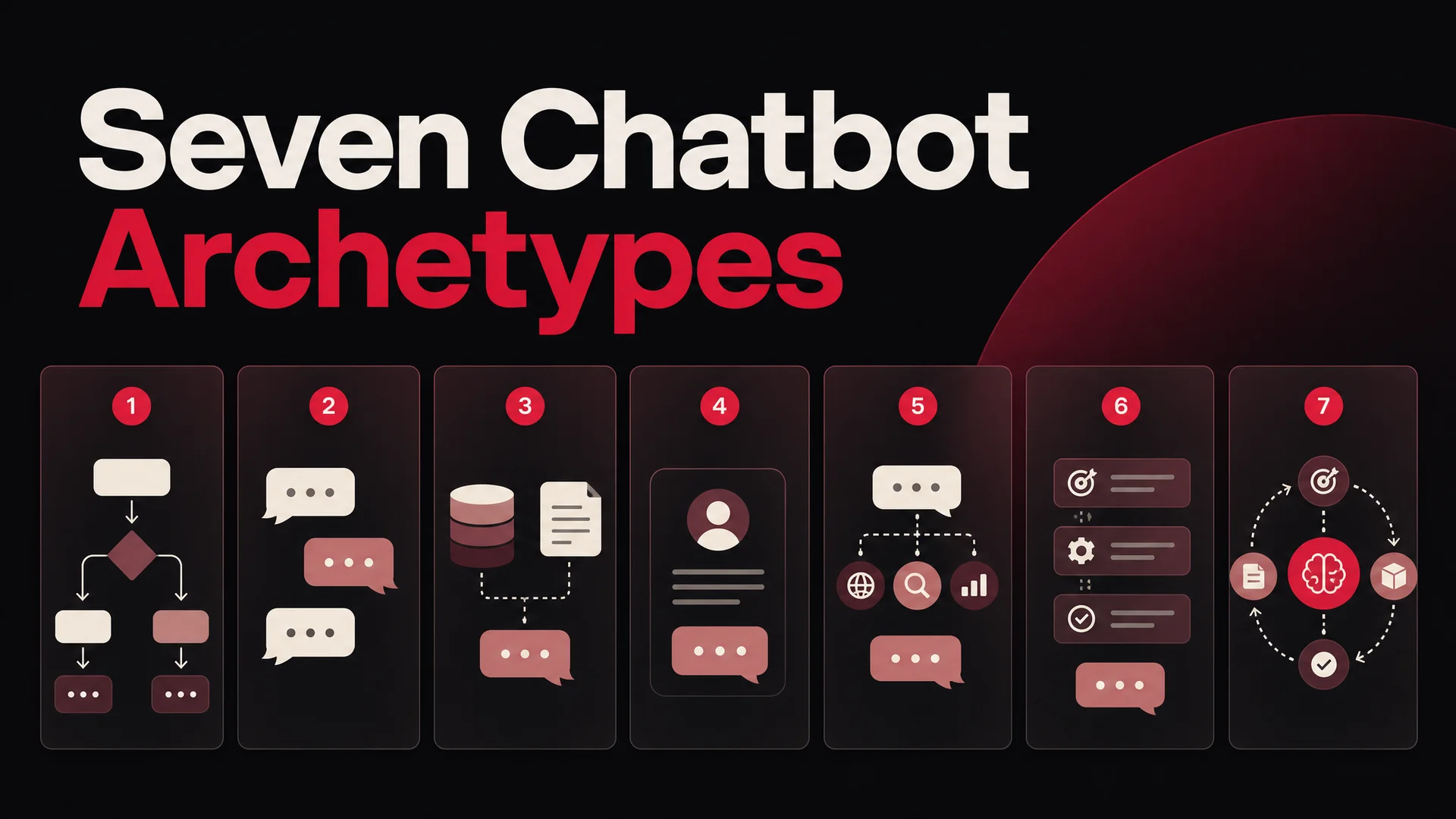
The word is an umbrella, and that is exactly why it confuses people. Underneath it sit several very different technologies, and the experience of talking to one versus another is night and day.
At the most basic end, a rule-based chatbot is a decision tree. Someone - usually a support manager and a contractor - sits down and writes out every question a customer might ask along with the canned response. If the user types something the script anticipated, the bot responds. If they type anything else, the bot either falls back to "I didn't understand that" or routes them to a human. These systems are still useful for tightly scoped tasks, like FAQ deflection on a contact form or a step-by-step guide through a known checklist. They are predictable, cheap, and easy to audit. They are also brittle. The instant a customer phrases a question in a way the author didn't imagine, the experience falls apart.
A step up from there is a chatbot built on traditional intent classification. Instead of matching exact keywords, it tries to bucket each message into a small set of intents - "track my order," "cancel subscription," "talk to human" - and then runs a fixed flow for each one. This is what most "AI chatbots" looked like before 2023. They are better than pure rules but still tightly scripted underneath, and adding a new intent is a multi-week project for a conversation designer.
At the top end of the umbrella sit AI-native chatbots powered by large language models. They are still called chatbots because the word stuck, but mechanically they have very little in common with a decision tree. This is where the term "conversational AI" actually starts to mean something concrete.
What a conversational AI agent is
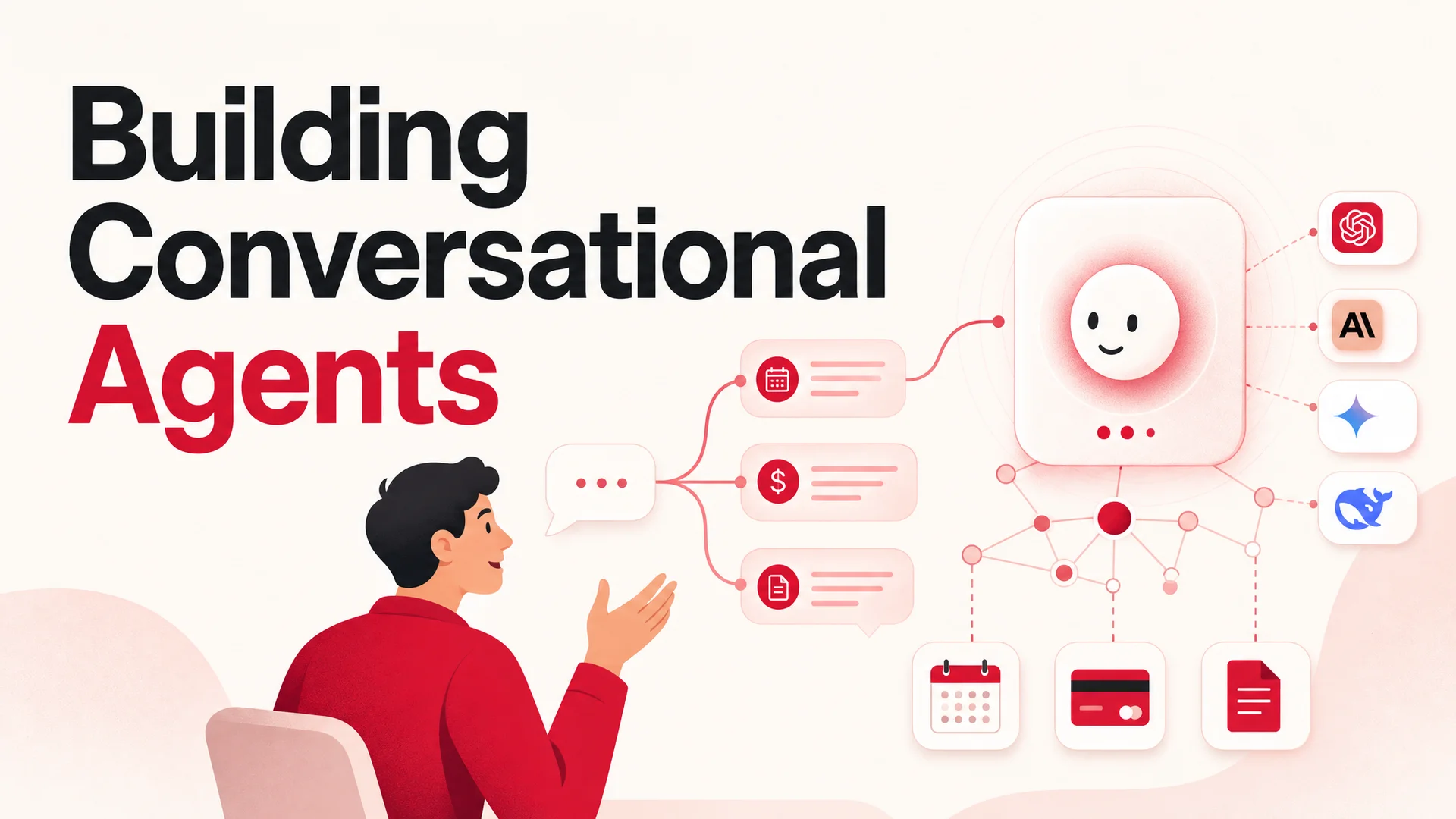
A conversational AI agent is the modern incarnation of a chatbot, built on top of a large language model and surrounded by the tools, memory, and integrations that turn a model into a colleague. It does not match keywords, classify intents, or follow a flowchart. It reads the message in context, reasons about what the user actually wants, and decides what to say or do.
That last part is what separates an agent from a model. A bare LLM can hold a conversation. An agent can take action - look up an order in your database, refund a charge through Stripe, book a demo on a sales rep's calendar, escalate to a human with a clean summary - and it can do all of that in the same exchange the customer started with a typo and a complaint.
The mechanics that make this possible are not magic, but they have improved dramatically in the last twelve months. A modern conversational AI agent is built on three layers. First, the language model itself, which has gotten radically better at multi-turn reasoning. Frontier models like GPT-5.5 and GPT-5.5 Pro now run parallel reasoning chains, Claude Opus 4.7 leads SWE-bench Pro at 64.3 percent on complex coding tasks, and Gemini 3.1 Ultra carries a 2M-token context window across text, image, audio, and video. Second, retrieval and context, which lets the agent ground every answer in your actual knowledge base instead of guessing. With Claude Opus 4.6 and Sonnet 4.6 now shipping a 1M-token context window at no surcharge, and DeepSeek V4 Flash hitting the same 1M context at fourteen cents per million input tokens, "fit the entire help center in the prompt" has gone from a fantasy to a budget line. Third, tool use - the ability to call APIs, fill out forms, and take real actions on the user's behalf. Agentic models released in early 2026, including Kimi K2.6, GLM-5.1, Qwen 3.6, and Xiaomi MiMo-V2-Pro, have made that layer dramatically more reliable.
Stack those three layers and you get something that feels qualitatively different from any chatbot that came before. The agent listens, asks a clarifying question if it needs to, pulls the right document, executes the right action, and writes a response that sounds like a person who actually read the ticket. It learns the shape of your customers' problems over time, not by rewriting decision trees but by improving the prompts, examples, and tools it has access to.
That is why conversational AI agents have moved from novelty to default in three of the largest cost centers a business runs:
Customer support. Instead of deflecting easy tickets, agents now resolve mid-complexity ones end to end - verifying identity, looking up the order, issuing the refund, and writing the email - while handing the rest to a human with a clean summary. The win is not deflection rate; it is full-resolution rate.
Revenue operations. Agents qualify leads, book meetings, push records into the CRM, and follow up on stalled deals. The conversation does not stop at "thanks, we'll be in touch." It moves the pipeline forward.
Internal knowledge. Agents help employees navigate HR policy, IT troubleshooting, and onboarding. A new hire can ask "what's our parental leave policy and how do I file for it?" and get an accurate answer with the right form attached, not a link to a 200-page PDF.
Where the line really sits
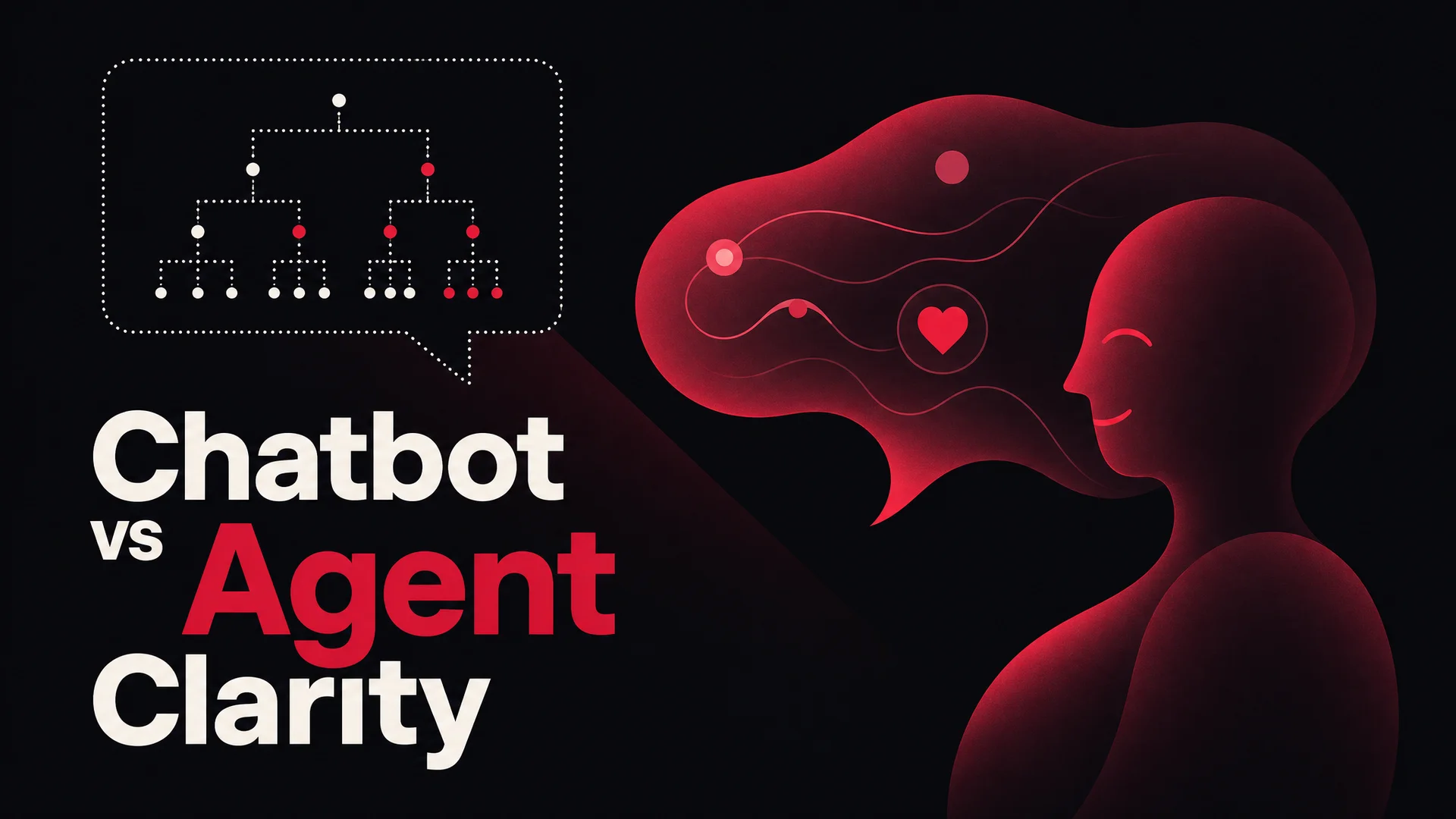
Reduced to a single sentence, the difference is this: a chatbot follows a script, a conversational AI agent follows the conversation.
But the practical gap is bigger than that. A scripted chatbot is transactional - it completes a narrow task if the user provides the right input in the right shape. A conversational AI agent is contextual - it works out what the user means, even when the message is messy, and it can carry context across turns. A chatbot escalates the moment the user says something unexpected. An agent escalates only when it has genuinely exhausted what it can do, and when it does, it hands off with a full summary so the human is not starting from zero.
There is also a maintenance gap that does not get talked about enough. Rule-based chatbots are cheap to build and expensive to maintain - every new product, policy change, or seasonal promotion is a chunk of new content for someone to author and test. Conversational AI agents flip that math. Building one is meaningfully more involved up front, but maintenance is largely about updating the source material the agent reads from. Add a new help article, and the agent can answer questions about it that afternoon.
Real scenarios where the gap shows
Abstract differences are easy to nod along to. Concrete ones are what move a budget. Here is how the two technologies behave in the situations a support or revenue team actually faces.
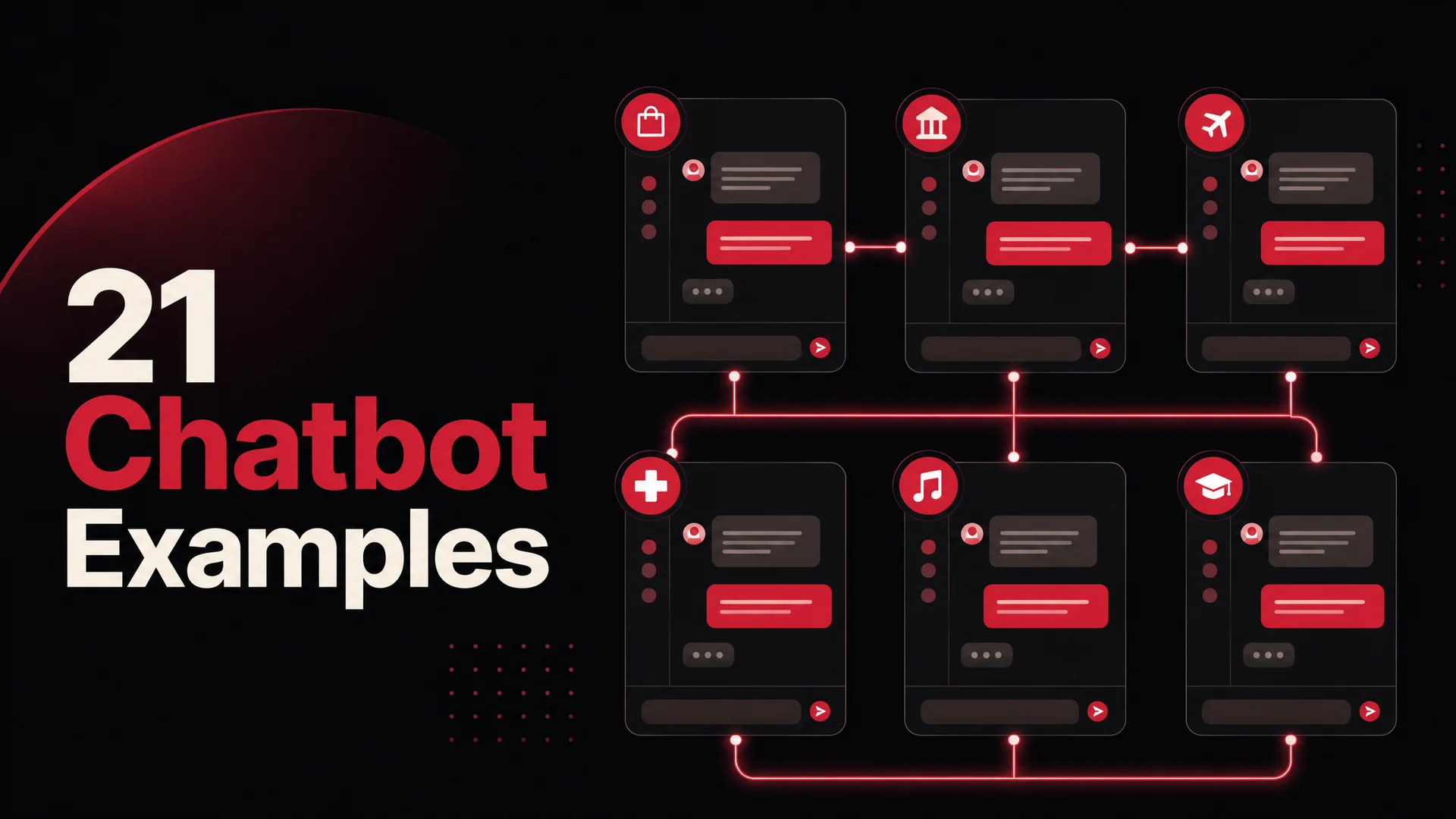
Hardware troubleshooting in consumer electronics. A rule-based chatbot for a laptop brand can tell a customer where to find their serial number and link to the warranty page. That is the ceiling. A conversational AI agent can take "my laptop won't turn on after the firmware update last night" and walk through a diagnostic - battery state, charger LED behavior, recent update logs, model-specific known issues - before deciding whether the customer needs a remote reset, a replacement charger shipped, or a tier-2 hardware engineer. With a 1M-token context window, the agent can hold the entire troubleshooting playbook, the product manual, and the recent release notes in working memory without RAG ever being involved.
E-commerce with thousands of SKUs. A scripted bot can show categories and link to a search box. A conversational AI agent can do styling consultations - "I'm shopping for a dinner with my partner's parents, smart but not stuffy, sub-$300" - read past order history to learn fit and color preferences, propose three options with reasoning, and check inventory in the user's size before offering them. Agentic models like Qwen 3.6 and Kimi K2.6 make those multi-step lookups reliable enough to put in front of paying customers, not just demos.
Healthcare and regulated industries. A simple bot can list clinic hours and provide a phone number. A conversational AI agent can triage symptoms against the clinic's intake protocol, schedule the right type of appointment, send the patient a pre-visit form, and flag urgent cases to on-call staff. Because MIT-licensed open-weight models like GLM-5.1 and Qwen 3.6-27B can run on-prem, regulated industries can now deploy agents inside their own VPC without sending PHI to a third-party API.
B2B SaaS support. A keyword bot can route tickets by category. A conversational AI agent can read a customer's actual error log pasted into chat, cross-reference it against the changelog, identify that they're hitting a known issue from last Tuesday's release, give them the workaround, and file a Jira ticket linked to the customer's account so the engineering team has the context.
In each case, the gap is not "chatbots are bad and agents are good." It is that the two technologies are aimed at different problems, and the moment a problem requires understanding rather than pattern matching, the chatbot stops working.
What changed in 2026 that made this real
For a few years, conversational AI promised more than it delivered. The agents demoed beautifully and broke quietly in production. Three shifts have closed that gap.
The first is context. With Gemini 3.1 Ultra at 2M tokens and Claude Sonnet 4.6, DeepSeek V4, and several others at 1M, an agent can hold an entire help center, a user's full conversation history, and the relevant policy documents in-context without any retrieval pipeline at all. RAG is no longer a hard requirement; it is a tuning lever you reach for when you have more data than fits, or when you want surgical control over what the model sees.
The second is cost. Open-weight frontier models from DeepSeek, Z.ai, Moonshot, MiniMax, Alibaba, and Xiaomi have collapsed the per-resolution cost of an AI agent. DeepSeek V4 Flash runs at $0.14 per million input tokens and $0.28 per million output tokens. MiniMax M2 advertises roughly eight percent of the cost of Claude Sonnet at twice the speed. A typical Berrydesk deployment can route routine traffic to V4 Flash or M2, and reserve the heavyweight models - GPT-5.5, Claude Opus 4.7, Gemini 3.1 Ultra - for the genuinely hard escalations.
The third is tool use. Agentic-first models trained explicitly for long, multi-step plans have become production-ready. Kimi K2.6 can run autonomous coding sessions for twelve hours and coordinate up to 300 sub-agents across 4,000 steps. GLM-5.1 runs an eight-hour plan-execute-test-fix loop and posted 58.4 percent on SWE-Bench Pro, beating GPT-5.4 and Claude Opus 4.6 on that benchmark. For a support agent, this means AI Actions - issue a refund, reschedule a booking, take a payment, look up an order - actually work the way they look in a demo.
Common pitfalls when teams move from chatbots to agents
Anyone who has shipped both knows the gap between a working agent and a working chatbot is not just better technology - it is a different operational model. A few pitfalls show up over and over.
Treating the agent like a chatbot you can fully script. Teams used to rule-based tools sometimes try to constrain a conversational AI agent into a tight flow with dozens of guardrails. The agent ends up worse than either approach. If you trust the model enough to use it, give it the room and the tools it needs to actually solve the problem. If you do not trust it, do not deploy it.
Picking one model and freezing it. The frontier moves every quarter. Locking your agent to a single provider is how you end up paying ten times what your competitor pays for slightly worse output a year later. Look for a platform that lets you swap models per deployment or even per intent, and that supports both closed-source frontier models and open-weight options.
Skipping the eval loop. A scripted chatbot is correct or it is not. An AI agent is on a spectrum. Without an evaluation set - real conversations from your support queue, scored against the right answer - you have no way to tell whether your last prompt change made the agent better or worse. Build the evals before you build the agent.
Underestimating handoff. The handoff to a human is where most agent deployments succeed or fail. The agent should write a summary, attach the documents it referenced, and surface the actions it has already taken. A handoff that drops context is worse than no agent at all.
Where Berrydesk fits
Berrydesk was built from the start as a conversational AI agent platform, not a scripted chatbot tool with AI bolted on later. The four-step flow reflects that. You pick a model - GPT-5.5 and 5.5 Pro, Claude Opus 4.7, Gemini 3.1, DeepSeek V4, Kimi K2.6, GLM-5.1, Qwen 3.6, MiniMax, and others - based on the trade-off you actually want for that deployment. You train it on your real material: documents, websites, Notion workspaces, Google Drive, even YouTube transcripts. You brand the chat widget so it looks like part of your product, not an afterthought. You turn on AI Actions for the things that matter - bookings, payments, order lookups, refunds - and the agent uses them in conversation. Then you deploy to the channels your customers already live in: your website, Slack, Discord, WhatsApp, and more.
Because Berrydesk is model-agnostic, you can route routine traffic to a low-cost open-weight model and reserve the frontier for hard cases, without rewriting your agent. Because it supports both closed-source APIs and open weights, regulated teams can choose deployments that keep data in their control. And because it was built around the long-context, tool-using generation of models - not retrofitted from an older intent-based stack - the agents you build behave like the conversational AI definition above, not the chatbot one.
Choosing what to build
The right answer is not always an AI agent. If your use case is genuinely narrow - a single form, a single FAQ - a rule-based chatbot might still be the cheapest, fastest, and most predictable choice. But the moment you need to handle messy phrasing, multi-turn conversations, or actions that touch real systems, the gap between a chatbot and a conversational AI agent stops being academic. It becomes the difference between automation that frustrates customers and automation that resolves their problem before they have to ask twice.
If you are weighing the move, the easiest way to feel the difference is to build one. You can spin up a Berrydesk agent on your own help content in an afternoon, point it at the model that fits your budget, and see how it handles your actual ticket queue.
Start at berrydesk.com - pick a model, upload your sources, and watch what a real conversational AI agent looks like on your own data.
 Berrydesk
Launch a real conversational AI agent in minutes
- Pick from GPT-5.5, Claude Opus 4.7, Gemini 3.1, DeepSeek V4, Kimi K2.6, GLM-5.1, Qwen 3.6, and more
- Train on docs, sites, Notion, Drive, and YouTube - deploy to web, Slack, WhatsApp, Discord
Set up in minutes

Chirag Asarpota is the founder of Strawberry Labs, the team behind Berrydesk - the AI agent platform that helps businesses deploy intelligent customer support, sales and operations agents across web, WhatsApp, Slack, Instagram, Discord and more. Chirag writes about agentic AI, frontier model selection, retrieval and 1M-token context strategy, AI Actions, and the engineering it takes to ship production-grade conversational AI that customers actually trust.