Customer service in 2026 is unrecognizable next to where it sat even two years ago. If your mental model still revolves around live chat queues and email back-and-forth, the rest of the industry has quietly walked past you. The era of reactive support is over. What replaced it is faster, more contextual, and far more automated - but also, paradoxically, more human in the moments that count.
A few forces converged to make this happen. Frontier AI got dramatically cheaper and dramatically more capable in the same twelve-month window. Customers started expecting Amazon-grade response times from a five-person SaaS company. Support stopped being a cost center and became a measurable lever on retention, expansion, and brand. The 2020 playbook is dead. Even the 2023 one is on its last legs.
Two and a half years after the first ChatGPT moment, the conversation about AI in customer support has changed completely. The question is no longer "can AI handle a real ticket?" - it visibly does, every day, on millions of websites. The question is which jobs to give it, which to keep with humans, and how to assemble the stack so it actually moves your numbers instead of just looking impressive in a demo.
That shift matters because the underlying technology has moved on too. The models powering support agents in 2026 are nothing like the ones we were squinting at two years ago. GPT-5.5 and GPT-5.5 Pro brought parallel reasoning into mainstream use this April. Claude Opus 4.7 sits at the top of SWE-bench Pro for genuinely complex tool-use work. Gemini 3.1 Ultra ships with a 2M-token context window. And on the open-weight side, DeepSeek V4, Moonshot Kimi K2.6, Z.ai's GLM-5.1, MiniMax M2.7, Alibaba's Qwen 3.6 family, and Xiaomi's MiMo-V2 have collapsed the cost of running production agents to fractions of a cent per resolution.
Below are ten trends and use cases shaping how leading support teams operate in 2026 - some genuinely new, some maturing fast, and a few that quietly became non-negotiable while everyone was looking the other way.
1. Coverage that doesn't sleep - and personalization beyond the greeting
The most obvious win is also the most under-appreciated. Human agents have shifts, sick days, holidays, training days, and lunch breaks. None of those are flaws - they're how humans work - but they're catastrophic for the customer who has a question at 11pm on a Sunday and watches a "we'll respond within 24 hours" auto-reply roll in.
A modern AI support agent answers the question in three seconds and closes the loop. No queue, no escalation, no "thanks for your patience." For a SaaS product with international users, this typically reverses what used to be a brutal off-hours backlog: by the time the support team logs on Monday morning, the overnight queue isn't 200 tickets, it's eight - the eight that genuinely needed a human.
Personalization in 2026 has very little to do with merge tags. Dropping a customer's first name into an opener was a 2018 trick. The bar today is whether your support experience reflects who that person actually is - what plan they're on, what they've already tried, what they care about, what they were doing thirty seconds before they reached out.
This is where the new generation of long-context models earns its keep. With Claude Sonnet 4.6 and DeepSeek V4 Flash both shipping a one-million-token window, and Gemini 3.1 Ultra pushing to two million, an agent can hold a customer's full account history, every prior conversation, and the relevant slice of your knowledge base in a single prompt.
A real example: a Series B SaaS gets a ticket from Daniel, a workspace admin who joined seven days ago. A modern support agent sees that he's stuck on the SSO step of onboarding, that his team invited four people but only one logged in, and that two of his last three sessions ended on the same configuration screen. The reply doesn't say "Hi Daniel, what can I help with?" It says "Looks like you're partway through SSO setup - here's the exact provider config for Okta, and I've already pinged your IT contact." The customer hasn't even had to type their question. Conversion and satisfaction both move in the right direction.
2. Real-time answers and instant resolution as the new bar
Speed is the single metric customers feel before any other. Every additional minute a ticket sits unanswered measurably correlates with worse CSAT, more follow-up messages from the same customer, and more abandoned carts. AI agents respond in seconds, and for the eighty-percent slice of tickets that are FAQs, password resets, order lookups, refund status checks, and "where is my shipment" questions, that's the entire interaction.
Underneath, this works because today's frontier models are fast enough that latency stops being a constraint. DeepSeek V4 Flash, for example, runs at $0.14 per million input tokens with response times that feel instant inside a chat widget. MiniMax M2.7 hits roughly twice the speed of Claude Sonnet at a fraction of the price. For routine support traffic, that combination - a cheap, fast open-weight model handling the firehose, with a frontier model in reserve for the hard cases - is now the default architecture, not a future state.
The downstream effect is that human agents stop being a queue and start being a specialist function. Their day shifts from "process 80 tier-one tickets" to "resolve the 15 hard ones the AI flagged." That's better for the customer and substantially better for the human.
3. Omnichannel becomes the floor, not a feature
Customers don't think in channels. They start a conversation in an Instagram DM, finish it on your website, and follow up over WhatsApp the next morning - and they expect every touchpoint to know what was already said.
The teams getting this right have stopped buying point tools per channel. They've consolidated onto unified support layers where a single conversation thread lives in one place, regardless of where the customer is typing. Berrydesk agents, for instance, deploy from the same configuration to a website widget, Slack, Discord, WhatsApp, and more, so the conversation history, tone, and tool access are identical wherever the customer shows up.
The keyword nobody negotiates on anymore is continuity. The customer who explained a billing issue in chat at 9 a.m. should not be re-explaining it on WhatsApp at 4 p.m. - the agent should pick up mid-sentence. With AI agents, omnichannel finally means what it was always supposed to mean, because there's one brain answering instead of five teams trying to coordinate.
4. AI Actions: agents that take real actions, not just answer
The thing that turns Berrydesk from a chat widget into an actual support team is AI Actions. The agent is not just answering - it is doing.
Modern support agents can look up orders, issue refunds, reschedule bookings, update account settings, generate upgrade links, apply loyalty discounts, complete payments, and hand off to checkout - all without bouncing the customer to a sales rep. This is not a popup ad in a chat window. It's the agent noticing that a customer who just bought a beginner camera is asking about low-light photos, and naturally offering the prime lens that solves the problem. Or noticing that a customer on the starter plan keeps hitting the seat limit, and surfacing the team plan with the exact math on what it would cost them.
Agentic models like Claude Opus 4.7, Kimi K2.6 (which can run 12-hour autonomous coding sessions and orchestrate up to 300 sub-agents), GLM-5.1 (running an 8-hour plan-execute-test-fix loop), and Qwen3.6 have made multi-step tool use reliable enough for production, not just demoware. A meaningful share of routine tickets - password resets, plan changes, shipping lookups - never enter a human queue.
5. A cost structure that finally makes sense
Customer support has historically been one of the most labor-intensive functions in any business. Hiring, training, attrition, scheduling, QA - the cost stack is enormous, and most of it scales linearly with ticket volume.
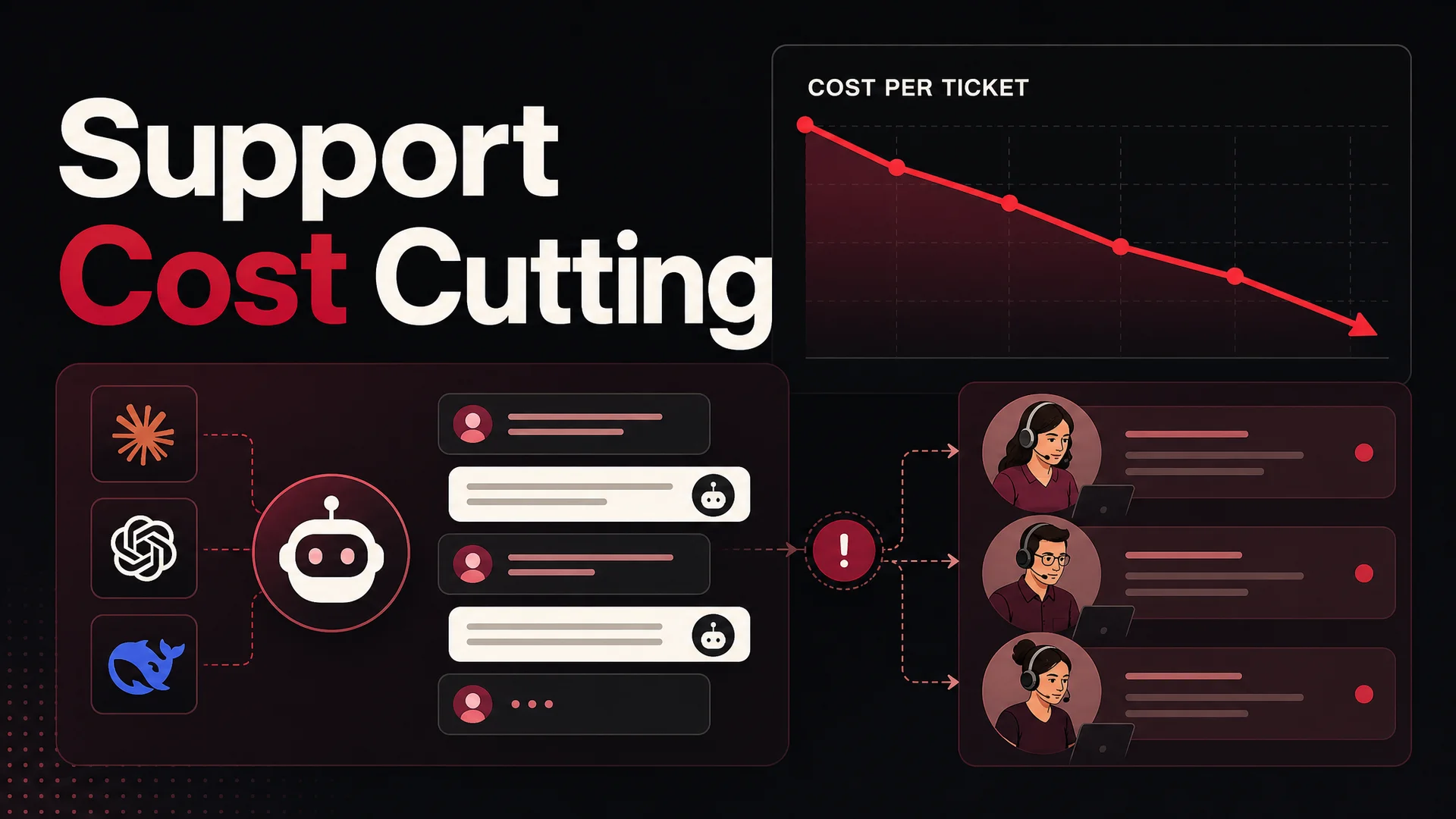
AI changes the slope. A single Berrydesk agent can handle the volume that previously required a roomful of tier-one reps, at a marginal cost dominated by token usage. With open-weight frontier models like DeepSeek V4 Flash at $0.14 / $0.28 per million input/output tokens, or MiniMax M2 at roughly 8% the cost of Claude Sonnet, routine resolutions land at fractions of a cent each. Even when you reserve Claude Opus 4.7, GPT-5.5, or Gemini 3.1 Ultra for the genuinely hard escalations, the blended cost per ticket is dramatically lower than a fully human-staffed equivalent.
The honest version of this story isn't "fire your support team." It's "stop spending tier-one headcount on questions a model can answer in two seconds, and reinvest that budget in the senior, empathetic humans who handle the moments that actually matter."
6. Insights and feedback loops you can actually act on
Collecting feedback was solved a decade ago. The harder question is what you do with it, and the gap between teams that close that loop and teams that don't is the gap between okay and excellent.
Every conversation an AI agent has is structured data. That sounds boring; it's actually transformative. For the first time, support leaders can answer questions like "what are the top five reasons customers contacted us this week, ranked by sentiment and revenue impact?" without commissioning a research project.
Berrydesk surfaces this layer directly: trending topics, deflection rates, sentiment trends, recurring product friction, the exact phrasing customers use to describe a bug before your engineers have even named it. That's a feedback loop that used to take a quarterly survey and now runs continuously.
Support is no longer a department that logs complaints into a spreadsheet that nobody reads. In high-functioning organizations it's a live, always-on signal source plugged directly into product, engineering, and design. When you can fit ten thousand recent transcripts into a single Gemini 3.1 Ultra context window, the question "what are customers actually struggling with this week?" goes from a project to a one-prompt query. There's a second-order benefit too: when an AI agent sees the same question fifty times in a week and the answer isn't in the knowledge base, that's a documentation gap. The agent isn't just answering - it's instrumenting your business.
7. Proactive support that resolves before customers ask
If a customer has to open a ticket for something you could have predicted, you've already lost a small piece of the relationship. That's the calculation behind proactive support, and it's why the best teams now aim to resolve a meaningful share of issues before the customer ever asks.
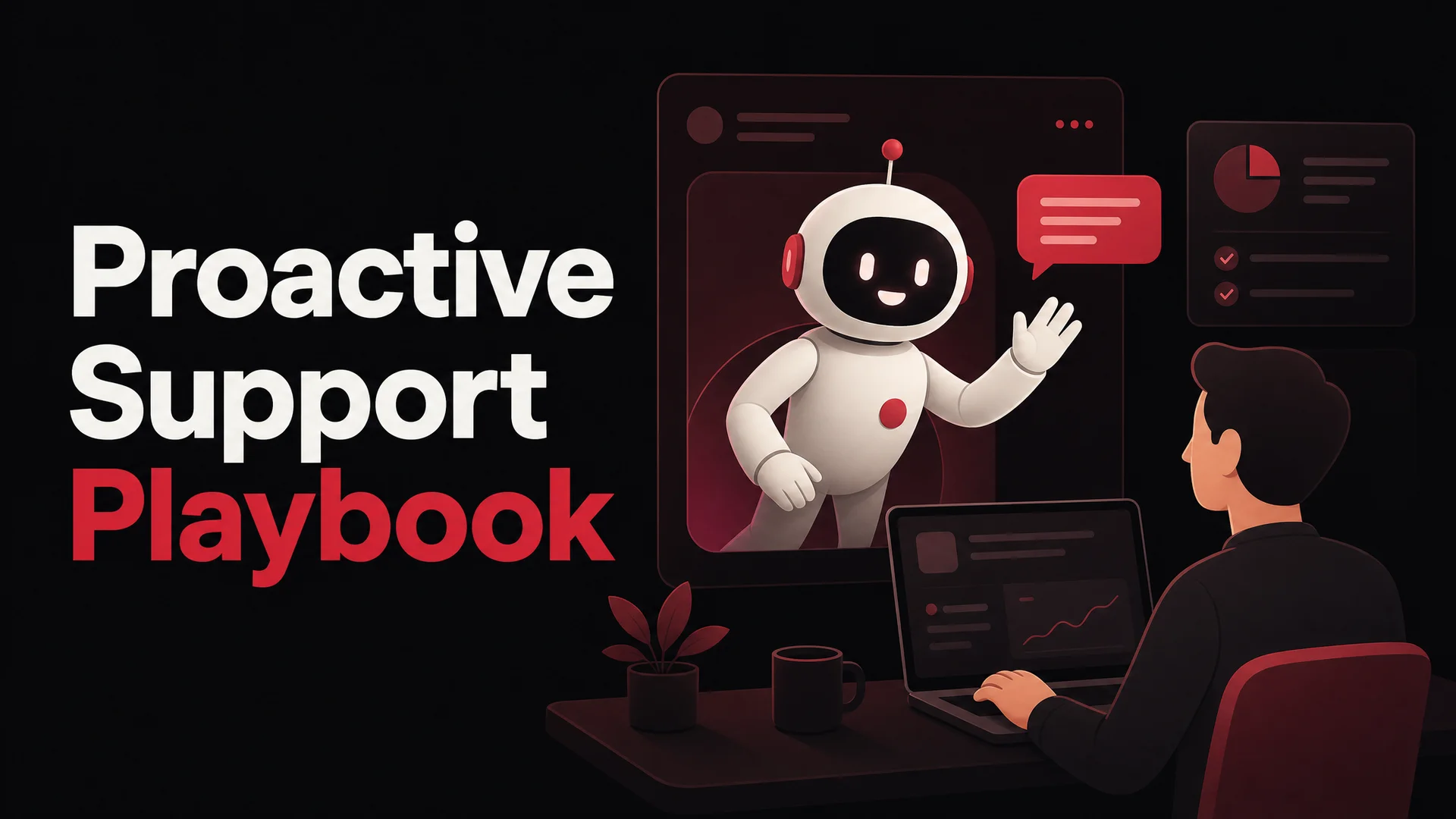
A passive support widget waits for the customer to click. A modern AI agent can read signals - time on page, scroll depth, repeated visits to a pricing tier, hesitation on a checkout step - and open a conversation at the moment the customer is most likely to need help. The classic example: a visitor lands on a pricing page, scrolls back and forth twice, and sits on the comparison table for thirty seconds. A proactive agent saying "Want me to walk you through the difference between Pro and Team for a company your size?" routinely converts at multiples of a static contact form.
The same pattern works inside a product. New users hitting a feature for the first time can get a contextual nudge instead of a generic onboarding tour. Stuck users can get a "looks like you're trying to set up SSO - want me to do it for you?" message that triggers an AI Action and finishes the job.
Tighter integration between support tooling, product analytics, and behavioral data makes this practical. When a checkout fails twice for the same user, the proactive playbook is to surface a help message before they bounce - not wait for the angry email. The compounding wins are simple: ticket volume drops because users got their answer first, and trust climbs because customers feel actively supported instead of merely responded to.
8. Self-service becomes a real channel - and voice/video make a comeback
Customers prefer to solve their own problems - but only when self-service actually works. The bar for that has risen sharply. Best-in-class teams treat self-service as a first-class channel, not an afterthought. That means searchable, visual, personalized help content. Articles that get refreshed on a monthly cadence based on what's currently driving tickets, not on a yearly content plan. Interactive walkthroughs and embedded support widgets that live inside the product, not hidden three clicks deep in a docs subdomain.
Several practices are pulling ahead: continuous content updates where teams monitor top queries weekly and rewrite the underlying article when patterns shift; format conversion where repetitive ticket categories get turned into short videos, GIF walkthroughs, or interactive guides; and semantic search over keyword search via AI-powered help that understands "I can't get my workspace to send invites" the same way it understands the official term for that bug.
Text-based channels still carry the most volume, but voice and video are reclaiming the high-stakes moments. As an issue gets more complex or more emotional, customers reach for the channel that feels the most human - and that's almost never typing. Onboarding for an enterprise account often goes faster on a fifteen-minute video walkthrough than via a forty-message thread. A frustrated customer on a billing dispute de-escalates twice as fast on a voice call. Some teams now embed pre-recorded video answers - generated with AI avatar tooling - to explain a fix visually instead of asking the customer to parse a paragraph of instructions.
Voice support itself has moved beyond the call center. In-app voice, smart-assistant integrations, voice notes inside chat threads - they're all reshaping what real-time support looks like. Voice builds trust where text can feel robotic.
9. Privacy, transparency, and security as first-class design choices
Customers used to assume their data was being handled responsibly. In 2026, they ask. They check. And in regulated industries, procurement teams now expect a credible answer before the trial starts, not after. This makes data transparency a customer service problem, not just a legal one. Vague reassurances about "industry-standard encryption" don't pass the sniff test anymore. People want to know which model is processing their message, where it runs, what gets logged, and how long it's retained.
Support conversations are some of the most sensitive data a business holds. They contain account details, payment problems, personal information, and the unguarded language customers use when something goes wrong. Pretending an AI deployment is a pure productivity question without addressing security is how teams end up in incident reports.
Two things have changed in 2026 that make this much easier to get right. First, modern agents can be configured to redact PII before it ever hits a log, encrypt conversation history at rest, and respect retention policies on a per-tenant basis. Second, MIT- and Apache-licensed Chinese open-weight models - GLM-5.1, Qwen3.6-27B, MiMo-V2 - make on-prem and air-gapped deployments genuinely viable for regulated industries. A bank or a hospital can run a competent support agent on its own infrastructure, with no customer data ever leaving the tenant.
Forward-looking teams train front-line agents to explain - in plain English - exactly what data the support stack collects and why. They run regular audits across every tool that touches customer messages, including model providers. They publish privacy policies a normal person can actually read. And they're upfront when third-party tools enter the loop.
10. Multilingual coverage, emotional intelligence, and continuous training
Hiring a fluent Japanese-speaking support rep for a single account is hard. Hiring twelve of them across the languages your international customers speak is impossible for most teams. AI support agents handle this trivially - every frontier model in 2026 is competent across dozens of languages, and a single agent can hold conversations in whichever language each customer prefers. For SaaS companies expanding internationally, e-commerce brands shipping globally, or marketplaces with users in dozens of countries, that's the difference between "we'll get to that market eventually" and "we already serve it."
People may forget exactly what your support agent said. They never forget how the conversation made them feel. Technical accuracy is necessary and not nearly sufficient. The agents who consistently turn frustrated customers into loyal ones have something harder to teach: they read tone, defuse tension, and adjust their style on the fly. EQ is not a soft add-on anymore - it shows up in interview rubrics, onboarding programs, and QA scorecards.
In practice that looks like: pacing (recognizing when a customer is overwhelmed and slowing the conversation down rather than rapid-firing solutions); reading subtext (catching passive frustration in word choice and offering an escalation path before the customer asks); warmth at speed (delivering correct answers without making them feel transactional); and knowing when to hand off (having clear instincts for when AI should step aside and put a human in the seat).
The pace of change on the front lines is brutal. New models ship every few weeks. Channels expand. Customer expectations move every quarter. Annual training tracks can't keep up. Leading teams are explicitly training agents on how to partner with AI rather than fear it: when to let the agent run, when to take over, how to coach a model that's giving subtly wrong answers. They're investing as much in emotional skill as technical skill. In an environment where automation handles more of the volume, human excellence on the remaining cases is the only real differentiator.
AI as infrastructure, not an add-on
You can't credibly write about customer service in 2026 without talking about AI - but you also can't get away with the 2023 framing. AI in support isn't a chatbot you bolt onto your homepage. It's the layer the entire support operation runs on.
Most teams that struggle here struggle because they treated automation as a feature instead of an architecture. A basic FAQ bot is not an AI strategy. A thoughtful AI strategy looks like deep integration of agentic models into how support is designed, delivered, and scaled.
In practice: agents that take real actions; workflows that resolve fully without human touch (a meaningful share of routine tickets - password resets, plan changes, shipping lookups - never enter a human queue); 24/7 coverage that doesn't degrade at peak (AI doesn't get slower at 3 a.m. or during a Black Friday spike); models that compound (each conversation feeds back into how the agent handles the next one, whether through retrieval, fine-tuning, or self-evolving systems like MiniMax M2.7).
The cost equation is different now
The reason this is finally real, and not just plausible, is what's happening on the model side. The closed frontier - GPT-5.5 Pro, Claude Opus 4.7, Gemini 3.1 Ultra - keeps pushing capability ceilings. But the open-weight frontier is collapsing the floor on cost.
DeepSeek V4 Flash runs at $0.14 per million input tokens and $0.28 per million output tokens. MiniMax M2 lands at roughly 8% the price of Claude Sonnet at twice the speed. GLM-5.1 outscores GPT-5.4 and Claude Opus 4.6 on SWE-Bench Pro and ships under MIT license. Qwen3.6-27B beats 397B-parameter MoE rivals on agentic coding benchmarks while running on hardware most teams already own.
The practical implication for support: route routine traffic to a cheap, fast open model and reserve a frontier closed model for the genuinely hard escalations. A typical Berrydesk deployment can land cost-per-resolution in the fractions-of-a-cent range while still putting Claude Opus 4.7 or GPT-5.5 on the conversations that warrant it.
What to watch out for
None of this is magic, and the teams that get the most out of AI support are the ones who go in clear-eyed about the failure modes.
Over-deployment. Handing the AI tickets it shouldn't handle. A model can answer "where is my refund" all day, but a furious customer threatening to churn needs a human, fast. Build the escalation path before you launch, not after the first bad incident.
Stale knowledge. An AI agent is only as accurate as the docs it was trained on. If your help center hasn't been updated in six months and your product changed, the agent will confidently quote outdated policies. Make documentation hygiene a recurring task.
Over-rotating to one model. Locking your entire support stack to a single provider - closed or open - is fragile. Pricing changes, capacity issues, and capability gaps all become single points of failure. The cost-and-quality story in 2026 strongly favors routing - cheap, fast open-weight models for the bulk of traffic, frontier models for the hard escalations.
Skipping evaluations. Teams that ship an AI agent without a real eval suite end up debugging in production. Build a regression set of representative tickets and run it on every model, prompt, or knowledge-base change.
Treating long context as a substitute for retrieval. A 1M-token window is a powerful tool, but stuffing everything into context is wasteful at scale. The right move is usually retrieval plus generous context, not retrieval-or-context.
The point of automation isn't to remove humans. It's to remove friction. When the predictable cases handle themselves, your human agents are freed up to do the work humans are uniquely good at - edge cases, judgment calls, and the conversations that build long-term loyalty.
Where Berrydesk fits
Berrydesk was built for exactly this moment. You pick the model - GPT-5.5, Claude Opus 4.7, Gemini 3.1, DeepSeek V4, Kimi K2.6, GLM-5.1, Qwen, MiniMax, or others - and route between them based on the task. You train the agent on your docs, websites, Notion, Google Drive, or YouTube content. You brand the chat widget so it feels native to your product. You wire up AI Actions for bookings, payments, refunds, and account changes. Then you deploy to your website, Slack, Discord, WhatsApp, and the rest of the channels your customers actually use.
No code. No six-month engineering sprint. No betting your support stack on a single model provider. The result is a support layer that makes customers happier, your team more leveraged, and the cost-per-resolution curve bend in the right direction as you grow.
If you've been waiting for AI customer support to be ready, it is. The teams shipping it now are the ones whose CSAT is going up, not the ones whose headcount is. Start a free build at berrydesk.com and see what your support stack looks like with an agent in the loop - most teams are answering live customer messages on it the same afternoon.
 Berrydesk
Launch your AI agent in minutes
- Pick from GPT-5.5, Claude Opus 4.7, Gemini 3.1, DeepSeek V4, Kimi K2.6, GLM-5.1, Qwen, MiniMax - or route between them
- Train on docs, Notion, Drive, websites, or YouTube and deploy to web, Slack, Discord, and WhatsApp
Set up in minutes

Chirag Asarpota is the founder of Strawberry Labs, the team behind Berrydesk - the AI agent platform that helps businesses deploy intelligent customer support, sales and operations agents across web, WhatsApp, Slack, Instagram, Discord and more. Chirag writes about agentic AI, frontier model selection, retrieval and 1M-token context strategy, AI Actions, and the engineering it takes to ship production-grade conversational AI that customers actually trust.