There are a few hard truths about running customer support at any kind of scale.
If your queue never drains, something upstream is broken. If the same ten questions keep flooding your inbox, that's not a staffing problem - it's a design problem. And if a customer has to file a ticket to do something they could have done themselves in thirty seconds, you've already lost the moment.
Now flip it. The single best outcome in modern support isn't a fast reply. It's a customer who hits a snag, finds the answer on their own, fixes the thing, and gets on with their day - without ever needing to talk to a human. They feel competent. You didn't spend an agent-minute. Everybody wins.
That's what self-service is supposed to deliver. Not a wall of FAQ links. Not a chatbot that paraphrases your help center. An actual system that lets users diagnose, decide, and resolve - by themselves, on their schedule.
In this guide, we'll unpack what customer self-service really means in 2026, why it has quietly become the most important lever in support economics, and how to build it on top of the modern AI stack - from frontier closed models like Claude Opus 4.7 and GPT-5.5 to the new wave of open-weight agentic engines like DeepSeek V4, Kimi K2.6, GLM-5.1, and Qwen3.6.
What Customer Self-Service Actually Means
Customer self-service is the set of tools, content, and automation that lets your users solve their own problems without having to flag down a human. The phrase covers a lot of surface area - help centers, AI agents, FAQs, automated workflows, status pages, in-product nudges, community forums - but the underlying contract is simple: the customer arrives with a question or a broken thing, and walks away with an answer or a fix, in one continuous motion.
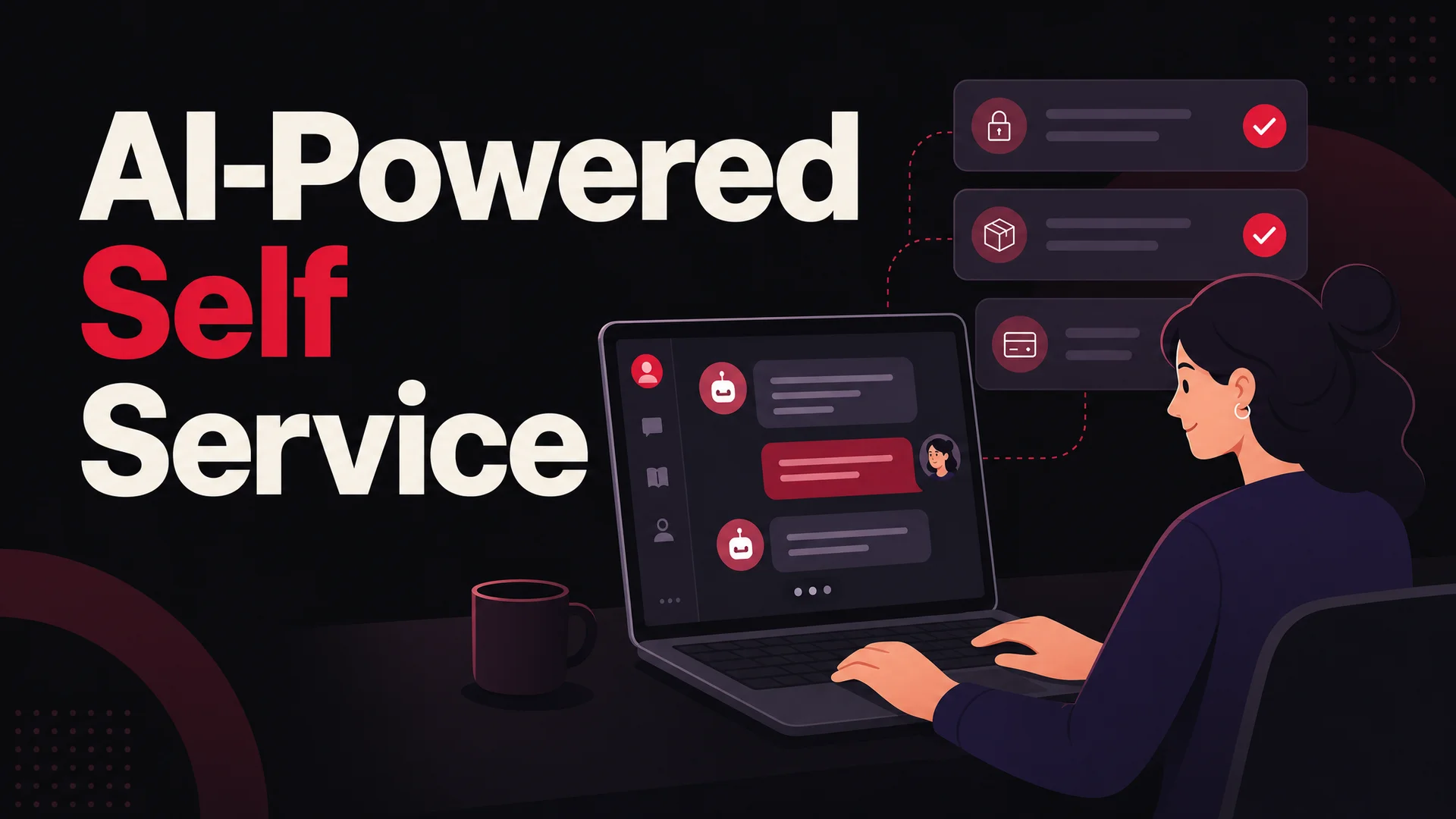
A small example tells the whole story. A SaaS user can't log in. In the old model, they email support, wait twenty minutes, get asked to confirm the email on file, wait another twenty, and finally get a reset link. In a real self-service flow, they click "Can't log in?", confirm their identity through the chat widget, the agent triggers the reset action, and they're back inside the product in under ninety seconds. No queue. No back-and-forth. No ticket created.
It's worth being precise about what self-service is not. It is not a way to hide your support team behind a maze of articles. It is not deflection for its own sake. And it is not a replacement for human escalation when the issue is genuinely complex or emotionally charged. Done right, self-service handles the predictable middle of the distribution so your humans can focus on the long tail - the angry enterprise customer, the edge-case integration bug, the churn risk who needs a real conversation.
Why Self-Service Matters More in 2026 Than It Ever Has
For years, self-service was a "nice to have" that lived in the same project tracker as a help center redesign. The economics have flipped. Three things changed at once: model quality crossed the threshold where AI agents can actually resolve issues end-to-end, context windows stretched to 1M–2M tokens so an agent can hold your full knowledge base in its head, and open-weight models like DeepSeek V4 Flash and MiniMax M2 dropped routine inference costs to fractions of a cent. Self-service stopped being a deflection tactic and became a primary support channel.
Here's why it matters now, in concrete terms.
Your headcount cannot scale linearly with your traffic
Even an excellent support team has hard limits - bandwidth, time zones, focus, attrition. When ticket volume doubles, hiring more agents is the obvious move, but it doesn't scale cleanly. You add management overhead, training time, quality drift, and a payroll line that grows faster than revenue. Self-service acts as a frontline filter: it absorbs the predictable, repeatable issues so your team can spend their cycles on the conversations that actually require judgment. The teams that look unreasonably efficient in 2026 aren't the ones with the biggest headcount - they're the ones whose agents only see tickets the AI couldn't close.
Customers measure you in seconds, not hours
The bar for "fast" has collapsed. A user with a frozen checkout doesn't want a 30-minute response - they want resolution before they tab away to a competitor. Self-service is the only mechanism that delivers true 24/7, sub-second response at scale. Office hours, time zones, and staffing models become irrelevant when the first line of support is a model that's always on. With agentic AI engines like Claude Opus 4.7 and Kimi K2.6 wired into your real systems, "instant" stops being an aspiration and starts being a baseline.
Most of your tickets are the same handful of problems wearing different costumes
Anyone who's spent a quarter on a support floor knows it: 70–80% of incoming tickets are variations on ten or fifteen recurring issues. Password resets. Where's my invoice. How do I cancel. Did my payment go through. Why is the integration failing. The pattern is brutally consistent across industries. The mistake is to keep answering each one manually instead of designing a system around the repetition. Once you accept that the long tail is small, building self-service stops feeling like a project and starts feeling like an obvious investment.
Solving your own problem feels good
This one is underrated. There is a real psychological lift when a customer figures something out without help. They feel capable. They develop a stronger mental model of the product. They start to see your software as something they understand, not a black box that occasionally breaks. That feeling translates into retention and referrals in ways that survey scores rarely capture.
The unit economics are, quietly, the best in support
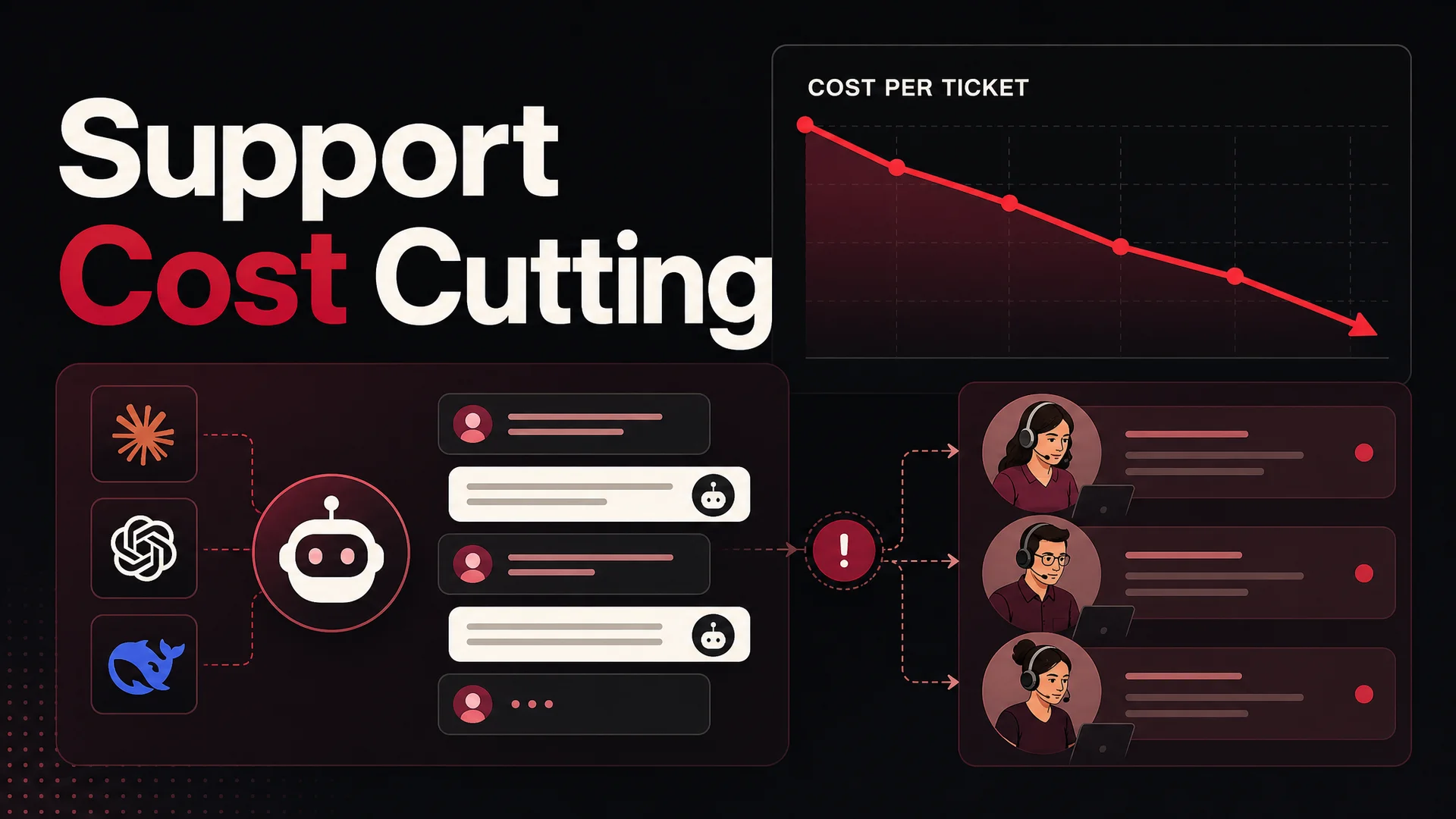
A human-resolved ticket has a real, calculable cost - agent salary, overhead, tooling, training. A self-resolved interaction, once the system is built, costs the price of a model call and a database query. With DeepSeek V4 Flash at $0.14 per million input tokens and $0.28 per million output tokens, you can route routine resolutions for fractions of a cent each. Multiply that by tens of thousands of monthly tickets and the math gets uncomfortable for any team still treating self-service as optional.
Every self-served interaction generates training data
When a customer uses your AI agent or knowledge base, you learn things you can't learn from tickets alone. You see which questions are most common, where users get stuck, which articles dead-end, which paths lead to escalation. That telemetry becomes the input to your next round of content, your next set of AI Actions, and even your next product fix. Self-service isn't just a deflection layer - it's the cleanest signal you'll ever get about what's actually broken or unclear.
How to Build a Self-Service System That Actually Works
The mistake most teams make is treating self-service as a content project. They write twenty help articles, drop in a generic chatbot, and expect ticket volume to crater. It rarely does. The teams that get real leverage treat it as infrastructure - a connected system of channels, with feedback loops, that gets sharper every month.
A working self-service system has four properties:
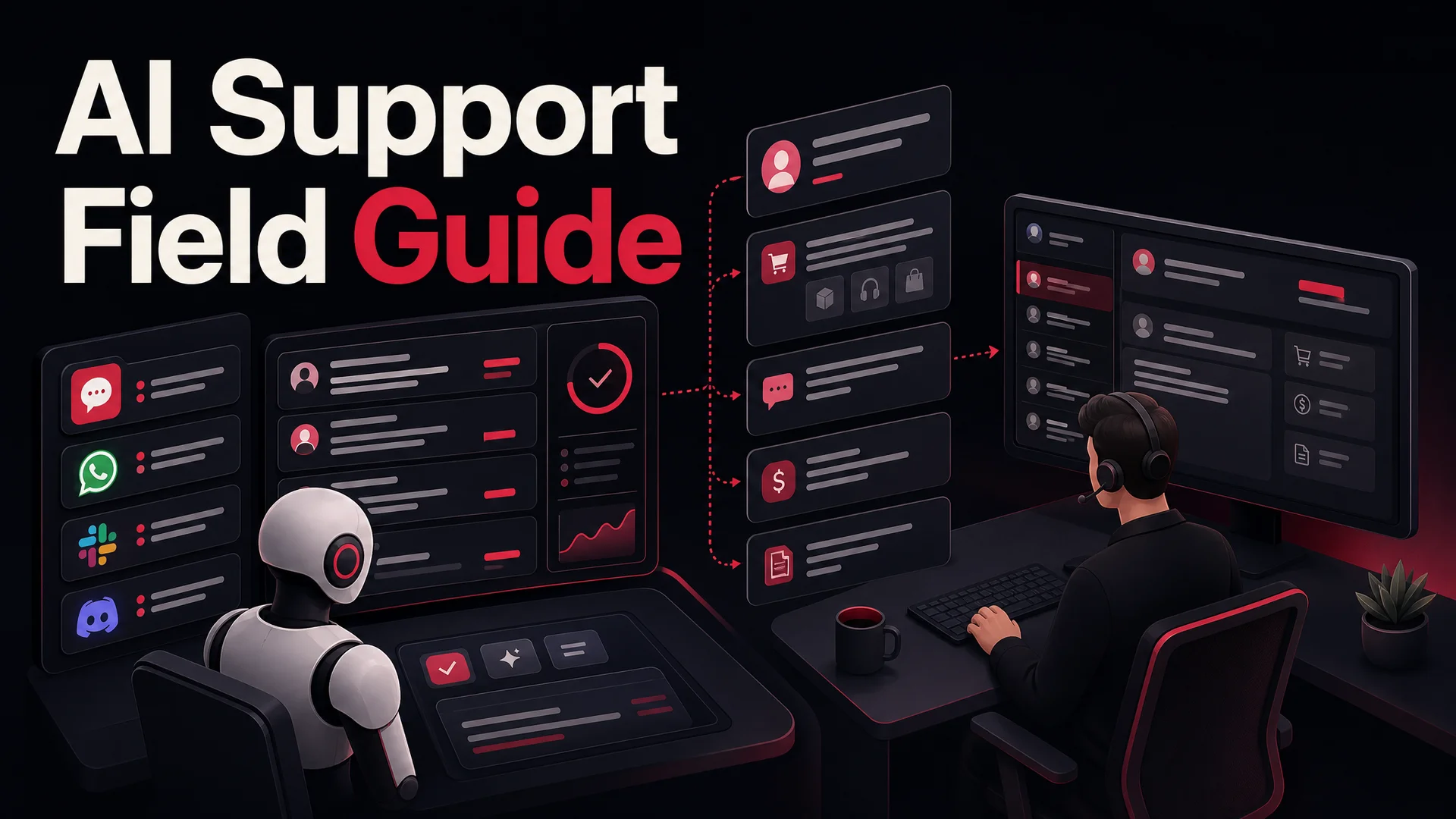
- It's available where customers already are. Inside the product, on the marketing site, in the channels they already use - Slack, Discord, WhatsApp - not on a help subdomain nobody finds.
- It's easy enough that they don't bail halfway. No login walls before help. No twelve-step trees. No forms that ask for an order number a logged-in user shouldn't have to type.
- It's actionable, not just informative. Telling a customer how to cancel is half a solution. Cancelling for them - with their consent - is the whole one.
- It evolves. Your product changes, your customers change, your AI gets smarter. The system has to keep up, which means owning it as a living surface, not a one-time launch.
With that frame, here are the five components that matter most.
1. AI Agents That Actually Take Actions
The single biggest shift in self-service over the last two years is the move from informational chatbots to agentic ones. A bot that quotes paragraphs from your help docs is, at best, a smarter search bar. A real AI agent reads your knowledge, understands the request, and does something - resets the password, refunds the order, books the meeting, files the warranty claim, updates the shipping address.
That distinction is now a hard requirement, not an aspiration, because the model layer has caught up. Claude Opus 4.7 leads SWE-bench Pro at 64.3% and brings reliable tool-use to coding-style reasoning, which translates directly to multi-step support flows. Kimi K2.6, an open-weight model from Moonshot, can run autonomous sessions of up to 12 hours and orchestrate up to 300 sub-agents across 4,000 coordinated steps - overkill for a password reset, but exactly what you want when an agent has to stitch a refund through your billing provider, your order management system, and your CRM. GLM-5.1 from Z.ai runs a similar 8-hour plan-execute-test-fix loop and is MIT-licensed, which matters for regulated industries that need on-prem deployment. Qwen3.6 and Xiaomi's MiMo-V2-Pro round out the open agentic field, with strong tool-use benchmarks and 1M-token context windows.
The practical upshot for support teams: AI Actions - the connective tissue that lets an agent call your APIs on a customer's behalf - finally work reliably enough to put in front of paying users. Berrydesk leans into this. You wire your AI agent to a model from any of these families, define the actions it's allowed to perform (cancel subscription, check order status, issue refund up to $X, escalate to human if Y), and the agent handles the rest in natural language inside the chat widget. The customer never bounces from the help center to email to a billing portal. They stay in one conversation. The problem gets solved.
If you only build one piece of self-service this year, build this one.
2. A Customer Support Portal That's Actually Personalized
The portal is your operations hub for self-service - the logged-in surface where a customer can see their own world. Done well, it becomes the place users instinctively go before they think about contacting you. Done badly, it's a dumping ground of links that people scroll past on their way to the email form.
The shift that matters: a modern portal is personalized, not generic. It's tied to the customer's account and shows them what's actually relevant. That means:
- A live view of past tickets and their status - no more "did anyone see my email?"
- Their current usage, billing state, plan, and upgrade paths.
- Suggested actions based on what's been happening on their account - a recent failed payment surfaces a "fix payment method" CTA, a near-quota account surfaces an upgrade prompt.
- Direct quick-actions for the things they're most likely to need: download invoice, reset API key, change shipping address, cancel.
The dividend is twofold. You eliminate a huge category of duplicate tickets - the "just checking in" emails - and you build the muscle memory that customers can self-serve with you, which raises their willingness to try the AI agent next time they hit a real problem.
3. A Knowledge Base That's Designed, Not Just Written
A knowledge base is the asset that scales most cleanly across every channel - your AI agent reads from it, your portal links into it, your community references it, your search engines index it. Which makes it disproportionately worth getting right.
Most knowledge bases fail in the same predictable ways. Articles are too long and try to cover three topics at once. They're written in product-speak instead of customer-speak. They reference UI elements that no longer exist. They never get audited. The fix is structural, not stylistic.
A good knowledge base in 2026 follows a few rules:
- One clear question per article. "How do I reset my password" is a topic. "How do I configure SSO with Okta, Azure AD, and Google Workspace" is three articles, not one.
- Customer language in the title and first sentence. Match how users actually search, not how your engineers describe the feature.
- Visual whenever possible. A 30-second screencast or a labeled screenshot will out-deflect three paragraphs of prose every time.
- A clear "what to do if this didn't work" path at the bottom. That's where your AI agent or contact form belongs - not in a sidebar nobody scans.
- A monthly audit loop. Pull search terms with no clicks, articles with high bounce, articles that pre-date your last UI change. Fix the top ten. Repeat.
There's also a second-order benefit that matters more in 2026 than it used to: with 1M-token context windows on models like Claude Sonnet 4.6, DeepSeek V4, and Gemini 3.1 Pro, your AI agent can hold a substantial chunk of your knowledge base in-context for every conversation. That changes the architecture. Where teams used to obsess over chunking, embeddings, and retrieval tuning to make RAG work, you can now load entire policy documents and product guides directly into the prompt. RAG becomes a tuning lever for very large corpora rather than a hard requirement. The cleaner your knowledge base, the better the agent's answers - directly, without an embedding pipeline in the middle.
4. A Community Forum, Run With Intent
Forums are where self-service meets the long tail. They're also the channel most teams either neglect entirely or run badly. A dead forum is worse than no forum - it signals that your community doesn't care, and it traps Google traffic on stale answers.
A thriving forum has a few non-negotiable ingredients. First, your team shows up. Not to answer every thread - that defeats the point - but to step in on the questions that need authoritative answers, to mark solutions, and to escalate bugs. Second, your power users get real recognition: badges, early access, perks, public credit. The 1% of users who write 50% of the helpful answers will only keep going if they feel seen. Third, the structure is searchable: clear categories, pinned best-answer threads, version tags, and clean URLs.
The strategic value most teams underestimate is long-tail coverage. Your knowledge base will never document every edge case, every integration permutation, every workaround a power user discovered at 2am. The forum will, organically. And once those threads are indexed, they pull in inbound traffic from people Googling exact-match product questions - people who weren't your customer yet, but might be after they find a community thread that solves their problem.
The trap to avoid: spam, abandoned threads, and zero moderation. A forum without active stewardship sends the opposite signal of the one you want.
5. An FAQ Page That Earns Its Keep
The FAQ page sits between your marketing site and your help center, and it's chronically underbuilt. Most are a token list of seven questions glued onto a product page, written by whoever drew the short straw, never updated.
A useful FAQ does two things. First, it answers pre-purchase and pre-support questions - the things people wonder before they sign up or open a ticket. Pricing edges. Plan limits. Shipping windows. Data residency. Refund policy. These aren't help-center questions; they're "do I trust you enough to buy" questions, and they belong somewhere a prospect will actually find them. Second, it acts as a launchpad. When the answer needs more depth, the FAQ links cleanly to a knowledge base article, opens the AI agent with the question pre-filled, or routes to the right portal flow.
A few field-tested rules: keep the answer short and decisive - "no, but here's the workaround" is better than three paragraphs of qualified yes. Track on-page search behavior to find what people are typing in your FAQ search bar that isn't an FAQ yet. And rotate the order based on click rate, not by asking the founder which questions feel important.
What to Watch Out For
A few patterns reliably wreck self-service rollouts. They're easy to avoid once you've seen them once.
Optimizing for deflection rate over resolution rate. Deflection - "the customer didn't open a ticket" - is a vanity metric. They might have given up. They might have churned. They might be tweeting about you. The metric that matters is resolution: did the issue actually get solved? Track it explicitly, ideally with a post-interaction "did this solve your problem?" prompt and a follow-up email a day later for issues that should have been resolved.
Locking everything behind login. Some of your highest-value self-service moments happen pre-login: a prospect comparing plans, a user who lost access, a customer on a teammate's device. Make sure your AI agent and FAQ work for unauthenticated visitors, with clear paths to escalate when identity is needed.
Single-model lock-in. A year ago, picking one model for your AI agent was reasonable. In 2026 it's a strategic mistake. Routine traffic should run on cheap, fast open-weight models like DeepSeek V4 Flash or MiniMax M2 - at roughly 8% the price of Claude Sonnet at twice the speed, the cost story is hard to argue with. Hard escalations and sensitive flows should fall through to Claude Opus 4.7, GPT-5.5 Pro, or Gemini 3.1 Ultra. Berrydesk supports this kind of routing natively, and it's the single biggest cost lever most teams haven't pulled yet.
Ignoring the "I want a human" path. Even great self-service needs an obvious, low-friction escape hatch. A user who can't get help from the AI but also can't find the contact button will leave with a worse impression than if they'd never tried the AI at all. Make the human path one click away, always.
Treating it as a launch, not a system. Self-service is never done. Your product ships new features, your customers ask new questions, the underlying models get better every quarter. Budget ongoing time - even just a few hours a week - to audit, prune, and extend. The teams that compound the most value are the ones that treat their self-service surface as a living product, owned by someone, with a roadmap.
A Quick Trade-Off: Open-Weight vs Frontier Closed Models
One question almost every support team is wrestling with right now: which model should power the AI agent? The honest answer is "more than one," but it helps to understand the trade-offs.
Frontier closed models - Claude Opus 4.7, GPT-5.5 Pro, Gemini 3.1 Ultra - give you the best raw quality on hard reasoning, the most polished tool-use, and the simplest operational story. You pay more per token, but for high-stakes flows (refunds above a threshold, account access, anything regulated), the reliability is worth it. Claude Opus 4.7's 64.3% on SWE-bench Pro is shorthand for "this model does multi-step tool-use better than almost anything else available," and that translates directly to support quality on complex issues.
Open-weight frontier models - DeepSeek V4, Kimi K2.6, GLM-5.1, Qwen3.6, MiniMax M2.7, Xiaomi MiMo-V2-Pro - have closed most of the quality gap on practical tasks while charging a fraction of the price. GLM-5.1 actually beats GPT-5.4 and Claude Opus 4.6 on SWE-Bench Pro (58.4 vs 57.7 and 57.3). MiniMax M2.7 hits 56.22% on SWE-Pro at roughly 8% of Sonnet's price. For routine support flows - order lookups, FAQ-style answers, tier-1 troubleshooting - these models are absolutely production-ready, and the cost difference is the difference between self-service being a profit center and a cost center.
The right architecture for most teams is a routing one. Cheap and fast on the easy stuff. Expensive and precise on the rare hard stuff. Berrydesk lets you wire this directly: pick the model per agent, per action, or per route, and rebalance as the open-weight frontier keeps shipping.
Get Started With AI-Powered Self-Service
Self-service has come a long way from the FAQ page glued to a footer link. The biggest unlock is that AI agents can finally act, not just explain - and that the cost to run them at scale has collapsed thanks to a wave of open-weight frontier models from DeepSeek, Moonshot, Z.ai, Alibaba, MiniMax, and Xiaomi. The teams that get this right in 2026 won't be the ones with the biggest support headcount. They'll be the ones whose customers stop thinking of "support" as a separate thing - because the product just helps them when they need it.
If you want to put a real self-service experience in front of your users - one that resolves issues instead of describing them - Berrydesk is built for exactly this. Pick from GPT-5.5, Claude Opus 4.7, Gemini 3.1, DeepSeek V4, Kimi K2.6, GLM-5.1, Qwen3.6, MiniMax M2.7, and others. Train your agent on your docs, websites, Notion, Google Drive, or YouTube. Brand the chat widget. Wire AI Actions for refunds, bookings, payments, and lookups. Deploy to your site, Slack, Discord, WhatsApp, and more - in an afternoon, not a quarter.
 Berrydesk
Launch a self-service agent your customers will actually use
- Pick from GPT-5.5, Claude Opus 4.7, Gemini 3.1, DeepSeek V4, Kimi K2.6, and more
- Wire AI Actions for refunds, bookings, and order lookups in minutes
Set up in minutes

Chirag Asarpota is the founder of Strawberry Labs, the team behind Berrydesk - the AI agent platform that helps businesses deploy intelligent customer support, sales and operations agents across web, WhatsApp, Slack, Instagram, Discord and more. Chirag writes about agentic AI, frontier model selection, retrieval and 1M-token context strategy, AI Actions, and the engineering it takes to ship production-grade conversational AI that customers actually trust.