Every support team is being asked the same question this year: where does AI sit in the queue, and how much of the workload should it own? The answers have changed sharply in the last twelve months. Models got dramatically cheaper, context windows grew large enough to swallow whole knowledge bases, and tool-using agents finally crossed the line from demo to production. The result is that a serious customer support chatbot in 2026 is no longer a glorified FAQ - it is an autonomous front line that resolves issues, takes actions, and routes the rest to humans with full context.
This guide walks through what a modern support chatbot actually is, why teams are deploying them, the trade-offs nobody warns you about, and how to stand one up on Berrydesk in an afternoon.
What a customer support chatbot actually is in 2026
A customer support chatbot is an AI agent that holds a conversation with a customer, retrieves the right information from your business, takes actions on their behalf, and either resolves the issue or hands it off to a human with the full transcript and context attached. The vocabulary used to be muddier - "rule-based bot," "scripted flow," "NLU classifier," "RAG chatbot" - but the line has clarified. Today, the bots that work share three properties: they reason over long context, they call tools, and they sit on top of a frontier or near-frontier language model that you can swap out as the field moves.
The current generation runs on a stack that did not exist a year ago. Closed frontier models - GPT-5.5 and GPT-5.5 Pro, Claude Opus 4.7, Gemini 3.1 Ultra and Pro - set the ceiling on reasoning and tool use, with Claude Opus 4.7 leading SWE-bench Pro at 64.3% for complex multi-step work. Open-weight peers from DeepSeek, Moonshot, Z.ai, Alibaba, MiniMax, and Xiaomi have closed most of the quality gap and obliterated the cost gap. DeepSeek V4 Flash sits at $0.14 per million input tokens and $0.28 per million output. MiniMax M2 ships at roughly 8% the price of Claude Sonnet at twice the speed. For a support agent answering thousands of tickets a day, those numbers reshape the unit economics.
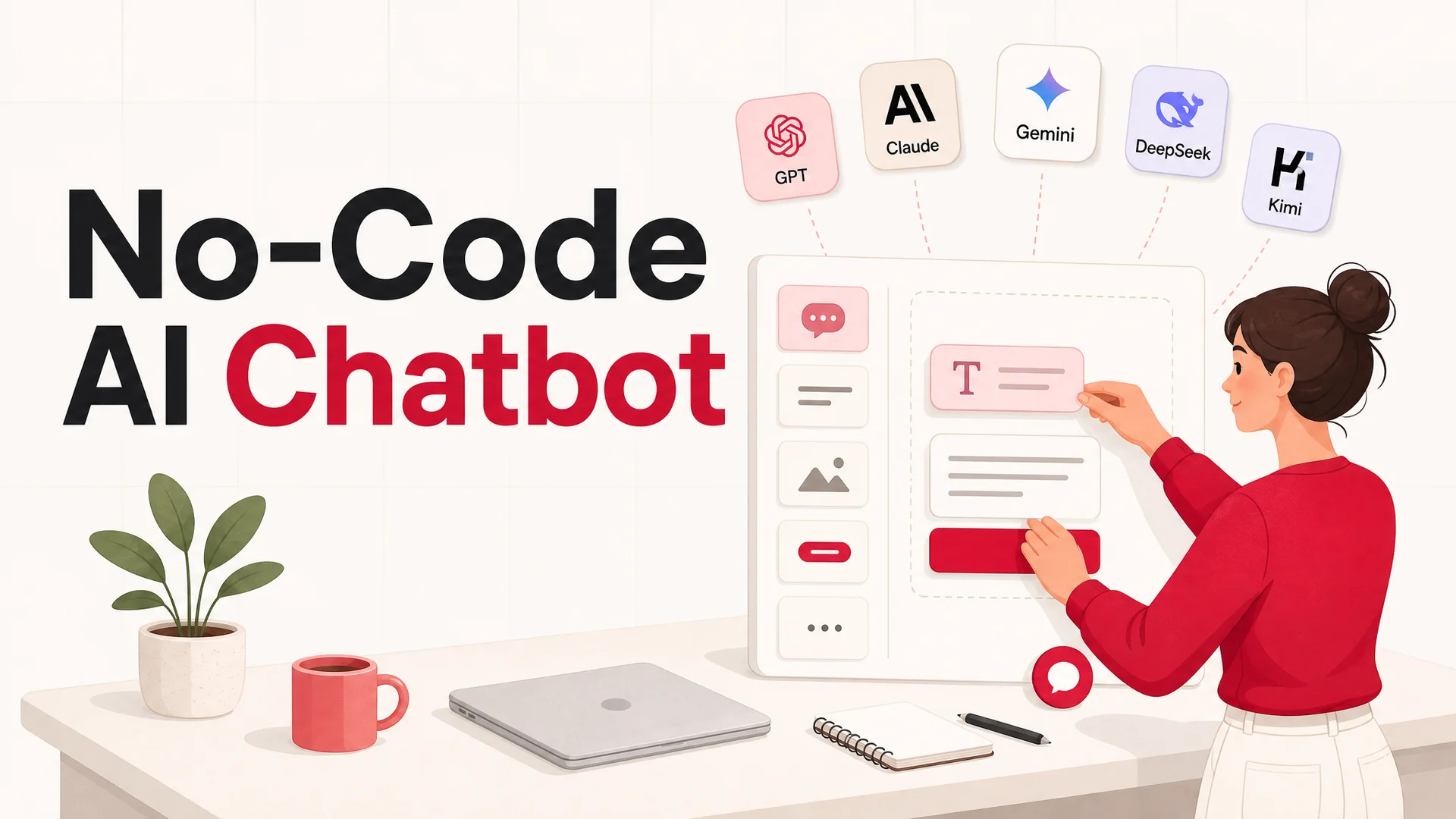
Berrydesk lets you pick any of those models - GPT, Claude, Gemini, DeepSeek, Kimi, GLM, Qwen, MiniMax, and others - train an agent on your knowledge sources, brand the widget, wire up actions like bookings and payments, and ship it to a website, Slack, Discord, WhatsApp, and more. The four steps look small on the page, but the underlying capability is what changed.
Why support teams are leaning in this year
The case for an AI support agent has always rested on availability, speed, and cost. Those are still the headline reasons, but each has sharpened.
24/7 coverage without a 24/7 payroll
Support tickets do not respect time zones. A SaaS company headquartered in Berlin still gets refund requests at 3am Pacific. A direct-to-consumer brand selling globally takes pre-sales questions from Manila on a Sunday morning. Hiring around the clock to answer "where is my order" is expensive and brittle - handoffs lose context, night-shift queues drown during incidents, and seasonal spikes break the staffing model entirely. An AI agent does not care about the clock.
Sub-second response times
The bar for "fast" used to be a few minutes. With a streaming agent on a 1M-token context window, the first useful tokens hit the customer's screen in under a second, and full answers - including a quoted policy and a next-step recommendation - land in three to four seconds. That changes customer behavior. People who would have closed the tab and emailed support stay in the conversation, which means more issues get resolved without a ticket ever being opened.
Elastic scale during spikes
Black Friday, a viral TikTok, an outage, a pricing change - every support team has the chart that looks like a spike. Adding human capacity to absorb that spike is impossible in the moment and wasteful afterward. AI agents handle a thousand simultaneous conversations as easily as ten, so you stop building the team around the worst day of the quarter.
Consistency that audits well
Two human agents reading the same refund policy at 9am and 5pm will give different answers. An AI agent grounded in a single source of truth does not. That is good for customer experience, and it is critical for regulated workflows where the answer to "can I cancel" or "is this covered" has to be the same every time. Pair the agent with citations back to the underlying source and you also get a built-in audit trail.
A real cost line, not a hand-wave
Routine questions - order status, password resets, plan changes, shipping windows, return windows - are 60–80% of inbound volume in most consumer-facing businesses. Routing those to an AI agent backed by a cheap, capable open-weight model like DeepSeek V4 Flash or MiniMax M2 brings cost-per-resolution into the single-digit cents. The expensive frontier models - Claude Opus 4.7, GPT-5.5 Pro, Gemini 3.1 Ultra - are still there for the hard cases, but you only pay for them when you need them.
How customer support changed to get here
To appreciate the current moment, it helps to remember the previous one. A decade ago, customer support was phone trees, business-hours email queues, and shared inboxes. Five years ago, it was live chat staffed by humans, with a thin layer of rule-based deflection on top. Three years ago, RAG-powered chatbots on GPT-3.5 and early Claude models started to actually work for FAQ - narrowly, fragily, and only if you wrote the prompt carefully.
Two things broke that ceiling. The first was context length. A 1M-token window - now standard on Claude Opus 4.6 and Sonnet 4.6 with no surcharge, on Gemini 3.1 Pro, on DeepSeek V4 Flash, and on Xiaomi MiMo-V2-Pro, with Gemini 3.1 Ultra reaching 2M - means an agent can hold an entire help center, a customer's full conversation history, and the relevant policy documents in working memory at the same time. RAG goes from a hard requirement to a tuning lever you reach for when you have hundreds of millions of tokens of source material, not tens of millions.
The second was reliable tool use. Models like Kimi K2.6 (which can run 12-hour autonomous coding sessions and coordinate up to 300 sub-agents over 4,000 steps), GLM-5.1 (running its own 8-hour plan-execute-test-fix loop), Claude Opus 4.7, Qwen3.6, and MiMo-V2-Pro turned tool calling from a flaky pattern into a primitive you can build on. In a support context, that means an agent can actually look up the order, issue the refund, change the shipping address, reschedule the appointment, and update the CRM - not narrate what a human should do, and not hallucinate confirmation codes.
That is the line between "chatbot" and "agent," and 2026 is the year most production deployments crossed it.
What an AI support agent unlocks for the business
Once the agent is running, the surface area of what you can change is wider than the response-time-and-cost framing suggests.
Faster resolution, not just faster reply
The interesting metric is not "time to first response," it is "time to resolution." A bot that says "thanks, a human will get back to you" within a second is fast and useless. A bot that pulls the order, sees the carrier exception, generates a return label, emails it, and updates the ticket has actually solved the problem. With AI Actions wired into your order system, billing platform, calendar, and CRM, the agent does the second thing.
Higher CSAT - and a clearer reason for it
Customer satisfaction goes up not because the bot is charming but because the bot is correct, fast, and capable of finishing the job. The behavior that drives CSAT down is friction: repeating yourself across handoffs, getting a stock answer that does not address the actual question, waiting overnight for a reply on a five-minute issue. AI agents collapse all three.
Headcount focused on harder work
Routine deflection does not eliminate the support team - it changes what the team works on. Senior agents stop answering "where is my order" twenty times a day and start handling the genuinely complex tickets: edge-case escalations, account-level anomalies, partner-handoff issues, anything where a human's judgment is the actual product. Hiring stays flat or shrinks slightly, attrition goes down because the work is less rote, and the team's ceiling on impact goes up.
A continuous stream of voice-of-customer data
Every conversation is structured data: what people are asking, what they are confused by, where the bot loses confidence, where customers escalate, which docs the agent reaches for most. That data flows back to product, marketing, and docs teams in a way that human-only support never produces at scale. You stop guessing which feature is unclear and start seeing it.
Multilingual coverage on day one
Frontier and near-frontier models are natively multilingual to a level that no human team realistically matches. A Berrydesk agent can hold a conversation in Spanish, Japanese, German, Arabic, or Brazilian Portuguese without a separate localization project. For companies with global customers and a domestic team, that is the cheapest international expansion they will ever do.
Personalization that was previously theoretical
With long context and tool access, the agent can read the customer's prior tickets, their plan, their usage pattern, and the history of how similar customers were helped - and tailor the answer accordingly. "Personalized support" used to mean "the agent remembers your name." It now means "the agent knows you upgraded last week, hit a usage cap yesterday, and probably need a credit, not a tutorial."
Where the agent should live
A support agent that only exists on your marketing site is leaving most of its value on the floor. Customers reach for support inside the products and platforms they are already in. Berrydesk deploys to all of the surfaces that matter:
- Website - embedded widget on your help center, product pages, or anywhere a question might come up.
- Mobile apps - same agent, native chat surface, via API.
- WhatsApp - the dominant support channel in much of Latin America, Southeast Asia, and Europe.
- Slack - for B2B products where the customer's primary surface is their team's Slack workspace.
- Discord - essential for gaming, creator-economy, and community-led products.
- Custom integrations - anywhere you can call an API, the agent can show up.
Choosing channels is not a checkbox exercise. It is a question of where your customer is when the question forms in their head - which is rarely the homepage of your site.
What to expect, with honest ranges
Numbers vary by industry, ticket mix, and how mature your knowledge base is, but typical results for teams that ship a serious agent and iterate on it for a quarter or two:
- 30–50% reduction in support cost per resolution, with most of the savings coming from routing routine traffic to cheap open-weight models.
- Time-to-first-response measured in seconds, replacing the minutes-to-hours range of human-only queues.
- 20–30% CSAT improvement, driven mostly by accuracy and resolution speed, not by perceived friendliness.
- 40–60% deflection on routine inbound, which translates directly into reclaimed agent hours.
- 24/7 coverage in every supported language with no overnight or weekend staffing.
These are not ceilings - teams that integrate the agent deeply with their order, billing, and CRM systems push past every one of them. They are the floor for a thoughtful deployment.
What to watch out for
The honest section, which most vendor guides skip.
Misreading complex or emotionally loaded questions
A frustrated customer who has been on hold three times does not want a clever paraphrase of the FAQ. They want to be heard, and they want a human if the AI cannot finish the job. The fix is twofold: route on sentiment, and make escalation a first-class path. Berrydesk agents can detect frustration cues and hand off to a human queue with the full transcript attached, so the customer does not start over. Skipping this step is the single fastest way to turn a useful chatbot into a CSAT problem.
Stale knowledge bases
An agent is only as accurate as the documents it is trained on. If pricing changed in March and the help center page was updated in March but the agent was last retrained in January, you have a hallucination factory pointed at your customers. The fix is to re-ingest sources on a schedule and treat your knowledge base as a versioned system, not a wiki nobody owns.
Over-reliance on a single model
The lock-in story used to be "we built on GPT, so we live and die with GPT." That is an avoidable mistake in 2026. With Berrydesk you can route different traffic to different models - DeepSeek V4 Flash or MiniMax M2 for cheap, high-volume answers, Claude Opus 4.7 or GPT-5.5 Pro for hard escalations, Qwen3.6 or GLM-5.1 for an on-prem deployment in a regulated environment. Bake that flexibility in early, before a price hike, an outage, or a new release forces a panicked migration.
Customers who genuinely want a human
Some customers, in some moments, just want a person. Forcing them through an AI flow they did not ask for is a CSAT tax. Always offer a clear, friction-free escape hatch, and measure how often it gets used - that number, more than any benchmark, tells you whether the agent is actually working.
Privacy, retention, and regulatory exposure
Support conversations contain PII, payment details, health information, and a long list of other regulated categories depending on your industry. Two things matter: where the data goes when it crosses into a model provider, and how long it lives in your transcripts. For regulated industries, an open-weight model under MIT or Apache license - GLM-5.1, Qwen3.6-27B, MiMo - running in your own VPC or on-prem is increasingly the right answer. For most teams, a frontier model with strict retention controls is fine, as long as you have actually read the retention controls.
Closed frontier vs open-weight: how to think about it
This is the trade-off most teams underestimate. Closed frontier models - GPT-5.5, Claude Opus 4.7, Gemini 3.1 - are the easiest to deploy, the most reliable on agentic tool use at the high end, and usually the right choice for the hardest 10–20% of conversations. They are also priced like premium services, with retention and routing rules you do not fully control.
Open-weight frontier models - DeepSeek V4, Kimi K2.6, GLM-5.1, Qwen3.6, MiniMax M2 / M2.7, Xiaomi MiMo-V2-Pro - are reshaping what "default" looks like. GLM-5.1 scores 58.4 on SWE-Bench Pro, edging out GPT-5.4 and Claude Opus 4.6 on that benchmark. MiniMax M2.7 hits 56.22% on SWE-Pro at a fraction of the cost of any closed peer. Qwen3.6-27B is dense and Apache-licensed, a clean fit for local deployment. They give you cost, control, and - with MIT or Apache licenses - the option to run entirely on your own hardware. The trade-off is a heavier ops surface, especially if you are not already running model infrastructure.
A pragmatic 2026 default for support: open-weight model for the bulk of routine traffic, frontier model for hard escalations, with the routing rules in your own hands. Berrydesk supports that pattern out of the box.
How to launch on Berrydesk
The mechanics are simpler than the strategy. Most teams go from sign-up to live agent inside an afternoon.
1. Pick a model
Choose the model that matches the bulk of your traffic. For most consumer-facing support, an open-weight option like DeepSeek V4 Flash, MiniMax M2, or Qwen3.6 is the right cost-quality point. For complex B2B support - software, legal-adjacent, finance, anything where the agent is going to reason across long documents - start with Claude Opus 4.7, GPT-5.5, or Gemini 3.1 Pro. You can switch later, and you can route by traffic type.
2. Train the agent on your sources
Point Berrydesk at your help center URL, drop in PDFs, sync a Notion workspace, link a Google Drive folder, or feed it product walkthroughs from YouTube. The agent ingests, indexes, and grounds answers in those sources. Rebuild whenever the underlying content changes - and set a recurring re-sync so you do not forget.
3. Brand the widget
Logo, colors, fonts, welcome message, suggested first questions, and tone of voice. The agent should feel like an extension of your product, not a generic chat bubble. Berrydesk's chat interface settings let you tune all of that without touching code.
4. Wire up AI Actions
This is where a chatbot becomes an agent. Connect order lookups, refund flows, calendar booking, payment links, CRM writes, ticket creation, escalation handoffs - anything you would otherwise have a human agent do by hand. Define the action, give the model the schema, and the agent will use it when relevant. With agentic models like Kimi K2.6, Claude Opus 4.7, or GLM-5.1 driving the decisions, this is reliable enough to put in front of paying customers, not a demo for a slide.
5. Deploy
Embed on the website, ship to WhatsApp, install in Slack, drop into Discord, or call the API from a mobile app. Same agent, same training, same actions - wherever your customers are.
6. Watch, learn, iterate
The first version of any agent is a starting point. Read the conversation logs (Berrydesk's analytics make this easy), look for the questions where the agent hedged or escalated when it should have answered, find the topics where it confidently said the wrong thing, and feed the fixes back into the source material or the action layer. Treat the agent as a product surface that improves weekly, not a one-time install.
Closing the loop
Customer support chatbots stopped being a "nice to have" the moment open-weight frontier models made them economical at scale and agentic tool use made them capable of actually finishing tickets. The companies that lean in this year are not buying a widget - they are building a 24/7, multilingual, action-taking front line that handles the bulk of inbound and gives their human team back the time to do work that actually requires a human.
Berrydesk gives you all of that in four steps. Pick a model from any frontier or open-weight family. Train it on the sources you already have. Brand it to fit. Wire up the actions that matter. Then ship it to every channel your customers are already in.
If you are ready to try it, start at berrydesk.com - no credit card, agent live in minutes.
 Berrydesk
Launch a branded AI support agent in an afternoon
- Pick GPT-5.5, Claude Opus 4.7, Gemini 3.1, DeepSeek V4, Kimi K2.6 or any model - switch any time.
- Train on docs, websites, Notion, Drive, and YouTube; deploy to web, Slack, Discord, and WhatsApp.
Set up in minutes

Chirag Asarpota is the founder of Strawberry Labs, the team behind Berrydesk - the AI agent platform that helps businesses deploy intelligent customer support, sales and operations agents across web, WhatsApp, Slack, Instagram, Discord and more. Chirag writes about agentic AI, frontier model selection, retrieval and 1M-token context strategy, AI Actions, and the engineering it takes to ship production-grade conversational AI that customers actually trust.