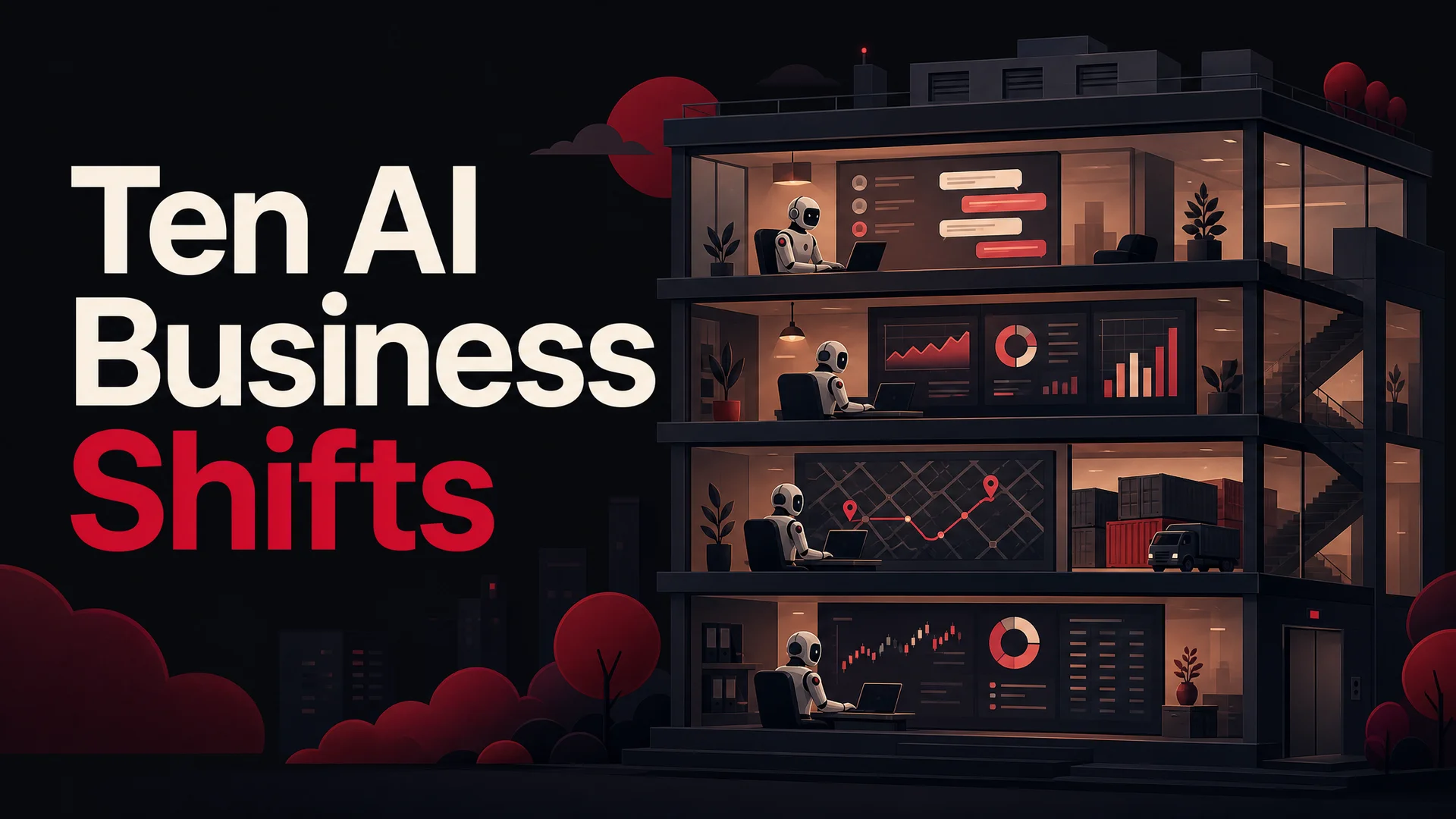
The question every operator is asking in 2026 is no longer "should we use AI?" It is "where exactly do we put it, with which model, and what does it actually change about the way the work gets done?" The answer has shifted hard in the last twelve months. Frontier closed models like GPT-5.5 and Claude Opus 4.7 keep raising the ceiling on what is possible, while a wave of open-weight releases - DeepSeek V4, Z.ai's GLM-5.1, Moonshot's Kimi K2.6, Alibaba's Qwen 3.6, Xiaomi's MiMo-V2-Pro, MiniMax M2.7 - have collapsed the floor on what production AI costs.
That combination is the actual story of AI in business this year. Capability is no longer the constraint. Deployment, design, and discipline are. This guide walks through ten places that shift is showing up in real companies, what's mechanically different now, and what to watch out for as you put each one to work.
1. Customer Experience Becomes Agentic, Not Scripted
Customer experience is the place where AI lands first because the loop is short and the value is obvious. What changed in 2026 is that the chat in the corner of your site is no longer a deflection bot - it is an agent that can actually do the thing the customer came for.
Branded support agents that hold the whole conversation
A modern support agent on Berrydesk runs on a model of your choice - GPT-5.5, Claude Opus 4.7, Gemini 3.1 Ultra, or open-weight options like DeepSeek V4 or Kimi K2.6 - trained on your documentation, your website, your Notion, your Drive, and any YouTube walkthroughs you've published. With 1M-token context windows now standard on Sonnet 4.6 and DeepSeek V4 Flash, and 2M on Gemini 3.1 Ultra, the agent can hold the entire knowledge base, the full prior conversation, and the relevant policy docs in working memory at once. The "RAG vs no RAG" debate is becoming a tuning lever rather than an architectural decision.
Always-on support that doesn't feel scripted
Round-the-clock coverage used to mean a chatbot that could answer ten questions and escalate everything else. With agentic models like Kimi K2.6 (capable of 12-hour autonomous coding sessions and 4,000-step reasoning) and Claude Opus 4.7 leading SWE-bench Pro at 64.3%, the bar has moved. These agents will look up an order, check stock at a fulfillment center, calculate a refund against your policy, and confirm the action with the customer - all in the same conversation, at three in the morning, in any of fifty languages.
Personalization that actually personalizes
AI Actions on Berrydesk let the agent take real steps - book a call, charge a card, change a shipping address, upgrade a plan - using customer history and live account state. Recommendations stop being "people who bought this also bought" and become "based on what you told me two weeks ago, here is the exact plan that fits."
What teams measure after rolling this out: median time-to-resolution dropping from hours to seconds on the long tail of routine questions, CSAT staying flat or rising even as deflection climbs past 70%, and human agents moving up to the work that was always too hard for tier-one anyway.
2. Decisions Get Faster Because the Data Layer Got Smarter
The harder transformation, and the more durable one, is what AI does to decision-making inside the business. The companies that get this right in 2026 aren't running more dashboards - they're routing more questions through models that read the dashboards for them.
Predictive analytics that survives contact with reality
Forecasting tools have existed forever; the difference in 2026 is the size of the context the model can hold. Gemini 3.1 Pro leading GPQA Diamond at 94.3% is not a parlor trick - it translates to a model that can reason across a quarter's worth of sales data, a season's worth of marketing experiments, and an industry report, all in one prompt, and tell you what it sees. Predictions become explainable in a way that finance partners will actually sign off on.
Market trend forecasting from messy signals
Public discourse is messy: reviews, forum posts, support tickets, partner emails, transcripts of sales calls. Frontier models can ingest the entire pile and surface the early signal - a feature that's becoming a deal-breaker, a competitor that's gaining mindshare, a region that's quietly accelerating - weeks before it shows up in the numbers.
Risk assessment as a continuous practice
Risk used to be reviewed quarterly. With cheap inference (DeepSeek V4 Flash at $0.14 per million input tokens, MiniMax M2 at roughly 8% the price of Claude Sonnet at twice the speed), risk reviews can run continuously across procurement, vendor health, customer concentration, and geographic exposure without blowing up the budget.
The pattern that wins: a routed setup where cheap, fast open-weight models triage the firehose of data, and a frontier model is called only when something needs deep reasoning or a defensible written conclusion.
3. Routine Work Gets Automated Without the Brittle Scripts
The first wave of business automation was rules engines and RPA - fragile, expensive to maintain, and broken every time a vendor changed a UI. The 2026 version is agents that read the screen, understand the intent, and adapt.
Process optimization that watches before it suggests
Modern AI doesn't just automate the process you describe; it observes what people actually do, where they stall, and where they re-key data between systems, then proposes the cut. Agentic models like Qwen3.6-27B and MiMo-V2-Pro are tuned specifically for this kind of multi-step tool use.
Error reduction at the edges
The biggest source of error in most operations is the handoff between systems. AI agents that span those handoffs - pulling a record from the CRM, validating it against the ERP, posting an update to the help desk - eliminate the copy-paste tax that quietly costs every operations team a meaningful slice of headcount.
Throughput that scales without headcount
Once a workflow is owned by an agent, scaling it is a matter of compute, not hiring. A team that resolves a thousand tickets a day can resolve ten thousand without a proportional staffing change. The constraint shifts to the upstream data quality and the downstream review process - both better problems to have.
A practical caution: don't automate a process you wouldn't want to do correctly by hand. AI multiplies whatever logic you give it, including the bad parts.
4. Marketing Gets Personal at a Scale That Used to Be Impossible
Personalization has been a buzzword for fifteen years. In 2026 it finally has the model economics to match the ambition.
Segmentation that's actually granular
Static segments ("SMB, North America, signed up in the last 90 days") are giving way to behavioral cohorts that the model rebuilds in real time. With long-context models, every customer's full history can inform the next message without a separate ETL pipeline.
Targeted advertising guided by reasoning
Bid optimizers have been ML-driven for years. What's new is creative - generating dozens of variants, reasoning about which framing fits which audience, and learning from response data inside the same loop. Frontier models handle the reasoning; cheaper open-weight models handle the volume of generation.
Content personalization that doesn't feel mass-produced
The same long-context window that helps support agents helps marketing. An email or landing page can be tailored based on what the customer last asked your support team, what they last viewed in product, and what stage of evaluation they're in - without an army of content operators stitching it together.
The trap to avoid: hyper-personalization without consent and clear value feels invasive fast. The teams getting this right in 2026 lead with utility, not flash.
5. Supply Chains Get Read End-to-End
Supply chain is one of the most underrated AI use cases because it rewards exactly what 2026 models do best - reasoning across heterogeneous data over long horizons.
Inventory levels tuned continuously
Reorder points used to be set quarterly, by hand, by an experienced planner. Now they're computed continuously by models that read sales velocity, supplier lead-time variance, weather, and macro signals together. The carrying cost reduction shows up in months, not years.
Demand forecasting that uses the unstructured data too
Most demand forecasts ignored social signal because it was too noisy. Long-context models with multimodal inputs (Gemini 3.1 Ultra natively handles text, image, audio, and video) can absorb that noise and pull the signal out. Categories that are impossible to forecast with classical methods - anything trend-driven, anything tied to cultural moments - start to become tractable.
Route and fulfillment optimization in real time
Delivery routing is a problem that has always benefited from more compute. With cheaper inference, route optimization can run not just at dispatch but continuously, re-routing as traffic, weather, and customer requests evolve.
For regulated logistics environments where data can't leave the building, MIT-licensed open-weight options like GLM-5.1 (754B-parameter MoE, trained entirely on Huawei Ascend chips, no Nvidia dependency) and Qwen3.6-27B make on-prem and air-gapped deployments practical for the first time.
6. Cybersecurity Gets an AI Partner - and a New Threat Surface
AI is on both sides of the security fight in 2026. The defenders that win are using it deliberately, not as a buzzword.
Fraud detection that learns continuously
Behavioral fraud signals - typing cadence, navigation patterns, transaction sequences - feed models that update faster than rule-based systems ever could. The result is faster catches with fewer false positives, which is the metric that actually matters for a business with paying customers.
Real-time threat analysis across the whole stack
Network telemetry, endpoint signals, identity events, and SaaS audit logs are too much data for human analysts to read. Frontier reasoning models can correlate across these in real time, flag the chain that looks like a kill chain, and write up the rationale for the on-call analyst before the page even goes out.
Automated response without automated mistakes
The line that matters: AI can recommend a response automatically, but the destructive actions (isolating hosts, killing sessions, locking accounts) should still pass through a human-in-the-loop for anything above a confidence threshold. The teams that skip this step generate their own outages.
The harder reality is that the same models attackers use to write phishing copy and probe systems are available to everyone. The defensive playbook in 2026 is: assume your adversary has Claude Opus 4.7 too, and design accordingly.
7. Product Development Compresses From Quarters to Weeks
The biggest change in how products get built in 2026 is the speed of the feedback loop between user signal and shipped code.
Customer insight at full firehose volume
Product teams used to sample customer feedback because reading all of it was impossible. With cheap long-context inference, every ticket, every call transcript, every NPS comment, and every public review can be ingested continuously and clustered into themes the PM team reads each Monday.
Predictive modeling for features before you build them
Instead of A/B-testing every micro-decision, teams are running model-based simulations against historical behavior to pre-screen ideas. Not a replacement for the experiment, but a way to skip the experiments that obviously wouldn't have moved the needle.
R&D that uses agents as research partners
Coding agents like Kimi K2.6 (12-hour autonomous coding runs, swarms of up to 300 sub-agents) and Claude Opus 4.7 (64.3% on SWE-bench Pro) are doing real engineering work - refactors, test generation, dependency upgrades, even greenfield prototypes - under human supervision. The cycle time from concept to working prototype is the lowest it has ever been.
A warning that experienced teams pass on: AI accelerates building the wrong thing just as fast as building the right thing. The discipline that matters is upstream - being clear about the customer problem before you let the agents loose on the implementation.
8. Financial Operations Get Quieter and More Accurate
Finance is a domain where small accuracy gains compound into big trust gains, and AI is delivering both.
Automated bookkeeping that ages well
Categorizing transactions, matching invoices, reconciling accounts - the tasks that used to consume the bulk of a junior accountant's week - are reliably automatable with current models. The team's energy moves up the stack to analysis and partnership.
Predictive financial modeling beyond spreadsheets
Long-context models can reason across the full chart of accounts, three years of actuals, current pipeline, and the macro environment all at once. The forecasts that come out are not just more accurate; they're more explainable, which matters when the board asks why.
Risk management that catches the early warnings
Customer concentration, vendor health, FX exposure, covenant proximity - the boring risks that quietly become big risks - are exactly what agentic models surface when given the data and a clear question to answer.
For small and mid-market businesses, the cost economics matter most here. Routing the bulk of routine financial reasoning through DeepSeek V4 Flash or MiniMax M2 (open-weight, eight cents on the dollar versus closed frontier) and reserving Claude Opus 4.7 for the quarterly close conversation puts capability that used to require a finance team of ten within reach of a team of two.
9. HR Becomes More Human, Not Less
Counterintuitively, AI in HR is making the function more humane in the places it lands well.
Recruitment that screens with less bias
Resume screening was always pattern matching; the question is whether it's pattern matching for skills or for proxies of class, school, and accent. Modern models, prompted carefully and audited regularly, can be tuned to focus on demonstrable skill signals. The discipline matters: an unaudited model will replicate any bias in the training data.
Performance analysis that triangulates signals
Instead of relying on a single manager's perspective, AI can synthesize multiple data points - code commits, customer feedback, peer recognition, project outcomes - into a more complete picture of contribution. The output isn't a number; it's a narrative that the manager and employee discuss together.
Personalized learning paths
Career development plans built by agents that know each person's role, skills, gaps, and stated goals are far more useful than the generic curriculum every company used to deploy. Frontier models can recommend specific resources, draft project briefs, and check in on progress.
The piece that actually matters: HR is the function where the human judgment call is the product. AI should accelerate the prep and the documentation around those calls, not replace them.
10. Competitive Intelligence Stops Being a Quarterly Slide Deck
The last shift is meta: AI is changing how companies understand their market and their competition.
Market analysis as a live feed
Press releases, job postings, product changelogs, pricing pages, social mentions, podcast interviews, conference talks - the full digital exhaust of the industry - can be monitored continuously and summarized on demand. The strategy team gets a feed instead of a rear-view-mirror report.
Competitor monitoring without an army
Tracking five competitors used to require a team. Tracking fifty is now feasible for one analyst with the right agent setup. The interesting question becomes which signals to actually act on.
Strategic planning support that argues both sides
The most useful thing AI does for strategy is argue against your draft. Asking Claude Opus 4.7 or GPT-5.5 Pro (with parallel reasoning) to steelman the opposite of your stated plan, given the same evidence, is the cheapest second opinion available. The output is rarely "you're wrong" - it's usually "here are the three assumptions you didn't realize you were making."
What to Watch Out For
A few patterns separate the deployments that work from the ones that quietly stall.
Don't ship one giant agent when you need many small ones. The teams getting the most value have routed setups: cheap models for triage and bulk work, frontier models for the hard reasoning, all coordinated through clear handoffs. Berrydesk is built for this - pick the model per use case, not per company.
Open-weight is not just a cost play, it's a control play. GLM-5.1 under MIT, Qwen3.6-27B under Apache 2.0, MiMo-V2-Pro under MIT - these are real options for regulated industries that need on-prem or air-gapped deployment. The quality gap to closed frontier has narrowed faster than most planning cycles assumed.
Long context doesn't replace good retrieval. A 2M-token window is a feature, not a strategy. The teams that win still curate what goes into the prompt; they just have more headroom when curation is hard.
Measure the right thing. Deflection rate alone is a vanity metric. Measure resolution quality, downstream contact rate, and CSAT together. An agent that "resolves" a ticket the customer reopens an hour later is worse than no agent at all.
Plan for the model to change. GPT-5.5 will be GPT-6. Claude Opus 4.7 will be 5.0. The team that wires its workflows to a specific model upgrade-by-upgrade will spend more time on plumbing than on outcomes. Build on a layer - like Berrydesk - that lets you swap models without rewriting the agent.
The Bottom Line
The companies that will look most different in 2027 aren't the ones using the most AI. They're the ones using the right AI in the right places, with discipline about cost, governance, and measurement. Customer experience is the place to start because the loop is short and the wins are visible. From there, every function on this list is a candidate.
Berrydesk gives you the support entry point and the model flexibility to grow into the rest. Pick a model - closed frontier or open-weight - train it on what you have, brand it, give it AI Actions for the things it should be allowed to do, and ship it to your site, Slack, Discord, WhatsApp, or wherever your customers already are.
If you're ready to put a real AI agent to work, start at berrydesk.com.
 Berrydesk
Launch your AI agent in minutes
- Pick from GPT-5.5, Claude Opus 4.7, Gemini 3.1, DeepSeek V4, Kimi K2.6 and more
- Train on docs, websites, Notion, Drive, and YouTube - deploy anywhere
Set up in minutes

Chirag Asarpota is the founder of Strawberry Labs, the team behind Berrydesk - the AI agent platform that helps businesses deploy intelligent customer support, sales and operations agents across web, WhatsApp, Slack, Instagram, Discord and more. Chirag writes about agentic AI, frontier model selection, retrieval and 1M-token context strategy, AI Actions, and the engineering it takes to ship production-grade conversational AI that customers actually trust.