You can build the best product on the market and still go out of business. The thing that quietly kills companies isn't the product - it's the gap between an interested visitor and a paying customer. Every minute someone waits for a reply, every form they abandon, every objection no one is around to answer at 11 p.m. on a Sunday - that is revenue evaporating in real time.
Most sales teams know this. The honest question is what to do about it when your reps are already fully booked, your lead volume is uneven, and the sales motion is competing with onboarding, demos, renewals, and a dozen Slack threads. Hiring is slow. Sequences feel robotic. Live chat is only live during business hours. Something has to absorb the load.
A few years ago, "AI for sales" was a deck slide. In 2026, it is the line item that decides whether a pipeline hits or misses. Frontier models are now smart enough to qualify a lead, recommend a SKU, draft the follow-up, and close a checkout - and cheap enough to do it on every visitor, not just the top of the funnel. With models like Claude Opus 4.7, GPT-5.5, Gemini 3.1 Ultra, and open-weight contenders like DeepSeek V4, Moonshot Kimi K2.6, and Z.ai's GLM-5.1, an AI agent can hold an entire product catalog and a year of conversation history in context, take real actions like booking demos and processing payments, and route hard cases to a human without dropping the thread.
The trick is to use AI to amplify the human moments that actually win deals, not to replace them. The teams getting outsized results in 2026 are the ones treating AI as a tireless co-pilot - answering questions at 2 a.m., scoring leads while reps sleep, and surfacing the three accounts most likely to convert this week. This post is a working playbook for that - the moves you can make, the model decisions behind them, and the failure modes to avoid.
Why your support surface is now your best sales channel
There used to be a clean wall between "support" and "sales." Marketing brought traffic, sales closed deals, support cleaned up afterwards. That wall is gone. The same chat widget that answers a returns question at 2 p.m. is the one a prospect will use to ask whether your enterprise plan supports SSO at 2 a.m. - and whether someone (or something) replies in ten seconds versus ten hours decides whether you get the meeting.
What changed is the underlying capability. The current generation of frontier models has crossed three thresholds at once. Context windows of 1M to 2M tokens (Claude Opus 4.6 and Sonnet 4.6 ship with 1M at no surcharge; Gemini 3.1 Ultra goes to 2M) mean an agent can hold your full pricing page, every doc, the prospect's prior conversations, and your objection-handling guide all in one prompt. Tool-use reliability has gone from "demo-grade" to "production-grade," with agentic models like Kimi K2.6 sustaining 12-hour autonomous sessions and GLM-5.1 running 8-hour plan-execute-test loops. And open-weight pricing has collapsed: DeepSeek V4 Flash runs at $0.14 / $0.28 per million input/output tokens, which makes a routine sales conversation cost fractions of a cent. Open-weight releases have made always-on AI economically obvious for sales teams of any size.
Put together, that is a sales rep that doesn't sleep, doesn't forget context, doesn't get expensive at scale, and can actually do things - book the demo, send the quote, log the activity to your CRM - instead of just talking about doing them.
Nine tactics that actually move revenue
Below are nine concrete plays. Each one works on its own, but they compound when you stack them. You don't need to build all nine on day one. Pick the two or three that map to where your funnel leaks most, ship them, then add the rest.
1. Agentic chat that sells, not just supports
The chat widget on a product page used to be a deflection tool. In 2026 it is one of the highest-converting surfaces on the site. Modern AI agents - built on tool-use-native models like Claude Opus 4.7, Kimi K2.6, and GLM-5.1 - can read a visitor's session, pull live inventory, apply a coupon, schedule a demo, and take payment, all in one thread. K2.6 alone can coordinate up to 300 sub-agents across thousands of steps, which means a single conversation can quietly orchestrate inventory, pricing, and CRM lookups behind the scenes.
For a sales-focused deployment, the agent should:
- Reply in under a second, even at peak. Slow replies leak revenue. With DeepSeek V4 Flash or MiniMax M2 routing routine traffic, you can keep latency tight without paying frontier prices on every message.
- Recommend products contextually, using browsing history, cart contents, and any past orders.
- Recover abandoned carts with a follow-up that is conversational, not a generic email blast. The agent can ping the user back via the same widget, or jump to WhatsApp or Slack.
- Qualify leads with a few targeted questions and route the high-fit ones straight into your sales pipeline.
2. Lead capture that doesn't feel like a form
The first job of an AI sales agent is to turn anonymous traffic into known contacts without making the visitor fill out anything that looks like a 1998 contact form. A well-trained agent opens with a question that is actually useful to the visitor - "Looking for pricing, a demo, or just exploring?" - and threads identity capture into the natural shape of the conversation. Email is asked for in the moment it makes sense (sending a quote, booking a slot, emailing a comparison), not as a gate.
The reason this works in 2026 and didn't in 2022 is grounding. With a long-context model holding your entire site and product copy, the agent can answer the prospect's actual question well enough that they're willing to identify themselves to continue. The agent isn't a tollbooth; it's a useful conversation that happens to leave a trail.
3. Qualification that respects the buyer's time
A good agent qualifies leads by being curious, not by reading from a checklist. Behind the scenes you can still encode the BANT-style filters your team uses - budget, authority, need, timeline - but the agent surfaces them as relevant questions inside a normal conversation. A prospect who mentions they're "evaluating tools for a 200-person team" has already told you most of what your old form was going to ask.
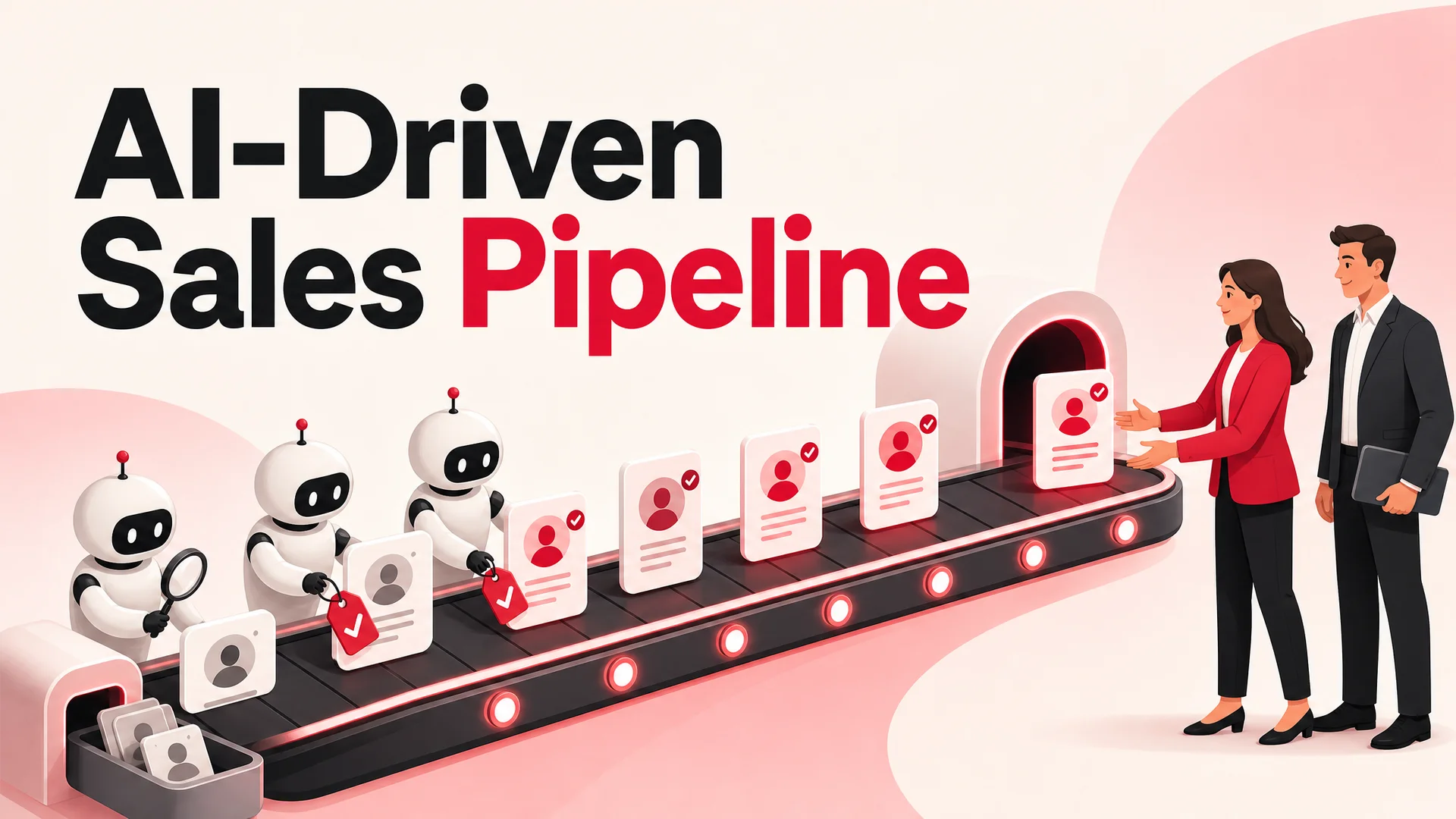
The payoff is two-sided. Your reps stop spending the morning sorting MQLs from tire-kickers, because the agent has already pushed each lead into a tier with a one-paragraph synopsis. And your prospects don't feel like they got intercepted by an interrogation bot - they got useful answers, and the qualification fell out as a side effect.
4. Conversational commerce as the default buying experience
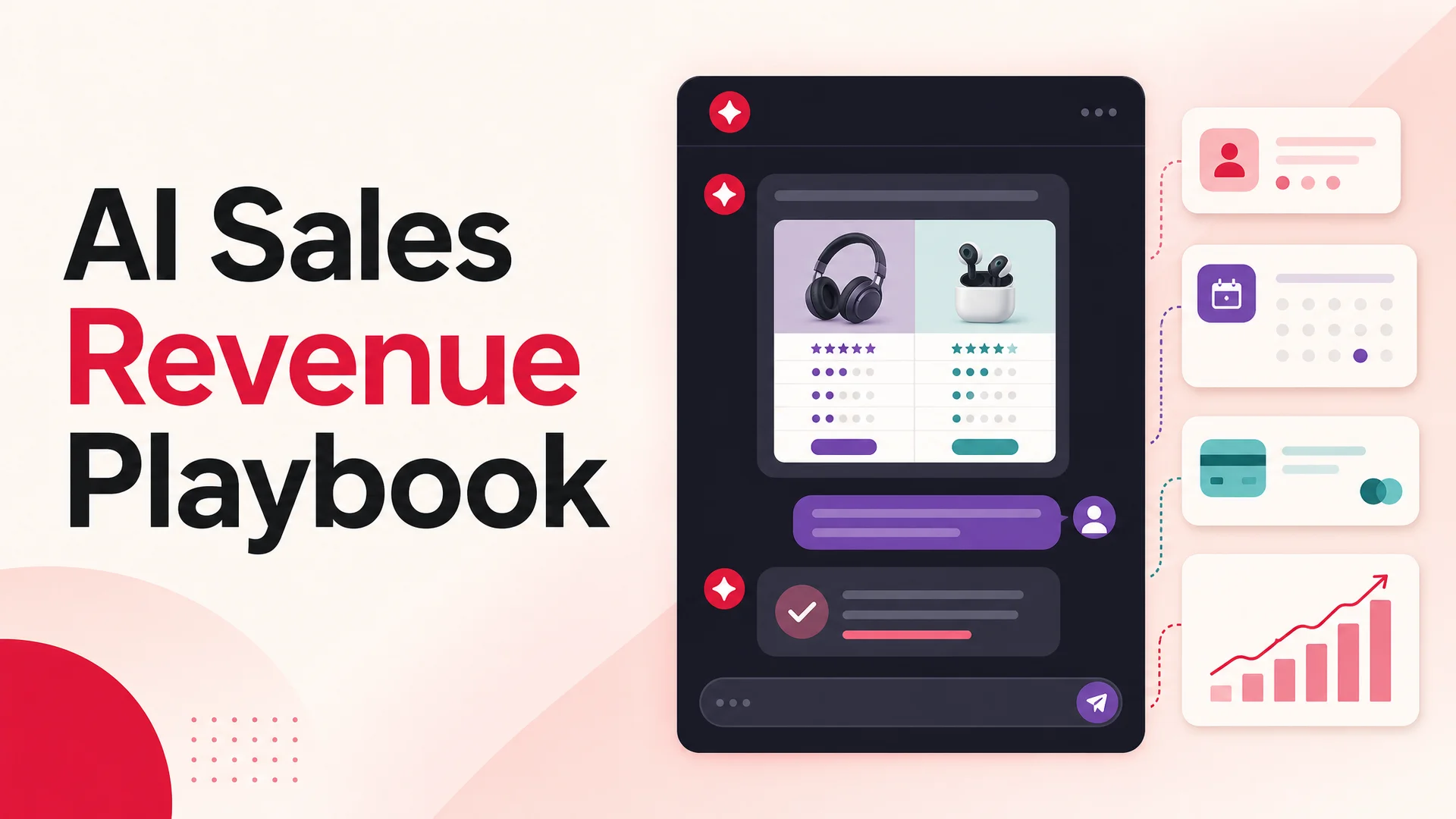
Static product pages with a checkout button at the bottom are a 2010s pattern. Buyers in 2026 expect to ask a question, get a recommendation, and finish the purchase without ever leaving the conversation. Conversational commerce - selling inside the chat - is the natural endpoint, and the latest agentic models finally make it reliable enough for production.
What that unlocks for a sales team:
- Guided buying: the agent answers spec questions, compares variants, and surfaces the right SKU in seconds. It can pull product data, stock levels, and shipping ETAs from your backend and reason over them in one turn.
- Lower drop-off: instead of losing a hesitant shopper to a 404 in the help center, the agent nudges them with a tailored offer, a finance option, or a quick demo slot.
- One-stop journeys: support, sales, and checkout collapse into a single thread. The same agent that explains a return policy can take the next order.
The reason this finally works in 2026 is tool reliability. Models like Claude Opus 4.7 (64.3% on SWE-bench Pro), GLM-5.1 (58.4), and Kimi K2.6 (58.6) execute multi-step tool calls cleanly enough that booking a meeting, applying a discount, or charging a card no longer feels like a demo trick. Berrydesk's AI Actions plug into Stripe, Calendly-style booking flows, and your CRM so the agent can close the loop.
5. Personalization with real context - at scale
Generic "you may also like" rails are noise. The recommendations that actually convert are the ones that look like a knowledgeable salesperson who remembers your last visit. Long-context models change what's possible here: Gemini 3.1 Ultra's 2M-token window and Claude Sonnet 4.6's 1M context can hold a customer's full history - every order, every chat, every support ticket - and reason across it without retrieval gymnastics.
There is a long-running myth that personalization is a luxury reserved for top accounts. In 2026 it is the default, because the math finally works. Open-weight models from DeepSeek, MiniMax, and Alibaba have collapsed inference cost so far that running a tailored message per customer per channel is cheaper than the email design system you already pay for.
What "personalized at scale" really means in practice:
- Customized content. The agent rewrites the subject line, the opening, and the offer for each segment - sometimes each individual - based on past behavior.
- Real-time adjustments. If a customer clicks one offer and ignores another, the next message reflects that.
- Channel consistency. The visitor who chatted with the widget on Tuesday gets a follow-up email on Thursday that picks up exactly where the conversation left off.
- Higher conversion because the suggestions are obviously relevant, not stochastic.
- Larger baskets because the agent can see what's already in the cart and add a complement, not a duplicate.
- Stronger retention because customers feel understood.
The risk to manage is the uncanny line. Personalization that references something a customer didn't realize they shared feels invasive. Stick to first-party data, be transparent about why the experience is tailored, and let users opt out cleanly. The technology can do far more than you should - and that restraint is itself a sales tactic.
6. Always-on coverage and instant response
Most sales are lost in the silence between "I'm interested" and the first reply. Speed-to-lead studies have shown the same pattern for years: response within five minutes converts dramatically better than response within an hour. AI agents collapse that to seconds, on every channel where you operate - your site, Slack Connect, Discord, WhatsApp, Messenger, embedded inside your product.
This matters more for global businesses than the domestic case. A prospect browsing your pricing page at 3 a.m. their time is, statistically, your most committed-looking lead - they are doing research, alone, with intent. If they hit your site and find no one home, you taught them to look elsewhere.
The thing to watch here is escalation. An always-on agent that can't reach a human when it should is worse than no agent. The better pattern is to let the AI agent handle the obvious 80%, summarize the rest into a clean handoff for the team's morning queue, and offer the prospect a guaranteed callback window so they don't feel parked.
7. Smart nurture sequences and cart recovery
Most "drip sequences" are blind. They send Email 2 on Day 3 whether or not Email 1 was opened, replied to, or made the prospect lukewarm. An AI agent does nurture differently because it remembers - every prior conversation, every page visited, every objection raised, every link clicked.
You can use this in two ways. The first is reactive: when a qualified lead comes back to your site, the agent opens with context. "Last time we talked you were comparing Plan B and Plan C for a team of fifty - want me to pull up the SSO and audit-log differences?" The second is proactive: scheduled outbound check-ins where the agent drafts a personal message based on what's actually in CRM, and either sends it directly or queues it for a human to send. This is where 1M-token context windows earn their keep - the agent has the full history, not a 200-token summary.
Cart abandonment is rarely about the cart. It's about a question the buyer couldn't answer in the moment - does shipping include duties, does the warranty cover this use case, can I cancel if it doesn't fit. An AI agent embedded in checkout, or watching for a stalled session, can intervene with the right question at the right time. Because modern agents can take real actions through AI Actions, the recovery doesn't stop at conversation. The same agent can apply a discount code, swap a variant, split a payment, or queue a callback.
8. Predictive forecasting, lead scoring, and dynamic pricing
Sales forecasting used to be a quarterly tarot reading. Modern models - fed pipeline data, seasonality, marketing spend, support volume, and macro signals - produce forecasts that are accurate enough to commit to in inventory and headcount decisions. The same long-context windows that help with personalization help here too: a single prompt can carry years of weekly numbers, every active deal, and every campaign calendar.
What you get when forecasting works: smarter inventory, cleaner staffing, sharper marketing, and quotas reps believe in. The trade-off worth flagging: forecasts are only as good as the data flowing in. Stale CRM hygiene poisons the output.
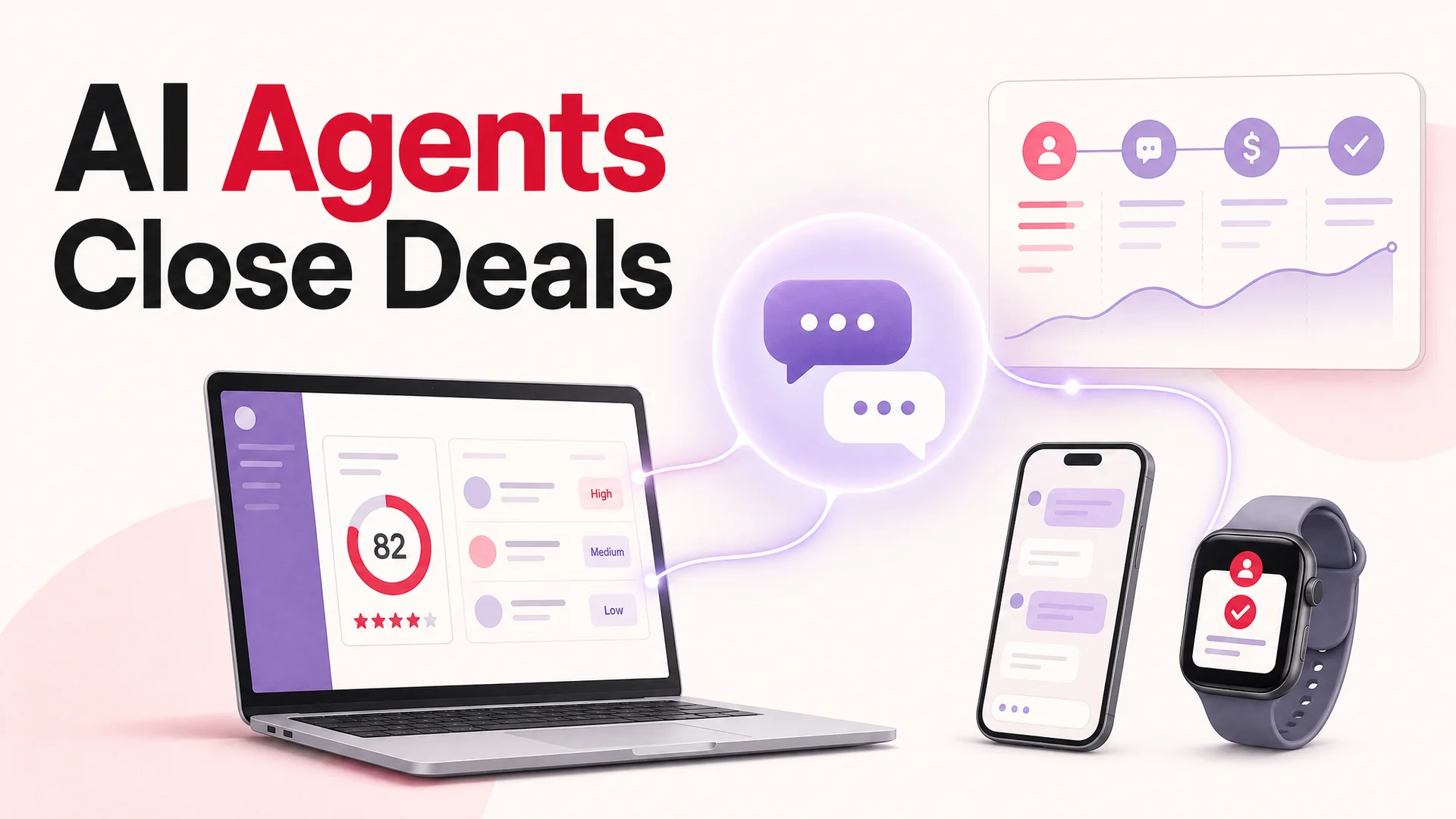
Reps waste an enormous amount of time on leads that were never going to close. AI fixes this by scoring every inbound - and every silent, browsing visitor - on the signals that actually predict purchase: recent product page visits, pricing page dwell, repeat sessions, role and company fit from enrichment, prior interactions in chat or email. Higher win rate because the team is talking to people who are already leaning in. More throughput per rep because the queue is sorted by likelihood. Lower CAC because spend follows the segments scoring highest.
Pricing is one of the highest-leverage levers in any business and one of the least-touched. AI makes continuous price optimization realistic without a quant team. The model watches demand, competitor moves, inventory, and customer-level signals. Demand-based pricing captures willingness to pay during traffic peaks. Competitor-aware pricing keeps you sharp without an analyst refreshing a sheet every Monday. Customer-level pricing lets loyal customers see different offers than first-time visitors. A practical guardrail: never let the model push prices outside a range your team has approved.
9. AI Actions that take work off reps' plates
The hidden tax on most sales orgs is the post-conversation work - the booking, the quote, the order entry, the recap email. Agentic AI takes a meaningful slice of that off the rep's plate. Berrydesk calls these AI Actions: tool calls the agent can run safely, on its own, after a customer asks for them.
Concrete actions worth wiring up:
- Bookings. The agent reads availability and books a real meeting, with the right rep, in the right time zone. No "what works for you" tennis.
- Quotes. For a request that fits a template, the agent generates a clean quote and sends it inside the chat. Edge cases route to a human.
- Order lookups and updates. "Where is my order" handled in a single turn, including a shipping ETA pulled live from the carrier.
- Refunds and reschedules. Bounded by the policy you wire in, the agent handles the routine cases and frees the team to focus on judgment calls.
- CRM updates. Every conversation closes with a structured note in the right account, automatically. No more reps spending Friday afternoon catching up on data entry.
- Promotion and upsell. AI agents are very good at the kind of promotion humans dislike doing - surfacing the right loyalty offer to the right buyer at the right moment, reminding a customer that their plan renews soon, pointing a power user toward the feature they keep almost-discovering. The dial here is restraint. Promotions should be triggered by signals (page visits, repeat questions, deal-stage moves, anniversary dates), not by calendar slots. A rep can upsell five buyers a day; an agent can do five hundred, and unlike a "Customers also bought" widget, it can justify each suggestion with the specific reason it fits.
The reliability bar for these actions used to be the reason teams kept them on the manual side. That has shifted in 2026. Models specifically built for agentic execution - Kimi K2.6's multi-hour autonomous sessions, GLM-5.1's plan-execute-test-fix loop, Claude Opus 4.7's tool-call accuracy, MiMo-V2-Pro's reasoning-first design - are dependable enough to run in front of customers without a babysitter on every call.
Customer insights you don't have to mine for
Most teams sit on a goldmine of behavioral and conversational data and look at maybe 2% of it. AI flips that ratio. With long-context models holding entire transcript libraries in a single prompt, the agent can read every chat and every ticket from the last quarter and tell you what the top three friction points are, what features keep coming up, and which segments are quietly churning.
What that looks like in practice:
- Behavioral analytics. The model identifies the exact step where free-trial users drop off and correlates it with the message they saw. You ship a copy fix the next day.
- Sentiment over time. Tone analysis across thousands of conversations surfaces a slow-burning frustration with shipping speed three weeks before it shows up in NPS.
- Real-time signal. When a high-value customer's tone shifts negative mid-conversation, the agent flags a CSM and pre-drafts a save offer before the chat closes.
For regulated industries that can't ship transcripts to a closed API, the open-weight side of the landscape unlocks this in-house. GLM-5.1 (MIT-licensed, trained entirely on Huawei Ascend chips), Qwen3.6-27B (Apache 2.0), and MiMo-V2 (MIT) make on-prem and air-gapped deployments viable.
Patterns from the field
You don't need a Pizza Hut budget to make this work, but the same patterns show up across every successful deployment we've seen.
A mid-market e-commerce brand with around 800 SKUs replaced their post-purchase support form with an AI agent trained on their product catalog and returns policy. The agent handles roughly 70% of order-status, sizing, and returns questions on its own, recovers about 12% of stalled checkouts via a simple "can I help finish this?" prompt, and routes the rest to a small support pod. The cost per resolution dropped from a high-single-digit dollar figure to a few cents - they routed routine traffic to DeepSeek V4 Flash and reserved Claude Opus 4.7 for the gnarly multi-item, multi-policy edge cases.
A B2B SaaS company in the HR-tech space wired an AI agent into their pricing page and demo-booking flow. Rather than gating the demo behind a form, they let the agent answer pricing questions in plain language, then offered to book the slot directly with an AI Action against Google Calendar. Booked-demo rate from chat conversations roughly tripled, and their SDRs walked into calls with a one-paragraph synopsis of what the buyer cared about and what objections came up - written by the agent, attached to the deal in their CRM.
A specialty coffee retailer ran their entire holiday-season sales floor through an AI agent on Instagram, WhatsApp, and their site. The agent took natural-language orders ("a pound of medium roast for someone who likes Ethiopian"), confirmed payment via an AI Action against Stripe, and queued fulfillment. They processed more orders during the holiday week than the prior year with one fewer seasonal hire.
These deployments are not exotic. They share a shape: train the agent on the actual operational documents, give it real tools instead of just a chat box, and route to a human cleanly when it should.
Picking the right model stack for sales agents
The single biggest decision you'll make is which model the agent runs on. In 2026 there are roughly three good answers and one bad one.
Routed (most common). Most successful deployments don't pick a model - they route. Routine, structured traffic (order status, pricing lookups, FAQ-shaped questions) goes to a fast, cheap open-weight model - DeepSeek V4 Flash, MiniMax M2 (around 8% the price of Claude Sonnet at twice the speed), or Qwen3.6-35B-A3B. Hard cases - multi-step reasoning, ambiguous policy questions, anything where being wrong has a real cost - escalate to a frontier model: Claude Opus 4.7 (currently leading SWE-bench Pro at 64.3% and an excellent reasoner generally), GPT-5.5 Pro for parallel-reasoning work, or Gemini 3.1 Ultra when you need the full 2M-token window.
Single agentic frontier model. If your sales conversations require sustained tool use - booking, payments, CRM updates, multi-step workflows - running everything on a model purpose-built for agentic work, like Kimi K2.6 or GLM-5.1, can simplify the architecture and improve reliability versus a routed setup. You pay more per token and gain in fewer failed handoffs.
On-prem open-weight. For regulated industries that can't ship customer data to a US hyperscaler. The MIT-licensed open-weight class - GLM-5.1 (754B-param MoE, beats Claude Opus 4.6 on SWE-Bench Pro, trained entirely on Huawei Ascend chips), Qwen3.6-27B (Apache 2.0, dense, beats much larger MoE rivals on agentic coding), Xiaomi MiMo-V2 - make a previously hard problem tractable.
The bad answer: freezing on a single closed model and hoping. The pace of model releases in 2026 is roughly monthly. A platform that locks you into one model is one release away from being expensive, slow, or both.
Common pitfalls to avoid
A few patterns reliably wreck AI sales agent rollouts.
Treating the agent as a marketing widget instead of an operational system. If the agent isn't tied to your actual order system, calendar, CRM, and payment processor, it can only ever talk about doing things. Buyers can tell. Wire in real actions on day one, even if you start with two of them.
Over-promising in the welcome message. "Hi! I can help you with anything!" sets the agent up to fail. A clear, narrow opener - "I can help with pricing, demo booking, or product questions" - calibrates the buyer and dramatically reduces frustrated escalations.
Hiding the human handoff. An agent that won't let a determined buyer reach a human is a brand-damaging machine. The handoff path should be one click, available from any turn of the conversation, with the full transcript attached to the human's view.
Over-personalizing in the first turn. If the first thing the agent says references a page the buyer just looked at, it feels surveillance-flavored. Use prior context to inform what you say, not to perform that you have it.
Stale training data. A sales agent trained on last quarter's catalog hallucinates last quarter's prices. Wire continuous re-training to your product source of truth - Notion, Drive, your CMS - so the agent updates as you do.
Ignoring evaluations. "It feels right" is not a sales metric. Track resolution rate, conversion rate by route, time-to-first-response, and human escalation rate from week one. A small, regularly-run evaluation set - covering your top twenty real conversation shapes - catches regressions long before customers do.
Letting personalization tip into creepy. Use first-party data, be transparent, and give users a clean way to reset the personalization layer.
Single-model lock-in. The model leaderboard moves every month in 2026. A platform that lets you swap models without rebuilding the agent is a hedge worth taking.
Where Berrydesk fits
Berrydesk is built for the playbook above. You pick the model - GPT-5.5, Claude Opus 4.7, Gemini 3.1 Ultra, DeepSeek V4, Kimi K2.6, GLM-5.1, Qwen, MiniMax, or others - or route between them based on the kind of conversation. You train the agent on the sources that actually matter for sales: your docs, website, product catalog, Notion workspace, Google Drive, even YouTube videos. You brand the widget so it looks like part of your site, not a third-party bolt-on. You add AI Actions for the things sales actually needs - booking demos, taking payments, looking up orders, syncing to CRM, applying discount codes - and you deploy to your site, Slack, Discord, WhatsApp, and the rest of the surfaces your buyers already use.
AI doesn't replace good selling. It removes the work that gets in the way of it - the slow replies, the missed leads, the unread tickets, the data entry - and gives reps more room to do the parts only humans do well. The teams pulling ahead in 2026 are the ones treating AI as the connective tissue across chat, email, CRM, and checkout, not a single feature bolted onto a website.
If you've read this far and you're nodding along, the gap between "we should try this" and "this is shipping" is short. Build a sales-ready AI agent on Berrydesk and route your first conversations through it this week.
 Berrydesk
Launch a sales-ready AI agent in minutes
- Pick from GPT-5.5, Claude Opus 4.7, Gemini 3.1, DeepSeek V4, Kimi K2.6 and more
- Wire AI Actions for bookings, quotes, and payments out of the box
Set up in minutes

Chirag Asarpota is the founder of Strawberry Labs, the team behind Berrydesk - the AI agent platform that helps businesses deploy intelligent customer support, sales and operations agents across web, WhatsApp, Slack, Instagram, Discord and more. Chirag writes about agentic AI, frontier model selection, retrieval and 1M-token context strategy, AI Actions, and the engineering it takes to ship production-grade conversational AI that customers actually trust.