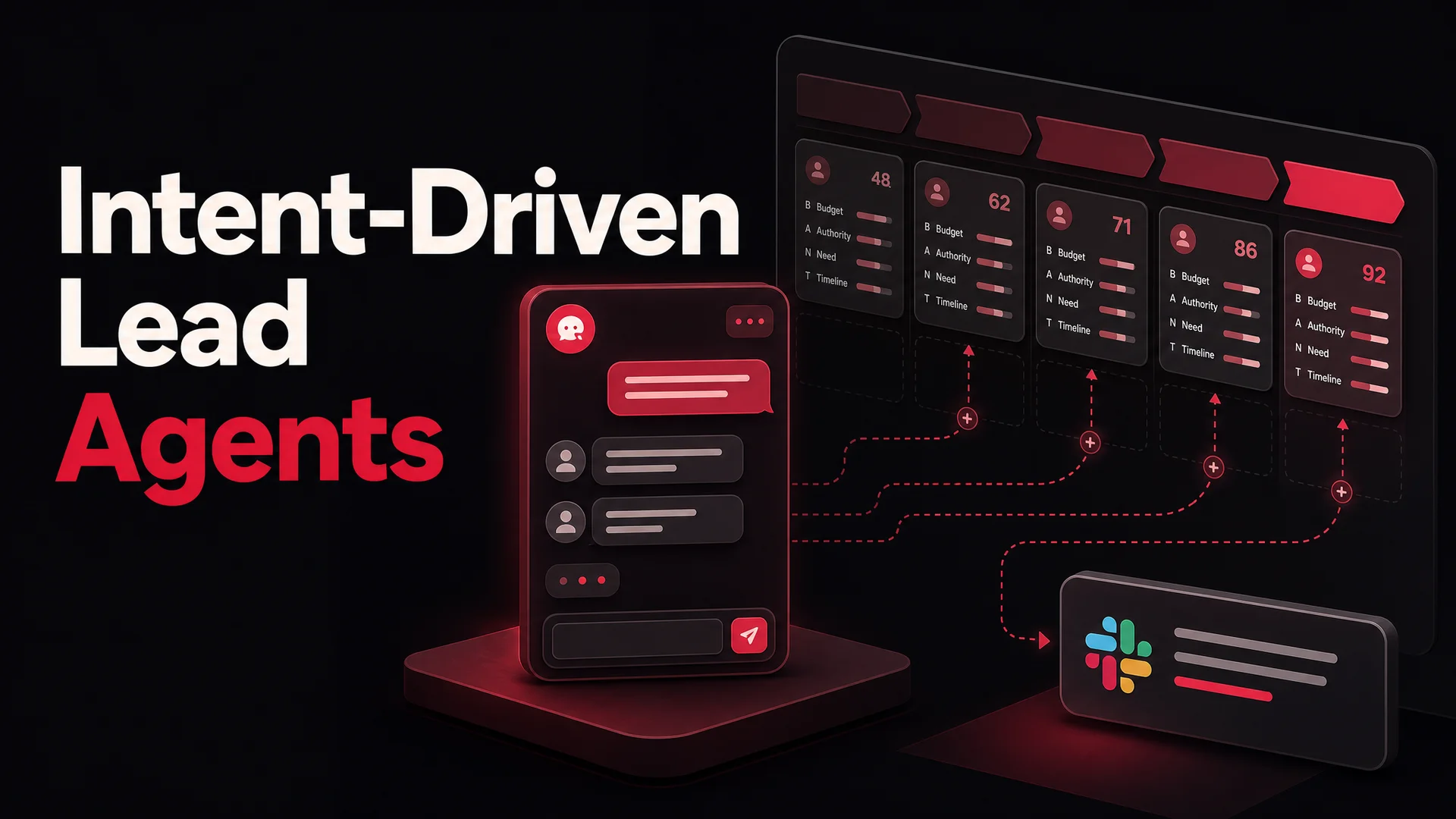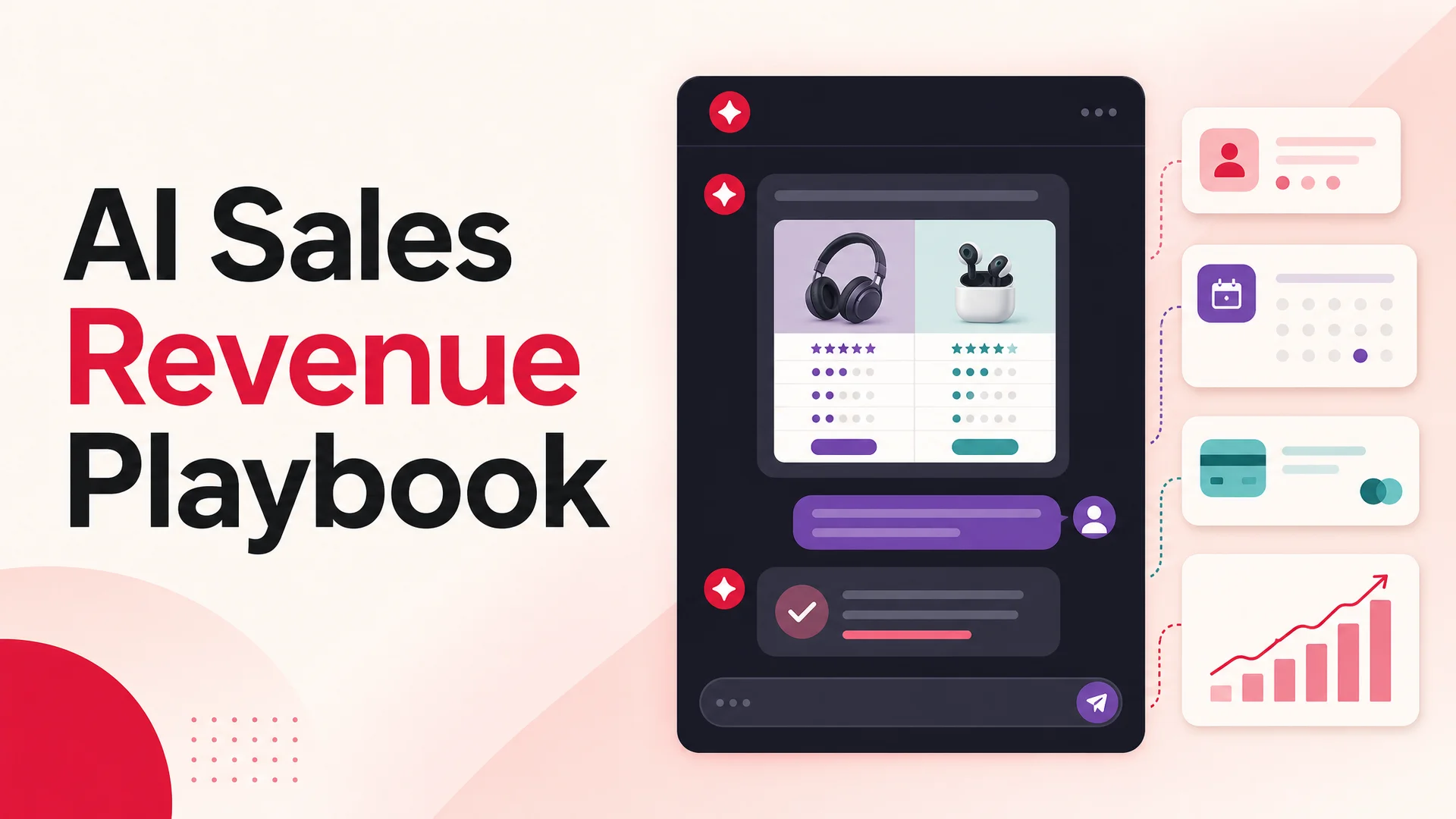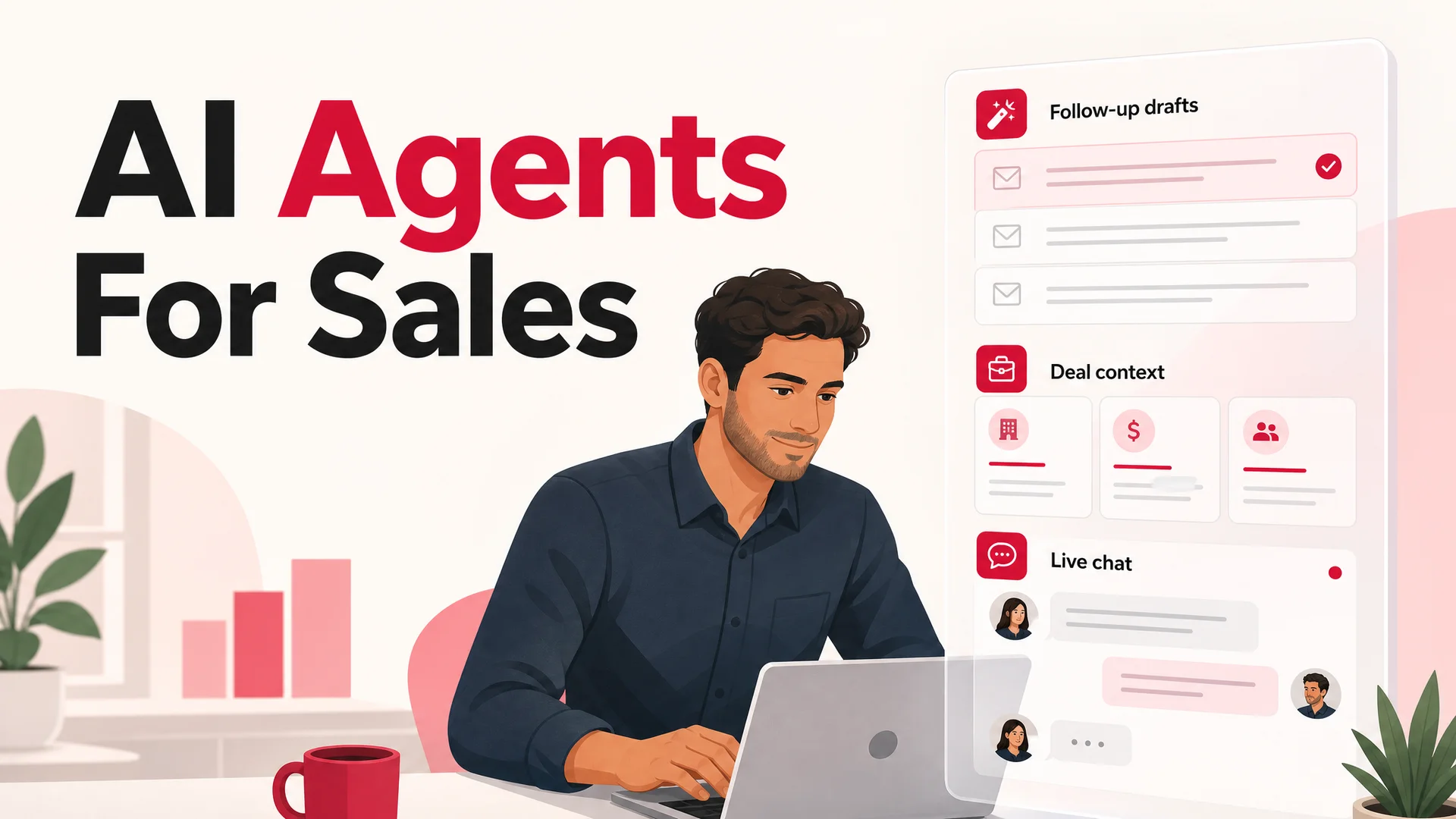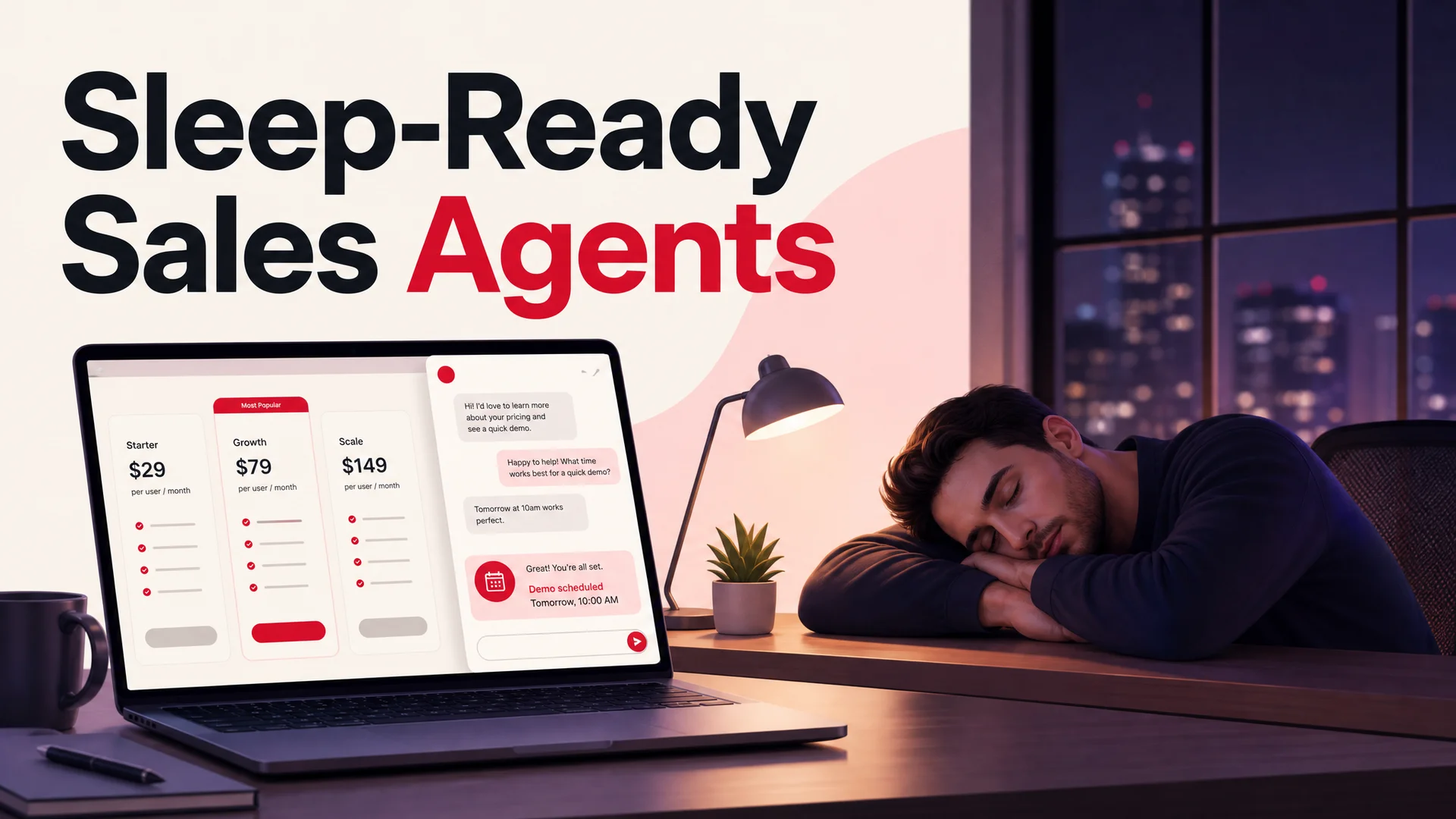
It is 11:47 PM. A prospect lands on your pricing page from a LinkedIn ad, scrolls past the Starter tier, hovers on Enterprise, and toggles between annual and monthly twice. Twenty-eight seconds in, a chat panel slides open with a single line: "Want a hand picking the plan that fits your team?" They start typing. Four messages later, the agent has logged the company size, the use case, the rough timeline, and an email. It surfaces the right plan, drops a calendar invite for a Tuesday morning slot, and pings the AE channel in Slack with a one-paragraph brief and the full transcript. Nobody on your team was awake. No lead leaked into the void. By the time the AE opens their laptop the next morning, the deal is already at second base.
That is what an AI sales agent is supposed to do - and in 2026, with frontier models like GPT-5.5 Pro, Claude Opus 4.7, and Gemini 3.1 Ultra reasoning across million-token contexts, it finally does. Below are five conversation flows you can copy into Berrydesk this week, the four-step build you can finish in an afternoon, the ROI math that justifies it to your CFO, and the situations where you absolutely should not let a bot drive.
Sales Agent vs. Support Agent: Two Jobs, Two Setups
Most teams start with a support agent. It deflects tickets, answers product questions, and saves a CSAT-hungry team from death by repetition. That is real money, but it is not pipeline. A sales agent is a different animal entirely: its job is to interrupt a high-intent visitor, ask the four questions a good SDR would ask, neutralize the obvious objections, and either book a meeting or capture a qualified lead before the tab closes. It is trained on your pricing tiers, your battle cards, and your ICP - not your help center.
The setup differences that actually matter
Goal. A support agent measures itself by ticket deflection and first-response time. A sales agent measures itself by SQLs generated, demos booked, and pipeline influenced. The KPIs you wire into your dashboard determine which behaviors the agent learns to optimize.
Primary action. A support agent answers, summarizes, and escalates. A sales agent asks, qualifies, recommends, and books. It treats every conversation as a funnel stage, not a question to close.
Training data. A support agent feeds on knowledge base articles, troubleshooting guides, and changelogs. A sales agent feeds on the pricing page, competitor comparisons, case studies, objection-handling docs, and the discovery script your best AE actually uses. In Berrydesk you can mix sources - pull pricing from your live site, drop case studies from Google Drive, and sync the discovery questions from a Notion page so the agent retrains automatically when sales updates the playbook.
Where it lives. Support belongs on the help center, contact page, and post-purchase email. Sales belongs on pricing, product, comparison, and high-intent landing pages - anywhere the visitor is already evaluating spend.
Conversation style. Support is reactive: it waits to be asked. Sales is proactive: it watches for intent signals (time on page, scroll depth, return visits) and opens the conversation when the odds are highest.
Why this distinction is not academic
If you train a generic chatbot on your FAQ and bolt it onto your pricing page, it will cheerfully answer "what is the difference between Pro and Business" and then sit there while the visitor closes the tab. It will not ask whether the visitor has buying authority. It will not surface the case study from a peer in their industry. It will not book the meeting. The data you load and the instructions you write are the difference between a bot that informs and an agent that sells. Treat the configuration like an SDR onboarding doc, not a help-center index, and the gap between deflection and conversion closes fast.
What an AI Sales Agent Actually Does Across Your Funnel
Think of the agent as a four-stage workflow, not a feature checkbox. Each stage has its own trigger, its own success metric, and its own failure modes.
Stage 1 - Engage: catch the visitor before they bounce
Pricing-page bounce rates north of 60 percent inside 60 seconds are normal. A sales agent fires a proactive message after roughly 20 to 30 seconds on high-intent pages, and the opening line carries most of the weight. Generic openers ("How can I help?") perform terribly because they read as pop-ups. Specific openers framed around the page the visitor is on ("Trying to figure out which plan covers your support volume?" on /pricing, or "Want to see how this compares to Intercom?" on /alternatives) read as conversation. In Berrydesk you can configure trigger timing, opener copy, and even the underlying model per page - you might run Claude Opus 4.7 on enterprise pages where nuance matters, and DeepSeek V4 Flash on high-traffic top-of-funnel pages where cost per conversation matters more than reasoning depth.
Stage 2 - Qualify: ask the four questions without sounding like a form
Once the visitor replies, the agent runs three to five qualification questions: company size, primary use case, current tooling, timeline, and rough budget band. The reason this beats a static form is that the next question is conditional on the previous answer. If the visitor says "we use this for ecommerce returns," the follow-up shifts to monthly order volume and current return-management stack. If they say "internal HR knowledge base," it pivots to headcount and existing IT constraints. With agentic tool-use models like Kimi K2.6, GLM-5.1, and Claude Opus 4.7, the branching is genuinely dynamic - you write the qualification rubric in plain English in your Berrydesk system prompt, and the model handles the conversational state. No flow builder, no if/then trees, no JSON schema fights at 2 AM.
Stage 3 - Convert: book the meeting or close in chat
For B2B with a sales-led motion, the conversion event is a booked demo. The agent surfaces a real-time calendar with available slots, the visitor picks one without leaving the conversation, and the invite lands in both calendars before they close the tab. For self-serve and PLG products at lower price points, the agent can route directly to checkout, drop a Stripe payment link inline, or upgrade an existing user via an AI Action. Berrydesk ships both patterns out of the box - calendar booking and payment flows are AI Actions you wire up by clicking through a config screen, not by writing webhooks.
Stage 4 - Hand off: know when to get out of the way
Not every conversation should stay automated, and the agents that try to close everything are the ones that burn pipeline. When a prospect mentions a custom contract, names a competitor by name, hits a budget threshold above your self-serve cap, or shifts into a frustrated tone, the agent should escalate immediately. In Berrydesk you set escalation rules in plain language ("if the visitor mentions procurement, security review, MSA, or a deal size above $50K, ping #sales-hot in Slack with the transcript and stop responding until a human takes over"). The handoff carries the full conversation context so the AE picks up mid-flight without making the prospect repeat themselves.
Five Conversation Flows You Can Ship This Week
These five flows cover the bulk of inbound sales scenarios. Each is designed to be deployed as-written, with the trigger, opener, qualification questions, and conversion action specified. Treat them as a starting library, not a finish line.
Flow 1 - The pricing-page qualifier
Trigger: 25+ seconds on /pricing, or a scroll past the third tier.
Opener: "Trying to figure out which plan covers your team?"
Qualifying questions: (1) How many people on the team will use this? (2) Is the primary use case customer support, lead gen, or internal knowledge? (3) When are you looking to roll out - this month, this quarter, exploring?
Conversion action: Routes the visitor to the recommended plan with a pre-filled signup link. If headcount is over 50 or the use case mentions security/compliance, it pivots to a demo booking instead.
Best for: SaaS with tiered pricing. In Berrydesk, point the agent at your pricing page URL, drop the qualification rubric into the system prompt, and you are live in under ten minutes.
Flow 2 - The inbound lead qualifier
Trigger: First-touch homepage visit from a paid ad or organic search term.
Opener: "What brought you in today?"
Qualifying questions: (1) What problem are you trying to solve? (2) What are you using today, if anything? (3) How big is the team? (4) What is your email - happy to send a tailored walkthrough.
Conversion action: Captures email, name, and company; tags the lead with use case and team size; pushes the record to your CRM and a Slack alert to the SDR rotation.
Best for: Replacing static "Contact Us" forms. The conversational version typically converts at 2–4x the rate of a form because the visitor is in dialogue, not transaction mode. Berrydesk's lead capture AI Action handles the CRM push natively for HubSpot, Salesforce, Attio, and a long tail of others via webhook.
Flow 3 - The demo booker
Trigger: Click on "Book a Demo," or 2+ minutes on the features page.
Opener: "Happy to set up a 20-minute walkthrough. What does your week look like?"
Qualifying questions: Light. Intent is already high. Just confirm name, company, role, and surface available slots.
Conversion action: Books the meeting via integrated calendar in-chat. No email back-and-forth, no separate tab, no friction.
Best for: B2B with a sales team. Berrydesk's calendar AI Action handles the booking and the confirmation email natively, and you can route to round-robin or named-account ownership rules.
Flow 4 - The return-visitor re-engager
Trigger: Second or third visit to the same product or pricing page within 14 days.
Opener: "Welcome back. Last time you were looking at the [tier] - anything I can clear up to help you decide?"
Qualifying questions: Light. Ask whether anything has changed since their last visit, and what would help them move forward.
Conversion action: Re-engages a warm lead before they churn out of consideration. Offers a demo, a comparison doc, a case study from their industry, or a direct upgrade path.
Best for: Products with a longer evaluation cycle (typically two weeks or more). Berrydesk's session memory persists across visits, so the opener references real prior browsing rather than guessing.
Flow 5 - The objection handler
Trigger: Visitor scrolls past the pricing tiers without clicking any plan.
Opener: "Anything holding you back from getting started?"
Common objection branches:
- "Too expensive" triggers a response that highlights ROI math, the free tier, and a comparison to the cost of leads going cold. If the visitor names a competitor, the agent surfaces a battle card.
- "Not sure it fits my use case" prompts a clarifying question, then a tailored explanation backed by a relevant case study from a similar industry or company size.
- "Need to talk to my team" offers to send a one-page summary email the visitor can forward, plus a group demo booking link.
- "How does this handle [security/compliance/specific feature]" routes to the relevant doc and, if the question is non-trivial, escalates to a human SE.
Conversion action: Removes friction at the exact moment of hesitation. Routes to the right next step based on which objection actually fired.
Best for: Products with high pricing-page drop-off. In Berrydesk, train the agent on your real objection-handling playbook by uploading your sales enablement deck, your competitive battle cards, and a Notion page of FAQs. The agent will pattern-match against the visitor's actual phrasing rather than running through a fixed decision tree.
How the 2026 Model Landscape Changes the Math
If your last attempt at a sales bot ran on GPT-4 or an early-generation chat API, almost everything that frustrated you has been fixed by the model class shipping right now. That is worth a few minutes of context because it determines what you can reasonably expect from the agent and how you should configure it.
Reasoning has caught up with sales judgment. Claude Opus 4.7 leads SWE-bench Pro at 64.3 percent - a coding benchmark, but a useful proxy for the kind of multi-step reasoning that handles "we use Salesforce for CRM, Zendesk for support, and we are migrating to HubSpot in Q3, so what does the integration look like for us?" GPT-5.5 Pro's parallel reasoning lets the agent consider multiple qualification paths in a single turn. Gemini 3.1 Pro tops GPQA Diamond at 94.3 percent. In practice this means the agent can hold a coherent multi-thread conversation about pricing, integrations, and timeline without losing the plot - the kind of thing that broke a 2024-era bot inside three turns.
Context windows have stopped being a constraint. Claude Opus 4.6 and Sonnet 4.6 ship with a 1M-token context window at no surcharge, Gemini 3.1 Ultra goes to 2M, and DeepSeek V4 and Kimi K2.6 both hit 1M. For a sales agent, that means the entire pricing page, every battle card, every case study, the full transcript history with this prospect, and the playbook for the current quarter all fit in-context. Retrieval becomes a tuning lever, not a hard requirement. The agent stops "forgetting" what it learned three messages ago.
Open weights have collapsed the cost floor. DeepSeek V4 Flash runs at $0.14 per million input tokens and $0.28 per million output, MiniMax M2 lands at roughly 8 percent of Claude Sonnet's price at twice the speed, and GLM-5.1 (MIT-licensed, 754B-param MoE) actually beats Claude Opus 4.6 on SWE-Bench Pro at 58.4 versus 57.3. For a sales agent that handles thousands of conversations a month, the difference between routing every conversation to a frontier closed model and routing the easy 80 percent to an open-weight model is the difference between a $4,000 monthly inference bill and a $400 one. Berrydesk lets you pick the model per agent, per page, or even per conversation type, so you can put Claude Opus 4.7 on enterprise pricing pages and DeepSeek V4 Flash on the FAQ.
Agentic tool use is finally production-grade. Kimi K2.6 can run 12-hour autonomous coding sessions and coordinate up to 4,000 steps across 300 sub-agents - a capability ceiling that translates downstream into AI Actions that actually work end-to-end. Booking a meeting, looking up an account in HubSpot, applying a discount code, sending a payment link, escalating to Slack - all of these are now reliable rather than demoware. Qwen3.6-27B (Apache 2.0) and MiMo-V2-Pro extend the same agentic capability to fully open-source deployments for teams with on-prem or air-gapped requirements.
Regulated industries finally have an answer. MIT and Apache-licensed Chinese open weights - GLM-5.1, Qwen3.6-27B, MiMo-V2-Pro - make on-prem deployment viable for healthcare, financial services, and government workloads. Berrydesk supports both the SaaS path for the 95 percent of teams that want it managed, and the bring-your-own-model path for teams that need the agent to never call out to a third-party API.
The practical takeaway: in 2026 the bottleneck is no longer model quality. It is configuration, instructions, and data hygiene.
Build It in Berrydesk in Four Steps
Here is the build sequence that takes a typical team from zero to live in an afternoon.
Step 1 - Train the agent on your sales knowledge
Point Berrydesk at your pricing page URL, your product docs, your case studies, and your objection-handling collateral. Pull from Google Drive for the sales decks, Notion for the discovery script, your live site for pricing, and YouTube for any product demo videos you want the agent to be able to time-stamp into. The training pipeline reads and indexes all of it in a few minutes. With million-token context windows, you can lean on the model to hold the full corpus directly, but the retrieval index still helps with citation quality and cost.
Step 2 - Write the qualification rubric in plain English
This is the highest-leverage step. Treat the system prompt like the brief you would give a new SDR on day one. "Ask about company size, primary use case, current tooling, timeline, and rough budget band. Recommend the Starter plan if the team is under 10 and the use case is straightforward support deflection. Recommend Business if the team is 10 to 50 or the use case includes lead gen plus support. If the team is over 50, the use case mentions security or compliance, or the visitor names a procurement process, do not try to close - book a demo and ping #sales-enterprise in Slack." No code, no flow builder. The agentic models in 2026 are good enough to follow a paragraph of instructions reliably.
Step 3 - Wire up your AI Actions
In the AI Actions tab, connect the calendar booking, lead capture, and Slack notification actions you need. Berrydesk ships native integrations for Calendly, Cal.com, HubSpot, Salesforce, Attio, Slack, Discord, and a long tail of others through webhooks. Add the payment AI Action if you have a self-serve checkout you want the agent to drive directly. Set escalation rules in plain language and pick the channel each rule fires into.
Step 4 - Brand the widget, embed, and red-team your own bot
Customize the widget colors, avatar, and welcome copy to match your brand. Drop the embed script on your pricing, product, and high-intent landing pages. Then - and this is the step most teams skip - spend 30 minutes acting as your worst prospect. Ask hostile questions. Try to make it hallucinate a feature you do not have. Push it to discount. See whether the escalation rules fire correctly. Whatever you find here you would have found later in production with real prospects, so find it now. Most teams complete the full setup in two to three hours.
The ROI Math: What This Actually Earns
The formula
Monthly leads that currently go cold (because nobody responded inside the SLA window) × the recovery rate from instant 24/7 response × your average deal value × your close rate. That is your monthly recovered revenue. Subtract the agent's run cost - both the Berrydesk subscription and the underlying model inference - and you have your net.
Three illustrative scenarios:
-
Small business. 50 leads per month leak past the response window. 30 percent recovery rate, $200 average deal value, 10 percent close rate. Monthly recovered revenue: $300. Berrydesk plus inference cost on a routed open-weight model: roughly $35 per month. Net gain: ~$265 per month, mostly in the form of leads you would otherwise have lost without ever knowing they came in.
-
Mid-market. 200 leads per month, 30 percent recovery, $500 ACV, 15 percent close. Monthly recovered revenue: $4,500. Run cost on a mixed-model setup (Claude Opus 4.7 for enterprise, DeepSeek V4 Flash for the rest): roughly $130 per month. Net gain: ~$4,370 per month.
-
Growth stage. 500 leads per month, 30 percent recovery, $1,500 ACV, 12 percent close. Monthly recovered revenue: $27,000. Run cost at scale, with most traffic routed to open-weight models: roughly $400 per month. Net gain: ~$26,600 per month.
The cost gap between these scenarios used to be much wider, because every conversation hit a frontier closed model at $5–$15 per million output tokens. With DeepSeek V4 Flash at $0.28 per million output and MiniMax M2 at roughly 8 percent of Sonnet's price, the inference line on your bill barely moves as you scale, and the unit economics actually improve.
The time-saved calculation
A reasonable benchmark: an SDR spends about 15 minutes on initial qualification per inbound lead - discovery questions, pulling up the company in CRM, sending the calendar link, logging notes. If your team handles 200 leads a month and the agent automates 65 percent of that initial qualification, you reclaim about 33 hours of SDR time per month. That is roughly an extra eight hours per week per rep that shifts from "asking screening questions" to "running real discovery calls with prospects who are already qualified and have a calendar invite booked."
Pitfalls to Avoid (and Where Not to Use This at All)
Most failed sales-bot rollouts do not fail because of model quality. They fail because of configuration choices that look reasonable in the dashboard and disastrous in front of a real prospect.
Do not let the agent close enterprise deals. Above a certain ACV, prospects expect a person. The agent should qualify hard, capture context, and route immediately - its job is to set the table for an AE, not to negotiate a six-figure contract. If you let it try, you will land in a negotiation it cannot finish and a prospect who feels jerked around.
Do not run win-back conversations through a bot. Re-engaging a churned customer requires emotional context, an honest acknowledgment of why they left, and often a one-off offer that is outside your published pricing. Models in 2026 are good enough to recognize sentiment, but the right move when a former customer surfaces is to escalate immediately, not to attempt a save.
Do not let the agent negotiate on price. It can cite published pricing and explain what each tier includes. It cannot agree to a custom discount, a non-standard term, or a multi-year commitment. Hard-code the discount ceiling at zero and route every "can you do better on price" conversation to a human.
Do not skip the sentiment escalation rule. When a visitor's tone turns frustrated - and modern models like Claude Opus 4.7 are extremely good at detecting this - the agent should escalate within one turn. Trying to recover a frustrated prospect via bot is the single fastest way to turn a soft loss into a public one.
Do not over-engineer the qualification script. Five questions is plenty. Eight is too many. The conversion-rate cliff between question four and question seven is brutal, and the marginal qualification quality you gain after question five does not pay for the drop in completion rate.
Do not run every conversation on your most expensive model. Routing the full FAQ traffic to Claude Opus 4.7 or GPT-5.5 Pro is how you end up with an inference bill that surprises your CFO. Reserve the frontier closed models for the conversations where reasoning depth actually matters - enterprise pricing, security questions, complex multi-product configurations - and route the routine traffic to DeepSeek V4 Flash, MiniMax M2, or Qwen3.6 to keep unit economics healthy.
Frequently Asked Questions
What is an AI sales agent?
A conversational AI that engages high-intent website visitors, asks qualification questions, surfaces the right plan or product, handles common objections, and books demos or captures leads automatically. It is trained specifically on your sales process, pricing, and competitive positioning rather than your help docs.
How is this different from a live chat tool?
Live chat needs a human online to function. An AI sales agent works around the clock, takes action on its own (it books meetings, captures contact info, pushes records to your CRM, fires Slack alerts), and stays consistent with your messaging across thousands of conversations. Live chat enables conversation. A sales agent drives conversion.
Can it actually close deals without a human?
For self-serve and lower-ACV products, yes - the agent can qualify, recommend, and route to checkout or upgrade in-flow. For complex B2B deals, it handles qualification and demo booking, then hands the AE a fully briefed prospect who has already booked a calendar slot. Both patterns shorten the sales cycle materially.
Which model should the agent run on?
Depends on the conversation. Berrydesk lets you pick from GPT-5.5, Claude Opus 4.7 and Sonnet 4.6, Gemini 3.1 Ultra and Pro, DeepSeek V4, Kimi K2.6, GLM-5.1, Qwen3.6, MiniMax M2, and others. A common production pattern in 2026 is to route enterprise and security-heavy conversations to Claude Opus 4.7 or GPT-5.5, and route the routine top-of-funnel traffic to DeepSeek V4 Flash or MiniMax M2 to control inference cost.
How long does setup take?
Most teams go from zero to a live, embedded sales agent in two to three hours. Step 1 (training on your docs) takes minutes. Step 2 (writing the qualification rubric) takes the longest because it is the highest-leverage step. Steps 3 and 4 (AI Actions and embed) are mostly clicking through configuration. A custom-coded equivalent typically takes weeks and a lot of glue code to maintain.
What about regulated industries?
If you need on-prem or air-gapped deployment, Berrydesk supports the open-weight model path - GLM-5.1 (MIT), Qwen3.6-27B (Apache 2.0), and MiMo-V2-Pro (MIT) all run in environments where you cannot call out to a third-party API. The sales agent capabilities are the same; only the deployment topology changes.
Your pricing page already has the traffic. The only question is whether that traffic talks to you tonight or closes the tab and forgets. Spin up your AI sales agent at berrydesk.com - train it on your pricing and battle cards, wire up the calendar and Slack actions, embed the widget, and start booking pipeline before your next coffee.
 Berrydesk
Launch your AI sales agent in an afternoon
- Qualify pricing-page traffic 24/7 across GPT-5.5, Claude Opus 4.7, Gemini 3.1, and the open-weight frontier
- Book demos, capture leads, and route hot prospects to Slack with no-code AI Actions
Set up in minutes

Chirag Asarpota is the founder of Strawberry Labs, the team behind Berrydesk - the AI agent platform that helps businesses deploy intelligent customer support, sales and operations agents across web, WhatsApp, Slack, Instagram, Discord and more. Chirag writes about agentic AI, frontier model selection, retrieval and 1M-token context strategy, AI Actions, and the engineering it takes to ship production-grade conversational AI that customers actually trust.