A polished greeting and a sub-minute first response don't automatically add up to good customer service. Plenty of teams hit their SLA targets every week and still lose customers, because the customer walked away feeling processed rather than helped.
The most common misread of "good service" is that it's a stopwatch problem. Speed is part of the picture, but a fast answer to the wrong question is just frustration delivered quickly. The opposite trap is just as bad - a warm, apologetic agent who never actually fixes anything. Customers can tell the difference between being soothed and being served, and the soothing wears off about thirty seconds after the chat closes.
Good customer service is best measured by what the customer is feeling at the moment the conversation ends. Did they get an outcome? Did they feel respected while they got it? Did they leave with the sense that the company is paying attention to them, specifically? That's the bar.
Underneath those feelings is a stack of practical things working together: empathy, accuracy, channel consistency, ownership, and a level of personalization that makes the customer feel like more than a row in a CRM. None of these are new ideas. What's new in 2026 is that the tooling - frontier reasoning models, million-token context windows, agentic AI Actions - has finally caught up to the ambition.
What good customer service actually looks like
Most people can name a service experience they still remember years later. It's almost never the one where someone read the right macro at them.
It's the dental receptionist who remembered you'd been nervous last time. The airline agent who skipped the script and rebooked you on a competitor's flight because it was the only way to get you home that night. The SaaS support engineer who joined a screen share at 11pm to walk you through a config you'd been fighting with for three days.
Those moments share a few traits. The person on the other end seemed to actually be present. They had context about you before the conversation started, or they earned it quickly. They treated the resolution as the goal, not the ticket close. And they were willing to flex the standard process by a few degrees when the standard process wasn't going to get the job done.
Good customer service rarely comes from grand gestures. More often it's an accumulation of unglamorous things: a fast first reply, a clear explanation in plain language, not having to repeat your account number to three different people, getting a follow-up message a day later asking if everything is still working. Those small signals tell a customer that they are dealing with a company that takes them seriously.
That trust compounds. A team that consistently delivers this kind of experience doesn't just resolve tickets - it converts one-off buyers into a base of customers who renew, expand, and refer.
What separates great support from average support
There's no single template for good service. A two-person founder team running support out of a shared inbox can absolutely deliver it. So can a global org with five thousand agents on rotation. What they have in common is a set of habits that show up in every interaction.
Below are the eight traits that consistently separate teams that customers love from teams that customers tolerate.
1. AI used as an amplifier, not a wall
For a stretch of years, "AI customer service" was synonymous with the cheap deflection bot - the widget that asked you to rephrase your question four times before grudgingly handing you off to a human. That era is over. The current generation of models has actually closed the gap.
Imagine a customer messaging at 2am because their checkout failed and they need to give a gift the next morning. A modern support agent built on Claude Opus 4.7 or GPT-5.5 can read the failed transaction, recognize that the card was declined for a CVV mismatch, generate a one-time retry link, and confirm success - inside a single minute, without paging anyone. That's not deflection. That's a resolution the customer is grateful for.
Or take the case of a repeat contact. A customer who has already opened two tickets about the same shipping issue should never have to start from scratch. A million-token context window - standard now on Claude Sonnet 4.6 and Opus 4.6, and 2M on Gemini 3.1 Ultra - lets the agent pull the entire conversation history, the order record, and the carrier's tracking events into a single prompt. The customer says "this still isn't fixed" and the agent already knows what "this" is.
Tone-aware routing is the third superpower. The same model that detects frustration in a message can bump the priority, summarize the situation for a human teammate, and warm-transfer the conversation with full context attached. The human picks up a customer who feels heard, not a stranger who has to vent for a third time.
The pricing math behind all of this changed in 2026 as well. With open-weight frontier models like DeepSeek V4 Flash at fourteen cents per million input tokens, MiniMax M2 at roughly eight percent of Claude Sonnet's price, and GLM-5.1 under MIT license, routine support volume can be answered for fractions of a cent per resolution. That frees up budget to spend top-tier models - Claude Opus 4.7, GPT-5.5 Pro, Gemini 3.1 Ultra - on the hard escalations where reasoning quality actually moves the needle. With Berrydesk you can pick the model per agent, or route by complexity, instead of paying flagship rates for "where is my order."
2. Empathy and emotional intelligence
No script can manufacture genuine empathy. A customer who reaches out is almost always reaching out from somewhere on a spectrum that runs from mildly annoyed to genuinely panicked, and the first thing they want is the sense that the person on the other end recognizes that.
Picture someone locked out of their account two hours before they need to file a tax return. The wrong opening move is "Please attach a photo of your government ID." The right opening move is "I can see this is the worst possible time for this - let's get you back in. While I pull up the verification step, can you confirm the email on the account?" Same end state. Completely different experience.
Empathy is not the same as agreeing with everything. It's not the same as discounting your way out of conflict. It's acknowledging the emotional content of the message before launching into mechanics, treating the customer's problem as fresh and important even though you've seen it three hundred times this quarter, and being patient when someone is frustrated even when their frustration is misdirected at you.
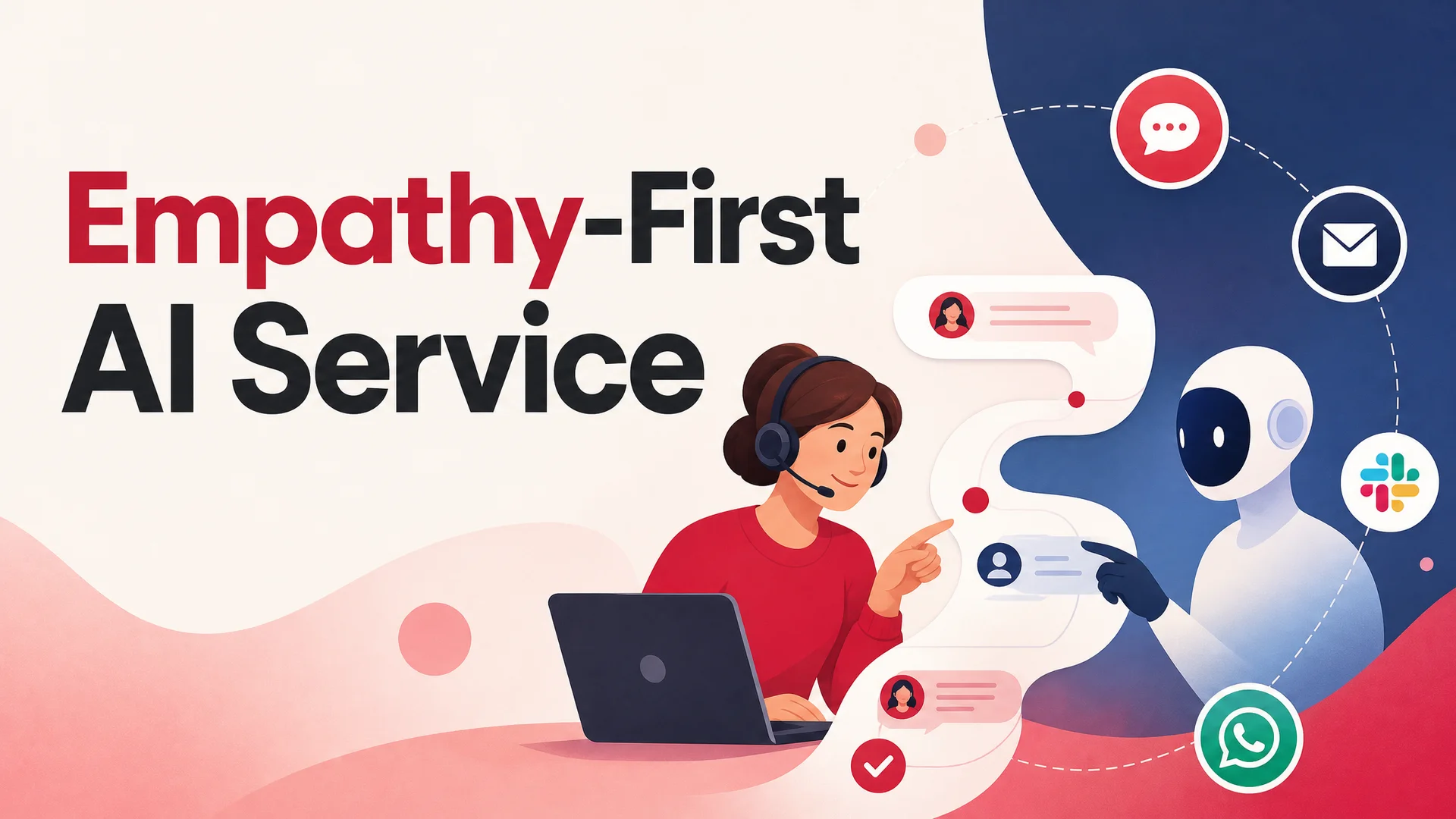
This is also where modern AI surprises people. Models in the Claude Opus and GPT-5.5 families are unusually good at calibrating tone - they back off the corporate-speak, mirror the customer's register, and apologize without sounding scripted. When you pair that with clear escalation rules to a human for anything truly emotional or high-stakes, you get a hybrid that feels human at every step.
3. Consistency across every channel
Customers don't think in channels. They think in problems. The same person might tweet a complaint, follow up over email an hour later, and then DM your Instagram account that evening - and they expect those three conversations to be the same conversation.
When channels feel different, customers feel like they're talking to a disorganized company. A breezy, almost-too-friendly reply on social followed by a chilly, legalistic reply by email reads as either incompetence or insincerity. Worse is the version where the customer has to re-explain their order number, the issue, and what's already been tried, because the agent on the new channel can't see the previous thread.
Real consistency means three things. The brand voice is the same on every surface. The data is the same on every surface - the agent on Slack sees what the agent on the website widget saw. And the resolution authority is the same on every surface, so the customer doesn't get a yes on chat and a no on email.
This is structurally easier when one agent handles every channel. Berrydesk deploys a single trained agent to your website, Slack, Discord, WhatsApp, and email at once, with a unified conversation log and the same model, tone, and policies wherever the customer reaches out. The customer never feels the seams.
4. Fast, but not careless
Speed is a feature. Speed at the expense of accuracy is not.
A customer who emails about a damaged item doesn't want a sixty-second reply that says "please ship it back for a replacement" with no acknowledgment of the inconvenience and no consideration of whether they actually wanted the replacement or a refund. That reply technically met the SLA. It also moved the customer one step closer to writing a one-star review.
The right balance is fast first response, careful resolution. An immediate acknowledgment that the message was received and is being handled buys the agent - human or AI - the runway to actually read the message, look up the order, check the policy, and respond with something useful. AI is excellent at the first half of that pattern, which is why customers experience modern support as faster overall even when the substantive reply takes a few minutes.
The other thing speed should never sacrifice is depth. An agentic model - Kimi K2.6, GLM-5.1, Claude Opus 4.7, Qwen3.6, MiMo-V2-Pro - can call tools, look up live data, run a refund, and write back with a complete answer in the time it used to take a human to find the right tab in a CRM. That's the right kind of fast.
5. Clear, simple communication
Good service doesn't hide behind policy language, jargon, or copy-pasted templates. The customer asked a specific question. They want a specific answer.
Compare these two replies to the same situation. Version A: "Due to internal policy constraints, we regret to inform you that your request does not qualify for resolution under Clause 4.7 of our Terms of Service." Version B: "We can't refund this one because it's outside the 30-day window, but I can offer you store credit for the full amount or a replacement at half price - would either of those work?"
Both deliver the same core news. Only one of them respects the customer's time and intelligence. Clarity makes a "no" easier to accept, because the customer can at least see the shape of the decision and what their options are.
Plain language has the side benefit of being faster to write and faster to read, which compresses the back-and-forth. A customer who understands the answer the first time doesn't need to send three follow-up messages asking what it meant.
6. Taking ownership end to end
Few things drain a customer's goodwill faster than being bounced. "That's a billing question, please contact billing." "That's a technical issue, please contact tech." "Let me transfer you to the right team." Each handoff that loses context is a tax on the customer.
Good service means whoever picks up the conversation owns the conversation until it lands somewhere safe. If the right answer involves another team, the agent doesn't toss the customer over the wall - they bring the other team in, summarize what's happened so far, and stay on the thread until the resolution lands. The customer never has to chase.
This is another place where modern agentic AI quietly changes the dynamic. An AI Action - a structured tool call to a backend system - lets a single conversation handle a refund, a shipping update, a subscription change, and a calendar booking without leaving the chat. There's no department to hand off to. There's just a customer with a problem and an agent that has the keys to actually solve it.
For the cases that genuinely require a human, the handoff itself can be designed for ownership: the AI prepares a one-paragraph case summary, attaches the relevant order and conversation history, and pages a teammate with full context. The customer says nothing twice.
7. Personalization that feels real
There's a thin line between personalization and creepiness, but the line is clearer than most teams treat it. Personalization is about relevance, not about reciting facts at the customer to prove you have a CRM.
A customer who reaches out for the second time about the same shipping delay should not get a reply that reads "Dear Valued Customer, We're sorry for the inconvenience." They should get something like "I see this is the second time your order's been delayed - that's genuinely unacceptable. I'm escalating this to our logistics lead and personally getting you an update within the hour." The first version is a form letter with a name field. The second is a real response from someone who looked at the situation.
This is where long-context models matter. With a million-token window, an agent can hold the customer's entire conversation history, account data, and recent order activity in working memory, and reference any of it without a brittle RAG pipeline failing on the retrieval. Personalization stops being a feature and starts being the default.
The honest test of personalization is whether the customer feels noticed. Not "the bot used my name" noticed - actually noticed. That comes from referencing the right past detail at the right moment, matching the customer's tone and pace, and treating their individual situation as primary.
8. Following up before the customer has to ask
Closing the ticket is not the same as finishing the job. The best support teams check in afterward.
A simple message a day or two after a fix - "Just wanted to make sure that account reset is still working for you?" - does an outsized amount of work. It catches problems that resurfaced. It signals that the company actually cares whether the fix held. And it surprises the customer in the rare, good way that companies almost never bother to.
Automated follow-ups used to feel hollow because the bots writing them couldn't tell a real check-in from a survey blast. The current generation of models can - they can look at the resolution, decide whether a follow-up is warranted, write something specific to the case, and route any negative reply straight back to a human. The customer gets the warmth of a personal check-in without anyone on the team having to remember to send it.
A few things to watch out for
A handful of failure modes show up over and over when teams adopt AI support. They're worth naming.
Over-deflection. If your agent is incentivized purely to keep humans out of the loop, customers will eventually feel it. Set clear escalation rules - frustration signals, high-value accounts, edge-case policy questions - and let the AI hand off cleanly when the situation calls for it.
Hallucinated policy. A model that doesn't have access to your real policy documents will sometimes guess. Train on your actual help center, terms, and SOPs, and lock the agent to those sources. Million-token context windows make it practical to include the entire policy stack in every prompt.
One-model-fits-all. Routing every conversation through a single flagship model is expensive and unnecessary. Most support traffic - order status, password resets, basic FAQ - is well within reach of cheaper open-weight models. Reserve Claude Opus 4.7, GPT-5.5 Pro, or Gemini 3.1 Ultra for the genuinely hard cases.
No human in the loop on edge cases. AI Actions are powerful, but a model that can issue refunds and change subscriptions needs guardrails. Cap the dollar amount of automated refunds, require confirmation for irreversible actions, and review a sample of agent transactions weekly until you trust the pattern.
Channel sprawl without unification. Adding a chatbot to one channel without unifying the others creates exactly the inconsistency customers complain about. Deploy one agent across surfaces, with a single source of truth for context and memory.
Open-weight, closed-frontier, or both?
A practical question every support team will face in 2026: should you run on a frontier closed model, an open-weight model, or a routed combination?
Closed frontier - GPT-5.5 Pro, Claude Opus 4.7, Gemini 3.1 Ultra - gives you the best raw reasoning, the strongest tool-use, and the cleanest tone. The trade-off is per-token cost and the fact that your data leaves your perimeter to a third-party provider.
Open weight - DeepSeek V4, Kimi K2.6, GLM-5.1, Qwen3.6, MiniMax M2.7, Xiaomi MiMo-V2 - collapses cost dramatically and opens the door to on-prem and air-gapped deployment. GLM-5.1 (MIT license) and Qwen3.6-27B (Apache 2.0) in particular make regulated-industry deployments viable. The trade-off is operational overhead if you self-host, and a slight quality gap on the hardest reasoning tasks compared to the absolute frontier.
For most support teams, the right answer is both. Route the long tail of routine traffic to a low-cost model - DeepSeek V4 Flash at fourteen cents per million input tokens, MiniMax M2 at a fraction of Sonnet's price - and reserve a flagship for the conversations where it matters. Berrydesk lets you do exactly this: pick the model per agent, or layer multiple models behind a single deployed agent and route by intent.
Putting it together with Berrydesk
Customers in 2026 don't grade you against last year's chatbot. They grade you against the best service experience they've ever had, regardless of who delivered it. The bar is higher than it was, and the tools to clear it are also better than they were.
Berrydesk is built around the eight traits above. You launch in four steps - pick a model, train it on your knowledge, brand the widget, deploy. Underneath, the platform handles the things that turn an AI agent into a service that customers actually thank you for.
How Berrydesk supports each trait
1. Conversations that feel personal, not templated. Berrydesk agents draw on past conversations, account data, and your knowledge base in a single long-context prompt. With Claude Sonnet 4.6 or DeepSeek V4 you have a million tokens to work with - the entire customer relationship can fit in memory.
2. Fast first response, careful resolution. Customers get an instant acknowledgment around the clock, and the agent takes the time it needs to actually read the order record, check the policy, and respond with something useful. AI Actions let it complete refunds, bookings, and order lookups inside the conversation.
3. Empathy at scale, with a clean human handoff. Tone-aware routing detects frustration and escalates priority. When a conversation needs a person, Berrydesk hands off with a one-paragraph summary and full context attached.
4. Consistent everywhere a customer reaches out. A single agent deploys to your website, Slack, Discord, WhatsApp, and email. Same brand voice, same data, same authority across channels.
5. Plain language, by default. Modern frontier models are dramatically better at writing the way humans write. Berrydesk lets you set tone guidelines that the agent actually respects.
6. End-to-end ownership through AI Actions. Bookings, payments, order lookups, refunds, subscription changes - wired directly into the conversation, so customers don't get bounced.
7. Real personalization, not name-merge personalization. Long-context models reference the right past detail at the right moment. RAG becomes a tuning lever, not a load-bearing crutch.
8. Automatic, specific follow-ups. Set rules for when to check back, and let the agent write a follow-up that references the actual issue and resolution - not a generic survey.
Getting the most out of it
- Brand the widget so the agent feels like part of your product, not a bolted-on bot.
- Wire up AI Actions for the highest-volume request types - refunds, order lookups, scheduling, plan changes.
- Connect your channels - website, Slack, Discord, WhatsApp, email - so customers get one experience across surfaces.
- Pick the right model per agent - flagship for hard escalations, open-weight for routine volume - to keep cost per resolution low without sacrificing the experience.
- Iterate in the playground - adjust tone, escalation thresholds, and Action behavior before pushing to production.
- Watch the analytics - resolution rate, escalation rate, customer sentiment - and tune from real data, not assumptions.
Good customer service is a compounding asset. Every interaction where a customer leaves feeling heard, helped, and respected is one more reason for them to stay, expand, and tell someone else. The teams that win the next few years will be the ones that take that bar seriously and build for it.
If you want to see how this feels in practice, you can build and deploy a Berrydesk agent for free at berrydesk.com - pick your model, point it at your docs, and have it live on your site in an afternoon.
 Berrydesk
Launch a support agent customers actually thank you for
- Pick from GPT-5.5, Claude Opus 4.7, Gemini 3.1, DeepSeek V4, Kimi K2.6, GLM-5.1, Qwen, MiniMax - train it on your docs in minutes
- Add AI Actions for refunds, bookings, and order lookups, then deploy to your site, Slack, Discord, and WhatsApp
Set up in minutes

Chirag Asarpota is the founder of Strawberry Labs, the team behind Berrydesk - the AI agent platform that helps businesses deploy intelligent customer support, sales and operations agents across web, WhatsApp, Slack, Instagram, Discord and more. Chirag writes about agentic AI, frontier model selection, retrieval and 1M-token context strategy, AI Actions, and the engineering it takes to ship production-grade conversational AI that customers actually trust.