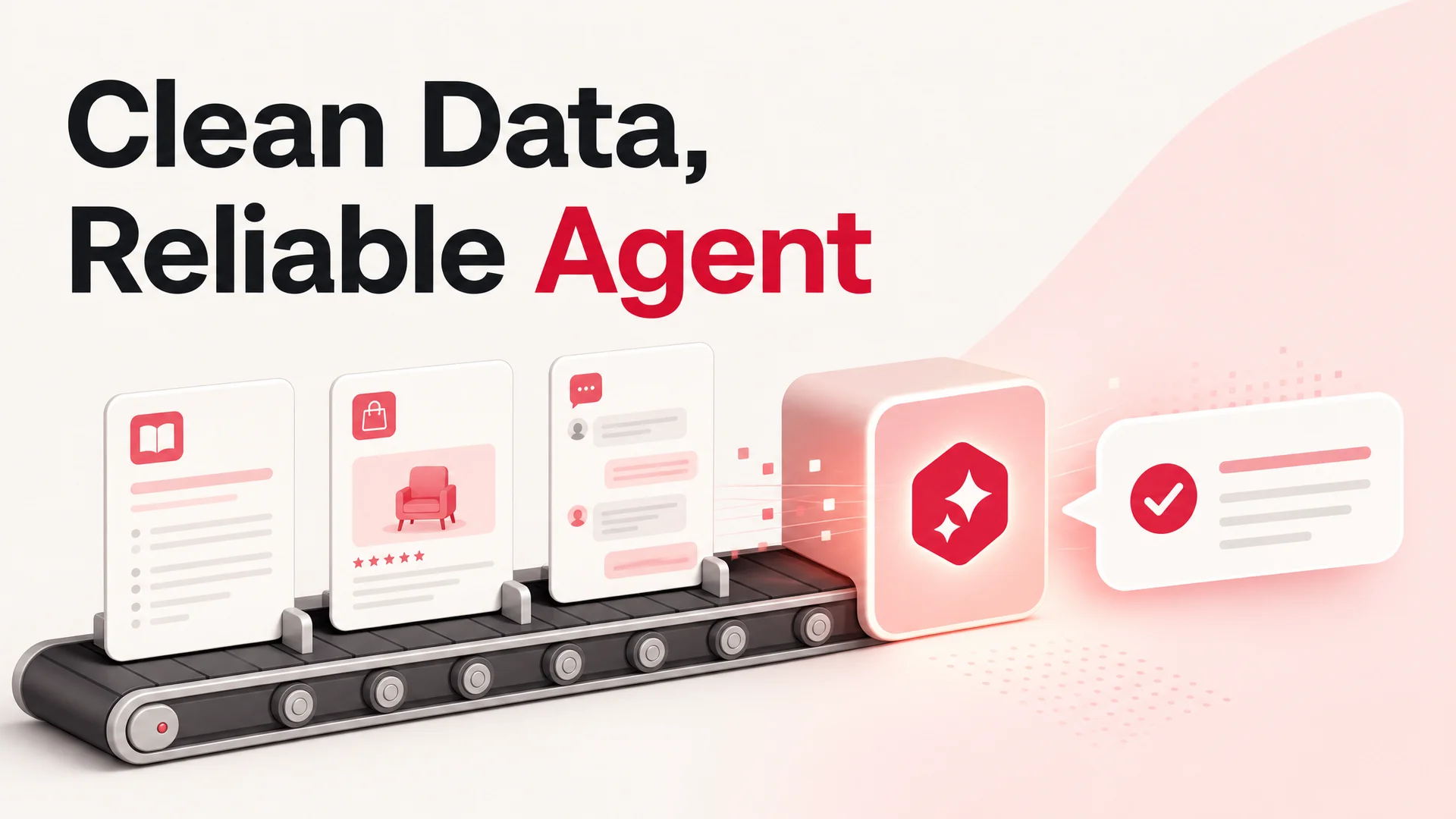
Every AI support agent runs on the same fuel: the content you feed it. Pick the right model and the wrong data, and you get a confident-sounding bot that escalates more tickets than it resolves. Pick the right data and even a mid-tier model will outperform a frontier model trained on garbage.
That second sentence is more true in 2026 than it has ever been. Open-weight models like DeepSeek V4, MiniMax M2.7, and GLM-5.1 have closed most of the quality gap with closed frontier models, and Claude Opus 4.6 and Sonnet 4.6 now ship with a 1M-token context window at no surcharge. Long context, agentic tool-use, and reasoning are commodities. The remaining differentiator - the one your customers actually feel - is whether the agent has been pointed at clean, current, well-structured information about your business.
This guide is about how to do that part well. It is the work that decides whether your AI agent feels like a teammate who read the docs or a stranger who read the internet.
Why your data quality outranks your model choice
A common mistake when teams start building an AI support agent is to overweight the model and underweight the corpus. They will spend three weeks debating GPT-5.5 Pro versus Claude Opus 4.7 versus Gemini 3.1 Ultra, then point whatever wins at a help center that has been silently rotting for two years. The result is predictable: the agent confidently quotes a 2023 pricing page, references a feature that was sunset six months ago, and contradicts itself across consecutive turns.
The reason is simple. A modern frontier model is, in effect, a very capable junior hire who has read every public document on the internet but knows nothing specific about your company. The only way it learns your refund window, your SLA, your enterprise plan limits, your shipping carrier rules, is by reading the corpus you give it. If that corpus is contradictory, the model will hallucinate consistency. If it is stale, the model will sound out of date. If it is full of marketing copy, the model will sound like a brochure when a customer asks for a tracking number.
The mechanics of this are worth understanding. When a customer message arrives, the agent retrieves the most relevant chunks from your training sources and uses them as grounding for its reply. Two things can go wrong here. First, the retrieved chunks can be wrong or contradictory - and the model has to pick one. Second, the right chunks can be missing entirely - and the model has to either say "I don't know" or, worse, improvise. Both failure modes trace back to data, not to the model.
Before getting tactical, here is the short version of what poor training data does to a live support agent:
- Contradictions become coin flips. Your help docs say returns are accepted within 30 days. Your product page says 14. The agent picks one, the customer relies on it, and your team eats the difference at the end of the month.
- Stale content becomes confident misinformation. Old prices, retired SKUs, and deprecated features get repeated to every customer who asks until somebody catches it. By then it has been said hundreds of times.
- Coverage gaps become hallucinations. When a top-twenty question is missing from your sources, the model fills the void with a plausible answer. Plausible is not the same as correct.
- Inconsistent voice breaks the brand. A casual product page paired with a formal legal disclaimer gives you an agent that sounds like two different people on consecutive turns. Customers notice.
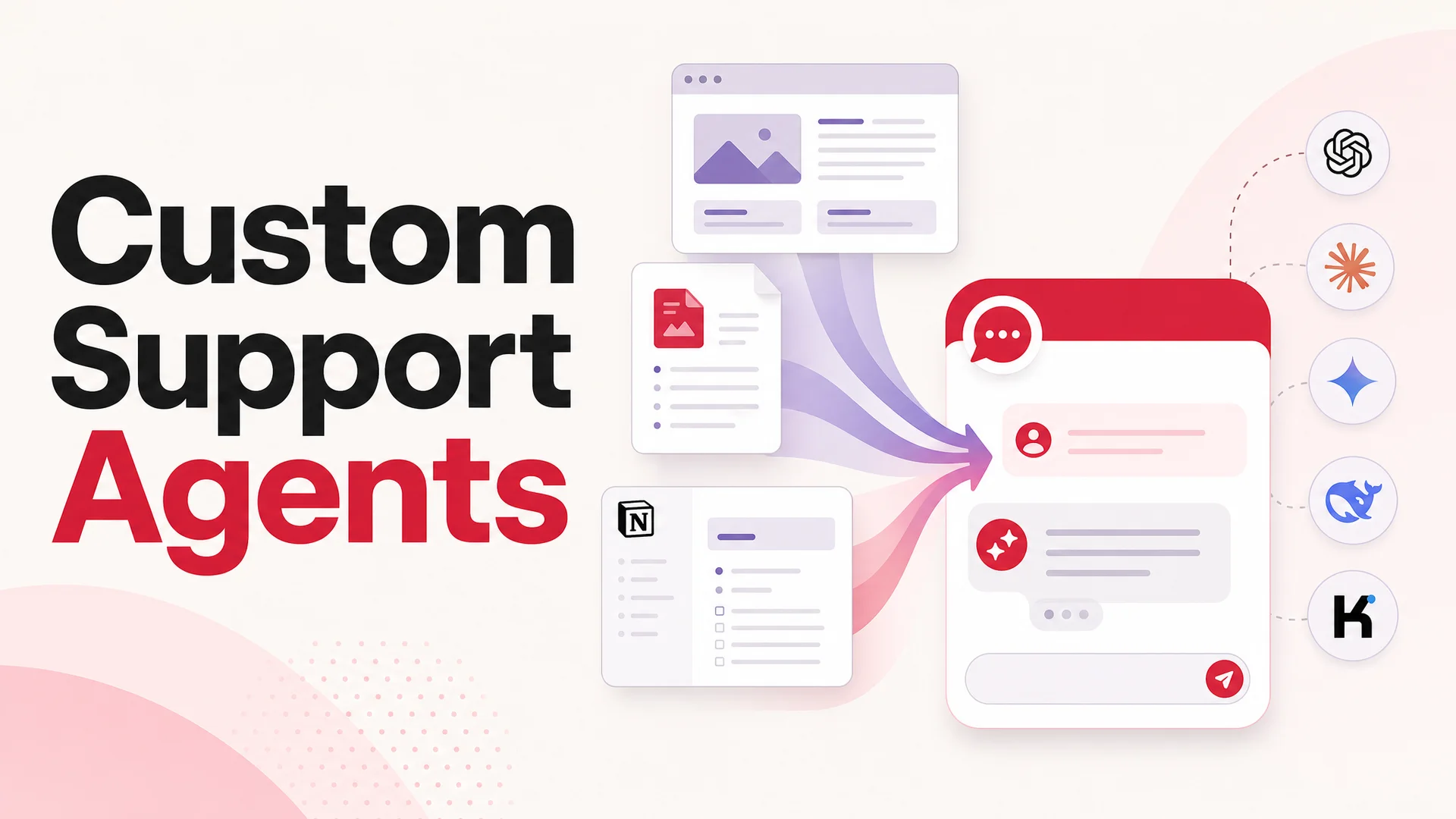
Berrydesk gives you precise control over what the agent learns from. You decide which docs, sites, Notion pages, Drive folders, and YouTube transcripts make the cut. The agent stays inside that boundary. Hallucination rates drop because the surface area for error drops.
The pre-training audit: what to fix before you upload anything
Cleaning your data does not require a data team. It requires the same kind of attention you would give a new support hire's onboarding doc - except this hire reads the entire library on day one and remembers every contradiction.
1. Inventory what you actually have
Start by listing every place your support content lives: the public help center, the marketing site's FAQ, the product changelog, internal Notion runbooks the support team uses, macros and saved replies in your ticketing tool, and any standalone PDFs that get sent to customers. Most teams discover during this step that they have three to five overlapping sources and no canonical one.
Flag the obvious problems as you go:
- Articles that quote pricing or plan limits that no longer apply
- Multiple documents that answer the same question with slightly different specifics
- Guides that assume a customer is on a deprecated UI
- Anything that has not been touched in more than six months and lives in a category you have shipped changes to
The point is not perfection. The point is catching the issues that would confuse a smart new hire - because those are the exact same issues that will confuse a model.
2. Pick one source of truth per topic
Most teams do not have a content problem; they have a fragmentation problem. The return policy lives in four places, each slightly different. The shipping rules live in three. Pick one canonical version per topic and consolidate everything else into it. If you have three articles on password resets, merge them into one clear, complete guide and train the agent on that.
Duplicate content does not make the agent smarter. It makes retrieval ambiguous. When two chunks rank similarly and disagree on the specifics, the model has to break the tie - and there is no good way for it to know which version is current. Eliminating duplicates is one of the highest-leverage things you can do, and it costs nothing but discipline.
3. Structure for retrieval, not for reading
Modern agents do better with content that is shaped for them. That means clear headings, short paragraphs, and direct answers near the top of each section. A 2,000-word essay where the actual answer is buried in paragraph nine is harder to retrieve cleanly than a tight 300-word doc that leads with the answer.
A few practical rules that pay off:
- Break long articles into focused sections with descriptive H2/H3 headings - these often become the retrieval anchors.
- Lead with the answer, then add the context. Customers and models both prefer it.
- Keep formatting consistent across docs so retrieval does not have to fight your stylistic variation.
- Cut jargon where you can, and define it once where you cannot.
- Keep specifics - numbers, dates, eligibility criteria - in the same paragraph as the topic, not split across sections.
If you are using Berrydesk's Q&A training, this matters even more. A precise question paired with a precise answer is the cleanest possible signal. The agent does not have to guess which paragraph of a 1,500-word article you meant; you told it.
4. Mine your tickets to find the real gaps
Pull the last ninety days of conversations from your ticketing tool and cluster them by intent. Compare that distribution against your training corpus. There is almost always a long tail of questions that customers ask all the time and that nobody has ever written a doc for, because they were handled ad hoc by a human.
These gaps are where AI agents fail most visibly. A customer asks something straightforward, the agent has nothing to ground on, and the conversation ends in a frustrated escalation - or, worse, a confidently wrong answer.
Closing these gaps is the highest-impact pre-launch task you can do. Write clear, complete answers for the top twenty to thirty questions you keep finding in tickets and add them to the corpus. In Berrydesk, you can attach these as manual Q&A pairs for the cases where you want exact wording, alongside the broader doc and site sources that handle the long tail.
5. Treat the corpus as a living thing
Your training data is not a one-time setup. Products ship, prices move, policies change, regulations shift. An agent referencing last quarter's plan tiers is a liability.
Set a recurring cadence - monthly for fast-moving teams, quarterly for stable ones - to walk through the corpus and prune what is stale. Wire updates into your release process so that whenever marketing changes a price, support updates a policy, or product retires a feature, the agent's sources are updated in the same week. Berrydesk lets you re-sync sources on demand and on a schedule, so this becomes a checkbox in your launch process rather than a separate project.
The model layer: what changed in 2026, and what it means for your data
Here is where the data conversation intersects with the model conversation, because the answer is no longer "use the biggest model and hope."
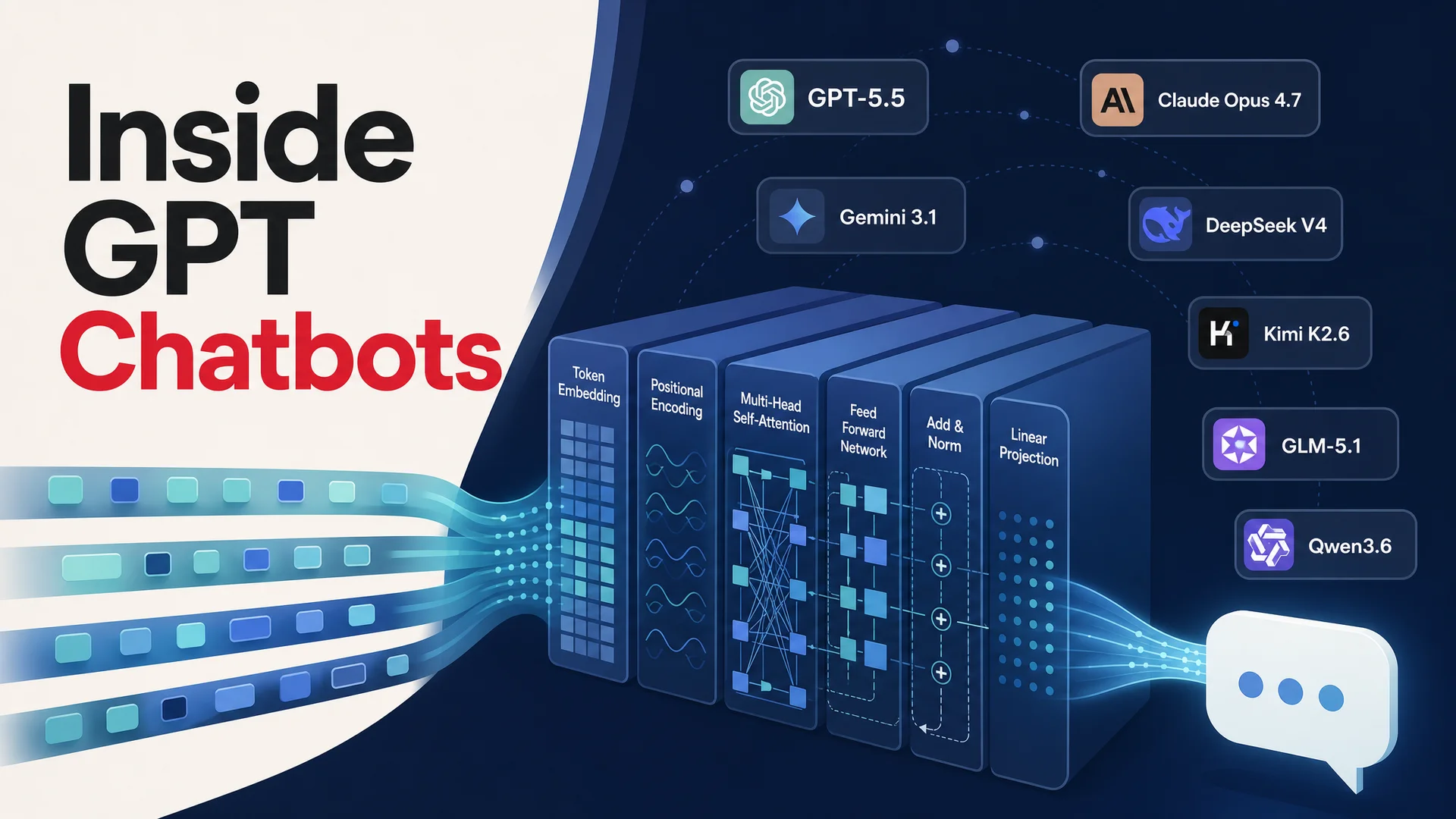
The 2026 lineup looks like this. On the closed side, GPT-5.5 and GPT-5.5 Pro added parallel reasoning in April, Claude Opus 4.7 leads complex coding at 64.3% on SWE-Bench Pro, and Gemini 3.1 Ultra holds a 2M-token context with native multimodality. On the open side, the cost story has been rewritten: DeepSeek V4 Flash runs at $0.14 per million input tokens and $0.28 per million output tokens, MiniMax M2.7 hits production-grade benchmarks at roughly 8% the cost of Claude Sonnet at twice the speed, and GLM-5.1 - MIT-licensed, trained entirely on Huawei Ascend chips - beats GPT-5.4 and Claude Opus 4.6 on SWE-Bench Pro. Moonshot's Kimi K2.6, Alibaba's Qwen 3.6 family, and Xiaomi's MiMo-V2-Pro round out the open frontier with serious agentic capability and 1M-token contexts.
Two practical consequences for your data strategy:
Long context is a tuning lever, not a substitute for clean data. A 1M- or 2M-token window means you can stuff an entire knowledge base, full conversation history, and policy docs into a single prompt without aggressive retrieval engineering. RAG becomes optional for many cases. But "optional" is not "irrelevant" - feeding 800,000 tokens of contradictory garbage into the prompt produces contradictory garbage out, just at higher cost and latency. Long context rewards clean corpora and punishes messy ones harder than short context did, because the model has more rope.
Routing beats picking. The smart deployment in 2026 is not "we use Claude" or "we use GPT." It is a router that sends routine, narrow-intent traffic - order status, password resets, plan questions - to a cheap open-weight model like DeepSeek V4 Flash or MiniMax M2.7, and escalates the hard cases - multi-step troubleshooting, edge-case policy questions, anything requiring AI Actions like a refund or a booking - to Claude Opus 4.7, GPT-5.5 Pro, or Gemini 3.1 Ultra. Berrydesk supports this directly: you can pick the model per-agent or per-flow, mix open and closed, and reserve frontier spend for the queries that actually need it.
The data implication: your corpus needs to serve both ends of that ladder. The cheap model handling ninety percent of traffic needs answers it can copy almost verbatim - which means your top-intent questions need crisp, well-structured Q&A. The frontier model handling the hard ten percent needs richer, more nuanced source material that supports reasoning across documents.
Common mistakes that quietly hurt accuracy
Even teams that take the audit seriously tend to trip on a few predictable things:
Uploading everything because you can. Crawling your entire marketing site, blog archive, careers page, and investor relations section does not make a smarter agent. It makes a noisier one. The retriever now has to decide whether a press release from 2023 is more relevant than your refund policy. Restrict the corpus to content that directly helps customers, and put your blog and marketing pages in a separate source - or skip them entirely.
Ignoring voice and tone. Your agent's personality is partly a function of the documents it learned from. If half your sources are terse internal runbooks and half are breezy marketing pages, the agent will switch registers between turns. Pick a target voice, audit your highest-traffic sources against it, and rewrite the outliers. This is mostly a writing problem, not a model problem.
Skipping the post-launch review. Going live is the start of the data work, not the end. Every week, sample twenty real conversations - both resolved and escalated - and read them. Look for the same patterns you would in a new support hire's first month: confident wrong answers, missed intents, awkward phrasing. Push the fixes back into the corpus. Berrydesk's analytics surface unresolved conversations and low-confidence answers so you can find these without manually reading thousands of chats.
Treating Q&A pairs as optional. File uploads and site crawls scale fast and cover broad ground, but they give you less control over phrasing. For your top twenty intents - the ones that drive the most volume and where a wrong answer is most expensive - write explicit Q&A pairs. Use crawls and uploads for breadth; use Q&A for precision. The combination outperforms either approach alone.
Forgetting the agentic layer. In 2026, an AI support agent is not just a question-answering machine. It books appointments, processes refunds, looks up orders, and updates accounts. The data those actions read from - your CRM, your order system, your billing platform - is part of the corpus too, even though you do not "train" on it directly. If your CRM has dirty contact records or your order system has duplicate SKUs, the agent will surface those problems to customers. Clean the data the actions touch with the same rigor you clean the docs the agent reads.
Open-weight versus closed frontier: a quick trade-off
A question that comes up on every Berrydesk deployment: should we use an open-weight model for the support agent, a closed frontier model, or both? Quick guidance:
- Closed frontier (GPT-5.5, Claude Opus 4.7, Gemini 3.1 Ultra): Best raw quality on hard, multi-step reasoning. Best tool-use reliability for AI Actions involving money or irreversible state changes. Higher per-token cost. Right for escalations, complex troubleshooting, and any flow where a wrong answer is expensive.
- Open-weight frontier (DeepSeek V4, GLM-5.1, Kimi K2.6, Qwen 3.6, MiniMax M2.7, MiMo-V2-Pro): Cost-collapse for routine traffic. MIT/Apache licenses on several variants make on-prem and air-gapped deploys realistic for regulated industries. Lower per-token cost by an order of magnitude or more. Right for narrow-intent, high-volume questions and for environments where data residency matters.
The right answer for most support deployments is "both, behind a router." Your data needs to be good enough that even the cheaper model can answer correctly from it. If it is, the cost-per-resolution math gets very attractive very fast.
Why all this work pays off
Clean data does not just make your AI accurate. It changes the economics of support. When the agent resolves correctly the first time, your team stops drowning in repetitive tickets and gets pulled into the cases that actually need a human. CSAT goes up because customers get fast, confident answers. Ticket volume goes down because the agent stops creating new tickets through bad resolutions. Cost per resolution drops because you can route more confidently to cheaper models.
With Berrydesk, clean inputs translate to:
- No fabricated answers - the agent stays inside the corpus you defined.
- No contradictory replies - because you collapsed the duplicates before launch.
- No off-brand voice - because you rewrote the outliers.
- AI Actions - bookings, refunds, payments, lookups - that fire on accurate context.
When the business changes, you update the sources and re-sync. No re-platforming, no model re-training, no rebuild.
If you want to see what a support agent looks like when it is built on data you actually trust, start a Berrydesk agent for free. Connect your docs, point it at your help center, drop in your top Q&A pairs, pick a model - and ship something your customers will not have to apologize for.
 Berrydesk
Launch a support agent that learns only what you approve
- Train on docs, sites, Notion, Drive, and YouTube - your sources, your scope
- Route routine traffic to cheap open-weight models, escalate to frontier when it counts
Set up in minutes

Chirag Asarpota is the founder of Strawberry Labs, the team behind Berrydesk - the AI agent platform that helps businesses deploy intelligent customer support, sales and operations agents across web, WhatsApp, Slack, Instagram, Discord and more. Chirag writes about agentic AI, frontier model selection, retrieval and 1M-token context strategy, AI Actions, and the engineering it takes to ship production-grade conversational AI that customers actually trust.