A Berrydesk agent is one of the most flexible pieces of software you can drop into a business in 2026. You pick the brain - GPT-5.5 or 5.5 Pro from OpenAI, Claude Opus 4.7 or Sonnet 4.6 from Anthropic, Gemini 3.1 Ultra or Pro from Google, or open-weight frontier models like DeepSeek V4, Moonshot Kimi K2.6, Z.ai GLM-5.1, Alibaba Qwen 3.6, MiniMax M2.7, or Xiaomi MiMo-V2-Pro. You feed it your docs, your help center, your Notion workspace, your Drive folder, or your YouTube library. You brand the widget, wire up AI Actions for the things you actually want it to do, and ship it to a website, Slack, Discord, WhatsApp, or all of them at once.
That flexibility is the point. The same agent that answers refund questions on a checkout page can also field "what is our PTO policy" inside Slack at 11pm. Below are eight ways teams are putting Berrydesk agents to work right now - with notes on which models tend to fit best, what to actually configure, and where the failure modes are.
1. Turn Slack into a self-serve knowledge layer
Most companies have a knowledge problem long before they have a customer support problem. Policies live in Notion. Engineering decisions live in Linear comments. The "real" answer to most questions lives in the head of one tenured employee who is in five other meetings. The same Berrydesk agent you deploy on your marketing site can sit inside Slack and route around that bottleneck.
Connect your Notion workspace, your Drive, your Confluence pages, or any internal URLs. Drop the agent into the channels where questions actually get asked - #engineering, #people-ops, #sales-questions. When a teammate types "what is the refund cap for an enterprise customer on the legacy plan," the agent answers inline, with citations back to the source doc. No DMs. No "asked and answered last Tuesday." No half-remembered policy.
Two practical notes. First, choose a long-context model for this job. Claude Opus 4.6 and Sonnet 4.6 ship with a 1M-token window at no surcharge, Gemini 3.1 Ultra extends that to 2M, and DeepSeek V4 Flash gives you 1M context at $0.14/$0.28 per million input/output tokens. That means an agent can hold an entire policy handbook, a quarter of meeting notes, and the current question in one prompt - RAG becomes a tuning lever, not a hard requirement. Second, decide what the agent is not allowed to summarize. Compensation conversations, performance reviews, and security incident threads should be excluded at the source connector, not patched at the prompt layer.
A nice secondary use is meeting recall. If your team drops transcripts into a shared folder, the agent can produce a clean summary of yesterday's standup, surface the action items that got assigned to a specific person, or answer "what did we decide about the pricing rework on the April 18 call." It is the kind of small, frequent ask that costs a real human five minutes and the agent five seconds.
2. Onboarding and ongoing internal support
The first two weeks of a new hire's life are 80% the same questions in different orders. How do I request equipment? What is the holiday policy? Where are the brand assets? Who owns the staging environment? A Berrydesk agent trained on your handbook, IT runbooks, and HR policies absorbs almost all of that load.
The point is not to replace the human onboarding plan - buddy systems and 1:1s still matter - but to give a new hire somewhere to ask the embarrassing questions. The thirty-eighth time someone asks "how do I get a Figma seat" should not require interrupting a person. With AI Actions, the agent can do better than answer: it can file the access request, create the IT ticket, or invite the user to the right Slack channels in one step.
Long-tenured employees benefit just as much. The agent becomes a single front door for "do we still use that vendor," "what is the latest brand color for accent purple," or "where is the form for international travel reimbursement." HR and Ops stop being a human switchboard for trivia. Pair this with an escalation rule - anything that involves PII, comp, or a legal flag goes straight to a person - and you avoid the failure mode where the bot tries to be helpful in a conversation that needs a human.
3. Automate the front line of customer support
This is the most common deployment, and the one where the model landscape has shifted the most in 2026. A year ago, putting a frontier closed model on every customer message was expensive enough that teams rationed AI to the simple tickets. That math has flipped. A typical Berrydesk deployment now routes routine traffic - order status, password resets, refund eligibility, store hours - to a low-cost open-weight model like DeepSeek V4 Flash or MiniMax M2.7, and reserves Claude Opus 4.7, GPT-5.5 Pro, or Gemini 3.1 Ultra for the harder escalations and tone-sensitive replies.
The numbers matter. DeepSeek V4 Flash at $0.14/$0.28 per million tokens in/out makes a typical resolution cost a fraction of a cent. MiniMax M2.7 advertises roughly 8% the price of Claude Sonnet at twice the speed. That is not a "we should look at AI for support someday" budget - that is a "we should run AI on every ticket and tier up only when the agent is unsure" budget. Berrydesk's model picker is built for exactly that pattern: route by intent, by customer tier, or by confidence, and let the routing change as model prices change underneath you.
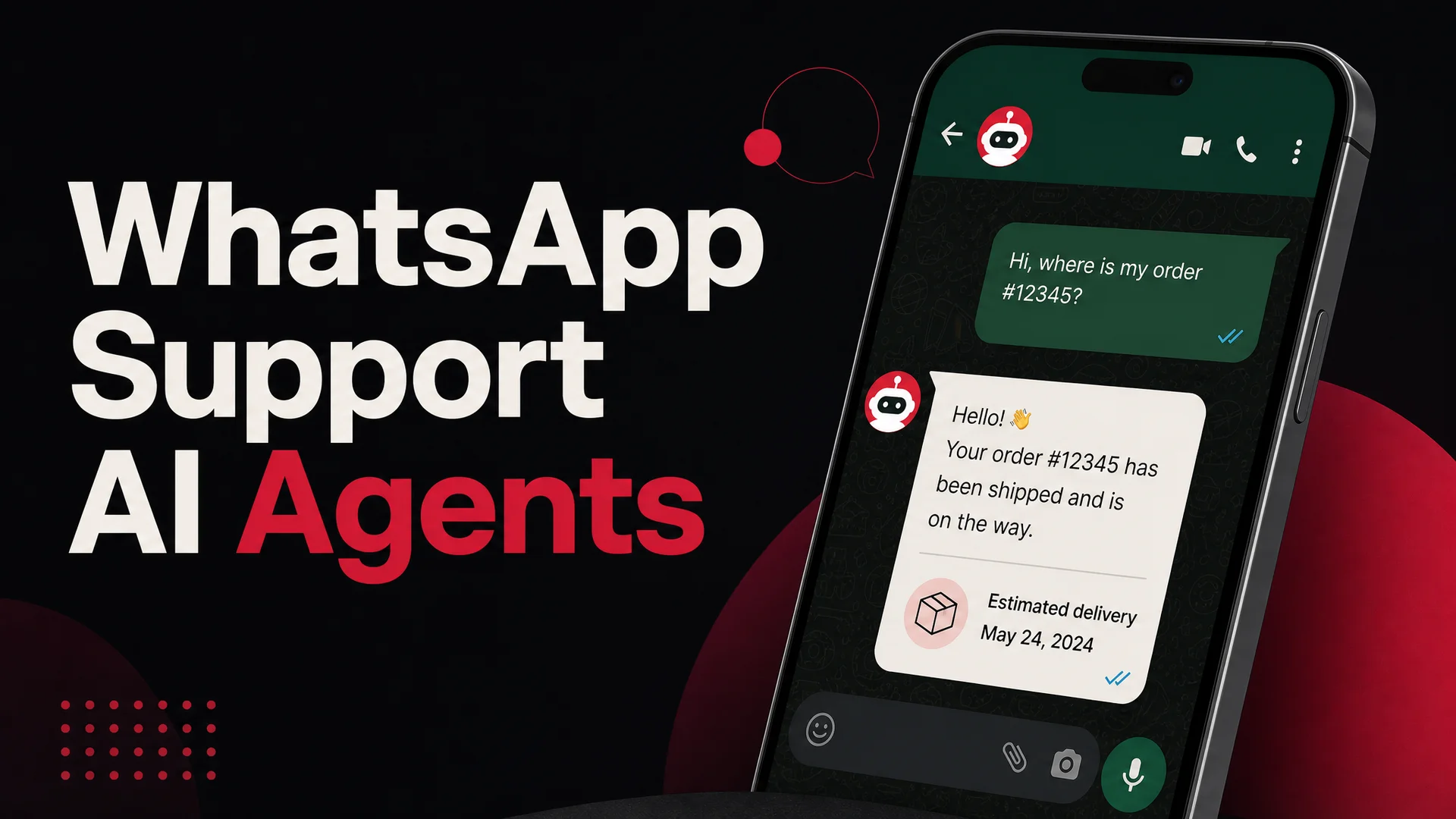
What does the agent actually handle? On the read side: order status, return policy, shipping windows, plan comparisons, "where is the unsubscribe link," "do you ship to Spain." On the write side, with AI Actions: create a return label, look up an order in Shopify or Stripe, reschedule a delivery, apply a one-time discount within a policy guardrail, book a follow-up call. The point of AI Actions is that the agent is no longer just answering - it is closing tickets end to end. Agentic models like Claude Opus 4.7, Kimi K2.6, GLM-5.1, Qwen 3.6, and MiMo-V2-Pro have made this reliable enough for production, where eighteen months ago most "AI agent" demos broke the second a real customer threw an off-script question at them.
A short word on what to watch out for. Agents that try to be helpful at all costs will hallucinate refund eligibility, invent shipping speeds, or quote a discount that does not exist. The fix is structural, not stylistic: scope the agent to a clear set of AI Actions with hard guardrails (max refund amount, allowed SKUs, region rules), give it a clean handoff path to a human, and instrument every conversation so you can see where it is over-promising. The model is only one variable; the action surface is the more important one.
4. Build a personal AI assistant tuned to you
Not every Berrydesk agent has to ship to customers. The same builder lets you spin up a private agent for your own work - closer to a custom GPT, but with more control over the model, the data sources, and the deployment surface.
A few patterns we see. A multilingual founder uploads style references and recent emails and uses the agent as a drafting partner that writes in their voice across English, Spanish, and Portuguese. A graduate student trains an agent on lecture notes, slide decks, and a textbook PDF, then quizzes it before exams. A consultant feeds in every proposal they have written in the last three years and uses the agent to draft the first cut of the next one. A researcher pipes a shared Drive folder of papers into a long-context model like Gemini 3.1 Ultra (2M tokens) and uses the agent as a literature review assistant that can hold dozens of papers in working memory at once.
The trade-off worth naming: a personal agent earns its keep once your data is in it. Spend an hour up front cleaning up the source folders, removing the half-finished drafts, and giving the agent a system prompt that describes what you want - your style, your typical output length, your defaults. The agents that disappoint people are the ones that got a raw dump of a Drive folder and a one-line instruction.
5. Productize the repetitive parts of a service business
If you are a coach, consultant, therapist, lawyer, accountant, or any other expert-driven service, your time is the bottleneck and also the product. AI Actions in a Berrydesk agent let you peel off the front end of the engagement - intake, qualification, scheduling, prep - without diluting what makes your work valuable.
Picture a leadership coach. The intake conversation usually covers the same ground: what is the person trying to change, what have they tried, what does success look like, what is their availability. Trained on your methodology and prior session notes (with the right consent), an agent can run that intake conversationally, capture the answers in a structured form, recommend a starter exercise from your library, and book the first paid session via the calendar action. The coach gets a fully prepared brief instead of a cold first call, and never spends a billable hour on logistics.
The same shape works for a tax accountant who runs the agent through document collection in February, a therapist who uses an agent for between-session check-ins and psychoeducational resources (with clear scope: not a substitute for the clinician), or a boutique law firm that runs a triage agent on the website to figure out whether a prospect is actually a fit before a partner spends time on a call. The right model here is usually one of the agentic, tool-use leaders - Claude Opus 4.7, GPT-5.5 Pro, or Kimi K2.6 - because the value is in the actions, not just the words.
6. Use the agent as a continuous data collection layer
Surveys are blunt. NPS forms are gamed. Usability tests are expensive and small-N. A conversational agent on your site or product is a richer instrument than any of them - every chat is a structured interview if you bother to look at it that way.
A Berrydesk agent can run a five-question discovery script when a visitor lingers on the pricing page. It can ask a churning customer one open-ended question on the cancel flow and get a real answer instead of a checkbox. It can collect feature requests in the actual language users use, tagged by plan and segment, and pipe them into the team that owns the roadmap. The model picks up nuance that a Likert scale never will - confusion vs. frustration, "missing feature" vs. "feature exists but is unfindable," price objection vs. fit objection.
The lift is in what you do with it. Tag conversations by intent, ship a weekly digest to product and support leadership, and close the loop by linking the change you made back to the conversation that surfaced it. An agent that quietly hoovers up signal nobody reads is worse than no agent at all. An agent whose transcripts shape next quarter's roadmap is one of the best research tools a small company can run.
7. Run lead generation as a conversation, not a form
Most B2B lead forms have a 2–5% conversion rate, and the leads that come through them are barely qualified. Replacing the form with a conversational agent does two things at once: it lifts conversion (people will answer five questions in a chat that they will not type into a form) and it lifts quality (you can ask follow-ups based on what they said, instead of trying to write the perfect static form).
Set the qualification questions explicitly. Use case, team size, budget range, timeline, current tooling, who else is involved in the decision. Tell the agent how to behave - friendly, brief, no hard sell, gracefully drop a question if the visitor seems annoyed. Tell it when to push for a meeting and when to just hand off a useful resource. Tell it where to write the result: directly to your CRM as a qualified lead, or to a Slack channel where a human SDR picks it up within minutes.
A few practical wins this unlocks. The agent answers off-hours, so a prospect who shows up at 9pm on a Sunday gets a real conversation instead of a contact form. It captures the content of intent - "we are switching off Zendesk because their pricing changed" is worth a thousand "interested in a demo" radio buttons. And because Berrydesk supports a wide model menu, you can pick a model that matches your brand voice: Claude Opus 4.7 if you want carefully-worded and warm, GPT-5.5 if you want crisp and direct, GLM-5.1 or Qwen 3.6 if you need an open-weight model for cost or compliance reasons.
8. Grow your email list through conversation, not popups
The interstitial newsletter popup has a job to do, and the job is "get closed in under a second." A conversational signup flow is a fundamentally better experience and a measurably better converter, because the signup is the natural end of a useful exchange instead of a tax someone pays before they read your post.
Train the agent on your brand voice, your best content, and the actual reason someone would want your newsletter. When a visitor asks the agent a question - "do you have a guide on switching CRMs," "what's your take on AI vs. human support" - the agent answers, and at a sensible moment offers to send a related deeper resource by email. That is a value-first ask. Compared to a popup, it converts a different audience: people who were already engaged, who self-selected into the topic, and who you are now allowed to email about exactly that thing.
A small structural tip: do not let the agent ask for an email in the first message. Two or three substantive turns first, then the offer. The agents that feel pushy are almost always the ones whose system prompt told them to capture an email by turn one.
A short word on picking the model
The hardest decision in any of these eight use cases is which model to point at the problem. Three rules of thumb after a year of watching deployments:
- Cost-sensitive, high-volume tasks - bulk support, FAQ answers, internal Slack lookups - go to open-weight workhorses. DeepSeek V4 Flash, MiniMax M2.7, and Qwen3.6-35B-A3B all sit in the right cost-per-resolution band and are strong enough for routine traffic.
- Tone-sensitive or escalation-grade conversations - refund disputes, customer-success outreach, anything a CFO will read - pick Claude Opus 4.7, GPT-5.5 Pro, or Gemini 3.1 Ultra. The cost premium is worth it on a small share of traffic.
- Agentic, multi-step work - bookings, complex order flows, research-style tasks, autonomous fixes - favor models built for tool use. Kimi K2.6 (12-hour autonomous sessions, 300-agent swarms), GLM-5.1 (8-hour plan-execute-test-fix loop, 58.4 SWE-Bench Pro), Claude Opus 4.7 (64.3 SWE-Bench Pro), and Qwen 3.6 are all designed for this regime.
Berrydesk's model picker is meant to be a dial you adjust over time, not a one-time choice. As open-weight frontier models keep landing - DeepSeek V4 in April, Kimi K2.6 in April, GLM-5.1 in April, Qwen 3.6 in April, MiniMax M2.7 in April, MiMo-V2-Pro weights opening in April - the right answer for any given workflow is going to keep moving. Build the use case once; let the routing keep getting cheaper underneath you.
Where to start
If you are reading this and trying to figure out which one of these eight to actually try first, the honest answer is: pick the use case where the manual cost is most visible to you right now. If your support inbox is on fire, start with #3. If you just hired three people and HR is getting buried, start with #2. If your sales team is leaking leads into a contact form they never read, start with #7. Each one of these takes a single afternoon to stand up in Berrydesk; the leverage compounds across the rest as you go.
Ready to try it? Spin up your first agent at berrydesk.com - pick a model, point it at your data, brand the widget, and ship it. No credit card, no model lock-in, and no need to commit to a use case you have not tested yet.
 Berrydesk
Launch your AI agent in minutes
- Pick from GPT-5.5, Claude Opus 4.7, Gemini 3.1, DeepSeek V4, Kimi K2.6, and more
- Train on docs, websites, Notion, Drive, or YouTube - deploy to web, Slack, WhatsApp, Discord
Set up in minutes

Chirag Asarpota is the founder of Strawberry Labs, the team behind Berrydesk - the AI agent platform that helps businesses deploy intelligent customer support, sales and operations agents across web, WhatsApp, Slack, Instagram, Discord and more. Chirag writes about agentic AI, frontier model selection, retrieval and 1M-token context strategy, AI Actions, and the engineering it takes to ship production-grade conversational AI that customers actually trust.