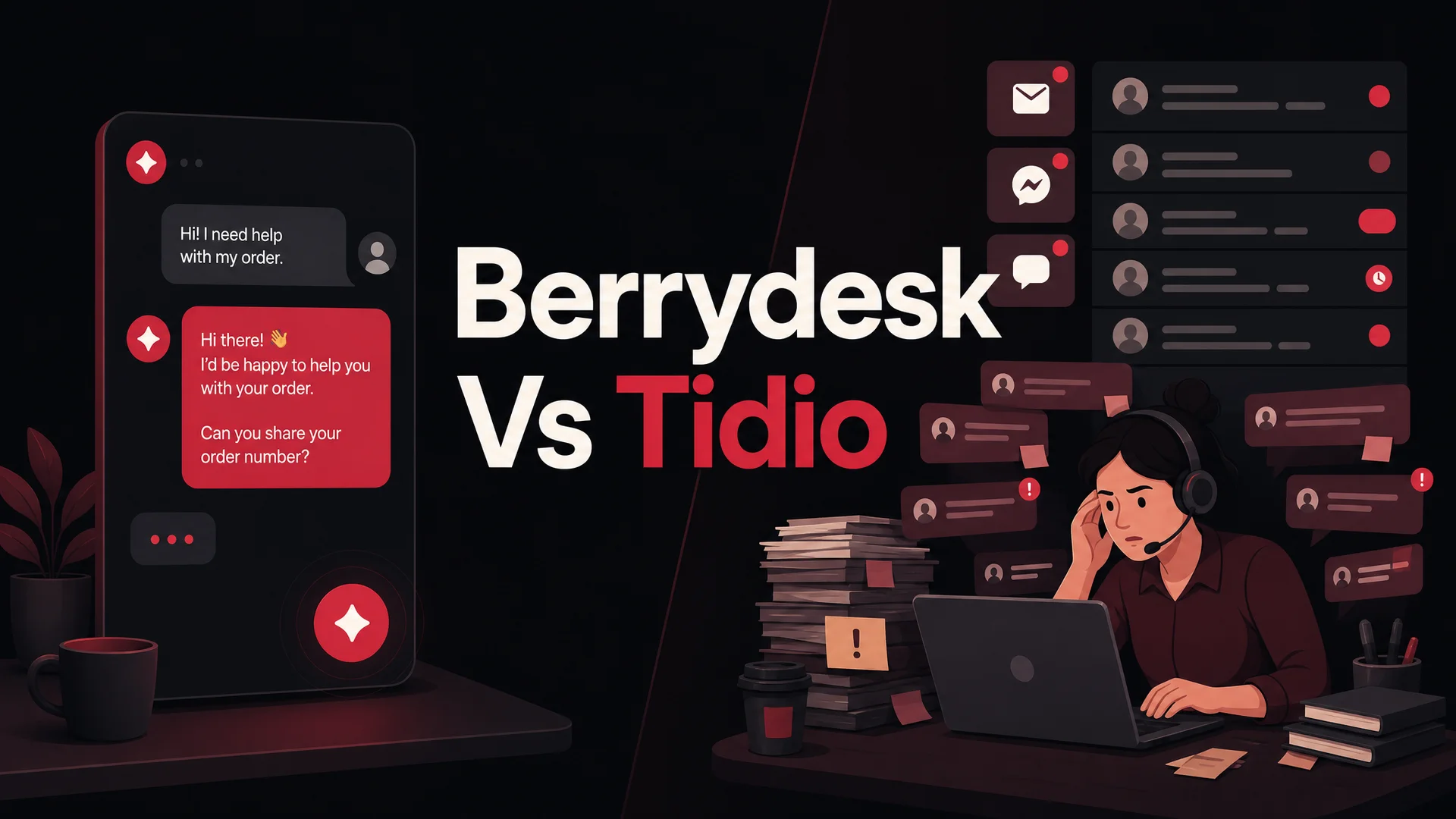
Picking a chat tool in 2026 is really a question about the shape of your support team. Are you trying to deflect 70%+ of incoming questions with an autonomous AI agent that already reads your docs, books appointments, processes refunds, and never sleeps - or are you running a small human team that needs a tidy inbox, a few canned bot flows, and a place to handle email and Messenger in one window?
That fork in the road is exactly what makes the Berrydesk vs Tidio comparison interesting. Both have "chat" in the description, but they solve different problems. Berrydesk is an AI agent platform built around the latest frontier and open-weight models - Claude Opus 4.7, GPT-5.5, Gemini 3.1 Ultra, DeepSeek V4, Kimi K2.6, GLM-5.1, Qwen 3.6, MiniMax M2 - and the AI Actions that turn those models into real workers. Tidio is a long-running customer communication suite: live chat, ticketing, email, and a visual flow builder, with AI bolted on alongside.
This post unpacks where each one shines and where each one starts to creak, so you can pick with intent.
A 30-Second Snapshot
Berrydesk and Tidio sit on opposite ends of the chatbot spectrum.
Berrydesk is the AI-first option. You pick a model, point it at your knowledge sources (websites, PDFs, Notion, Google Drive, YouTube transcripts, help-center exports), brand the widget, wire up AI Actions for things like booking and payments, and deploy to your site, Slack, Discord, WhatsApp, and other channels. The whole flow is built around one idea: an autonomous agent that resolves tickets end-to-end, not a script that gates conversations behind a "talk to a human?" button.
Tidio is the all-in-one option. You get a live-chat widget, a shared inbox that pulls in email and social messages, a drag-and-drop bot builder for simple flows, and an AI assistant module called Lyro that handles a slice of conversations. It's optimized for small teams who want their humans on the front line and the bot acting as a triage layer.
The cleanest mental model is this: Berrydesk replaces the first line of support; Tidio organizes the people who are already there.
Setup and Time-to-Live
Both platforms can be live the same day, but the work you do during setup looks very different.
With Berrydesk, the four-step flow is the entire onboarding. Choose a model - most teams start with Claude Sonnet 4.6 or DeepSeek V4 Flash for the cost-to-quality ratio, then route hard questions to Opus 4.7 or GPT-5.5 Pro. Drop in your sources and let the platform ingest them. Customize the widget colors, persona, and tone. Add AI Actions for the tasks that matter to your business: cancel an order, schedule a demo, look up a shipment, take a payment. Embed the snippet, or push to Slack, Discord, or WhatsApp. Most teams have a real, knowledge-grounded agent answering tickets within an afternoon.
Tidio asks you to set up more pieces because it's doing more things. You configure the chat widget, route incoming channels into the unified inbox, define agent seats and permissions, build out conversation flows in the visual editor, and then layer Lyro on top for AI replies. None of these steps are hard, but the platform genuinely expects you to assemble it like a CRM-lite, not flip a switch.
If your goal is "answer customer questions automatically by tonight," Berrydesk gets there with less assembly. If your goal is "give my three support reps a cleaner workspace by next week," Tidio's broader scope starts to earn its keep.
The Model Layer (and Why It Matters in 2026)
This is where the gap between an AI agent platform and an inbox-with-AI shows up most clearly.
Berrydesk gives you direct access to the frontier of LLMs. The closed-source leaders - GPT-5.5 and GPT-5.5 Pro with parallel reasoning, Claude Opus 4.7 at 64.3% on SWE-bench Pro, Gemini 3.1 Ultra with a 2M-token context window - are all selectable as the brain behind your agent. So is the new wave of open-weight frontier models that have collapsed the cost of running production support: DeepSeek V4 Flash at $0.14 / $0.28 per million input/output tokens, MiniMax M2.7 at roughly 8% the price of comparable closed models at twice the speed, Kimi K2.6 with 12-hour autonomous coding sessions and native video input, GLM-5.1 at 58.4 on SWE-Bench Pro under MIT license, Qwen 3.6 for strong on-prem deploys, and Xiaomi MiMo-V2-Pro with a 1M context.
In practice, this means you can route 80–90% of routine tickets - refund status, password resets, "where is my order," shipping policy - to a cheap, fast open-weight model and reserve premium reasoning for the 10% of conversations that actually need it. Pre-2026 platforms forced everyone onto one model and one bill; that era is over.
Tidio's Lyro uses an integrated model under the hood, but you don't pick it, you don't swap it, and you don't route between cheap and expensive tiers. That's a perfectly fine trade if you only need light AI support inside a primarily human workflow. It is a poor trade if AI deflection is the whole point of the deployment.
Knowledge, Context, and AI Actions
Modern support agents stand or fall on two things: what they know, and what they can do.
For knowledge, Berrydesk pulls from documents, full website crawls, Notion workspaces, Google Drive folders, and YouTube channels. Combined with the 1M-token context windows now standard on Claude Sonnet 4.6, DeepSeek V4, and others - and 2M tokens on Gemini 3.1 Ultra - an agent can hold an entire mid-sized knowledge base, the full prior conversation, and your refund policy in-context at once. RAG becomes a tuning lever, not a hard requirement.
For action, Berrydesk's AI Actions turn the agent into a real worker. Bookings, payment flows, order lookups, ticket creation in your existing helpdesk, CRM updates - these run inside the conversation, not as a handoff. Agentic tool-use models like Kimi K2.6, GLM-5.1, Qwen 3.6, and Claude Opus 4.7 have made these flows reliably production-ready in 2026; they used to be demoware.
Tidio's bot builder handles deterministic flows well - "if user clicks pricing, show pricing card" - and Lyro can answer FAQs from a knowledge base. It is a much smaller surface area than agentic Actions, and it is built around the assumption that anything important still lands in a human's inbox.
Channels and Deployment
Berrydesk deploys the same agent to your website widget, Slack, Discord, WhatsApp, and other channels with no per-channel rebuilding. The agent's brain, sources, and Actions follow it everywhere.
Tidio's strength is breadth on the inbox side: it pulls email, Messenger, Instagram, and live chat into one human-facing workspace. The bot side covers fewer channels, but the inbox side covers more. Worth weighing if your team currently lives in five tabs.
Pricing
Berrydesk uses a usage-based model that scales from a free tier (great for testing) through paid plans that bundle messages, training sources, and team seats. Because you can route to cheap open-weight models for routine traffic - fractions of a cent per resolution on DeepSeek V4 Flash or MiniMax M2 - the marginal cost of high-volume deflection has dropped dramatically in the last twelve months.
Tidio prices around seats and conversations, with Lyro AI replies billed separately on top. For a three-person team handling a few hundred chats a month, it's straightforward; for a team trying to automate ten thousand conversations, the math gets less friendly.
Where Each One Wins
Choose Berrydesk if:
- You want to deflect a real percentage of tickets, not just route them. AI Actions and frontier-model reasoning get you 70%+ resolution on routine traffic in most deployments.
- You care about model choice - picking the right LLM for the right job, on cost as much as quality.
- You ship to multiple channels (web, Slack, Discord, WhatsApp) and want one agent to power all of them.
- You're a SaaS, e-commerce, fintech, or services company where the bottleneck is volume, not headcount.
Choose Tidio if:
- You're a small team where humans handle most conversations and you mostly want a tidy multi-channel inbox.
- You don't need agentic Actions, model routing, or deep knowledge ingestion - a basic FAQ bot in front of live chat is enough.
- Your support model is "humans first, automation as a polite assistant."
Common Pitfalls to Avoid
A few things to watch for whichever way you go:
Don't pick a platform on feature lists alone. Run a one-week pilot with real tickets. Deflection rate, escalation accuracy, and customer satisfaction matter more than checkbox parity.
Don't lock yourself into a single model. The 2026 landscape moves quickly - DeepSeek shipped V4 in April, GLM-5.1 in early April, Kimi K2.6 mid-April, MiniMax M2.7 in April. A platform that lets you swap and route is a platform that ages well.
Don't underestimate the value of agentic Actions. A bot that can answer questions is half the win; one that can act - book the meeting, refund the order, update the address - is the whole win.
The Bottom Line
If your support strategy in 2026 is "humans, with a small bot in front," Tidio's integrated inbox is a sensible home base. If your strategy is "AI agent first, humans on the hard escalations," Berrydesk gives you the model selection, knowledge ingestion, AI Actions, and multi-channel deployment to actually pull it off - and the open-weight pricing curve to make it economical.
Try it the way you'd try any infrastructure decision: with real traffic, on real tickets, for a real week. Spin up a free Berrydesk agent, point it at your help center, and see how much of your queue it can quietly resolve before lunch.
 Berrydesk
Launch your AI agent in minutes
- Pick from GPT-5.5, Claude Opus 4.7, Gemini 3.1, DeepSeek V4, Kimi K2.6 and more
- Train on docs, sites, Notion, Drive, or YouTube - no engineers required
Set up in minutes

Chirag Asarpota is the founder of Strawberry Labs, the team behind Berrydesk - the AI agent platform that helps businesses deploy intelligent customer support, sales and operations agents across web, WhatsApp, Slack, Instagram, Discord and more. Chirag writes about agentic AI, frontier model selection, retrieval and 1M-token context strategy, AI Actions, and the engineering it takes to ship production-grade conversational AI that customers actually trust.