Black Friday 2026 lands on Friday, November 27, and the spike it produces no longer looks like a single bad day in a support queue - it looks like a multi-week siege. Cyber Week starts earlier every year, mobile carts spread shopping across time zones, and customers expect the same answer in five seconds at 3 a.m. that they would get from a human at noon. Most support teams cannot hire their way through that wave. The ones that scale calmly are the ones that put an AI agent in front of the queue and route everything through it before a human ever sees a ticket.
This post is a working guide to doing that well: what the modern AI support stack actually looks like in 2026, where it earns its keep on Black Friday, what to put in place before traffic spikes, and the mistakes that turn a "we deployed an AI agent" announcement into a "we rolled it back" Slack thread on the Monday after.
The shape of Black Friday traffic has changed again
The era of doors-busting at 5 a.m. is mostly memory. Online sales have grown every year of this decade, mobile share is now the default, and a meaningful fraction of buyers begin researching gifts as early as the first week of November. The practical effect for support: the curve is wider and flatter, but the peak is taller. You no longer get one bad Friday - you get fifteen days where ticket volume is two to four times the normal baseline, with a vertical spike on the weekend itself.
Three patterns matter for support teams planning the season:
- Pre-event volume is real volume. Roughly a third of buyers start shopping before Black Friday week proper. Pre-sales questions about sizing, compatibility, shipping windows, and discount eligibility hit the same agents who later have to handle order issues.
- Mobile dominates the conversation. A large share of Black Friday chats now arrive on a phone screen, often through WhatsApp, Instagram DMs, or an in-app chat widget rather than a desktop web pop-up. Agent UX has to assume tiny screens and one-thumb typing.
- Order-status questions still consume the queue. "Where is my order," "did my discount apply," and "can I change my address" remain the dominant ticket types - work that is fully automatable but, when ignored, eats every minute your human agents have for genuinely complex problems.
Why traditional staffing models break here
Seasonal hiring used to be the default fix: spin up contractors in October, train them on your help center, and pray. That math gets worse every year. Training costs are real, ramp time eats half the season, and a human agent can hold one or two chats at a time before quality cratters. When peak hits, queues balloon, response times stretch past ten minutes, and a meaningful share of would-be buyers abandon the chat - and often the cart with it. The cost of a missed sale during peak is ten to fifty times the cost of a missed sale in February, which is what turns "support is a cost center" thinking upside down for the holidays.
The AI agent is not a replacement for that team. It is the layer in front of it that absorbs the routine work, escalates the messy stuff with full context, and gives your humans back the bandwidth to handle the small fraction of conversations where judgment actually matters.
What an AI support agent actually does in 2026
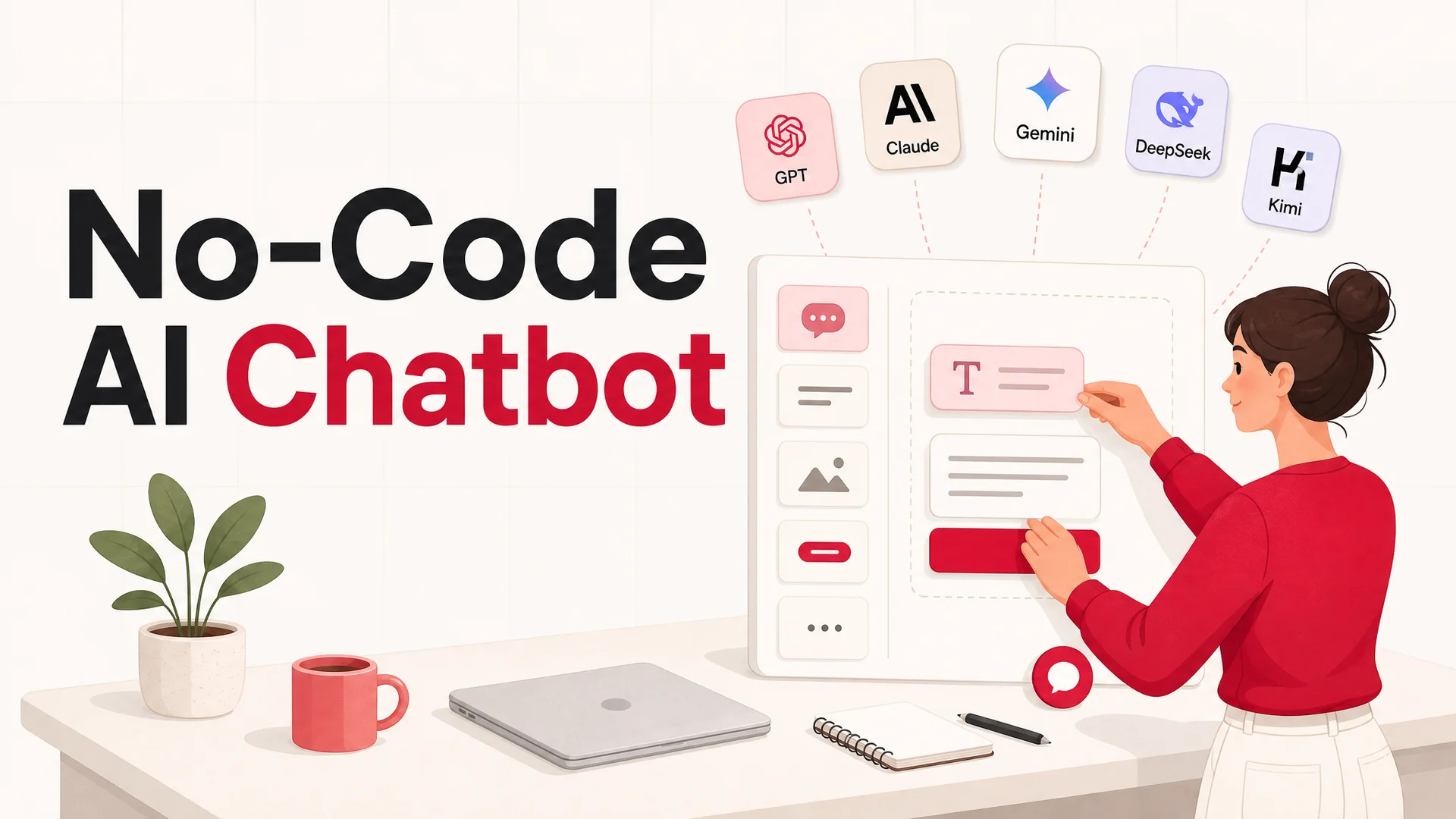
The phrase "AI chatbot" still gets used, but it badly underdescribes what is shipping into production this year. The current generation of support agents - the kind you build on a platform like Berrydesk - combines four things that used to be separate: a frontier language model, a fresh index of your knowledge base, a tool layer that can take real action in your other systems, and a deployment surface that runs across web, mobile, and messaging apps from one configuration.
The model layer alone has changed beyond recognition since the last time most teams looked. Closed-frontier options now include GPT-5.5 and GPT-5.5 Pro with parallel reasoning, Claude Opus 4.7 leading SWE-bench Pro at 64.3% for genuinely hard reasoning work, and Gemini 3.1 Ultra with a 2M-token context window and native multimodal handling for text, image, audio, and video. Open-weight frontier models - DeepSeek V4 Flash, Moonshot Kimi K2.6, Z.ai's GLM-5.1, Alibaba Qwen 3.6, MiniMax M2.7, Xiaomi MiMo-V2-Pro - have collapsed the price of running a competent agent so far that routing decisions, not raw model capability, are now the main lever for unit economics. DeepSeek V4 Flash sits at $0.14 / $0.28 per million input/output tokens. MiniMax M2 runs at roughly 8% the price of Claude Sonnet at twice the speed.
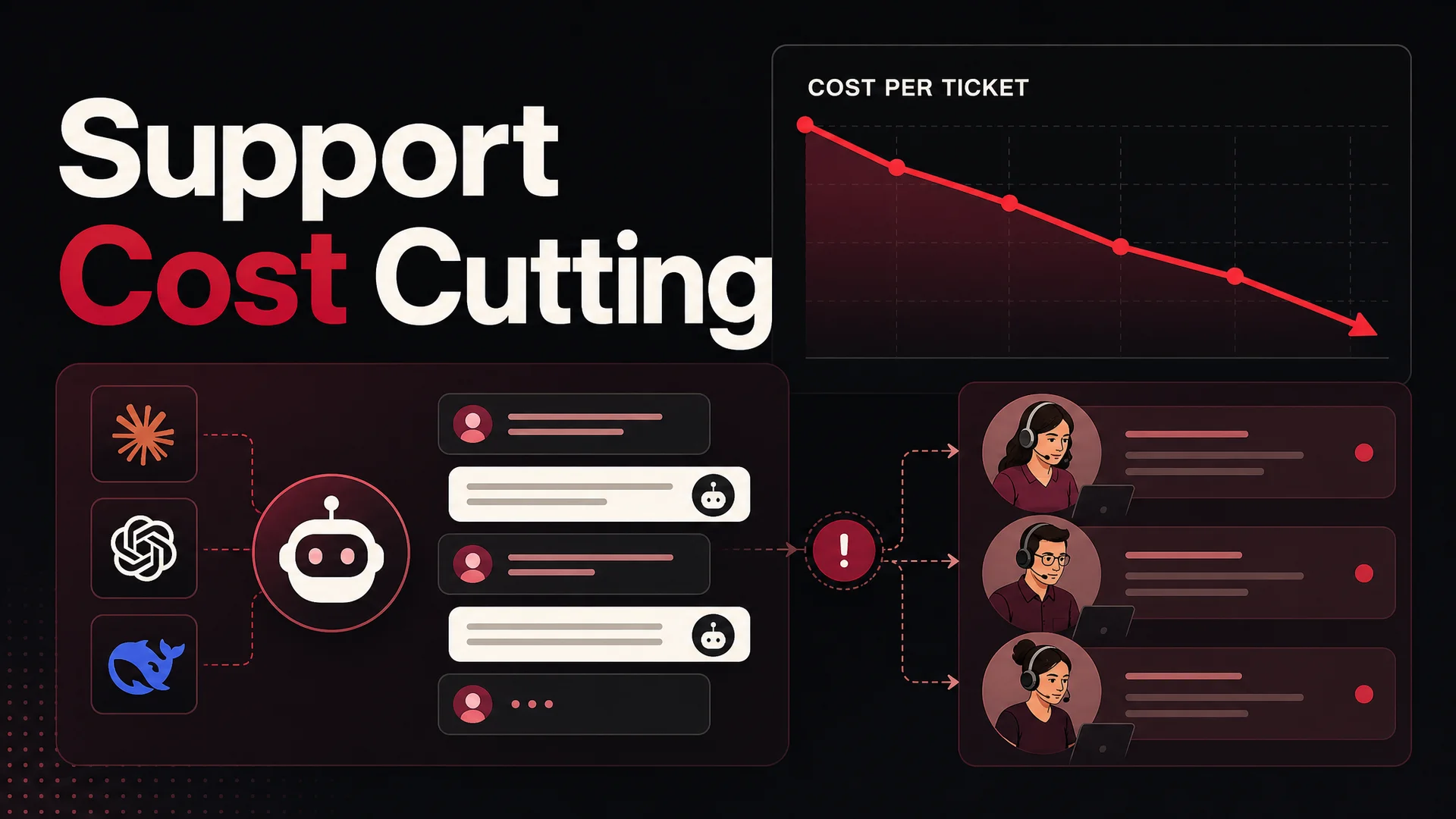
For Black Friday, the combination matters more than any single model. A well-built support agent routes routine intent - order lookups, return policy questions, sizing help - to a fast, cheap open-weight model and reserves a frontier model for the small slice of conversations that actually need it: angry escalations, multi-step troubleshooting, anything where a wrong answer turns into a chargeback. That routing alone is what turns "AI support is too expensive at our volume" into "AI support is the cheapest line item we have."
Always-on, every channel, every language
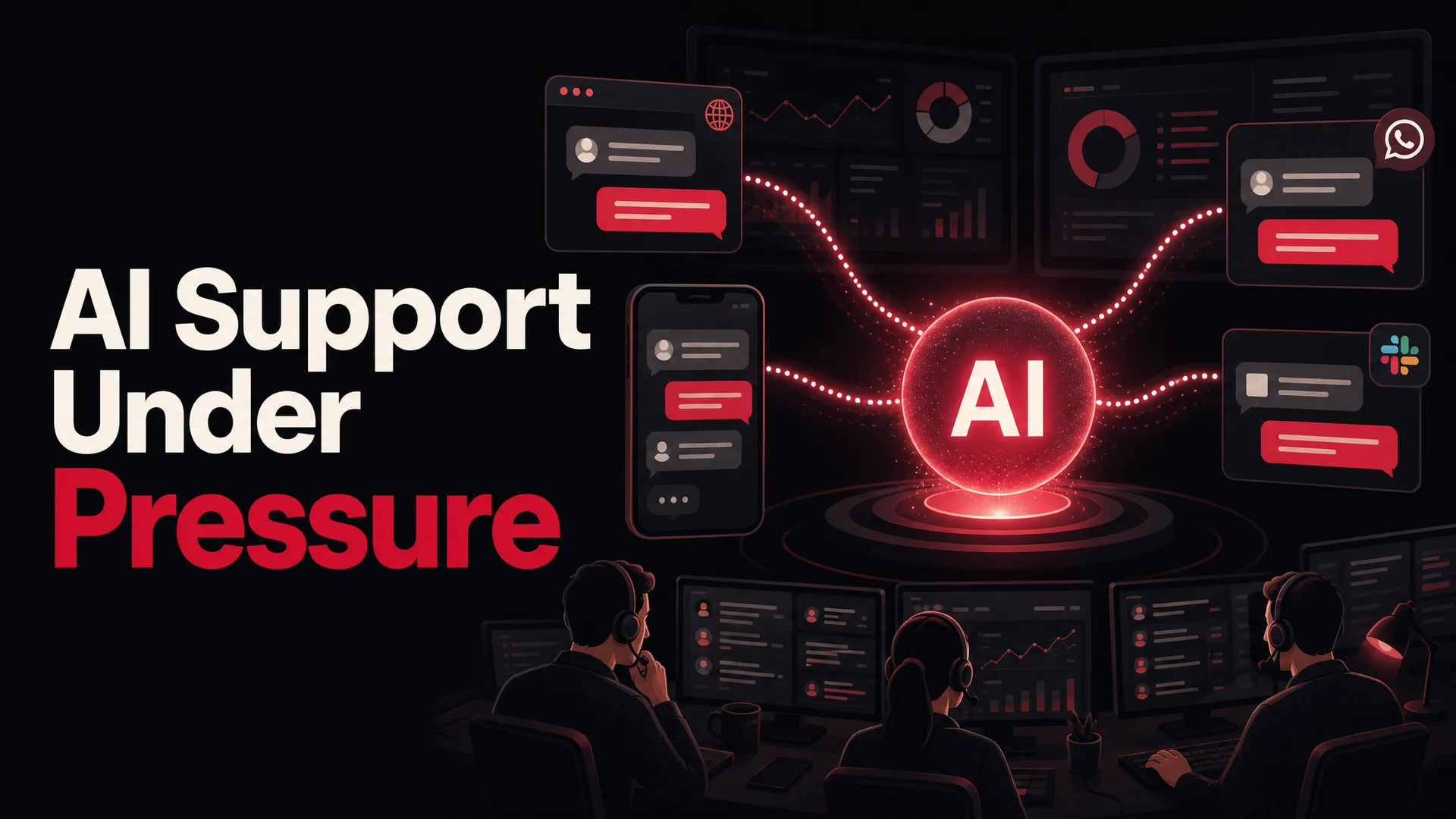
The single most-cited benefit of AI support is also the most concrete: it is awake at 3 a.m. on the Saturday after Thanksgiving, and it speaks every language your buyers do without you hiring for it. In 2026 that "always-on" claim has teeth that older bots did not. A modern agent can simultaneously hold thousands of conversations, each with the full context of the customer's order history, the merchant's current promotions, and the live state of the shipping system, all without queue times. Berrydesk customers typically deploy the same agent to a website widget, Slack, Discord, WhatsApp, Instagram DMs, and an in-app SDK from a single source - so a customer who starts a question on mobile and finishes it on desktop sees the same conversation, not a fresh greeting from a different bot.
Cost math that finally pencils
The recurring number quoted from older studies - that AI can take roughly a third out of support cost - is conservative for 2026. With routed open-weight models handling the majority of traffic and frontier models reserved for hard work, most teams that move from human-only to AI-first staffing for tier-one volume see far steeper drops. The savings are not really about tokens. They are about not hiring 40 seasonal contractors, not paying a third-party BPO for surge capacity, not training people in October who quit in January, and not losing carts to ten-minute response times during peak.
The honest version of the math:
- Per-resolution cost. With a routed setup, an automated resolution often clears under a cent in model costs even on long, multi-turn conversations.
- Deflection rate. A well-tuned agent on a typical ecommerce help center deflects most tier-one volume before any human sees the ticket, and a sizable chunk of tier-two as well once AI Actions are wired up.
- Bandwidth recovered for humans. The agents you keep stop drowning. Their average handle time on the conversations they do see often goes up - because they are now handling the harder ones - but their throughput goes up faster, and CSAT on the conversations that reach them improves because every chat arrives with a clean summary and the customer's history attached.
Where AI agents directly drive revenue, not just deflect tickets
Reframing AI support as a sales channel is not marketing - it is what the better deployments actually look like. Once an agent is in front of every conversation, it sees more first-party intent than any other system in your stack, and a few capabilities turn that visibility into revenue.
Recommendations grounded in the actual catalog
A modern agent can sit on top of your product catalog, your inventory feed, and the customer's browsing and purchase history, and answer "what should I get my dad who likes whisky for under $80" with a real, in-stock answer that respects the active Black Friday discount. The lift over a generic recommendation widget shows up in average order value: customers who get a relevant suggestion from a confident-sounding source convert at meaningfully higher rates than those who scroll a "you may also like" carousel.
The mechanics matter. With a 1M-token context window - now standard on Claude Sonnet 4.6 and DeepSeek V4 - the agent can hold the entire active catalog and the customer's full session in one prompt without RAG gymnastics. RAG becomes a tuning lever for very large catalogs, not the only way the agent can see your inventory.
Cart rescue at the moment of doubt
The most expensive point in the funnel is the cart page where a buyer pauses. AI agents reduce that abandonment by intervening exactly there: a proactive trigger fires when a customer dwells on the cart or hovers over the back button, and the agent answers the unspoken question - usually shipping speed, return policy, or "is this discount applied correctly." On Berrydesk, this is built as an AI Action: the agent can check the live shipping ETA against the customer's zip, confirm the discount is on, and offer a one-time top-up incentive if the cart total is borderline.
AI Actions: the part that turns chat into work
This is the unlock that separates the 2026 generation of support agents from earlier chatbots. Older bots could answer questions. Modern agents - built on tool-using models like Claude Opus 4.7, Kimi K2.6, GLM-5.1, and Qwen 3.6 - can take action. On a Berrydesk deployment that means the agent can:
- Look up an order and read back the shipping status from your OMS.
- Generate a return label and email it to the customer.
- Apply a goodwill credit, after checking the customer's lifetime value against a rule.
- Reschedule a delivery window through your carrier integration.
- Take a payment for an upgrade or bundle inside the chat.
- Book an installer slot or a follow-up call without a hand-off.
Each of these used to require a human agent and a CRM tab switch. With AI Actions, they happen inside the chat, in seconds, and the agent only escalates when the action is outside policy or fails. For Black Friday traffic that ratio - actions taken vs. tickets escalated - is the single most important number on the dashboard.
Omnichannel as a default, not a project
A common mistake is to think of "AI on the website" and "AI in WhatsApp" and "AI in the Shopify app" as separate builds. They are the same agent in different deployment surfaces. Done right, you train once on your sources - docs, help center, Notion, Google Drive, YouTube, public site - pick a base model, set your tone, and ship that agent to every channel with the same configuration. Customers who ask about a return on Instagram and follow up on the website pick up where they left off. Operators who measure deflection see one funnel, not five.
Putting it together: a 30-day Black Friday plan
Most teams that succeed at peak did the work in October. The rest did it in late September. If you are reading this in May with seven months of runway, you are early enough to do this calmly. The order matters.
1. Train the agent on the right sources
Start with your help center, your product catalog, and your shipping and returns policy. Add the long-tail: ticket macros, internal "how to handle X" runbooks in Notion, FAQ docs in Google Drive, video walkthroughs on YouTube, and recent ticket transcripts. Berrydesk ingests all of these natively. Then write a tone document - not a prompt, a one-page brand voice guide - and feed it as a system message. The agent will sound like you, not like a generic bot.
2. Layer in AI Actions early
Pick the three to five actions that account for the majority of your routine ticket volume. For most ecommerce teams that means: order lookup, shipping ETA, return initiation, discount eligibility, and address change. Wire them to your OMS, your shipping API, and your billing system. Test each one end-to-end. Add policy guardrails - a credit limit, an exception list - so the agent fails gracefully rather than improvising.
3. Choose a model strategy
Decide your default. For most teams in 2026, a routed setup looks like: a fast open-weight model (DeepSeek V4 Flash, MiniMax M2.7, Qwen3.6-35B-A3B) for the majority of conversations, with automatic escalation to Claude Opus 4.7 or GPT-5.5 Pro when the agent flags a hard intent. Regulated industries that need on-prem deploys can run GLM-5.1 (MIT license), Qwen3.6-27B (Apache 2.0), or MiMo-V2-Pro (MIT) inside their own VPC and never send a token to a third-party API.
Three things to think about when choosing:
- Cost vs. accuracy on your traffic. Model leaderboards do not tell you how a model performs on your specific support tickets. Run a few hundred real conversations through each candidate and measure resolution rate.
- Latency under load. A model that wins benchmarks but takes seven seconds per response will lose Black Friday. Test under simulated peak load.
- Compliance posture. If you process payment data or health information, your model choice has to be one that lets you audit data handling end-to-end. Open-weight on-prem deploys make this much simpler than they used to be.
4. Wire the escalation path
The single best predictor of a successful AI support deployment is a clean handoff to humans. Define when the agent escalates: low confidence, explicit customer request, abusive language, refund requests over your threshold, anything legally sensitive. When it does escalate, it must hand the human a one-paragraph summary, the customer's history, and a suggested resolution. Berrydesk handoffs include all three by default.
5. Stress test before the wave
Run a load test. Run a quality test. Have your CX team adversarially try to break the agent - ask trick questions, demand impossible refunds, claim issues that are not in your policy. Patch what fails. Then run the same test against an evolving traffic mix that approximates Black Friday: spiky volume, multilingual queries, mobile-formatted messages, screenshots attached to tickets.
6. Watch the right dashboards on the day
Not all metrics are useful in real time. The ones that matter on November 27:
- First-response time. Should be near-zero. If it climbs, the model is overloaded - switch to a faster route.
- Resolution rate without escalation. Your deflection number, live.
- Action success rate. Order lookups returning errors? Fix the OMS integration before the queue notices.
- Escalation backlog. This is what your humans see. If it grows, your guardrails are too tight or your action catalog is too small.
- CSAT on completed conversations. Sample, do not survey everyone, but watch the trend.
Common pitfalls that turn a launch into a rollback
Most failed deployments fail in the same handful of ways. None of them are about the model.
Shipping it untrained. A bot pointed at your homepage and told to "be helpful" will hallucinate within five turns. Train it on the same content your human agents would reach for. Update it weekly during peak.
No clear escalation path. When the agent does not know how to escalate, it either invents an answer or loops the customer through dead ends. Both produce viral screenshots. The escalation rule should be explicit and visible to the team.
Over-engineering the conversation flow. Treating the agent like a decision-tree IVR - branching menus, "press 1 for returns" energy - wastes the model's strengths. Let the model handle intent. Reserve flows for the parts that need rails (payment, identity verification).
Ignoring the action layer. A bot that can only answer questions deflects pre-sales chatter and not much else. The deflection number triples once the agent can actually do the work - order lookups, refunds, bookings.
Single-model lock-in. Putting all of Black Friday on one model, especially one with rate limits, is a single point of failure. Routed deployments degrade gracefully when a provider has an outage. Single-vendor deployments do not.
Treating Black Friday as the only test. Whatever you ship in November will be your tier-one support layer in December, January, and beyond. Build it for ongoing operation, not for a sprint.
What to keep an eye on past the season
Three trends are reshaping support agents through the rest of 2026, and they are worth tracking even if you do not adopt them on day one.
Long autonomous runs. Agentic models - Kimi K2.6 with its 12-hour autonomous coding sessions, GLM-5.1's 8-hour plan-execute-test-fix loop - are bringing the same approach to support. The future "agent" handles a multi-day shipping issue end-to-end: opening tickets with the carrier, following up, escalating, closing the loop with the customer. Today this is early; by end of year it will be deployable.
Voice and video natively. Gemini 3.1 Ultra and Kimi K2.6 take video input directly. A customer who films their broken product and sends it through a chat can get a real diagnosis from the agent without a human reviewing the clip. Voice-first commerce - answering pre-sales questions on a phone call routed to an AI - is moving from demo to production.
On-prem agentic deploys. GLM-5.1, Qwen3.6, and MiMo-V2-Pro under MIT or Apache licenses make air-gapped support agents real for healthcare, financial services, and government. The capability gap between the best closed model and the best open one has narrowed enough that most regulated teams will not need to compromise meaningfully on quality to keep data on their own infrastructure.
The bottom line
Black Friday 2026 is the year AI support agents stop being a "nice addition" and become the default tier-one layer for any team taking serious peak traffic. The cost math has flipped. The action layer is real. The deployment surface is everywhere your customers are. Teams that prepare in May, June, and July will spend November watching dashboards instead of fighting fires.
If you are building toward that posture, Berrydesk lets you ship a branded support agent in four steps - pick a model from across the closed-frontier and open-weight catalog, train it on your docs, sites, Notion, Drive, and YouTube, brand the widget, wire up AI Actions for bookings, refunds, and payments, and deploy to the web, Slack, Discord, WhatsApp, and beyond. Start free, test it against a real ticket sample, and have it ready well before the wave.
 Berrydesk
Stand up your Black Friday AI agent in an afternoon
- Pick a model, point it at your help center, ship to web, WhatsApp, Slack, and Discord
- AI Actions handle order lookups, refunds, and bookings - not just FAQs
Set up in minutes

Chirag Asarpota is the founder of Strawberry Labs, the team behind Berrydesk - the AI agent platform that helps businesses deploy intelligent customer support, sales and operations agents across web, WhatsApp, Slack, Instagram, Discord and more. Chirag writes about agentic AI, frontier model selection, retrieval and 1M-token context strategy, AI Actions, and the engineering it takes to ship production-grade conversational AI that customers actually trust.