The chaos always starts the same way. It's December, traffic is up 3x, and three different conversations are happening at once: a shopper is hunting for a last-minute gift she can't quite describe, another is asking whether the order will land before the holiday, and a third is staring at a checkout error she can't make go away. Your support team is fielding all of it through the same shared inbox. The product is good. The marketing is working. The revenue leak is happening between "added to cart" and "thank you for your order."
This is where AI sales agents pulled away from the rest of the support stack in 2026. Not as a chat widget that answers FAQs, but as a small, tireless commerce employee that recommends, persuades, troubleshoots, and books money - at the speed of a page load. If you've heard the term thrown around but you're not sure what counts as one, what to look for, or how to actually ship one, this guide will walk you through the whole loop.
What an AI sales agent actually is
Strip away the marketing, and an AI sales agent is software that handles the sales-shaped parts of your customer conversations end-to-end. It greets the visitor, qualifies intent, recommends products, handles objections, follows up, and - when the shopper is ready - actually completes the transaction or hands off cleanly to a human.
Picture the best human seller you've ever hired. They listen first. They notice what someone is really asking for. They have product, policy, and pricing in their head, and they connect it to whatever the shopper just said two messages ago. Then they close.
An AI sales agent built on the 2026 model stack does a passable imitation of that for the routine 80% of conversations, and it does it at the same time across thousands of sessions. In practice, the same agent fills three roles at once:
- Salesperson. It surfaces the right SKU, bundles complementary items, and upsells the premium version when the signal warrants it.
- Support rep. It answers shipping, returns, sizing, and policy questions without a ticket queue in between.
- Checkout concierge. It removes the small frictions that kill carts - a wrong promo code, an ambiguous shipping estimate, a payment retry - and walks the buyer over the line.
Unlike a human, it doesn't sleep, doesn't have a bad Tuesday, and doesn't forget the return policy update from last quarter. It analyzes session context, personalizes on the fly, and never lets a high-intent prospect ghost into the void because the team was on PTO.
If your business sells anything - physical goods, digital products, services, subscriptions - an AI sales agent is no longer a "nice to have for big retailers." It's a default piece of the funnel.
AI chatbot vs. AI agent vs. AI sales agent
The three terms get used interchangeably and they shouldn't. The differences matter when you're choosing what to build.
AI chatbot
The classic widget. A visitor lands on your site, a small bubble pops up, and the bot answers from a fixed knowledge base.
- "What's your return policy?"
- "Do you ship to Canada?"
- "Where's your pricing page?"
It's reactive. It tells you things. That's the ceiling. Useful, narrow, and - by 2026 standards - a thin slice of what's possible.
AI agent
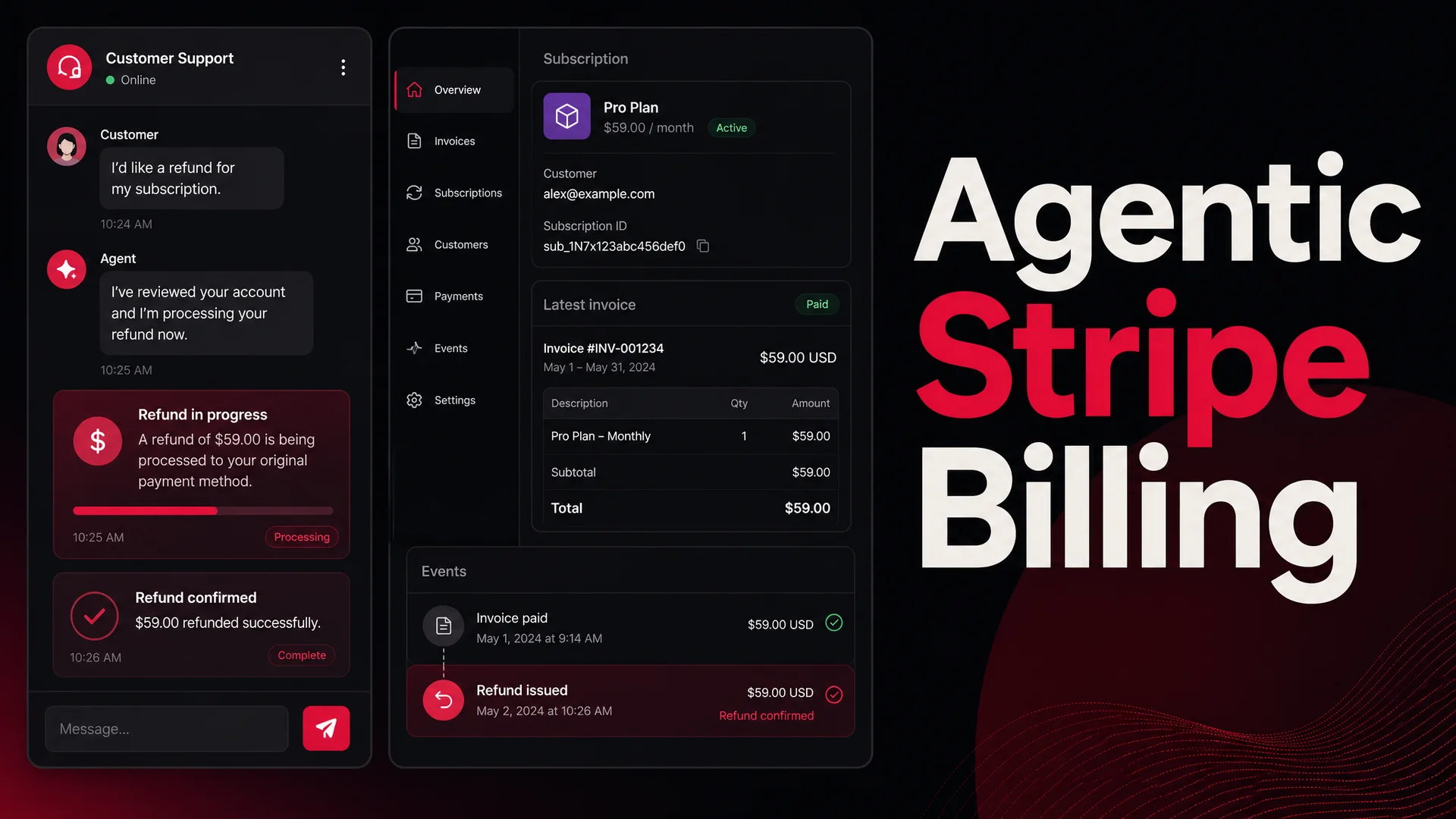
An AI agent doesn't stop at words. It takes actions inside the systems you connect to it. Same shopper, same question - "Do you have the navy linen shirt in medium?" - but the agent doesn't just say "yes." It checks live inventory, holds the size, recommends matching trousers, generates the cart, drops a Stripe link in the chat, and follows up if the shopper goes quiet.
That last leap - from responding to acting - is what defines the agentic generation of LLMs. Models like Claude Opus 4.7, GPT-5.5, Kimi K2.6, GLM-5.1, and Qwen3.6 are specifically engineered for long tool-use loops: open a tool, read the result, decide the next call, recover from a failure, finish the job. That's the technical substrate that makes "the bot completes the checkout" go from demoware to a thing you'd actually let touch your revenue.
AI sales agent
Take that agent capability and aim it specifically at conversion. That's an AI sales agent. The chatbot supports. The agent acts. The sales agent closes.
What separates a real AI sales agent in 2026
Not every product calling itself an AI sales agent earns the name. Here's what to look for if you want one that actually moves the number.
Context-aware product recommendations
A flat "best sellers" carousel doesn't count. The recommendation engine has to be a function of the conversation, not a function of last month's analytics dashboard.
The standard now: a shopper asks about a trail running shoe; the agent suggests the right cushion grade for their stated mileage, cross-sells a moisture-wicking sock pair, and floats a higher-tier model with a real reason ("this one has the rock plate you mentioned wanting"). It can lean on prior session data if the shopper is returning, but it doesn't need to - modern context windows are roomy enough that the agent can carry the full conversation in working memory and reason over it. Claude Sonnet 4.6 and Opus 4.6 ship with 1M-token windows at no surcharge; Gemini 3.1 Ultra goes to 2M; DeepSeek V4 Flash and MiniMax M2 round out the open-weight 1M club. RAG becomes a tuning lever, not a hard requirement.
Real-time assistance through the entire purchase funnel
Online checkouts die from a thousand tiny cuts. A coupon won't apply. Shipping cost shows up at the last step and changes the math. A card declines and the buyer doesn't know why. A good AI sales agent intervenes at the moment of friction, not after the abandoned-cart email has gone cold.
The shape of the intervention matters. The agent should be able to look at the cart, surface the working promo, recalculate shipping, and - if it can't fix it itself - escalate to a human with the conversation history attached. Multiply this by a few hundred near-bounces a week and the math changes quickly.
Genuine language understanding
The strongest 2026 models - GPT-5.5 Pro with parallel reasoning, Claude Opus 4.7 (64.3% on SWE-bench Pro for the technically inclined), Gemini 3.1 Pro at 94.3% on GPQA Diamond - handle vague, indirect, multi-turn requests in a way that older GPT-4-class systems simply could not. "I need something for cold weather but not too bulky for travel" turns into a coherent narrowed selection, not a retrieval miss.
Watch for: how the agent handles follow-ups ("what else matches this?"), how it copes with a switch in language mid-conversation, and how it responds when the shopper goes off-script. If it falls back to "I'm sorry, I didn't understand," you're looking at last year's tech.
Always-on coverage that doesn't feel mechanical
Coverage isn't just "the bot is online at 3am." It's the experience at 3am should be indistinguishable from the experience at 3pm. That's a function of model quality, prompt design, and how cleanly the agent hands off when it genuinely shouldn't try to answer.
For a global brand, this is table stakes. For a small team, it's the difference between losing every shopper in a different time zone and capturing them.
Action-taking, not just answer-giving
This is the core test. Can the agent:
- Add to cart and create a checkout link?
- Apply a promo, generate an invoice, refund an order?
- Book a demo or a call on the team's calendar?
- Push a high-intent lead into the CRM with full context attached?
- Trigger a Slack ping when a VIP shopper hits a snag?
If "yes" to most of these, you're looking at an AI agent. If "no," it's a chatbot wearing a costume.
Cost-aware model routing
The dirty secret of running an AI agent at scale is that you don't want to handle every conversation with the most expensive model. The good platforms route. A simple "what's your return policy?" goes to DeepSeek V4 Flash at $0.14 / $0.28 per million input/output tokens, or to MiniMax M2 at roughly 8% the price of Claude Sonnet at twice the speed. A complex multi-step refund-and-reorder flow goes to Claude Opus 4.7 or GPT-5.5 Pro. The shopper never knows. Your invoice does.
Choosing the model behind the agent
This used to be a closed-vs-open debate. In 2026 it's mostly a routing decision.
Closed frontier - Claude Opus 4.7, GPT-5.5 Pro, Gemini 3.1 Ultra. These are the models you reach for when the conversation is high-value, ambiguous, or involves multi-tool reasoning. Claude Opus 4.7 currently leads SWE-bench Pro at 64.3%, which translates into reliable behavior on long agentic loops - exactly what an AI Action like "look up order, validate refund window, issue partial refund, confirm via email" needs to survive. GPT-5.5 Pro's parallel reasoning is the natural fit for cases where the agent has to weigh two or three branches of action in parallel. Gemini 3.1 Ultra, with native multimodality across text, image, audio, and video, is the right call when the conversation involves a screenshot of a damaged product or a quick voice note from a confused shopper.
Open-weight frontier - DeepSeek V4, Kimi K2.6, GLM-5.1, Qwen3.6, MiniMax M2/M2.7, Xiaomi MiMo-V2. This is the cost-and-control story. DeepSeek V4 Flash (284B params, 13B active, 1M context) is the new default for routine support traffic - it's cheap enough that you can let it run hot. Moonshot's Kimi K2.6 is purpose-built for long agentic sessions (12-hour autonomous coding runs, swarms of up to 300 sub-agents) and is excellent at multi-step actions like complex order management. Z.ai's GLM-5.1, MIT-licensed, scores 58.4 on SWE-Bench Pro, edging out GPT-5.4 and Claude Opus 4.6 - and it was trained entirely on Huawei Ascend 910B silicon, which matters if your procurement team is paying attention to supply chains.
On-prem and air-gapped. For regulated industries - health, financial services, anything that can't send customer data over the public internet - Apache- and MIT-licensed open weights from Qwen3.6-27B, MiMo-V2, and GLM-5.1 mean an AI sales agent inside your own VPC is no longer a six-month project. It's a deploy.
The right answer for most teams: pick a default model for the long tail of conversations, and let the platform escalate to a frontier model on the cases that warrant it.
How to build an AI sales agent on Berrydesk
Building this used to mean stitching an LLM API to a vector store, a tool runtime, an analytics layer, a widget, and a deployment pipeline. With Berrydesk it's a small handful of steps end-to-end.
For this walkthrough, the goal is a sales agent for an e-commerce store that:
- Makes context-aware product recommendations
- Cross-sells and upsells with real reasoning
- Provides real-time purchase support and recovers stuck checkouts
- Answers store-specific questions with confidence
- Books demos and processes payments through AI Actions
Step 1: Create your agent
Sign up at berrydesk.com, open the dashboard, and click New Agent. Give it a name that reflects how it'll show up to shoppers - something like "Aurora" or "Storefront Concierge" beats "Bot v1."
Step 2: Train it on your store
The agent is only as good as what it knows. Berrydesk gives you several sources, and you'll typically use more than one.
- Documents. Drop in product catalogs, sizing guides, return policies, internal SOPs - PDF, DOCX, Markdown, CSV. The agent indexes them and treats them as authoritative.
- Website crawl. Point it at your domain, let it pull every relevant page, then review the list before training. This is the fastest way to bootstrap if your site already documents the things a shopper asks about.
- Notion. Connect your Notion workspace and pick the pages and databases that matter. Useful when product specs, policies, and team playbooks already live there.
- Google Drive. Same idea, for teams whose source of truth is a Drive folder of policies and product sheets.
- YouTube. Transcribe product walkthroughs and unboxing videos so the agent can answer questions that only exist in spoken form.
- Q&A. Hand-write the high-leverage questions and the exact answers you want. This is where you anchor the agent's voice on the conversations you can't afford it to fumble.
A good rule of thumb: crawl the site for breadth, upload the PDFs for the canonical sources, and hand-write 20–30 Q&A pairs for the questions that come up daily. With 1M-token context windows on the leading models, the agent can hold most of that at once - RAG becomes a tuning lever rather than a hard requirement.
Step 3: Pick a model
Open the model selector and choose the LLM the agent will run on. Berrydesk supports GPT-5.5, GPT-5.5 Pro, Claude Opus 4.7, Claude Sonnet 4.6, Gemini 3.1 Ultra and Pro, DeepSeek V4, Kimi K2.6, GLM-5.1, Qwen3.6, MiniMax M2/M2.7, and others - all switchable from a dropdown.
For most e-commerce teams, the opening setup looks like: DeepSeek V4 Flash or MiniMax M2 as the default for breadth, Claude Opus 4.7 or GPT-5.5 Pro as the escalation tier for complex reasoning and refund flows. You can change this after you ship.
Step 4: Brand the widget
The chat surface is where the agent meets the shopper. Set the avatar, the brand color, the welcome message, the suggested first prompts. Match the typography to your site. Decide where the widget anchors and on which pages it auto-opens. Small detail, real conversion impact.
Step 5: Turn on AI Actions
This is the move that turns the agent from a polite assistant into a sales agent. Open the Actions tab in your Berrydesk dashboard.
- Booking. Connect a calendar so the agent can schedule demos, fittings, or callbacks directly inside the conversation. No "let me forward you to someone."
- Payments. Generate Stripe checkout links, accept payments, run upsell flows. The shopper completes the purchase without leaving chat.
- Lead capture. Collect name, email, intent, and budget in a structured way and write them straight to your CRM.
- Slack and Discord pings. Route VIP conversations or critical issues (failed payment, churn-risk language, big-cart abandonment) to a channel where a human can step in.
- Custom webhooks. Trigger anything that has an API - order lookups in Shopify, inventory checks in your ERP, refund flows, escalation tickets in Zendesk or Linear.
For each action you turn on, write a clear instruction for when the agent should use it. "Generate a Stripe link only after the shopper has confirmed the SKU, size, and shipping address" is the difference between a smooth checkout and a queue full of half-finished sessions.
The Berrydesk Playground lets you stress-test the agent against realistic conversations before it goes live. Drive it through a happy path. Then drive it through the messy ones - the angry refund, the price-shopping skeptic, the indecisive gift buyer. Watch where it stumbles and tighten the system prompt.
Step 6: Deploy everywhere your buyers are
Embed the widget on your site with a single snippet. Then, from the same agent, deploy to Slack, Discord, WhatsApp, Telegram, or wherever else your shoppers actually live. The agent stays consistent across surfaces - same training, same actions, same voice - and you stop losing buyers because they wanted to message you on the channel they prefer.
Common pitfalls to avoid
A few patterns separate AI sales agents that work from ones that quietly cost the team money.
- Training on the website only. Your site is marketing copy. It often skips the answers shoppers actually ask for. Pair the crawl with policy PDFs and a hand-written Q&A set.
- Letting the agent freelance on price. Pin pricing answers to authoritative sources. Hallucinated discounts are the fastest way to break trust (and your margin).
- Skipping the escalation path. Every agent should know when to hand off, and the handoff should arrive with full context. Otherwise the human picks up cold and the experience dies.
- No model routing. Running every conversation through the most expensive frontier model is fine in week one and untenable by month three. Pick a default tier and an escalation tier early.
- Forgetting the long tail. The agent will get asked things you didn't predict. Review transcripts weekly for the first month, then monthly. Add Q&A pairs for the gaps. The agent compounds.
- Treating "actions" as optional. An AI sales agent without actions is a chatbot in costume. The whole conversion lift comes from the agent being able to do things in your stack.
Open-weight versus closed-frontier - which one for sales?
A short trade-off note, since this question now comes up in every implementation conversation.
Closed frontier models - Claude Opus 4.7, GPT-5.5 Pro, Gemini 3.1 Ultra - are still the strongest single-call performers on the hardest reasoning. If your sales conversations involve long policy reasoning, complex refund logic, or multi-step orchestration across five tools, you'll feel the difference.
Open-weight frontier - DeepSeek V4, GLM-5.1, Kimi K2.6, Qwen3.6, MiniMax M2.7, MiMo-V2 - has closed most of the gap on standard benchmarks and pulled ahead on cost and deploy flexibility. MiniMax M2 at ~8% of Claude Sonnet pricing, DeepSeek V4 Flash at $0.14/$0.28 per million tokens, and Qwen3.6-27B running locally on a single high-end box are all real numbers, not aspirational ones. For a high-volume support and sales surface, the cost difference compounds into a meaningful number on the P&L.
The shortcut: don't pick one. Route. Default to an open-weight model for breadth, escalate to a closed frontier model when the conversation crosses your complexity threshold. Berrydesk handles this from the model selector.
Where to start
The future of selling online isn't a mystery anymore. The teams that ship AI sales agents in 2026 get a real, measurable lift on conversion, ticket volume, and time-to-resolution - not because the technology is magical, but because the routine 80% of sales conversations is finally tractable as software.
You don't need to plan for six months. Pick the highest-leverage flow on your store - usually checkout recovery, gift discovery, or post-purchase support - and build the agent for that one job first. Watch it work for a week. Add the next flow. Compound.
If you want a tool that gets you from idea to deployed agent in an afternoon, Berrydesk is built for exactly that loop: pick a model, train on your sources, brand the widget, turn on Actions, ship. No code, no rebuild required when you change your mind about the model. Start free at berrydesk.com and put your first AI sales agent in front of real shoppers today.
 Berrydesk
Launch your AI sales agent in minutes
- No code, any LLM - GPT-5.5, Claude Opus 4.7, Gemini 3.1, DeepSeek V4, Kimi K2.6
- Recommend, upsell, and check out - with built-in AI Actions
Set up in minutes

Chirag Asarpota is the founder of Strawberry Labs, the team behind Berrydesk - the AI agent platform that helps businesses deploy intelligent customer support, sales and operations agents across web, WhatsApp, Slack, Instagram, Discord and more. Chirag writes about agentic AI, frontier model selection, retrieval and 1M-token context strategy, AI Actions, and the engineering it takes to ship production-grade conversational AI that customers actually trust.