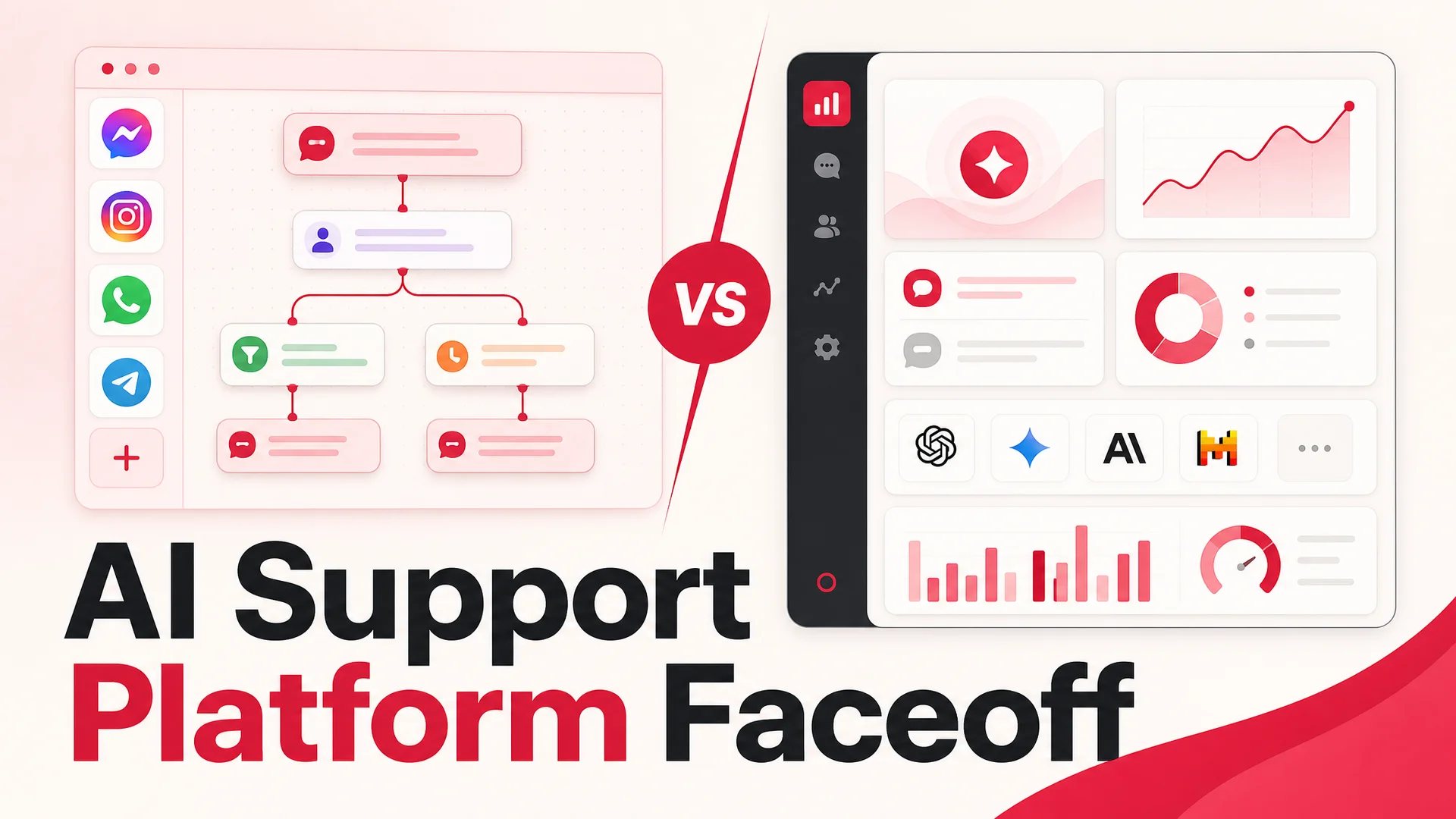
If you have spent any time evaluating chatbot platforms in 2026, two names show up often for very different reasons: Chatfuel, the long-running Meta-ecosystem flow builder, and Berrydesk, the AI agent platform that lets you stand up a fully branded support agent on the model of your choice in an afternoon.
The two tools overlap in places, but they were built around different jobs. Chatfuel grew up automating Facebook Messenger funnels; Berrydesk was built from day one for the era of frontier and open-weight LLMs - GPT-5.5, Claude Opus 4.7, Gemini 3.1, DeepSeek V4, Kimi K2.6, GLM-5.1, Qwen 3.6, MiniMax M2, and others - handling production support, bookings, refunds, and order lookups across every channel a customer might message you on.
This piece walks through where each platform shines, where the gaps are, and how to choose without regret.
TL;DR - which one do you actually need?
Pick Berrydesk when you want:
- A real AI support agent - not a scripted flow - that resolves tickets end to end with frontier or open-weight models.
- Multi-channel deployment to a website, Slack, Discord, WhatsApp, Messenger, Instagram, and more out of the box.
- AI Actions that book demos, process refunds, look up orders, and trigger payments inside the conversation.
- Training on your real knowledge: Help Center docs, websites, Notion workspaces, Google Drive folders, and YouTube playlists.
- A predictable cost structure that scales with conversations, with the option to route routine traffic to cheap open-weight models.
Pick Chatfuel when you want:
- A Meta-first marketing automation tool centered on Messenger, Instagram, and WhatsApp.
- A drag-and-drop visual flow builder for scripted funnels, broadcasts, and comment-to-DM triggers.
- A team that mostly lives inside Meta Business Suite and rarely needs to deploy elsewhere.
- Built-in human handoff for social DMs, with a focus on conversion campaigns rather than support deflection.
Most teams in 2026 want the first list. Even brands that started on Chatfuel for Instagram growth tend to add a real support agent on the side, because flow builders cannot keep up with open-ended customer questions trained against a real knowledge base.
Detailed feature comparison
1. Building the bot
Chatfuel is a flow-first product. You drag blocks onto a canvas, wire them with conditions, and pre-author what the bot says at each step. There is a ChatGPT add-on for AI Agents, but the core unit of work is still a flow you maintained by hand. That model is great for short marketing journeys ("send 20% off if user clicks ad") and predictable Q&A trees, but it falls apart the moment a customer asks something the author did not anticipate.
Berrydesk flips the default. You start by uploading sources - PDFs, your live website, a Notion space, a Google Drive folder, even a YouTube channel - and the agent figures out how to answer from them. You then layer structure on top: persona and tone, guardrails, escalation rules, and AI Actions that hit your real APIs. There is a visual editor when you want one, but the underlying engine is an LLM grounded in your content, not a finite state machine. That distinction matters when a customer asks about something three hops removed from your scripted topics.
Verdict: Tie if you are building a marketing funnel; Berrydesk for anything that resembles real customer support, sales qualification, or self-service.
2. Channel coverage
Chatfuel's strength and constraint are the same: it lives inside Meta. You get strong Messenger, Instagram DM, and WhatsApp Business integration, plus a basic website widget that has historically been an afterthought.
Berrydesk treats channel reach as a first-class problem:
- A fully brandable website widget with custom colors, avatar, position, suggested prompts, and CSS overrides.
- WhatsApp Business with the same agent, knowledge, and actions you use on the site.
- Slack for internal IT, HR, and engineering support.
- Discord for community-driven products and creator economies.
- Messenger and Instagram DM for social commerce.
- Email, SMS, and a JSON API for anywhere else you need the agent to live.
For a 2026 buyer, multi-channel is rarely optional. Customers increasingly start on TikTok or Instagram, switch to your site, and finish in WhatsApp. The agent needs to recognize the same person and pick up the conversation. Chatfuel handles a slice of that path; Berrydesk handles the whole thing.
Verdict: Berrydesk.
3. AI capabilities
This is the gap that has widened most sharply between the two products.
Chatfuel offers ChatGPT integration through OpenAI keys and bills its AI Agents on top of that. The model selection is shallow and the tooling around it - evaluation, A/B testing, fallback routing - is thin.
Berrydesk gives you a serious model layer:
- Frontier closed models: OpenAI GPT-5.5 and GPT-5.5 Pro (parallel reasoning), Anthropic Claude Opus 4.7 (currently #1 on SWE-Bench Pro at 64.3%) and Sonnet 4.6 with a 1M-token context window at no surcharge, Google Gemini 3.1 Ultra (2M-token context, native multimodal) and Gemini 3.1 Pro (94.3% on GPQA Diamond).
- Open-weight frontier: DeepSeek V4 Pro and the much cheaper V4 Flash at $0.14 / $0.28 per million tokens, Moonshot Kimi K2.6 with up to 12-hour autonomous coding sessions, Z.ai GLM-5.1 (754B-param MoE, MIT licensed), Alibaba Qwen 3.6 (Apache-licensed dense and 35B-A3B variants), MiniMax M2.7 at roughly 8% the price of Claude Sonnet, and Xiaomi MiMo-V2-Pro with a 1M context.
- Routing logic so cheap models handle routine traffic and frontier models pick up escalations.
- AI Actions that work reliably because the underlying tool-use models - Kimi K2.6, GLM-5.1, Claude Opus 4.7, Qwen 3.6, MiMo-V2-Pro - have crossed the threshold from demoware to production-grade.
- A/B testing, evaluation sets, and conversation-level grading so you can change model without changing the experience.
The practical effect is that Berrydesk customers route 70–90% of traffic to inexpensive open-weight models and reserve frontier models for the edge cases, while Chatfuel customers either pay full GPT prices on every message or fall back to scripted flows.
Verdict: Berrydesk, by a wide margin.
4. Analytics and insights
Chatfuel's dashboard is geared toward marketing: opens, clicks, broadcast reach, traffic sources, and unrecognized messages. It does what it does well, but it does not tell you whether your support is good.
Berrydesk treats analytics as the feedback loop that improves the agent:
- Resolution rate, deflection rate, and CSAT trended by topic and channel.
- Topic clustering that surfaces what customers are actually asking, including the questions you never wrote a help article for.
- Sentiment scoring on every conversation, with alerts when negative sentiment crosses a threshold.
- Geographic and device breakdowns.
- Conversation-level inspection with the model's reasoning trace, retrieved sources, and any AI Actions taken.
- Custom date ranges, exports, and webhook events into your warehouse.
If you are running a real support operation, the second list is the one your QA lead and your head of support actually need.
Verdict: Berrydesk.
5. Pricing
Chatfuel charges by conversation volume across tiers - Business plans start around $20/month for a small bucket of conversations, WhatsApp-specific plans start around $35/month, and enterprise begins in the low hundreds. AI usage is metered separately.
Berrydesk has a free tier that includes the full feature surface - model picker, training sources, branded widget, AI Actions, multi-channel deploy - so you can ship a real agent before you commit. Paid plans scale on conversations and seats, with enterprise pricing for SSO, custom data residency, and on-prem deployments.
The cost story changes again once you factor in routing. A Berrydesk deployment that sends routine queries to DeepSeek V4 Flash or MiniMax M2 lands at fractions of a cent per resolution; reserving Claude Opus 4.7 or GPT-5.5 for the hard escalations keeps the average low while still delivering frontier quality where it matters.
Verdict: Berrydesk, especially at scale.
Use cases by team
Marketing and growth
Chatfuel is purpose-built for Meta marketing. If your channel mix is 90% Instagram comment-to-DM and Facebook ad funnels, Chatfuel still has muscle memory there.
Berrydesk competes on the parts of marketing that touch real conversations - qualifying leads on the website, answering pre-sale questions in WhatsApp, booking demos through AI Actions, and pushing high-intent contacts into your CRM with full transcript context.
Customer support
This is Berrydesk's home turf. A typical deployment looks like a SaaS company training the agent on its Help Center, product docs, and a Notion runbook, then turning on AI Actions for password resets, plan changes, and refund issuance. The agent resolves the long tail of "where is my invoice" and "how do I export data" questions, and routes the genuinely complex tickets to a human with a clean summary already attached.
Chatfuel can run an FAQ deflection layer, but it is not where teams go when ticket deflection or cost-per-resolution is the metric on the wall.
IT and internal helpdesk
Slack and Discord deployments are where Chatfuel simply does not play. Berrydesk ships an internal-helpdesk pattern out of the box: connect Notion or Confluence as the knowledge base, deploy the agent into a Slack workspace, and watch it answer "how do I request access to the staging environment" without paging IT.
Integrations
Chatfuel connects through Zapier, Make, Google Sheets, Calendly, and a small set of e-commerce tools.
Berrydesk supports Zapier, Make, native CRM connectors (HubSpot, Salesforce, Pipedrive), Stripe for in-conversation payments, Calendly and Cal.com for booking, custom webhooks, and a full REST API for anything else. AI Actions are the integration story: the agent does not just say "I'll create a ticket" - it actually calls the API, writes the result back into the conversation, and confirms with the customer.
Security and compliance
Both platforms offer the table-stakes basics: encryption in transit, GDPR readiness, data deletion controls.
Berrydesk pushes further for regulated buyers:
- SSO, SAML, and SCIM provisioning on enterprise plans.
- Role-based access and audit logging for every workspace action.
- Configurable data retention windows.
- Self-hosted and air-gapped deployment options powered by MIT/Apache-licensed open weights - GLM-5.1, Qwen 3.6-27B, MiMo-V2-Pro - for healthcare, finance, and government use cases that cannot send data to a US frontier API.
If your security review will reject "data crosses a US border," Berrydesk has an answer that is hard to replicate on a flow-builder stack.
Common pitfalls to watch for
- Treating an agent like a flow. Teams that ship from Chatfuel sometimes try to recreate every branch they had before. Resist this. Let the model handle the open-ended stuff and reserve flows for the legally sensitive moments (refund disclosures, KYC steps).
- Ignoring the model bill. A frontier-only deployment can get expensive fast at high volume. Use Berrydesk's routing to send routine questions to DeepSeek V4 Flash or MiniMax M2.7 and reserve Claude Opus 4.7 or GPT-5.5 for hard cases.
- Skipping evals. Both platforms let you ship quickly. Only one of them gives you the eval harness to know whether the new model version actually answers your top 200 questions correctly. Use it.
- Underinvesting in sources. A great agent on bad documentation is still a bad agent. Spend an afternoon cleaning your Help Center before you connect it.
The bottom line
Chatfuel is a capable Meta-ecosystem marketing tool. If your entire world is Messenger and Instagram funnels, it remains a reasonable pick.
For everyone else - and especially for teams whose problem is "answer customer questions accurately, take action, and prove it works" - the 2026 stack looks like Berrydesk: pick the right model from the modern frontier and open-weight lineup, train it on your real knowledge, brand the widget, wire up AI Actions, and deploy across every channel your customers actually use.
Ready to see how it feels? Spin up an agent for free at berrydesk.com, connect a few sources, and have it answering on your site before lunch.
 Berrydesk
Launch your AI agent in minutes
- Pick from GPT-5.5, Claude Opus 4.7, Gemini 3.1, DeepSeek V4, Kimi K2.6, GLM-5.1, Qwen, MiniMax and more
- Train on docs, sites, Notion, Drive, and YouTube - then deploy to web, Slack, Discord, WhatsApp
Set up in minutes

Chirag Asarpota is the founder of Strawberry Labs, the team behind Berrydesk - the AI agent platform that helps businesses deploy intelligent customer support, sales and operations agents across web, WhatsApp, Slack, Instagram, Discord and more. Chirag writes about agentic AI, frontier model selection, retrieval and 1M-token context strategy, AI Actions, and the engineering it takes to ship production-grade conversational AI that customers actually trust.