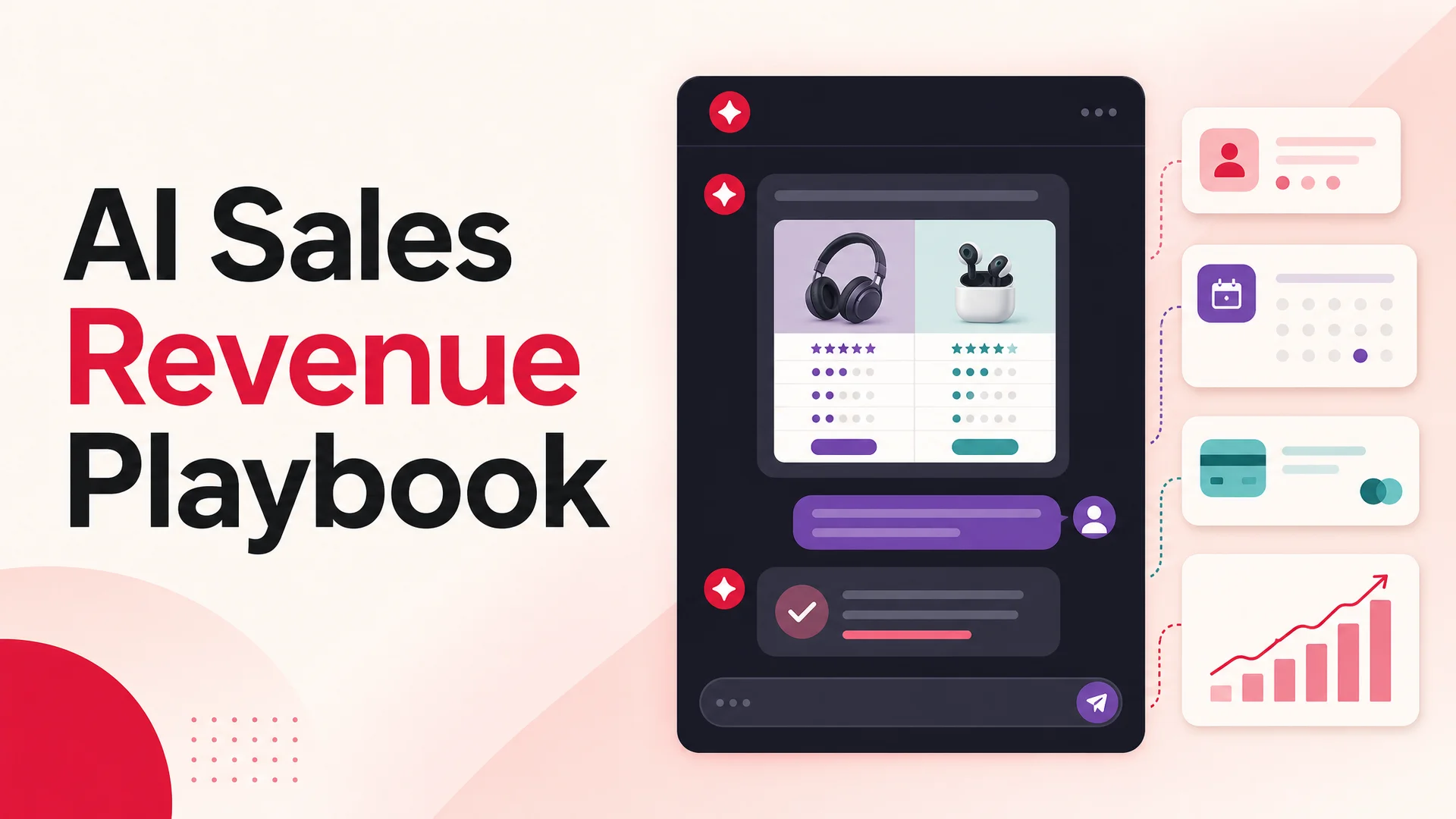
A few years ago, the idea of an AI that could read a prospect's website, draft a tailored pitch, handle objections in a live chat, and quietly file the meeting on your calendar felt like a slide in someone's keynote. In 2026, it is a Tuesday afternoon.
The frontier has moved fast. GPT-5.5 and GPT-5.5 Pro now run parallel reasoning over long sales contexts. Claude Opus 4.7 sits at the top of SWE-bench Pro at 64.3% and brings a 1M-token window with no surcharge in the Sonnet 4.6 tier. Gemini 3.1 Ultra holds 2M tokens and is natively multimodal across text, image, audio, and video - meaning a single prompt can carry a buyer's entire account history, every demo recording, and the latest product spec sheet without needing fancy retrieval gymnastics. Open-weight models from DeepSeek, Moonshot, Z.ai, Alibaba, MiniMax, and Xiaomi have pushed the price floor for running a competent sales assistant down by an order of magnitude.
What that adds up to for a revenue team is simple. The bottleneck in sales used to be how many personal touches a rep could fit in a day. AI agents now absorb the repetitive personalization, leaving humans to do the parts that still need a human. Below is a working playbook for what AI does well in sales today, where it still falls short out of the box, and how a platform like Berrydesk closes the gap.
Where AI agents earn their keep in sales
A general-purpose chat model can do a lot for a sales team the moment you give it the right prompt and the right context. Three patterns stand out.
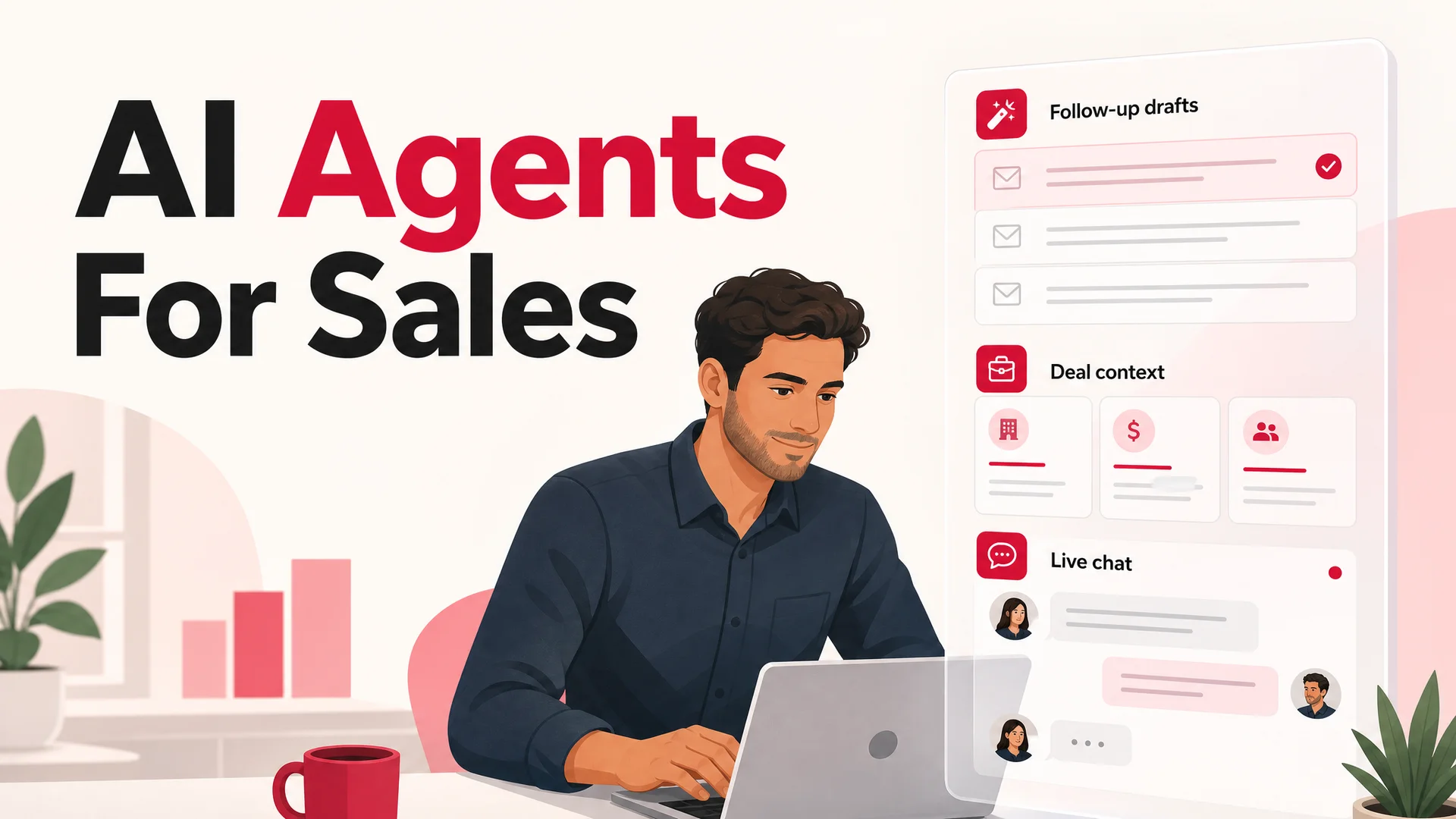
Follow-ups that actually go out
Every rep knows the math: most deals die in the gap between the first call and the third follow-up. The reason is rarely strategy. It is volume. Twenty live conversations a week mean roughly sixty follow-ups that should be specific, helpful, and on time. They almost never are.
A modern AI model handles that workload well. Feed it the call notes, the prospect's stated objection, and the product detail you want to anchor on, and it will draft a follow-up that reads like the rep wrote it on a good day. With Claude Opus 4.7's million-token window, the model can hold the entire account history - every email, transcript, and CRM note - in a single prompt and pick up exactly where the last thread left off. No more summarizing six months of context into 500 tokens.
A useful first prompt looks like this:
"Draft a follow-up email to a mid-market ops lead who liked our premium tier in our last call but flagged the per-seat price. Reference the volume-based discount we discussed, link the case study from a similar customer in their industry, and end with two concrete time slots for next week."
Or for a quieter prospect:
"Write a soft re-engagement note to a prospect who went silent after our discovery call. Lead with a useful insight from the report we published this month, tied to their stated priority around onboarding time. No hard ask - just a reason to reply."
The point is not to replace the rep. It is to give them a strong first draft they can edit in thirty seconds instead of writing from scratch in ten minutes.
Demos that match the buyer
A demo is one of the few moments where a buyer is fully attentive. Wasting that attention with a generic walkthrough is expensive. AI agents are very good at producing demo scripts that center on a specific buyer's stated problems, in their language.
The structure that works:
- A 30-second hook tied to the prospect's job, not your product
- A short tour of the two or three features that map to their pain points
- A live demonstration that uses the prospect's own data or a credible analog
- A fair handling of the obvious objection
- A clear, low-friction next step
A prompt that produces all five looks like:
"Build a 12-minute demo script for [Product] targeted at a head of customer success at a 150-person SaaS company. Their stated priorities are reducing first-response time and giving managers visibility into agent quality. Open with their world, walk through three features that address those priorities, address the objection that they already use [incumbent tool], and end with a concrete pilot proposal."
The same approach works for tutorial videos, comparison walkthroughs, and recorded pre-call primers. With Gemini 3.1 Ultra's native video understanding, the model can also watch a recording of yesterday's demo and tell the rep which moments landed, where the prospect lost focus, and what to tighten next time.
Pitches that read like they were written for one person
Generic templates have been dead for a while. Hunter's research has shown that a substantial majority of decision-makers do not mind that an email was AI-drafted, as long as it is genuinely relevant to their situation. Relevance is a context problem, not a writing problem.
The unlock in 2026 is that long-context models can ingest a prospect's entire public surface area - their site, their last earnings call, their LinkedIn posts, their open job reqs - and produce a pitch that proves the rep did the homework. DeepSeek V4 and MiniMax M2.7, both open-weight and very inexpensive on a per-token basis, are particularly well-suited to this kind of high-volume personalization where you do not want to pay frontier prices for every prospect.
A few prompts that work well:
"Write a personalized opener to the VP of operations at [Company]. Pull from the job postings on their careers page and their last two press releases. Anchor on the operational scaling problem implied by both. No more than 90 words."
"Draft a four-email nurture sequence for a free-trial signup from a 50-person logistics company. Email 1: welcome and one quick win. Email 2: a customer story from their industry. Email 3: a soft objection-handler about integration effort. Email 4: a meeting ask with two time slots."
"Rewrite this product description for a procurement-led buyer at a regulated enterprise. Emphasize audit logs, role-based access, and our SOC 2 posture. Strip the marketing adjectives."
Used well, this shifts the rep's day from writing toward editing and thinking - which is where their judgment actually compounds.
What a raw chat model cannot do for sales
Everything above assumes a human rep is in the loop, copying outputs into the right tools. That is fine for a small team. It does not scale, and it leaves a long list of jobs on the table. The honest list of what a generic chat AI cannot do in sales - and what it would take to fix each one - is worth working through carefully.
It does not know your business
A general-purpose model has no idea what your pricing looks like this quarter, which SKUs are out of stock, what the latest case study says, or how your sales motion handles the "we already use a competitor" objection. Every prompt has to carry that context, every time, or the output drifts.
The fix is to give the agent durable knowledge of your business. Berrydesk lets you train an agent on your help center, product docs, pricing pages, sales decks, Notion workspaces, Google Drive folders, and even YouTube videos. The agent then answers from that grounded knowledge instead of from generic training data. With 1M–2M-token context windows on the leading models, that knowledge can include the full conversation history of a deal, not just a clipped summary, which removes a class of awkward "let me check on that" moments.
It cannot do anything
A chat window can produce text. It cannot send a calendar invite, take a payment, look up an order, or push a record into your CRM. For sales, that is most of the actual work.
This is where the agentic side of the 2026 model landscape changes the picture. Claude Opus 4.7, Kimi K2.6, GLM-5.1, Qwen3.6, and Xiaomi MiMo-V2-Pro were trained from the ground up to use tools reliably across long, multi-step plans. Kimi K2.6 can run autonomous coding sessions for twelve hours and coordinate up to 300 sub-agents over thousands of steps. GLM-5.1, MIT-licensed and built for agentic engineering, runs a multi-hour plan-execute-test-fix loop. That same tool-use reliability is what makes AI Actions in a sales context - booking a meeting, charging a card, creating a Stripe link, pulling an order status, escalating to a rep - actually production-grade rather than demo-grade.
Berrydesk exposes AI Actions on top of these models so the agent does not just suggest the next step; it executes it. A prospect asks "can I book a 15-minute call with someone next Tuesday afternoon?" and the meeting lands on the rep's calendar inside the chat. A returning customer asks "can I upgrade my plan?" and the payment goes through without a handoff.
It does not see the market in real time
Most chat models have a knowledge cutoff. They do not know what your competitor announced last week, what the new pricing benchmark is, or which feature your industry suddenly cares about. For a sales team that lives or dies by relevance, that is a real problem.
The workable fix is two-layered. First, keep the agent's knowledge base fresh - Berrydesk re-ingests connected sources on a schedule, so when a competitor's new pricing page appears or your own positioning shifts, the agent learns about it without anyone re-uploading a PDF. Second, route the parts of the conversation that genuinely need fresh judgment to a frontier model. A typical Berrydesk deployment routes routine traffic to DeepSeek V4 Flash at $0.14 per million input tokens for cost-efficient resolutions, and reserves Claude Opus 4.7, GPT-5.5, or Gemini 3.1 Ultra for the harder, higher-value moments. The buyer never sees the routing.
It does not talk to your stack
A standalone chat model has no native connection to your CRM, your ticketing system, your billing platform, or your warehouse. It is a brilliant intern with no laptop access.
Solving this is mostly a matter of integrations. Berrydesk plugs into the tools sales teams actually use - Slack, Discord, WhatsApp, your help center, your CRM through standard automation platforms - so the agent can read context out of those systems and write back into them. A captured lead becomes a CRM record. A booked meeting drops into a rep's calendar. A refund decision is logged in the ticket. The AI sits inside the workflow rather than next to it.
It is not on your website
Out of the box, a chat model lives in someone else's product. Your customers cannot talk to it. They cannot get an upsell suggestion while looking at the basic plan, or a cross-sell prompt while adding the laptop to the cart.
Berrydesk's branded chat widget closes that gap. The agent runs on your domain, uses your colors and your voice, and is available exactly where your buyers already are - your pricing page, your product page, your help center, Slack and Discord communities, WhatsApp threads. When a prospect is on a comparison page, the agent can offer the case study that matches their industry. When a customer is at checkout, it can suggest the bundle that the analytics say lifts AOV. The shift from "AI on someone else's site" to "AI on my site, in my voice, at the moment of decision" is where most of the revenue lift actually shows up.
It does not capture or nurture leads
A generic chat model does not know who it is talking to and has no memory of yesterday's visitor. That is fine for a research tool. It is a hole in the bucket for a sales pipeline.
A deployed agent should be a lead-capture surface, not a passive answer box. Berrydesk's agents qualify visitors with a few well-placed questions, capture name, email, and stated interest, score the lead based on the conversation, and either route a hot lead to a live rep or drop it into a nurture sequence. The same agent can re-engage that lead a week later in a follow-up email, then continue the conversation when they come back to the site - with full memory of what was discussed before.
Open weights, long context, and what they mean for sales economics
It is worth pausing on the cost story, because it is the part most sales leaders underestimate.
A typical inbound conversation that ends in a captured lead costs a fraction of a cent on DeepSeek V4 Flash or MiniMax M2 - both open-weight, both 2026 frontier-quality on agentic tasks. M2.7 advertises roughly eight percent of Claude Sonnet's price at twice the speed and still hits 56.22% on SWE-Pro, which is well into the territory where the model can handle real reasoning, not just retrieval. For a B2C site that runs hundreds of thousands of conversations a month, that price difference is the difference between AI being a line item and AI being a margin lever.
For regulated industries - healthcare sales, financial services, government - the MIT- and Apache-licensed Chinese open-weight models (GLM-5.1, Qwen3.6-27B, MiMo-V2 weights) make on-prem and air-gapped sales deployments viable for the first time. The agent can talk to prospects without any data leaving the customer's network. That used to require a heroic engineering effort. In 2026, it is mostly a procurement decision.
Long context windows matter for sales for a different reason. With a 1M-token window in Sonnet 4.6 or DeepSeek V4, the agent can hold a prospect's entire account history, your full pricing and product documentation, the last quarter of marketing assets, and the live conversation in a single prompt. RAG becomes a tuning lever for cost, not a hard requirement for fidelity. The class of "sorry, I do not have that information" failures shrinks dramatically.
Common pitfalls to avoid
A few mistakes show up over and over when sales teams roll out AI agents.
The first is treating the agent as a replacement for the rep instead of a force multiplier. Buyers can tell when they are being deflected. The agents that work best are the ones that handle the long tail of repetitive, low-stakes interactions and quickly hand off the high-stakes moments to a human with full context attached.
The second is shipping the agent without a clear escalation path. Every deployment needs a tested route from "the AI is stuck" to "a human is in this conversation in under a minute" - ideally with the full transcript and the agent's best guess at what the customer actually wants. Berrydesk's handoff to Slack, Discord, or your existing helpdesk is built for exactly that.
The third is over-trusting the AI's first draft of the pitch. Even with frontier models, a final human pass on outbound copy is still worth the thirty seconds. The model is excellent at the structure and the personalization. The judgment about what to actually claim about your product, in this market, this week, still belongs to the rep.
The fourth is ignoring evaluation. The teams that get real lift treat their agent like a junior rep - review transcripts weekly, mark the ones that went well and the ones that did not, and feed that signal back into the agent's instructions and knowledge base. The model is only as good as the loop you close around it.
Putting it together
The shape of AI in sales in 2026 is not "a chatbot on the marketing site." It is an agent that is trained on your business, deployed where your buyers actually are, capable of taking real actions on their behalf, and routed across the right model for the right job - frontier intelligence when the stakes are high, fast and cheap open weights when they are not.
That is the version of AI that quietly works in the background, gives reps their afternoons back, and shows up in the pipeline numbers a quarter later.
If you want to see what that looks like for your own sales motion, build your agent on Berrydesk. Pick the model, point it at your docs and your site, brand the widget, wire up the AI Actions you care about, and ship it where your buyers already are.
 Berrydesk
Launch a sales-ready AI agent in minutes
- Train it on your decks, pricing pages, and CRM in a few clicks
- Capture leads, book meetings, and take payments inside the chat
Set up in minutes

Chirag Asarpota is the founder of Strawberry Labs, the team behind Berrydesk - the AI agent platform that helps businesses deploy intelligent customer support, sales and operations agents across web, WhatsApp, Slack, Instagram, Discord and more. Chirag writes about agentic AI, frontier model selection, retrieval and 1M-token context strategy, AI Actions, and the engineering it takes to ship production-grade conversational AI that customers actually trust.