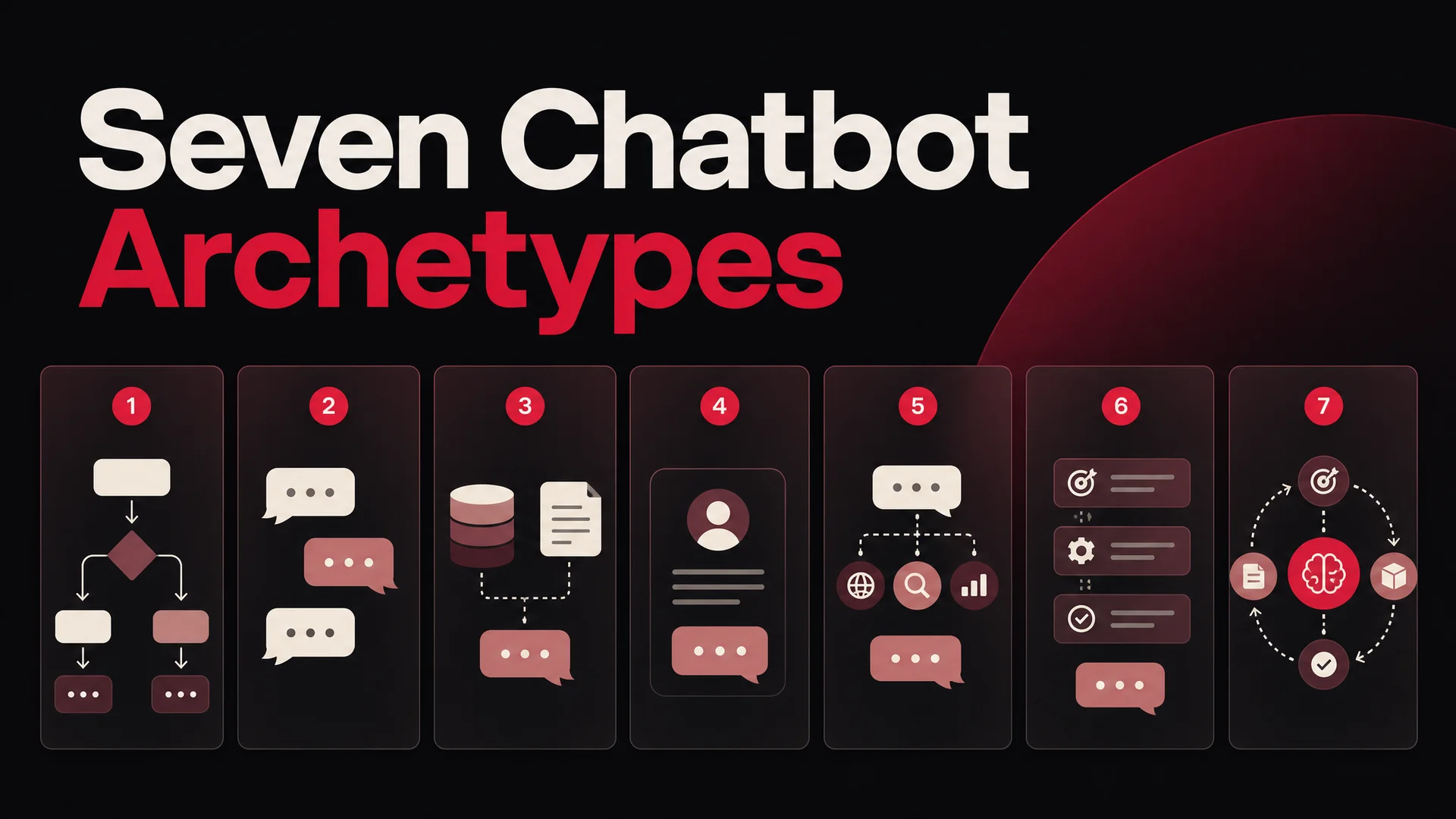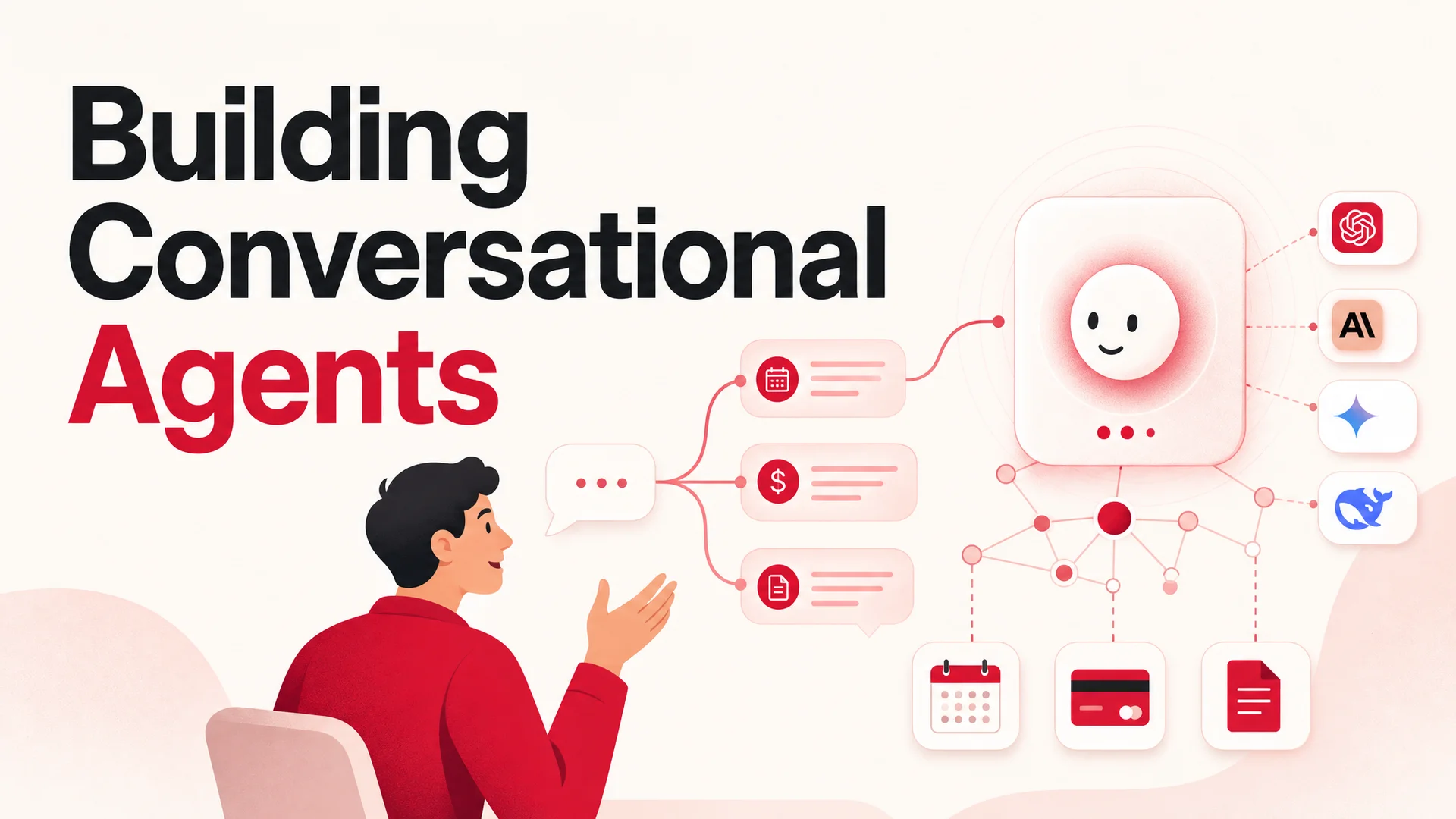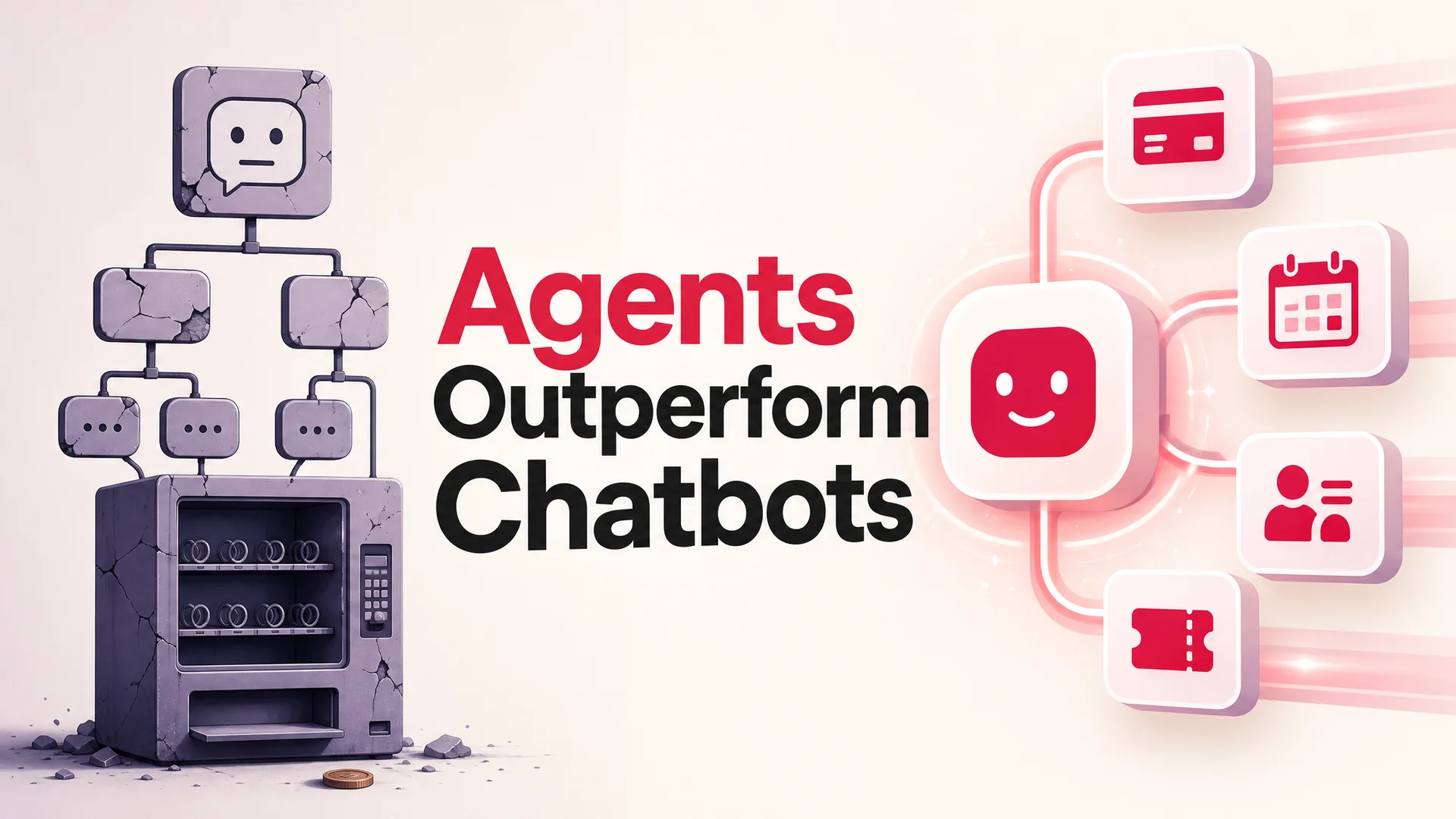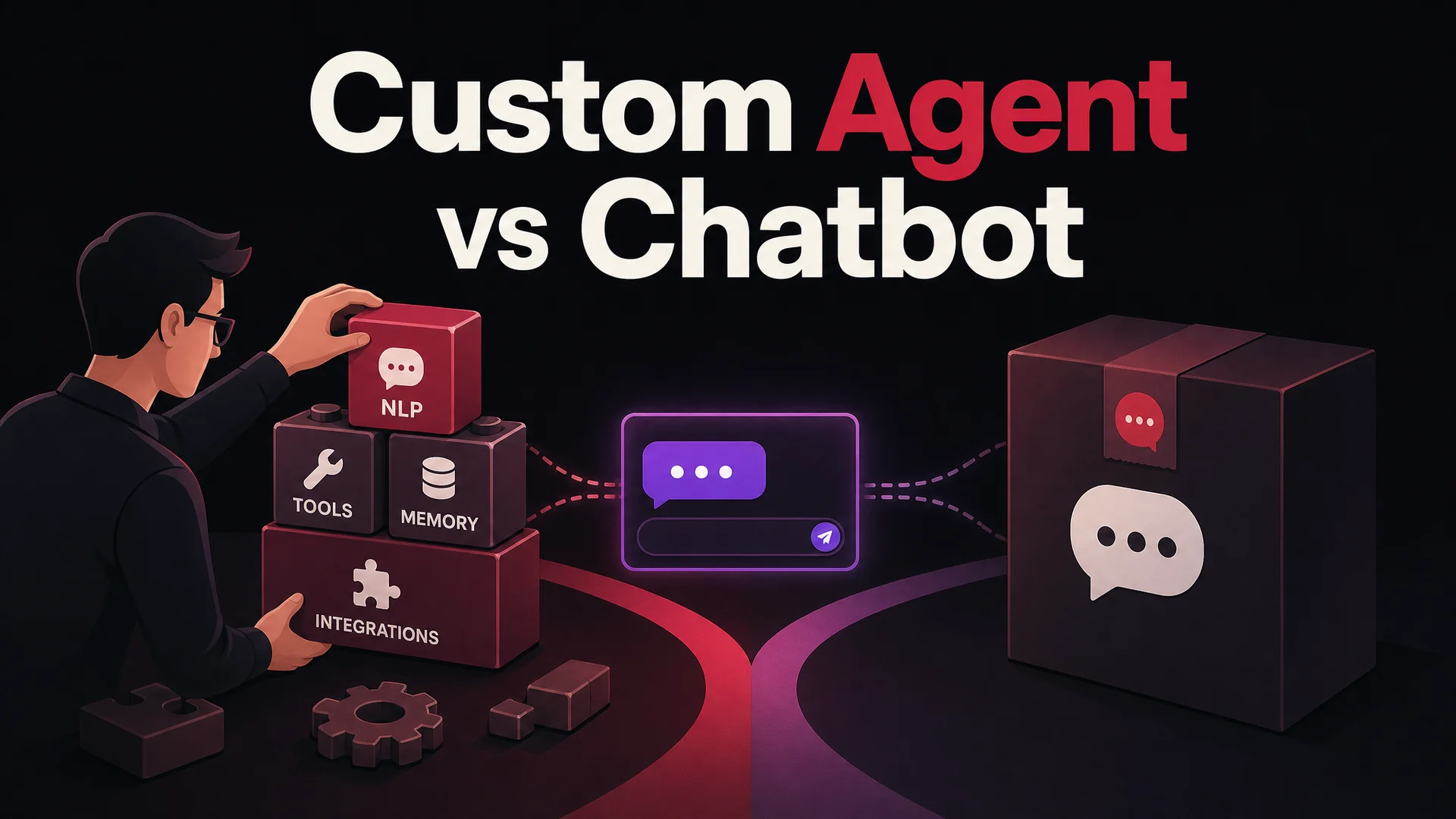
Build a chatbot from scratch, or buy something off the shelf? It used to be a clean fork in the road. In 2026, with frontier models like Claude Opus 4.7 and GPT‑5.5 Pro reasoning in parallel, and open-weight models like DeepSeek V4 and GLM‑5.1 closing the gap on benchmarks while undercutting closed models on price, the question has gotten more interesting - and the right answer for most support teams sits somewhere neither of those traditional options actually lives. This guide walks through how custom builds and pre-built chatbots really compare today, where each one wins, and the third path that has quietly become the default for serious operators.
Quick takeaways
- A custom AI agent gives you tight integration, model-level flexibility, and the security posture regulated industries need - but a true ground-up build now runs hundreds of hours and six figures before it serves a single ticket.
- A pre-built chatbot is fast and cheap to start, but the typical off-the-shelf product is locked to one model, has shallow tool-calling, and rarely survives a complex support catalog without becoming a deflection wall users learn to bypass.
- The right choice in 2026 is usually neither extreme. Platforms like Berrydesk produce a custom-quality outcome - your data, your model choice, your AI Actions, your brand - without any of the build cost, by handling model routing, ingestion, and deployment for you.
What "custom" actually means in 2026
A custom AI support agent is one that has been engineered around your specific business - its products, its policies, its tone, its systems of record. The interesting part is that "engineered" no longer has to mean "coded from a blank file." A custom agent in 2026 is defined by the outcome: it speaks in your voice, it knows what you sell, it can take actions inside your systems, and it can be tuned and audited by your team. How you arrive at that outcome - bespoke code, a configurable platform, or something in between - is an implementation detail.
Under the hood, a custom agent leans on three layers. The first is the model layer. The frontier today spans Claude Opus 4.7 (64.3% on SWE-bench Pro and the strongest pick for nuanced reasoning), GPT‑5.5 and GPT‑5.5 Pro for parallel-reasoning workloads, and Gemini 3.1 Ultra with a 2M-token context window for cases where the agent needs to see entire policy binders at once. Alongside them sits an open-weight tier - DeepSeek V4 Flash at $0.14 per million input tokens, MiniMax M2 at roughly 8% the cost of Claude Sonnet, Moonshot Kimi K2.6 with native agentic tool use, Z.ai's GLM‑5.1 under MIT license, Alibaba's Qwen3.6 family, and Xiaomi's MiMo‑V2 - that makes large-scale deployment economically realistic. The second layer is knowledge: what the model is grounded in, whether through retrieval, long-context loading, or fine-tuning. The third is action: the tools the agent can actually call to resolve a ticket, not just describe a resolution.
A custom build owns all three. A typical pre-built chatbot owns roughly one and a half.
Why the custom path appeals
Custom agents are designed to handle edge cases. They can be trained on transaction history, contract terms, internal procedures, and the specific language your customers use, so they read intent the way a tenured agent does. They can integrate with the booking system, the payment processor, the order management system, and the CRM in a way that lets the bot actually do the work - refund the order, reschedule the appointment, push a Stripe payment link - instead of handing the user back to a queue. And they can be hardened around specific compliance regimes: HIPAA for healthcare, PCI for payments, SOC 2 and GDPR for everything else.
Where the custom path hurts
The trouble is the build. A serious from-scratch agent involves model selection and evaluation, data pipeline work to clean and chunk the knowledge base, retrieval engineering, tool-call schema design, conversation memory, evaluation harnesses, an admin surface for support managers to inspect and correct behavior, deployment plumbing, and ongoing maintenance as the underlying models change every few weeks. Industry estimates still hover around 240+ engineering hours for an MVP and budgets that start at roughly $10,000 and routinely exceed $100,000 by the time the agent is production-grade. Then comes the part nobody warns you about: keeping pace with the frontier. Between April and May 2026 alone, DeepSeek V4, Kimi K2.6, GLM‑5.1, Qwen 3.6, MiniMax M2.7, and MiMo‑V2 all shipped. A team that froze its stack on a 2025 model is now running a slower, more expensive, less capable agent than competitors who upgraded.
What "pre-built" actually means in 2026
Pre-built chatbots are sold as turnkey: sign up, paste a script tag, answer a few onboarding questions, and you have a bot. They lean on a fixed model, a fixed retrieval strategy, and a fixed flow builder. The upside is obvious - small businesses can be live in an afternoon for somewhere between free and a few hundred dollars a month, with no developer time required.
Where pre-built wins
For a low-volume, low-complexity support load - a five-page knowledge base, a handful of repeated questions, no payment or booking automation needed - a generic chatbot is a perfectly reasonable starting point. Onboarding is fast. The interface is friendly. Most products ship with a stock widget that looks acceptable on a website without much fiddling.
Where pre-built breaks down
The cracks show up the moment your support load gets specific. Standardized templates struggle with nuanced policy questions. Tool-calling, where it exists at all, is often limited to a handful of pre-built integrations and falls over on anything custom. Model choice is usually a single locked-in option chosen by the vendor, which means you're stuck on whatever the vendor negotiated - often a year-old model - instead of routing tier‑1 traffic to a cheap, fast open-weight model and reserving Claude Opus 4.7 or GPT‑5.5 Pro for hard escalations. Security posture tends to be one-size-fits-all, which is fine for marketing chat but a non-starter for healthcare or finance. And the personalization ceiling is low: most pre-built bots can't reliably remember a returning user across sessions, can't reach into a CRM to grab the customer's plan, and can't write back to the systems they pulled context from.
The other quiet failure mode is escalation. When a pre-built bot doesn't know an answer, the typical fallback is "let me connect you to a human" - which works fine if you have humans staffed, and is a dead end if you don't. A custom-quality agent, by contrast, can pick a different reasoning model, route to a different tool, or summarize the conversation and open a ticket with full context attached.
Custom vs pre-built: the real trade-offs
Cost
Headline numbers tell one story; total cost of ownership tells another. A from-scratch custom build runs from roughly $10,000 to north of $100,000 to ship, plus a steady ongoing burn for maintenance, evaluation, and model upgrades. Off-the-shelf chatbots range from free to a few hundred dollars a month at the low end, and a few thousand at the high end. The catch with off-the-shelf is the long tail: limited resolution rates push tickets back to your humans, and the per-ticket cost of an unresolved AI conversation plus a human follow-up is often higher than a higher-priced agent that resolves the ticket cleanly the first time.
The other cost lever is inference itself. A modern customer-support deployment processes huge token volumes, especially when conversation memory and knowledge base both live in-context. The 2026 open-weight tier changes this calculus dramatically - DeepSeek V4 Flash and MiniMax M2 are priced low enough that routing routine questions to them and reserving Claude Opus 4.7 or GPT‑5.5 for genuinely hard tickets can cut model bills by an order of magnitude versus a single-frontier-model setup. A platform that supports model routing captures that saving for you. A pre-built bot locked to one model does not.
Flexibility and scalability
Custom agents flex. They can be retrained on a new product line in days, given a new tool when you launch a new system, and pointed at a different model when something better ships. They can scale across millions of conversations because the underlying model providers handle the elasticity for you, and they can hold an entire knowledge base in a 1M–2M-token context window when retrieval starts losing precision at the edges.
Pre-built bots flex within their flow builder. That ceiling is fine for FAQ deflection. It is not fine for an agent that needs to reason across a returns policy, a partial-shipment edge case, a loyalty tier benefit, and a payment retry - all in one conversation.
Integrations
Custom agents can wire into anything you have credentials for: a Salesforce object, a Postgres table, a Stripe customer, a Cal.com booking, a Zendesk ticket, an internal microservice. The trade-off is that every integration is your team's responsibility to build, test, and maintain.
Pre-built bots typically come with a fixed library of integrations. If yours is on the list, you're set. If yours is not, you're either out of luck or paying a developer to wedge a webhook into a flow builder that wasn't designed for it.
Security and data privacy
A serious custom agent can be deployed inside your VPC, can encrypt at rest with your own keys, can be scoped to your IAM policies, and can satisfy industry-specific compliance like HIPAA, PCI‑DSS, or FINRA. With MIT- and Apache-licensed open-weight frontier models like GLM‑5.1, Qwen 3.6, and MiMo‑V2 now on the table, full on-prem and air-gapped deployments are no longer a niche capability - regulated industries can run a frontier-class agent without sending a single token to a third-party API.
Pre-built chatbots tend to ship with a baseline security posture that is good enough for a generic SaaS product and not good enough for a regulated workload. Pushing customer PII through a generic vendor is a risk that most legal teams won't sign off on.
User experience
A custom-quality agent recognizes a returning customer, picks up where the last conversation left off, references the customer's plan tier, takes actions on their behalf, and stays consistent across web, Slack, Discord, and WhatsApp. The interactions feel more like a senior support rep and less like a search box with a chat skin. A pre-built bot can approximate parts of this - but the further you push toward "feels like a real teammate," the further the off-the-shelf product tends to fall behind.
When the custom path is genuinely worth it
A few patterns reliably justify a custom build, or at least a custom-quality platform deployment:
Regulated industries. Healthcare, finance, legal, and government workloads carry compliance requirements that generic chatbots can't satisfy. The combination of MIT-licensed open-weight models and on-prem deploys finally makes a fully owned, fully compliant agent affordable.
High-volume operations. When a support org handles tens of thousands of tickets a week, even small differences in resolution rate translate to real headcount math. A custom-quality agent that resolves 70% of tickets without escalation is a fundamentally different ROI story than an off-the-shelf bot that resolves 35%.
Deep system integrations. If the agent needs to read from and write to multiple systems - order management, billing, scheduling, inventory - generic flow builders run out of expressiveness fast. A platform with first-class AI Actions handles this cleanly.
Brand-sensitive surfaces. B2C companies and premium B2B brands care about voice and visual identity in a way that a stock widget can't deliver. Owning the chat surface end-to-end matters.
Multilingual and global support. Long-context frontier models combined with model routing let a single agent handle dozens of languages with consistent quality, where pre-built tools tend to degrade noticeably outside English.
Building from scratch: the honest version of the checklist
If you are seriously considering an in-house build, plan for these phases:
- Discovery. Map ticket categories, resolution paths, current containment rate, and integrations the agent will need. Decide what "good" looks like before you write any code.
- Model selection and evaluation. Test the relevant models against your real ticket data. In practice this means evaluating Claude Opus 4.7 and GPT‑5.5 for top-tier reasoning, DeepSeek V4 Flash and MiniMax M2 for cheap volume, Kimi K2.6 or GLM‑5.1 for agentic tool-heavy flows, and Qwen 3.6 or MiMo‑V2 if you need open weights. Build an eval harness you can rerun every time a new model ships, because that is now happening monthly.
- Knowledge ingestion. Pull docs, policies, product catalogs, and historical resolved tickets into a structured store. Decide between long-context loading, retrieval, and fine-tuning per use case.
- Tool design. Define the AI Actions: refund, reschedule, escalate, look up order, send payment link. Schema each tool with strict input validation and write tests that exercise the failure paths.
- Conversation layer. Memory, session state, handoff to humans, multilingual handling, identity verification.
- Admin surface. Reviewers need to inspect transcripts, label good and bad turns, and push corrections back into the agent's behavior. Without this, quality regresses silently.
- Deployment. Channels (web, Slack, Discord, WhatsApp), authentication, rate limiting, observability, cost monitoring.
- Continuous evaluation. Treat it as a software product, not a one-time launch.
This is real work. A capable team can do it. Many teams discover, halfway through, that they have built an in-house version of what a platform would have given them in an afternoon - and they are now responsible for maintaining it forever.
Common pitfalls to avoid
Even with a clear plan, a few traps catch most teams:
- Locking to a single model on day one. The frontier moves too fast. Whatever you pick in May 2026 will be middle-of-the-pack by August. Architect for swappable models.
- Treating the bot as a deflection wall. Bots that exist purely to keep tickets out of the queue eventually train users to mash "talk to a human" the moment the chat opens. Optimize for resolution, not deflection.
- Skipping evaluation. Without a real test set built from your historical tickets, every model upgrade is a leap of faith. Build the eval harness early.
- Ignoring escalation quality. When the agent does hand off, the human should receive a summary, not a wall of transcript. This single design choice affects CSAT more than most model upgrades.
- Hand-rolling things the platform layer should own. Channel deployment, model routing, widget styling, analytics - these are commodity. Spend your engineering on the parts that are genuinely yours: tool design, knowledge curation, brand voice.
The third path: custom outcomes without the build
This is where Berrydesk fits. Berrydesk is built on the premise that a support team should get the outcome of a custom AI agent - your data, your tools, your brand, your model choice - without the cost and risk of a from-scratch engineering project.
In practice that means four steps:
- Pick a model. Berrydesk supports the full 2026 frontier - GPT‑5.5 and GPT‑5.5 Pro, Claude Opus 4.7 and Sonnet 4.6, Gemini 3.1 Ultra and Pro, DeepSeek V4, Moonshot Kimi K2.6, Z.ai GLM‑5.1, Alibaba Qwen, MiniMax M2, and more. Route routine traffic to a cheap open-weight model and escalate the hard tickets to Opus 4.7 or GPT‑5.5 Pro automatically.
- Train on your knowledge. Upload docs, point at a website, sync from Notion or Google Drive, or pull in YouTube transcripts. The agent grounds answers in your real content, not generic web data.
- Brand the widget. Colors, tone, avatar, intro message, position - match the surface to your product instead of fighting a stock template.
- Add AI Actions. Bookings, payments, order lookups, refunds, ticket creation - wire the agent to the systems where work actually happens, so it can resolve tickets end-to-end instead of describing what a human would do.
Then deploy: website, Slack, Discord, WhatsApp, and other channels from a single configuration. Quality, security, and observability sit in the platform layer so your team can spend its time on what is unique to your business - the knowledge, the policies, the tone, the AI Actions - rather than on plumbing that everybody needs and nobody wants to maintain.
How to choose
A useful decision filter:
- Tiny scope, no integrations, fine with a single model: a generic pre-built chatbot will probably do.
- Real support volume, multiple integrations, brand-sensitive, model choice matters, no appetite to staff an AI engineering team: a platform like Berrydesk is the obvious pick.
- Heavily regulated, deeply custom internal stack, on-prem requirement, in-house ML team already in place: a true custom build with open-weight models like GLM‑5.1, Qwen 3.6, or MiMo‑V2 is justifiable - and worth pairing with a platform for the parts you don't want to own.
The mistake is forcing the decision into the old binary. In 2026 the build-vs-buy frontier sits in a different place than it did even a year ago. The question is no longer "do I write this myself or buy something generic?" It is "where do I want to spend my team's energy, and what does the platform layer let me skip?"
If the answer is anything other than "we want to build a chatbot platform from scratch," it is worth seeing how far the modern platform layer has come. Spin up an agent on Berrydesk, point it at your knowledge, and put it next to whatever you are using today. The comparison usually settles itself.
 Berrydesk
Get a custom-grade AI support agent without writing code
- Choose any frontier model - GPT-5.5, Claude Opus 4.7, Gemini 3.1, DeepSeek V4, Kimi K2.6, GLM-5.1, Qwen, MiniMax
- Train on your docs, sites, Notion, Drive, or YouTube and deploy to web, Slack, Discord, and WhatsApp
Set up in minutes

Chirag Asarpota is the founder of Strawberry Labs, the team behind Berrydesk - the AI agent platform that helps businesses deploy intelligent customer support, sales and operations agents across web, WhatsApp, Slack, Instagram, Discord and more. Chirag writes about agentic AI, frontier model selection, retrieval and 1M-token context strategy, AI Actions, and the engineering it takes to ship production-grade conversational AI that customers actually trust.