Every customer arrives with a different shape of problem. One is checking on a delivery, the next is mid-meltdown about a double charge, the third is quietly comparing your refund policy against a competitor's. The work of customer service is meeting all of them - calmly, quickly, and without making them tell their story twice.
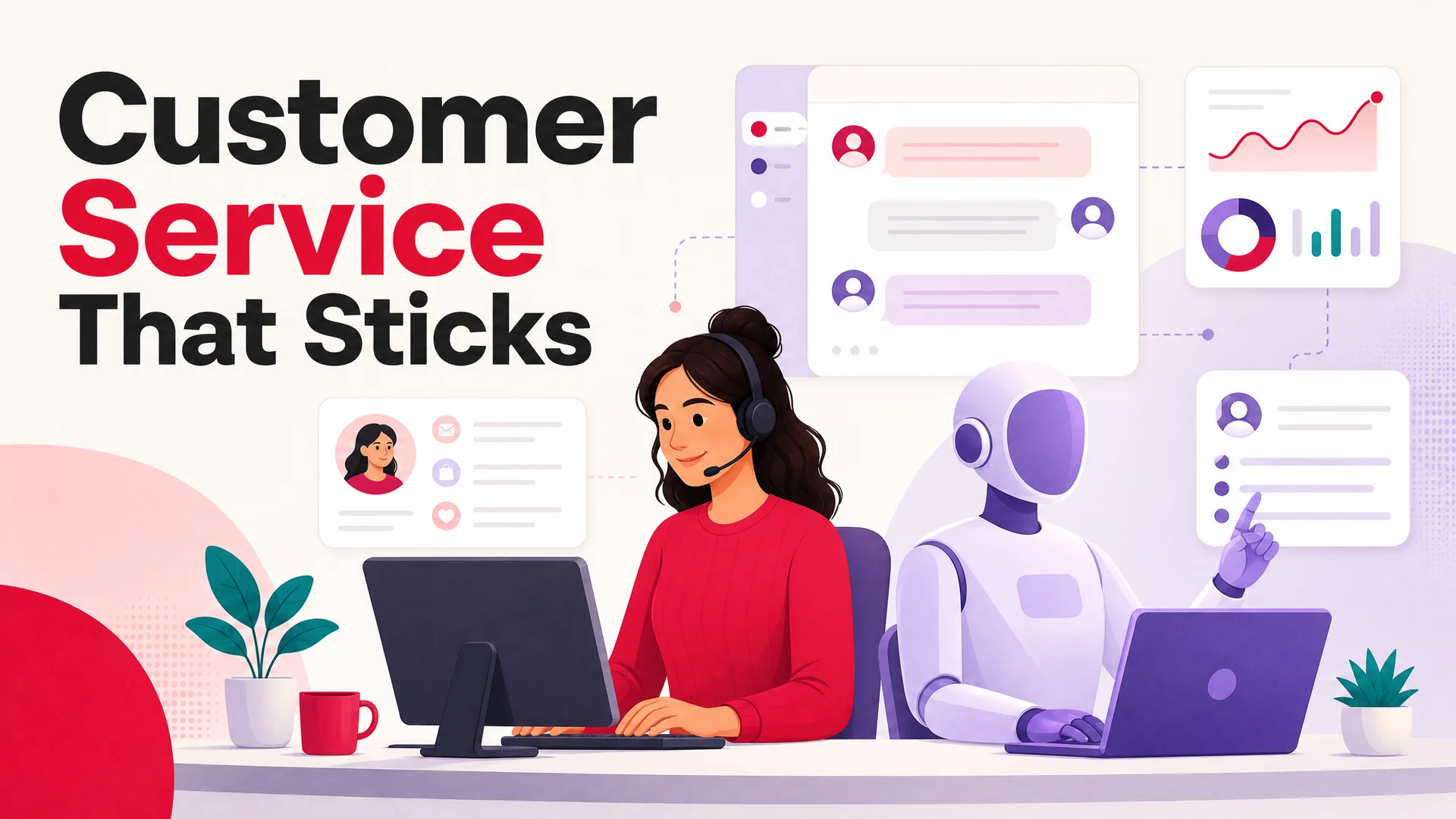
That work used to belong almost entirely to humans armed with macros and a help desk. In 2026, it's a hybrid discipline: AI agents handle the long tail of routine conversations, your humans handle the conversations that genuinely require judgment, and the operating job is making the handoff invisible. Get this right and customers turn into a retention engine. Get it wrong and they churn quietly, telling their friends as they go.
This post is the practical version of that argument: why customer service still drives the P&L, the seven moves that consistently separate good support orgs from forgettable ones, and how to wire AI into the loop without losing the human voice.
We'll cover:
- Why support is a growth lever, not a cost center
- Seven plays for delivering memorable customer service in 2026
- How modern AI agents reshape what's possible - and where they fall down
- How to choose a platform that won't lock you in
Let's get into it.
Why Support Quality Compounds Into Revenue
Customer service is one of the few functions where the quality of a single interaction can reshape a customer's lifetime value. A delivery question handled in forty seconds, with the right context, tells a buyer they made a safe choice. A refund request answered with empathy and a fast resolution turns a near-churn into a referral. The math is unforgiving in the other direction: a buyer who waits two days for a one-line answer rarely comes back, and they tell others.
The gap between average and excellent is rarely about heroics. It's about consistency - the boring work of being reachable, accurate, and fast across every channel, every shift, every season. When that consistency holds, retention compounds, support becomes a flywheel for product feedback, and the team starts surfacing patterns that marketing and engineering can act on.
Ask yourself what you would do as a customer. Would you reorder from a brand that left your refund request sitting in a queue for 36 hours? Probably not. Would you tell three friends about the company that fixed your problem in one message and threw in a small credit? Almost certainly. That asymmetry is where support quality earns its place on the revenue side of the spreadsheet.
The point is simple: feeling heard, respected, and quickly cared for is what people pay for, well past the product itself. Build the system that delivers that feeling at scale, and you stop competing on price.
Seven Strategies That Actually Move the Needle
Great support isn't a checklist of pleasantries. It's an operating system - fast responses, real personalization, channels that work the way customers expect, and a team equipped with the tools and training to fix problems instead of just acknowledging them. Here are the seven plays that consistently move the needle.
1. Put AI on the Routine 80% So Humans Can Do the Hard 20%
Your support team has a fixed amount of attention per day. Every minute they spend resetting a password or copy-pasting a tracking link is a minute they can't spend on the angry enterprise customer threatening to leave. As ticket volume grows, the only way the math works is to take the routine load off humans entirely.
That's where modern AI agents change the shape of the problem. They handle order status, returns, basic troubleshooting, account changes, and policy questions instantly - and they handle them at any hour, in any language, without a queue. The benefits stack up:
- Sub-second responses on questions that used to wait in a queue, every hour of the day.
- A team that does fewer repetitive tasks, freeing them up for nuanced cases that need a human.
- A 24/7 shift that never burns out, gets sick, or asks for time off in December.
The 2026 generation of models is genuinely different from what people remember from the early chatbot wave. Claude Opus 4.7 leads SWE-Bench Pro at 64.3%, and that same reasoning capacity makes it formidable at multi-step support tasks like reconciling an invoice or walking a customer through a complex configuration. GPT-5.5 Pro adds parallel reasoning, useful when an agent has to consider a refund policy, an account flag, and a shipping exception at once. Gemini 3.1 Ultra carries a 2M-token context window, so an agent can hold your full knowledge base, the customer's entire conversation history, and your policy documents in working memory.
The cost story has flipped just as dramatically. Open-weight frontier models - DeepSeek V4 Flash at $0.14 / $0.28 per million input/output tokens, MiniMax M2 at roughly 8% the price of Claude Sonnet at twice the speed, Z.ai's MIT-licensed GLM-5.1 - make it economical to run an AI on every single ticket. The Berrydesk pattern many teams adopt: route routine traffic to a cheap open model, reserve Claude Opus 4.7 or GPT-5.5 for the escalations that genuinely need frontier reasoning. Same agent, same widget, fractions of a cent per resolution on the routine path.
The other thing that's changed: AI doesn't only answer customers. It assists your humans in real time - surfacing the right past conversation, drafting a response, flagging sentiment shifts, summarizing a long thread before an agent picks it up. That's where the productivity gains compound.
→ See how to put a Berrydesk agent on your routine traffic
2. Treat Personalization as Table Stakes, Not a Bonus
Nobody wants to be Ticket #88421. Customers expect support that already knows who they are, what they've bought, what they've contacted you about before, and what they actually care about. If they have to retell their story every time, you've already lost them - even if the answer was technically correct.
Three habits make personalization real:
- Know your customers before you reply. Pull CRM data, order history, prior tickets, and product usage into the conversation context before the first message goes out. With 1M-token context windows now standard on Gemini 3.1 Pro, Claude Sonnet 4.6, and DeepSeek V4, your AI agent can hold all of that in-context without juggling a brittle RAG pipeline.
- Sound like a person. Drop the canned "We appreciate your patience" boilerplate. Match the customer's tone - concise with concise, warm with warm, technical with technical.
- Get ahead of the question. If a customer reorders the same item every six weeks, ping them when it's running low or on sale. Proactive outreach turns support into a retention channel.
Berrydesk plugs directly into your CRM, helpdesk, and product database, so the AI agent enters every conversation with the same awareness a senior human agent would have on day 200, not day one.
3. Train Like You Mean It - and Keep Training
A well-trained support team is the highest-ROI asset most companies underinvest in. Onboarding is the easy part. The harder, more valuable work is continuous training - keeping skills sharp as products evolve, customer expectations shift, and the AI tooling your agents work alongside changes every quarter.
The fundamentals don't go out of style:
- Active listening. Customers can tell the difference between an agent who is actually reading and one who's already typing the next macro. Train for the discipline of fully understanding a problem before responding.
- Empathy. A frustrated customer doesn't want a five-paragraph apology - they want acknowledgment and a fix. Teach agents to name the frustration, then move directly to a real path forward.
- Clarity and honesty. When something is going to be late, say so. Hedging language buys an hour and costs the relationship.
- Real problem-solving. Off-script situations are where reputations are built. Encourage agents to think past the playbook and use judgment.
Add a layer on top of the basics for 2026: training agents to work with AI. The best teams role-play scenarios where the AI gets it almost right, and the human has to spot what's missing. They build muscle for editing AI drafts quickly without rewriting from scratch. They learn how to feed signals back into the system - flagging hallucinations, correcting outdated KB pages, and tagging conversations that should escalate sooner.
4. Be Consistent Everywhere Customers Show Up
Customers don't think in channels. They think in problems. They'll start on Instagram, switch to email when they need to attach a receipt, and follow up on WhatsApp because that's the messaging app they live in. If your support quality drops every time a channel changes, the experience feels broken regardless of how good any single touchpoint is.
Three questions to audit your setup:
- Are you reachable where your customers actually are? A B2B SaaS company can probably get away with email and live chat. A direct-to-consumer brand selling to customers in Brazil, Indonesia, or India absolutely cannot ignore WhatsApp. A community-driven product needs to be in Discord.
- Does context survive a channel switch? If a customer pings you on Instagram, then emails the next day, the second conversation should pick up where the first left off. Anything else makes the customer feel like the system is broken.
- Are response times consistent across channels? A two-minute reply on chat and a 26-hour reply on email is two very different brands depending on which channel a given customer prefers.
This is one of the practical reasons to deploy through a platform that runs the same agent across surfaces. Berrydesk lets you launch one agent and put it on your website, in Slack, in Discord, on WhatsApp, and elsewhere - same training data, same brand voice, shared conversation memory. The customer gets one experience; you maintain one source of truth.
5. Treat Support as a Growth Function, Not a Cost Center
Companies that file support under "operations" tend to get the support program they pay for. Companies that recognize support as a growth lever - sitting next to product, marketing, and sales in the strategy conversation - get something different.
The mechanics:
- Customers who feel well-served spend more. Repeat-purchase rates, expansion revenue, and average order value all correlate strongly with how customers rate their last support interaction.
- Support is your fastest product feedback loop. Your agents are the first to hear about a confusing onboarding flow, a payment integration that breaks for a specific browser, or a feature your top customers actually want. Make sure that feedback gets routed to product weekly, not annually.
- Proactive support is the cheapest churn prevention you'll ever buy. Reaching out before a renewal, before a usage drop, before the cancel-button click is dramatically cheaper than win-back.
The numbers compound. A retention lift of even a few points across a year of new customers, multiplied by lifetime value, is almost always larger than the entire support headcount budget. The teams that internalize this stop arguing about whether to invest in support and start arguing about how to do it faster.
6. Measure What Matters and Hold the Line
What you can't measure, you can't improve. The teams that consistently raise the bar on support quality are the same ones that pick three or four metrics, stare at them weekly, and act on them.
The shortlist worth tracking:
- First response time. How long until a customer hears something - not necessarily the resolution, but a real, useful first reply. With AI handling the front line, this should be sub-minute on most channels.
- Resolution rate, especially first-contact resolution. Are problems getting solved in one conversation, or are customers ricocheting between agents and queues?
- CSAT and post-resolution sentiment. Are customers leaving the interaction better than they came in? Sentiment analysis on transcripts catches what survey response rates miss.
- Ticket volume by topic. A spike in "where's my order?" tickets is the loudest possible signal that something is broken upstream - fix the order tracking page and you've eliminated a thousand future tickets.
A quiet pitfall here: vanity metrics. A 30-second average response time looks great on a dashboard but means nothing if half of those responses are AI-generated non-answers. Pair speed metrics with quality metrics - sentiment, resolution, escalation rate - or you're just optimizing the cosmetic layer.
7. Stop Tab-Switching: Integrate the Stack
Disconnected systems are a slow tax on every interaction. If an agent has to open the helpdesk, the CRM, the order management system, the warehouse tool, and the billing portal to answer one question, you're not paying for tools - you're paying for context-switching.
The fix is unification:
- Connect the helpdesk to the CRM so every conversation opens with the customer's full history, not a blank slate.
- Connect the AI agent to the order, billing, and product systems so it can take action - issue a refund, reschedule a delivery, change a subscription tier - instead of just answering questions and handing off.
- Connect ticketing to product analytics so you can see what the customer was actually doing when the problem hit.
Berrydesk's AI Actions are built for exactly this. The agent doesn't just respond - it can book, refund, look up an order, run a payment flow, or trigger a downstream workflow. That last step is where 2026's agentic models earn their keep. Kimi K2.6 supports 12-hour autonomous coding sessions and coordinated swarms; GLM-5.1 runs an 8-hour autonomous plan-execute-test-fix loop; Claude Opus 4.7 and Qwen3.6 are reliably strong at multi-step tool use. The same capability that lets these models execute long agentic engineering tasks makes them dramatically more reliable on multi-step support flows than the chatbots most people had in mind two years ago.
A Quick Trade-off to Hold in Your Head
Two architectural decisions tend to come up over and over once a team starts taking AI support seriously. They're worth thinking through explicitly.
Single frontier model vs. routed mix. Sending every conversation to Claude Opus 4.7 or GPT-5.5 is simple to operate and produces consistently good answers, but the cost adds up at scale. A routed approach - open-weight models like DeepSeek V4 Flash or MiniMax M2 for routine traffic, frontier models for the tricky escalations - is dramatically cheaper and almost as good when configured well. For most teams handling more than a few thousand conversations a month, routing pays for itself within weeks.
RAG vs. long context. With 1M–2M-token windows now standard on the leading models, you can fit an entire knowledge base directly into the context window instead of building and maintaining a retrieval pipeline. RAG still has its place - especially for very large knowledge bases or strict citation requirements - but it's now a tuning lever, not a hard requirement. For most mid-market support deployments, long-context plus light retrieval is faster to ship and easier to debug than a full RAG stack.
Common Pitfalls Worth Avoiding
A few traps that show up repeatedly in support deployments:
- Shipping the AI agent without a clean handoff to humans. If the AI doesn't know when to escalate, customers get stuck in loops. Define escalation triggers (sentiment, retry count, specific keywords) explicitly.
- Letting the knowledge base rot. AI agents are only as good as what they're trained on. Schedule a monthly review of the top KB articles - what's outdated, what's missing, what's contradictory.
- Picking a closed platform that owns your data and your model choice. The model landscape is moving fast. A platform that lets you switch between GPT, Claude, Gemini, DeepSeek, Kimi, GLM, Qwen, and MiniMax is buying you optionality you'll need within twelve months.
- Optimizing only for cost. The cheapest model on a routine ticket is great until it confidently invents a refund policy. Build evals on your actual conversation data, not vendor benchmarks.
Pulling the Threads Together
The teams that win on customer service in 2026 aren't the ones with the biggest support headcount or the flashiest chatbot. They're the ones that combine fast, accurate AI on the routine layer, well-trained humans on the hard layer, consistent presence across the channels customers actually use, real personalization grounded in customer data, and a measurement discipline that holds the line.
Berrydesk is built for exactly this shape of operation. Pick a model - GPT-5.5, Claude Opus 4.7, Gemini 3.1, DeepSeek V4, Kimi K2.6, GLM-5.1, Qwen3.6, MiniMax M2.7 - train on your docs, websites, Notion, Google Drive, or YouTube content, brand the chat widget, wire up AI Actions for the things customers actually want done, and deploy across your website, Slack, Discord, WhatsApp, and the rest. Same agent, same brand voice, every channel.
If support is the next thing you want to take seriously, start building your agent at berrydesk.com. It takes minutes, and the work pays for itself the first time it answers a 2 a.m. order question in forty seconds instead of forty hours.
 Berrydesk
Launch a support agent that handles the routine 80%
- Train on docs, websites, Notion, Drive, and YouTube in minutes
- Route routine traffic to cheap open models, escalate to Claude Opus 4.7 or GPT-5.5 when it counts
Set up in minutes

Chirag Asarpota is the founder of Strawberry Labs, the team behind Berrydesk - the AI agent platform that helps businesses deploy intelligent customer support, sales and operations agents across web, WhatsApp, Slack, Instagram, Discord and more. Chirag writes about agentic AI, frontier model selection, retrieval and 1M-token context strategy, AI Actions, and the engineering it takes to ship production-grade conversational AI that customers actually trust.