It's tempting to treat "customer service" and "customer support" as interchangeable. Both involve helping people. Both run on the same channels - chat, email, phone, social DMs, sometimes WhatsApp or Slack. Both shape whether someone walks away a fan or a churn risk.
But the two terms describe different jobs, and conflating them quietly costs teams money. You end up hiring the wrong profile, routing tickets to the wrong queue, training generalists on technical edge cases they'll never see, and pointing your AI at the wrong slice of the funnel. The distinction is not pedantic - it changes how you build the team and how you deploy automation.
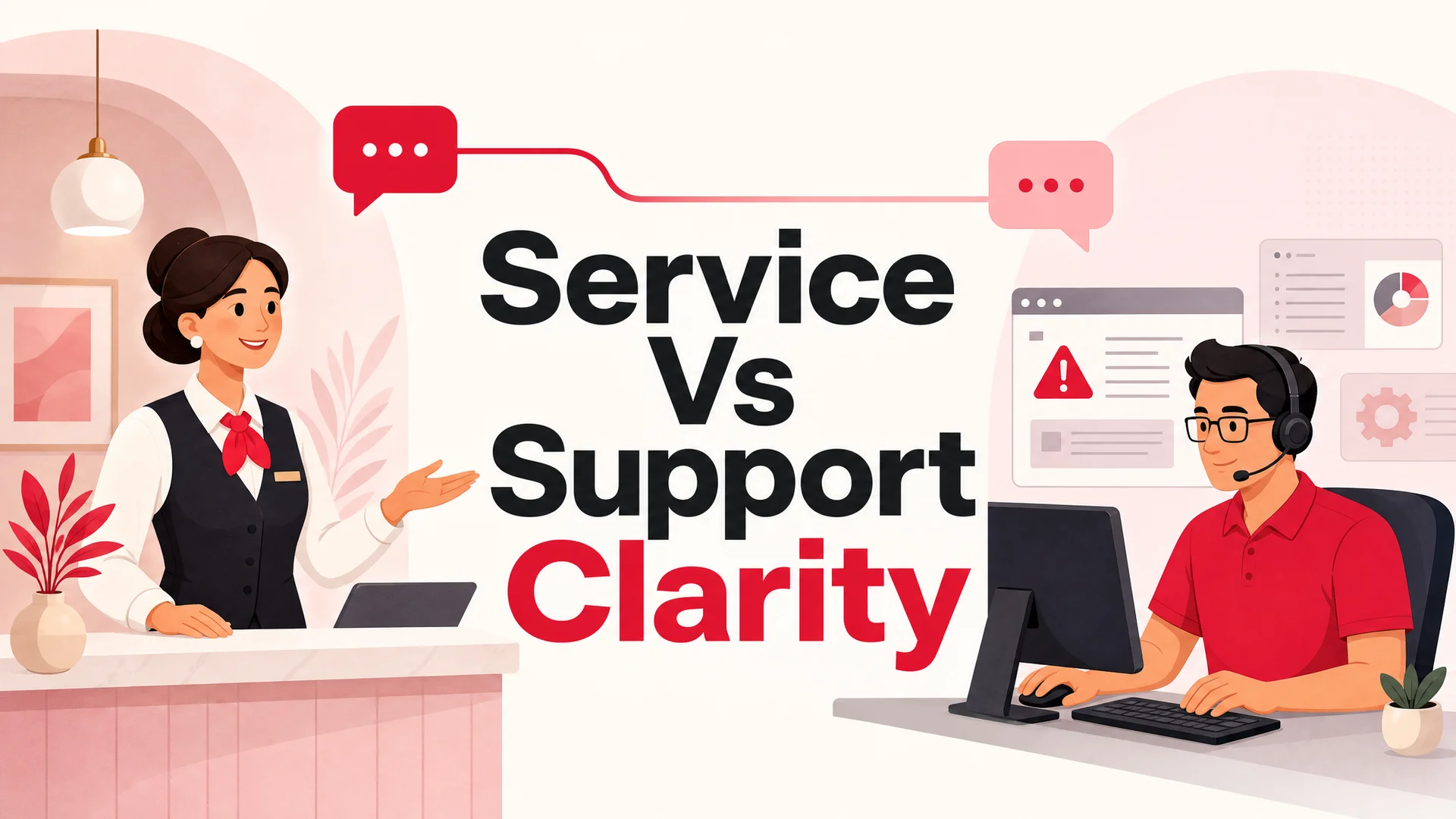
The cleanest way to think about it: customer service is the umbrella, the entire experience of dealing with your brand. Customer support is one specific function under that umbrella, the one that kicks in when something is technically broken or a user is stuck inside the product.
A hotel analogy helps. Customer service is the front-desk agent walking a guest through check-in, suggesting a restaurant for dinner, and arranging a late checkout. Customer support is the same guest twenty minutes later, trying to get the in-room Wi-Fi to authenticate after the captive portal times out - and the technician who walks them through a fix.
Same brand. Same guest. Two very different conversations, two different skill sets, and increasingly two different AI configurations.
What customer service actually covers
Customer service is the connective tissue of the customer journey. It is everything your business does to make interactions before, during, and after the sale feel smooth. The mandate is broad on purpose, because the moments that shape brand perception are rarely just about the product.
A short list of what typically lives under customer service:
- Onboarding and welcome motions - making sure new customers know what to do first, where to look for help, and how to get value quickly. For a SaaS product this might be a setup email sequence and a kickoff call. For an e-commerce brand it's a friendly post-purchase note and a shipping update.
- General inquiries across channels - questions about hours, locations, return policies, gift cards, partnership requests, "do you ship to the UK," and the long tail of "I just want to ask a human a quick thing."
- Billing, shipping, and account housekeeping - updating an address, changing a payment method, resending an invoice, applying a promo code, splitting a bill across cards. None of these are technically broken, they're just things humans need help with.
- Reviews and feedback collection - responding to public reviews, soliciting NPS or CSAT, escalating recurring complaints to product, and closing the loop with the people who took the time to write in.
- Recommendations and gentle upsell - suggesting a complementary product, flagging a better-fit plan, or pointing someone toward an annual discount when it genuinely saves them money.
- Routing and triage - getting customers to the right team when they've landed in the wrong place, without making them re-explain everything from scratch.
Customer service agents are generalists in the most flattering sense of the word. They know the brand voice, they know roughly how everything works, and they're trained to read a conversation and decide whether to answer directly, hand it off, or escalate. They don't usually go deep into a stack trace - that's not the job - but they do know how to defuse a frustrated tone, keep things moving, and leave the customer feeling looked after.
The skill set is overwhelmingly soft: empathy, active listening, plain language, patience, the discipline to read a question carefully before answering, and the judgment to know when to abandon a script. Reading from a flowchart never works, and customers can hear it through the screen.
What customer support is, specifically
Customer support is a narrower slice. While service is about the relationship, support is about the product working. It is the function customers reach for when something is failing, broken, or behaving in a way they don't understand - and they need someone who can actually fix it, not just acknowledge the frustration.
You see dedicated support teams most often in SaaS, fintech, developer tools, e-commerce platforms, IoT hardware, and IT services. Anywhere the product has enough surface area that things can go wrong, you will find a team whose entire job is unblocking the user.
A few representative scenarios:
- A finance app user gets a 500 error when uploading a bank statement and needs someone who can read the logs and figure out whether the parser choked on the file format.
- A SaaS customer can't log in after enabling SSO and needs guidance on whether the IdP metadata is misconfigured or the certificate has rotated.
- A new admin is stuck halfway through a multi-step integration setup and needs a walkthrough of the OAuth handshake.
- An e-commerce shopper hits a payment failure at checkout and needs the support team to determine whether it was a 3DS challenge, a card decline, or a bug in the gateway.
- A power user spots a recurring data sync issue across three accounts and needs the support team to file it with engineering with enough detail that it can be reproduced.
- A documentation engineer updates the help center after seeing the same question three times in a week, so the next ten customers self-serve.
These are time-sensitive, often technical, and almost always specific. The customer is rarely just chatting - they have something they were trying to accomplish, and they're now blocked. That changes the energy of the conversation and the bar for what counts as a good answer.
Support agents tend to be product specialists. They are comfortable in admin panels, fluent in the data model, capable of reading logs or replicating a bug locally, and on a first-name basis with the engineers they escalate to. The good ones can context-switch from a billing question to a webhook signature mismatch without losing patience.
Crucially, technical depth doesn't replace the soft skills, it stacks on top of them. The best support agents explain things in language the customer actually understands, stay calm when the customer is panicking because their integration broke during a launch, and never make someone feel small for asking a question. The combination is rarer than it should be, and worth paying for.
How the two compare, side by side
It helps to lay the contrast out across a few dimensions. The vocabulary overlaps, but the underlying work doesn't.
Focus
Customer service is relationship-led. The goal is for the customer to feel heard, valued, and well looked after across the full lifecycle. Customer support is problem-led. The goal is to identify what's broken and either fix it or get the customer to a working state as fast as possible. Service measures itself in satisfaction; support measures itself in resolution.
Type of interaction
Service is often ongoing and sometimes proactive - a check-in email, a thank-you after a renewal, a heads-up when a policy changes. Support is almost always reactive and triggered by an incident. The customer didn't want to write in. They had to.
Industry footprint
Service is universal: retail, hospitality, finance, healthcare, education, B2B sales, every industry has customers who need help that isn't strictly technical. Support concentrates in industries where the product has technical complexity - SaaS, developer tools, fintech, e-commerce platforms, hardware, telecom, IT.
Skill set
Service relies on communication, empathy, brand fluency, and judgment about when to escalate. Support requires all of that plus working knowledge of the product internals, comfort with debugging, and the ability to communicate technical concepts without condescension.
Tools
Service teams live in helpdesks (Zendesk, Intercom, Front, Help Scout), CRMs, and channel inboxes - email, phone, chat widget, social DMs. Support teams use the same channels but layer in admin dashboards, log explorers, error tracking like Sentry, internal knowledge bases, and ticket systems that link to engineering tools like Linear or Jira.
A concrete example
A customer wants to update the credit card on their billing profile. That's customer service. A customer is updating the card and getting an "invalid CVV" error even though the CVV is correct, and the failure is reproducible across two browsers. That's customer support.
Both interactions matter. Both are part of the same brand. They just need different tools and different brains.
What the AI shift changes about both
The most important update to this conversation since the 2024 wave of "ChatGPT for support" is that the model layer is no longer the bottleneck for either function. As of 2026 the frontier looks very different than it did even a year ago, and that changes which problems are worth automating.
On the closed-frontier side, GPT-5.5 and GPT-5.5 Pro shipped in April 2026 with parallel reasoning, Claude Opus 4.7 leads SWE-bench Pro at 64.3% for complex multi-step coding work, and Gemini 3.1 Ultra carries a 2M-token context window with native multimodality across text, image, audio, and video. Sonnet 4.6 ships a 1M-token context at no surcharge. For support, that means a single conversation can hold an entire account history, all relevant policy documents, and the customer's full back-and-forth without ever truncating.
On the open-weight side, the cost story has collapsed. DeepSeek V4 Flash runs at $0.14 / $0.28 per million input/output tokens. MiniMax M2 lands at roughly 8% the price of Claude Sonnet at twice the speed. GLM-5.1 from Z.ai posts 58.4 on SWE-Bench Pro under an MIT license. Qwen3.6-27B is dense, Apache 2.0, and beats much larger MoE rivals on agentic coding benchmarks. Kimi K2.6 from Moonshot can run 12-hour autonomous coding sessions and coordinate up to 300 sub-agents across 4,000 steps. Xiaomi's MiMo-V2-Pro brings >1T total params with 42B active and a 1M context, weights open under MIT.
What does this matter to a support leader staring at a queue?
For service-style traffic - FAQs, policy questions, order lookups, account housekeeping - you can route to a cheap, fast open-weight model and resolve at fractions of a cent per ticket. The economics are now firmly on the side of automating the entire long tail of "I just need a quick answer."
For support-style traffic - debugging an integration, walking a developer through a webhook signature mismatch, untangling a data sync issue - you want the agentic frontier models. Claude Opus 4.7, Kimi K2.6, GLM-5.1, Qwen3.6-Max, and MiMo-V2-Pro are genuinely capable of multi-step tool use, which is the unlock for refunds, password resets, account merges, and other actions that used to require a human. AI Actions for booking and payments are not demoware in 2026 - they are production patterns.
The 1M–2M token context windows on the frontier change the architecture too. RAG used to be the only way to keep a chatbot grounded in your knowledge base. Now you can stuff the entire knowledge base, the customer's full conversation history, and the relevant policy documents into a single prompt and let the model reason over all of it. RAG becomes a tuning lever for cost and latency, not a hard requirement for correctness.
And for regulated industries - healthcare, finance, government, anything air-gapped - the MIT and Apache-licensed Chinese open weights (GLM-5.1, Qwen3.6-27B, MiMo) make on-prem deployment realistic in a way it wasn't twelve months ago. You no longer have to choose between frontier quality and data residency.
How to structure both functions in your business
Knowing the difference is one thing. Operationalizing it is another. The right structure depends on what you sell and who you sell it to.
If you're a SaaS or e-commerce business
You almost certainly need both functions, even if they share a single helpdesk for now.
A customer service team owns onboarding, billing questions, account management, retention motions, and feedback loops back to product and marketing. They are the friendly default for anything that isn't strictly technical.
A customer support team owns product issues, integration problems, error messages, and escalations into engineering. They are the people who can read a HAR file and know which header is wrong.
The mistake to avoid is letting these two teams operate in silos. Service hears the soft signals - "the new dashboard is confusing," "I almost canceled because of how the pricing page reads" - that support never sees. Support hears the hard signals - "this webhook has been failing intermittently for three weeks" - that service never logs. A weekly sync, a shared Slack channel, and a clear taxonomy of issue types is usually enough to keep insights flowing both directions.
This is also where AI agents earn their keep. A well-configured agent on the front line can handle the bulk of service traffic on its own, leaving your humans to focus on the hard support cases and the relationship-building moments that automation shouldn't touch. Berrydesk lets you train a single agent on documentation, your help center, Notion pages, Google Drive, websites, and YouTube videos, then expose it across your website, Slack, Discord, WhatsApp, and other channels with a consistent brand. You pick the model - Claude, GPT, Gemini, DeepSeek, Kimi, GLM, Qwen, MiniMax - based on cost and capability needs, and route different intents to different models if you want to optimize the bill.
If you're in retail, hospitality, or B2C
You may not need a dedicated support team in the engineering sense, but you'll still want service agents who can handle light technical issues - a POS that's gone offline, a kiosk that's frozen, a CRM that's not syncing reservations, a payment terminal that's rejecting a card. Training service reps on basic troubleshooting playbooks goes a long way and reduces the number of incidents that escalate to a vendor call.
For digital-only properties (a brand site, a loyalty app, a booking funnel), an AI agent can absorb both the service questions ("what's your return policy?") and the lighter support questions ("the gift card field isn't accepting my code") on the same channel, with one configuration. The customer doesn't care which bucket their question falls into. They just want help.
If you're enterprise or regulated
Layer in escalation paths, named accounts, and stricter data handling. The model choice matters more here - for sensitive workloads, an open-weight model deployed on your own infrastructure may beat a frontier API on the only metric that matters, which is whether legal will sign off. The agentic capabilities of GLM-5.1, Qwen3.6, and MiMo make this newly viable.
Common pitfalls to watch for
A few traps teams fall into when they conflate service and support, or when they automate the wrong piece first:
- Hiring one profile for two jobs. A pure empath without product depth will struggle on technical tickets. A pure engineer without bedside manner will alienate customers on simple ones. Hire intentionally for each function, even if early on the same person wears both hats.
- Routing everything to the same queue. Without basic intent classification, your support specialists end up answering "what are your hours" and your service generalists end up trying to debug OAuth flows. Both sides burn out.
- Automating support before service. Support cases are higher-stakes and harder to resolve cleanly. Most teams should automate the high-volume service traffic first, prove the pattern, then layer in agentic AI Actions for support flows like password resets, refunds, and order modifications.
- Treating AI Actions as optional. A bot that can answer questions but can't do anything sends every actionable request to a human. The leverage shows up when the agent can issue a refund, reschedule a booking, take a payment, or update a record on the customer's behalf - not just describe how the human would do it.
- Picking one model for everything. In 2026 the smart pattern is routing - cheap open-weight for FAQs, frontier for hard escalations. A single-model deployment usually overpays on the easy traffic and underperforms on the hard.
- Letting the channels diverge. If your WhatsApp agent has different answers than your website widget than your Slack bot, customers will notice. One agent, one source of truth, many surfaces.
The short version
You don't need to choose between customer service and customer support. They're not in competition. They're complementary functions that protect different parts of the customer experience.
Service keeps the relationship strong. Support keeps the product running. When both are working well - and increasingly when an AI agent is absorbing the high-volume tier of each so your humans can focus on the moments that need them - customers stick around, expand, and tell their friends.
Berrydesk is built to handle both sides from one place. Pick a model, train it on your docs and websites and Notion and Drive, brand the widget, wire up AI Actions for the things that actually need to happen (bookings, refunds, lookups, payments), and deploy across every channel your customers use. Service questions get fast, friendly answers. Support requests get real resolutions, not deflections. And your team gets to spend time on the conversations only they can have.
Ready to give your customers both? Start building your agent at berrydesk.com.
 Berrydesk
One agent for service and support
- Handle FAQs, order updates, and refunds in the same chat thread
- Trigger AI Actions for bookings, password resets, and payments
Set up in minutes

Chirag Asarpota is the founder of Strawberry Labs, the team behind Berrydesk - the AI agent platform that helps businesses deploy intelligent customer support, sales and operations agents across web, WhatsApp, Slack, Instagram, Discord and more. Chirag writes about agentic AI, frontier model selection, retrieval and 1M-token context strategy, AI Actions, and the engineering it takes to ship production-grade conversational AI that customers actually trust.